Last Updated: August 2026 • Reviewed for NEC 2026 compliance

PV wire — photovoltaic wire — is the lifeline of every solar array. It carries DC power from your modules to the inverter, often in harsh outdoor conditions for 25 years or more. Get the gauge wrong, use the wrong insulation rating, or ignore temperature derating, and you're looking at voltage drop, efficiency losses, or worse — a fire. At PES Supply, we stock PV wire from 14 AWG up to 2 AWG in 600V and 1,000V ratings, and we've seen every mistake in the book. This guide walks you through selecting the right PV wire for your project, with real NEC data and field-tested sizing methods.
⚡ Quick Answer
For most residential solar arrays, 10 AWG PV wire (rated 1,000V DC, 90°C XLPE insulation) is the standard for module-to-module and module-to-combiner runs up to about 50 feet. For commercial arrays with longer runs or higher current, step up to 8 AWG or 6 AWG. Always size from NEC Table 310.16 using the 75°C column, then apply temperature and conduit fill corrections.
PV wire is a single-conductor cable specifically designed for photovoltaic systems. Unlike standard THHN or Romex, PV wire must withstand UV radiation, extreme temperature swings, moisture, and ozone exposure — often while carrying 600V or 1,000V DC continuously for decades. NEC Article 690 governs PV system wiring, and it specifically calls out PV wire (often labeled RHW-2 or USE-2 when dual-rated) as the appropriate conductor for exposed outdoor runs.
We've pulled thousands of feet of PV wire through racking and conduit in Oregon's wet winters and hot summers. The wire that holds up is always the one with the right insulation, the right gauge, and the right voltage rating for the job. Cheap wire with undersized insulation cracks after three seasons of UV exposure. We've had to replace entire home-run pulls because a contractor spec'd THHN instead of PV wire to save a few cents per foot. Don't be that contractor.
Key properties that separate PV wire from standard building wire:
- Dual voltage rating: 600V DC standard; 1,000V DC and 1,500V DC available for commercial and utility-scale arrays
- High temperature rating: 90°C wet/dry is standard; some premium grades rated to 105°C
- UV and ozone resistant: XLPE (cross-linked polyethylene) or EPR insulation rated for direct sunlight exposure
- Flame retardant: Must pass UL 4703 or UL 854 vertical flame tests
- Flexible stranding: Fine-stranded copper for easy routing through racking and junction boxes
Not all wire labeled for solar is the same. We see this confusion constantly in the field. Here's the breakdown:
| Wire Type | Voltage Rating | Temp Rating | UV Rated | Typical Use |
|---|---|---|---|---|
| PV Wire (UL 4703) | 600V / 1,000V / 1,500V DC | 90°C wet/dry | Yes | Module interconnection, exposed outdoor runs |
| USE-2 (UL 854) | 600V | 90°C wet/dry | Yes | Underground service entrance, some PV applications |
| THHN/THWN-2 | 600V | 90°C dry / 75°C wet | No | Conduit runs inside buildings, NOT exposed to sun |
| XHHW-2 | 600V | 90°C wet/dry | No | Building wiring in conduit, wet locations |
| MC4 Cable Assembly | 1,000V / 1,500V DC | 90°C | Yes | Pre-terminated module leads with MC4 connectors |
⚠️ Critical: THHN Is NOT a Substitute for PV Wire
THHN lacks UV resistance. Exposed THHN in direct sunlight degrades in 2–3 years, becoming brittle and cracking. We've cut open 4-year-old "THHN" home runs that looked like chalk. If the wire is exposed — even partially — use PV wire or USE-2. NEC 690.31(C) requires PV source and output circuits to use conductors listed and labeled as PV wire or USE-2.
PV wire ampacity follows the same rules as any other conductor: start with NEC Table 310.16, then apply correction factors for temperature, conduit fill, and rooftop distance. The difference is that PV circuits often run in conditions that demand serious derating — hot roofs, bundled conductors, and long conduit runs in direct sun.
Copper PV Wire Ampacity at 75°C (NEC Table 310.16)
| Wire Gauge (AWG) | Ampacity @ 75°C (A) | Max PV String Current* | Typical Application |
|---|---|---|---|
| 14 AWG | 20A | 16A | Small residential strings, rapid shutdown devices |
| 12 AWG | 25A | 20A | Standard residential module interconnection |
| 10 AWG | 35A | 28A | Residential home runs, most 60-cell arrays |
| 8 AWG | 50A | 40A | Commercial strings, longer runs, higher wattage |
| 6 AWG | 65A | 52A | Large commercial arrays, central inverter feeds |
| 4 AWG | 85A | 68A | Utility-scale combiner boxes, long trunk runs |
| 2 AWG | 115A | 92A | Main DC feeders, large central inverter inputs |
*Max PV string current applies the 80% continuous load derate (inverse of 125% rule). PV modules produce current continuously during daylight hours, so NEC treats them as continuous loads.
Temperature Correction Factors (NEC 310.16)
PV wire on a rooftop in August doesn't sit at 30°C ambient. We've measured conduit surface temps of 65°C on dark composite shingles in direct sun. Here's what that does to your ampacity:
| Ambient Temp (°C) | Ambient Temp (°F) | Correction Factor | Effective 10 AWG Ampacity |
|---|---|---|---|
| 21–30 | 70–86 | 1.00 | 35A |
| 31–35 | 87–95 | 0.94 | 32.9A |
| 36–40 | 96–104 | 0.88 | 30.8A |
| 41–45 | 105–113 | 0.82 | 28.7A |
| 46–50 | 114–122 | 0.75 | 26.3A |
| 51–55 | 123–131 | 0.67 | 23.5A |
| 56–60 | 132–140 | 0.58 | 20.3A |
| 61–70 | 141–158 | 0.41 | 14.4A |
Field Example: Rooftop Derating in Portland
Last July we wired a 12 kW array on a southeast-facing roof in Southeast Portland. Ambient hit 38°C, but the black conduit on the shingles measured 52°C. Our 10 AWG PV wire derated from 35A to 35A × 0.67 = 23.5A. The string ISC was 9.8A, so we were fine — but if that same array had been on a dark metal roof in Phoenix at 65°C ambient, we'd have been looking at 0.41 correction and only 14.4A capacity. That changes your whole wire schedule.
Voltage Drop: The Hidden Cost of Undersized PV Wire

Voltage drop in DC circuits directly reduces your system's energy harvest. A 3% drop on a 400V string costs you 12V — and on MPPT trackers, that can push the array out of its optimal voltage window, reducing harvest even further. NEC recommends ≤3% drop on feeders and ≤5% total. For solar, we aim for ≤2% on the DC side because every tenth of a volt matters for inverter efficiency.
| Run Length (ft) | 10 AWG Drop (400V, 8A) | 8 AWG Drop (400V, 8A) | 10 AWG Drop (500V, 10A) | Status |
|---|---|---|---|---|
| 25 | 0.32% | 0.20% | 0.32% | Excellent |
| 50 | 0.64% | 0.40% | 0.64% | Excellent |
| 75 | 0.96% | 0.60% | 0.96% | Good |
| 100 | 1.28% | 0.80% | 1.28% | Acceptable |
| 150 | 1.92% | 1.20% | 1.92% | Acceptable |
| 200 | 2.56% | 1.60% | 2.56% | Marginal |
| 250 | 3.20% | 2.00% | 3.20% | Too high |
Calculated using copper resistivity at 75°C, K=12.9 for 10 AWG, K=8.08 for 8 AWG. Formula: Vd% = (2 × K × I × L) / (CM × V) × 100.
Voltage Drop Calculation Walkthrough
For a 100-foot run of 10 AWG PV wire carrying 8A at 400V: Vd = (2 × 12.9 × 8 × 100) / 10,380 = 1.99V. Percentage drop = 1.99V / 400V × 100 = 0.50%. Well within limits. But if you have 150 feet at 10A on 10 AWG: Vd = (2 × 12.9 × 10 × 150) / 10,380 = 3.73V = 0.93%. Still good. The problem comes when installers use 12 AWG for 100-foot runs at 10A — that gives you 1.6% drop, and combined with inverter and AC-side losses, you're approaching the 5% total limit fast.
Here's the practical reference we use in the field when spec'ing wire for residential and light commercial arrays. These tables assume 400V string voltage (typical for 60-cell modules in series) and include the 80% continuous load derate:
| Array Size | Approx. String Current | Run ≤50 ft | Run 50–100 ft | Run 100–150 ft | Run >150 ft |
|---|---|---|---|---|---|
| 5 kW (residential) | 7–9A | 12 AWG | 12 AWG | 10 AWG | 10 AWG |
| 8 kW (residential) | 10–12A | 12 AWG | 10 AWG | 10 AWG | 8 AWG |
| 12 kW (residential) | 15–18A | 10 AWG | 10 AWG | 8 AWG | 8 AWG |
| 25 kW (commercial) | 30–35A | 8 AWG | 8 AWG | 6 AWG | 6 AWG |
| 50 kW (commercial) | 60–70A | 6 AWG | 4 AWG | 4 AWG | 2 AWG |
| 100 kW (C&I) | 120–140A | 2 AWG | 1/0 AWG | 2/0 AWG | 3/0 AWG |
Using THHN for Exposed Outdoor Runs
We've replaced hundreds of feet of cracked THHN that was run across rooftops "to save money." The UV degradation is real and rapid. Always use PV wire (UL 4703) or USE-2 for any conductor exposed to sunlight. NEC 690.31(C) mandates this.
Ignoring Rooftop Temperature Derating
A 10 AWG wire rated 35A at 30°C drops to 23.5A at 55°C. If you're not derating for rooftop conditions, your wire is undersized from day one. We always add 20–30°C to ambient for roof-mounted conduit when doing preliminary sizing.
Oversizing Voltage Drop
installers spec 8 AWG for every run to "be safe." That's unnecessary cost — 10 AWG is fine for most residential arrays under 100 feet. Do the math. Voltage drop calculations take five minutes and save hundreds of dollars in copper on every job.
Mixing 600V and 1,000V Wire on the Same Array
When you upgrade an older 600V array with new 1,000V modules, every conductor in the string must be rated for the new system voltage. Mixing ratings creates a weak link and voids warranties. We've seen inspectors fail jobs for this.
PES Supply stocks PV wire in cut-to-length spools and pre-cut harnesses. Here are our most popular configurations for residential and commercial solar:
- PV Wire Collection — 10 AWG through 2 AWG, 600V and 1,000V ratings, black and red jacket
- Solar Panels — Tier 1 modules from Qcells, JA Solar, Trina, and REC with pre-attached PV wire leads
- Complete Solar Kits — Pre-engineered kits with correctly sized PV wire, connectors, and racking
- Charge Controllers — MPPT controllers with proper PV wire terminals rated for your array voltage
- Solar Inverters — String inverters and microinverters with DC input ratings matched to your wire and module specs
Need help sizing PV wire for your project? Our team can run voltage drop calculations, derating analysis, and wire schedules based on your array layout. Request a quote or call 1-888-876-0007 to speak with a solar specialist.
What gauge PV wire do I need for a 10 kW solar system?
For a typical 10 kW residential array with string voltage around 400V and runs under 100 feet, 10 AWG PV wire is standard. If your runs exceed 100 feet or you're in a high-temperature climate, step up to 8 AWG. Always verify with a voltage drop calculation.
Can I use Romex (NM-B) for solar DC wiring?
No. NM-B is rated for 600V but is not UV-resistant or wet-location rated. NEC 690.31 specifically requires PV source and output circuits to use PV wire, USE-2, or other conductors listed for photovoltaic applications. Using NM-B outdoors is a code violation and a fire hazard.
What is the difference between 600V and 1,000V PV wire?
The insulation thickness and dielectric strength. 1,000V PV wire has thicker, higher-grade insulation that can withstand the higher voltage stress of larger commercial arrays. Most modern residential systems use 600V wire, but if you're running 72-cell modules or commercial strings, 1,000V is often required. Never use 600V wire on a 1,000V system.
How do I calculate voltage drop for PV wire?
Use the formula Vd = (2 × K × I × L) / CM, where K is the conductor material constant (12.9 for copper at 75°C), I is string current, L is one-way run length, and CM is circular mils (10,380 for 10 AWG). Divide by system voltage and multiply by 100 for percentage. Aim for ≤2% on the DC side.
Does PV wire need conduit?
PV wire is rated for direct exposure, so it can run without conduit in many cases. However, NEC 690.31(B) requires physical protection where the wire is subject to damage. We typically run PV wire in conduit across roofs, through attics, and down walls for protection and neatness. Underground runs must be in conduit rated for burial.
Can I splice PV wire in the field?
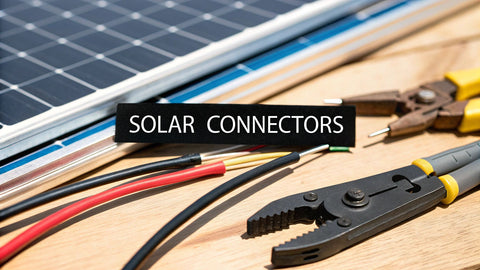
Yes, but only with listed splicing devices rated for the wire type and voltage. We use MC4 connectors or butt splices with adhesive-lined heat shrink for most applications. All splices must be accessible and in approved junction boxes. Never use wire nuts on PV wire — they are not rated for the fine stranding or the DC voltage.
Related Guides:
- NEC Wire Sizing Guide: Ampacity Charts for Solar and Generator Installations
- MC4 Connectors & Solar Wire Gauge Guide
- Wiring Solar Panels in Series: A Field Guide
- Transfer Switch Wiring: Complete NEC-Compliant Guide
- Whole-Home Generator Sizing Guide
Article: 10 PV Wire Service: The Ultimate Buyers Guide to Selecting the Right PV Wire
Category: Solar Wiring | NEC Compliance | PV Wire Sizing | Electrical Safety
Last Updated: August 2026 • Reviewed for NEC 2026 compliance
Disclaimer: This guide is intended for informational and educational purposes only. Always confirm the latest NEC edition requirements, local amendments, and authority having jurisdiction (AHJ) rules with a licensed electrician or engineer before finalizing any system design or installation decision.