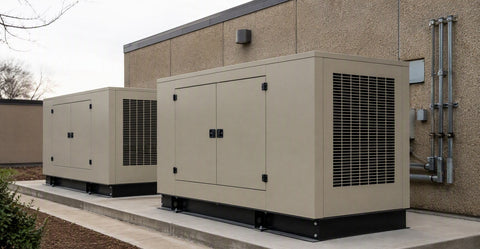
At 175 kW you stop shopping for a generator and start engineering a power plant. This is the size class that keeps a mid-size hospital wing, a grocery store, a water-treatment skid, or a 200-room hotel alive when the grid drops — and the class where a buying mistake costs six figures instead of four. We've specced and supplied Cummins sets from 13 kW residential units up through industrial blocks at Portlandia Electric Supply, and the 175 kW band is where the questions get serious: prime versus standby ratings, EPA Tier 4 aftertreatment, fuel logistics, paralleling, and service networks. This guide covers all of it. Live inventory sits in our 175 kW industrial generator collection and the broader Cummins generator catalog.

What a 175 kW Cummins Actually Covers
Do the arithmetic before you fall in love with a spec sheet. 175 kW at 480V three-phase is about 210–263 amps of real capacity depending on voltage and power factor (175,000 W ÷ (1.732 × 480V × 0.8 PF) ≈ 263 A). That's enough to carry a 100,000 sq ft retail box with refrigeration, a mid-size data hall's critical load with headroom, or a hotel's life-safety systems plus elevators and partial comfort cooling. It is not enough for a full hospital or a heavy manufacturing plant with large motor across-the-line starts — for those you're into paralleled sets or 500 kW+ singles.
| Facility Type | Typical Critical Load | 175 kW Fit | Recommended Headroom |
|---|---|---|---|
| Grocery / cold storage | Refrigeration racks, lighting, POS | Strong fit | 25–30% |
| Hotel (150–250 rooms) | Life safety, elevators, partial HVAC | Strong fit | 20–30% |
| Healthcare clinic / surgery center | Medical equipment, HVAC, refrigeration | Fit with load study | 30–40% (NEC 517 separation) |
| Data / telecom (small) | Racks + precision cooling | Fit, often N+1 with paralleling | 20–30% |
| Water / wastewater skid | Pumps, blowers, SCADA | Fit; check motor starting kVA | Per largest motor start |
| Manufacturing (medium) | Process-critical loads only | Usually undersized for whole-plant | Load-shed design required |
If 175 kW is more machine than you need, step down through our sizing guides for 35 kW generators, 60 kW generators, or the 100 kW Cummins backup generator. If it's not enough, look at 200 kW industrial generators and up.
Model Options and Configurations
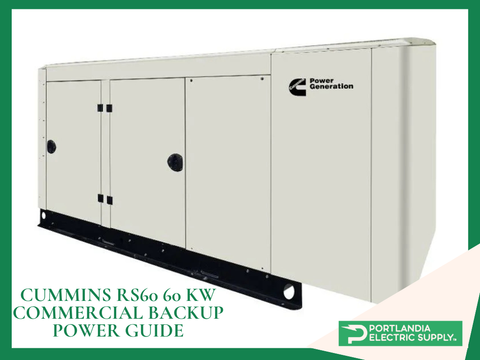
Cummins serves this class from two directions. The Quiet Connect and commercial liquid-cooled lines top out around 150 kW, so true 175 kW product comes from the Power Generation (industrial) family — C175 D6-class diesel sets built on Cummins' own engines (QSB7/QSL9 territory depending on configuration and emissions tier) with PowerCommand controls. Voltage configurations run 120/208V, 277/480V, and 600V three-phase, plus single-phase specials for utilities and telecom. We stock and source configurations like the Cummins C175D6D 175 kW Quiet Connect and can quote diesel industrial packages with weather-protective or sound-attenuated enclosures, sub-base or skid-mounted tanks, and cold-weather kits.
Warranties and total cost of ownership (TCO) considerations
Buy on the engine's service network as much as the nameplate. Cummins' distributor footprint in North America is deep — parts in days, not weeks, and factory-trained techs in every metro. That network is a line item in your total cost of ownership whether you put it in the spreadsheet or not. For context on how Cummins stacks against the other names in this class, see our Generac vs Cummins commercial comparison, Kohler vs Cummins 2026, and the Cummins brand guide for standby professionals.
Prime vs Standby: The Rating Decision That Sizes Everything
| Rating | Definition | Run Hours | Overload | Use For |
|---|---|---|---|---|
| Standby (ESP) | Max output during utility outage, variable load | Limited hours/yr (typically ≤200–500) | No overload capability | Grid-backup: most commercial installs |
| Prime (PRP) | Unlimited hours, variable load, ~10% overload 1 hr in 12 | Unlimited | 10% intermittent | Off-grid, unreliable grid, peak shaving |
| Continuous (COP) | 100% load, unlimited hours | Unlimited | None | Base load, remote power, utility peak plants |
Prime vs standby: what the ratings mean for a 175 kW system
Same engine, three ratings, and the standby number is always the biggest. A set sold as "175 kW standby" might be rated ~160 kW prime and ~145 kW continuous. Buy standby-rated equipment for a prime application and you'll void the warranty inside a year — we've untangled exactly that mistake for a customer who bought an auction unit for a Caribbean microgrid. Match the rating to the duty cycle, in writing, on the purchase order.
Fuel: Diesel, Natural Gas, and the Trade-offs
Diesel: reliability, energy density, infrastructure, and storage
Diesel dominates 175 kW because energy density and on-site storage decouple you from the gas utility — when the grid fails in a storm, gas pressure can hold, but the refinery outage scenario favors the fuel in your tank. Natural gas eliminates fuel storage, sidesteps Tier 4 diesel aftertreatment on some packages, and runs cleaner; its failure mode is the gas utility itself. Propane at this size is possible but the tank farm gets serious fast. Our natural gas vs propane vs diesel comparison runs the full analysis.
Representative diesel fuel consumption for a 175 kW-class set — always confirm against the specific engine's published fuel map:
| Load | Output | Est. Fuel Burn | Runtime on 500 gal |
|---|---|---|---|
| 25% | 44 kW | ~4.5 gal/hr | ~111 hr |
| 50% | 88 kW | ~7.5 gal/hr | ~67 hr |
| 75% | 131 kW | ~10.5 gal/hr | ~48 hr |
| 100% | 175 kW | ~13.5 gal/hr | ~37 hr |
Two field rules on that table. First, size the tank for your runtime requirement, not the other way around — 72-hour runtime codes (common for healthcare-adjacent and municipal work) at half load means roughly 540 gallons usable, so a 660-gallon sub-base tank with the 10% ullage reserve. Second, diesels hate light loading: sustained operation under 30% load causes wet stacking — unburned fuel washing the cylinders — so if your real load profile is 25%, either load-bank the unit monthly or step down a size. We sell cold-weather kits and service parts, and the fuel consumption calculator plus runtime calculator will check your tank math.
Emissions: EPA Tier 4 and What It Costs You
Stationary emergency engines in the US are generally permitted as EPA Tier 3-compliant emergency units — the Tier 4 Final aftertreatment (DPF + SCR + DEF) applies to non-emergency and prime applications in most jurisdictions, with California CARB and some air districts layering stricter rules. Translation: a pure standby 175 kW diesel for outage-only duty usually avoids the DEF/SCR stack; the same engine doing peak-shaving or prime duty needs the full aftertreatment train, plus DEF logistics and regeneration management. Confirm your air district's definition of "emergency operation" — annual testing hours count against the allowance, and we've seen districts cite owners for exercising too long.
Installation: The Part That Actually Determines Reliability
Installation considerations: enclosure, cooling, intake/exhaust, and vibration dampening
Intake and exhaust routing and vibration isolation
A 175 kW diesel package runs roughly 8,000–12,000 lb depending on enclosure and tank. The pad is engineered, not eyeballed: reinforced concrete sized for the wet weight plus dynamic loads, anchor bolts to the manufacturer's template, and clearance for radiator airflow — these sets move tens of thousands of CFM of cooling air and will overheat in a tight enclosure room. Exhaust routing must clear intakes, windows, and property lines per local code; sound-attenuated enclosures run roughly 68–75 dBA at 7 meters at full load in this class, standard weather enclosures louder. If neighbors or a residential property line are within 100 feet, buy the sound package now or buy it after the noise complaint — it's cheaper now.
Electrical integration at 175 kW means a service-rated ATS or a paralleling switchgear lineup. Conductor sizing for a 480V three-phase standby set: full-load current ≈ 263 A at 0.8 PF; per NEC 445.13, conductors at 115% of nameplate for continuous — call it ~300 A ampacity, which puts you at 350 kcmil copper (310A @ 75°C per NEC 310.16) with a 350A frame breaker per NEC 240.6. Voltage dip on motor starting is the other check: a 175 kW set will typically dip 15–25% starting a 50 hp across-the-line motor; if your process can't ride that, specify an oversized alternator or soft starters.
Transfer switches, paralleling, and system integration considerations
| System Element | Sizing Rule | 175 kW @ 480V 3-ph Example |
|---|---|---|
| Full-load current | kW ÷ (√3 × V × PF) | 175,000 ÷ (1.732 × 480 × 0.8) ≈ 263 A |
| Feeder conductors | NEC 445.13: ≥115% FLA | ~302 A → 350 kcmil Cu (310A @ 75°C) |
| OCPD | NEC 240.6 standard sizes | 350 A frame, set per transfer scheme |
| ATS | ≥ generator FLA; service-entrance rated if utility-side | 400A frame typical; see 400A+ transfer switches |
| Grounding | NEC 250; SDS rules if separately derived | GEC + neutral bond strategy per 250.30 |
ATS selection and sizing guidelines
For ATS selection depth, read what is a transfer switch, the manual vs automatic ATS guide, and the transfer switch sizing chart. Our transfer switch wiring guide covers the field side, and inventory is under transfer switches and automatic transfer switches.
Maintenance, Service, and What Breaks
What actually kills standby generators: dead starting batteries (the #1 no-start cause by a mile), coolant neglect, fuel that sat for two years growing algae, and block heaters nobody verified in October. The maintenance cadence for a 175 kW set:
| Interval | Tasks | Who |
|---|---|---|
| Weekly | Auto-exercise under building load or no-load per manufacturer; verify transfer, block heater temp, fluid levels | Automatic + operator log review |
| Monthly | Battery specific gravity/charge check, fuel sample, leak walk-down, enclosure louvers clear | Facility tech |
| Semi-annual | Oil and filter analysis or change, coolant test, belt and hose inspection, ATS exercise and contact inspection | Service tech |
| Annual | Full-load bank test (1–2 hr at ≥75% if building load can't reach it), fuel polishing if tank >12 months old, IR scan of connections | Generator service company |
| 2–3 years | Coolant replacement, battery replacement (3–5 yr life), thermostat and sensor verification | Service company |
That annual load-bank line is the one facilities skip because "it ran fine during the outage last spring." Light-loaded running is exactly how you get wet stacking and a failed set at hour four of the next big outage. Budget the load bank; it costs less than one emergency service call on a holiday weekend.
Controls, Monitoring, and Paralleling
Digital controls, remote monitoring, and integration trends (2026)
PowerCommand controls give you the full stack: digital voltage regulation, NFPA 110 Level 1-capable annunciation, Modbus/BACnet gateways into the BMS, and remote monitoring that texts you at 2 AM before the customer notices anything. In 2026, remote monitoring is table stakes — the question to ask a seller is whether the gateway and subscription are included or a $1,500 surprise at commissioning. Paralleling two 175s (N+1 or capacity) requires sync-check equipped switchgear; if you think you might parallel later, buy the paralleling-ready alternator and control option now, because retrofitting is a rebuild, not an accessory.
Total Cost of Ownership and Buying Checklist
Installed cost for a 175 kW diesel standby system in 2026 typically lands $95,000–$160,000 all-in: the set itself ($55,000–$85,000 depending on enclosure, tank, and emissions package), ATS and switchgear ($8,000–$20,000), and installation with pad, fuel, and electrical ($25,000–$55,000 depending on site). Fuel, service contracts ($3,000–$7,000/yr at this class), and load-bank testing ride on top. The checklist we run before any purchase order:
| # | Checklist Item | Failure It Prevents |
|---|---|---|
| 1 | Written load study or load calc; rating (standby/prime/continuous) matched to duty | Wrong rating, voided warranty, undersized set |
| 2 | Air district / EPA classification confirmed (emergency vs non-emergency) | Permit rejection or aftertreatment retrofit |
| 3 | Motor-starting kVA checked against largest motor and sequence | Voltage sag crashing the very loads you're protecting |
| 4 | Fuel autonomy vs code/runtime requirement; tank and polishing plan | 72-hour code with a 24-hour tank |
| 5 | Sound level at property line modeled; enclosure specified | Noise variance battles after install |
| 6 | ATS type (3-pole vs 4-pole, service-rated, bypass-isolation) specified | Ground-fault nuisance trips; failed SDS bonding |
| 7 | Service contract and parts availability confirmed with local distributor | Week-long parts waits during storm season |
| 8 | Commissioning: load bank, transfer test, monitoring registration, NFPA 110 documentation where applicable | Paper-generator syndrome — installed, never proven |
Emissions Permitting, Walked Through
The permit path for a stationary 175 kW diesel in most US jurisdictions looks like this: you file as a stationary emergency engine under the federal RICE NESHAP / NSPS framework, which permits outage response plus a limited annual allowance for testing and maintenance (commonly cited as 100 hours, with sub-limits — read your state rule, because several states are stricter than the federal floor). That classification is what keeps a standby unit out of Tier 4 Final aftertreatment. The moment the set earns revenue — peak shaving, demand response, prime power — it's non-emergency, and the aftertreatment train (DPF to catch particulate, SCR with DEF to cut NOx) plus its maintenance becomes part of your life. California and the Northeast states layer their own air-district rules on top; CARB-certified configurations cost more and are non-negotiable there. The cheapest hour in the whole project is the one you spend on the phone with the air district before you sign the equipment order.
Paralleling and N+1: Think It Through Before You Buy One
Two 175 kW sets paralleled give you either 350 kW of capacity or 175 kW with N+1 redundancy — and for data, healthcare-adjacent, and cold-storage loads, N+1 is often the real requirement wearing a capacity costume. The hardware difference at purchase is modest: paralleling-ready controls, sync-check relays, and a switchgear lineup designed for it. The retrofit difference is brutal — we've quoted paralleling retrofits that cost more than the second generator. If the five-year plan includes redundancy or growth past 175 kW, say so at the first quote. Also note the load-management corollary: with two sets you can run one at 60–70% load (its efficient, happy zone) instead of both at 30%, which is better for the engines and the fuel bill.
Storm Prep: The Week-Before Checklist
When a named storm is five days out, the facility managers who sleep well do the same five things. Top the fuel tank and order a priority-fill commitment from the fuel supplier — post-storm diesel allocation is real. Run the set under building load for 30 minutes and check for leaks hot, not cold. Verify the battery charger and block heater are actually working (put a hand on the heater — it should be warm). Confirm the ATS is in normal and the exercise clock didn't drift into the storm window. And print the service company's emergency number and tape it to the enclosure door. None of this requires tools beyond a flashlight and a phone, and it converts "hope it starts" into "watched it work Tuesday."
The Load Study: How to Actually Do One
Every sizing error we've untangled traces back to someone skipping the load study and sizing from the panel schedule. Here's the discipline. First, list the loads the generator must carry — not everything on the property, the loads that justify backup: life safety, refrigeration, process-critical, IT, and whatever operations say they can't lose. Second, meter them: a week of interval data from a power logger on the main and the critical subpanels tells you real peaks and real diversity. Clamp-meter spot readings are the budget version and better than nameplate arithmetic. Third, add motor starting: list every motor over 10 hp with its starting method, because a single 40 hp across-the-line start can demand 250+ kVA instantaneously and will define the alternator spec. Fourth, apply headroom — 20–30% for growth and tolerance, 30–40% where the load study is thin. Only then do you know whether 175 kW is the answer, and whether it's standby or prime. The generator sizing guide and kW-to-amps calculator formalize the arithmetic.
ATS Selection Beyond the Frame Size
At 175 kW the transfer switch decision has four dimensions that matter more than price. Transition type: open transition (break-before-make, a 1–5 second power gap) suits most commercial loads; closed transition (make-before-break, no gap) is for loads that can't blink, and costs real money in switchgear and utility approval; delayed transition adds a programmable pause in neutral for large motor loads to decay. Bypass-isolation: at this size, seriously consider it — it lets you service or replace the ATS without de-energizing the facility, and on a hospital-adjacent or 24/7 operation that capability is worth its premium the first time you use it. Pole count: 4-pole switched neutral if the generator is separately derived — and at 175 kW with ground-fault protection on the service, it often must be. And rating: service-entrance-rated ATS with the right fault-current withstand for the available utility fault current, which your engineer pulls from the utility's letter. The ATS sizing chart, ATS types guide, and transfer switch wiring article go deeper, and hardware sits under 400A+ transfer switches.
Natural Gas at 175 kW: A Different Conversation
Maintenance, service networks, and training
Everything above assumes diesel, which is what most 175 kW Cummins installs are. Natural gas at this size is viable and increasingly asked-for — no fuel storage, no polishing, cleaner stack — but the gating item is the gas utility's capacity letter. A 175 kW NG engine at full load wants on the order of 2,000+ ft³/hr at adequate pressure; that's a commercial service upgrade in many territories, quoted by the utility on their timeline, not yours. We've seen utility gas upgrades run four months. If the project calendar is tight and the disaster scenarios include regional infrastructure damage, diesel's tank-in-the-ground autonomy usually wins the argument. If outages are short and the gas service is already stout, NG's zero-fuel-maintenance life is genuinely pleasant. The fuel comparison and 150 kW natural-gas generator guide frame the neighboring size class.
Working With the Local Service Bench
At 175 kW, your relationship with the local Cummins distributor (or your chosen brand's service arm) is part of the asset. Establish it before the unit ships: introduce the project, confirm parts stocking for your engine family, negotiate the service contract, and put the emergency dispatch number in the facility's procedures — not just in someone's phone. The distributors we've worked with will walk a site pre-install and flag pad, exhaust, and clearance problems for free, because they'd rather prevent a bad install than inherit one. Take them up on it.
What Ownership Looks Like at Year Ten
A well-kept 175 kW diesel at year ten typically shows a few hundred operating hours, two or three battery replacements, one coolant service, and a stack of clean load-bank reports. The units that reach year twenty without drama share the same biography: exercised under load, fuel polished, coolant tested, and every alarm investigated the day it fired. The neglected ones share a biography too, and it ends with an engine that won't take load during the outage that finally matters. The machine is the easy purchase; the decade of discipline is the real product.
And one closing note from the field: the 175 kW projects that go smoothly share a trait — the owner treated the generator as infrastructure, with a budget line for service and a name on the monitoring alerts, rather than as an appliance. Do that, and a Cummins at this size is a thirty-year asset, not a purchase.
Final field note: the most reliable 175 kW installations we've supported treat the annual load-bank test like a fire drill — scheduled, witnessed, documented, and never skipped two years running. That single habit predicts long-term reliability better than any brand badge.
Worth repeating from the field: the gas-capacity letter and the air-district classification are the two documents that most often blow up 175 kW schedules. Request both in the first week of the project — they cost nothing, they take weeks, and everything else can proceed while they cook.
And a scheduling truth worth repeating: at 175 kW, the permit queue and the equipment lead time run neck and neck, so submit the air-district and building permits the same week you release the equipment order. Serializing those two tracks instead of parallelizing them is the single most common cause of six-figure projects sitting crated in a yard, installed a season late.
Start both conversations in week one, always.
Frequently Asked Questions
What can a 175 kW generator power?
Roughly 210–263A at 480V three-phase: a grocery store's refrigeration and lighting, a 200-room hotel's life-safety and elevator loads, a clinic, or a small data hall. Run a real load study — nameplate sums lie because of demand diversity.
How much fuel does a 175 kW Cummins burn per hour?
Approximately 4.5 gal/hr at 25% load, 7.5 at half, 10.5 at 75%, and 13.5 at full load — confirm against the specific engine's fuel map. A 500-gallon tank gives roughly 48–67 hours at typical mixed loads.
What's the difference between standby and prime at 175 kW?
Standby is for limited-hour utility backup with no overload allowance; prime allows unlimited hours with a 10% intermittent overload. The same engine carries a lower kW number at prime — buy the rating that matches your duty cycle or the warranty won't survive the first year.
Does a 175 kW standby diesel need DEF and a DPF?
US: EPA Tier 4 Final and aftertreatment considerations
Usually not in US emergency-only service — stationary emergency engines are generally permitted at Tier 3 levels. Prime, peak-shaving, or non-emergency duty typically triggers Tier 4 Final aftertreatment (DPF + SCR + DEF). Confirm with your air district before ordering.
How loud is a 175 kW generator?
Sound-attenuated packages in this class run roughly 68–75 dBA at 7 meters at full load; standard weather enclosures are louder. Measure to the property line, not the unit, and buy attenuation up front if neighbors are close.
What size transfer switch does a 175 kW generator need?
At 480V three-phase the full-load current is ~263A, so a 400A-frame ATS is typical. Service-entrance-rated with the right pole count for your grounding scheme — separately derived systems need 4-pole switched neutral.
Related: generator sizing guide · kW-to-amps sizing calculator · whole-home generator sizing 2026 · generator maintenance guide · 80 kW Cummins emergency generator · 125 kW generators · 150 kW generators · all generators