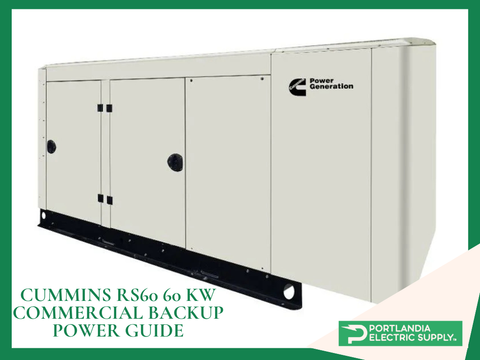
60 kW Cummins Standby Generator: The Essential Buyers Guide
Load math, voltage choices, fuel burn, transfer equipment, and the installation details that decide whether a 60 kW Cummins is the right machine for your building.

The 60 kW class is where standby power stops being a convenience and becomes infrastructure. Grocery stores, medical offices, small manufacturing, houses of worship, multi-tenant buildings — this is the size that keeps the lights on and the inventory cold when the grid drops. We spec and ship Cummins standby units in this class regularly, and the buying conversation is always the same: measure the real load, pick the voltage that fits the service, size the fuel system for the outage you actually expect, and don't cheap out on the transfer switch. This guide is that conversation, written down.
Sixty kilowatts covers a lot of building. The profiles we match to this class most often: a grocery or convenience store with two or three freezer banks plus HVAC, landing at 45–55 kW of measured peak; a dental or urgent-care clinic with imaging equipment and stringent NEC 517 obligations; a small church or school with a commercial kitchen; a farm operation running a 15 HP irrigation pump alongside shop loads; and large residential estates north of 6,000 square feet with dual geothermal systems, pools, and workshops.
The honest counter-question we ask every buyer: what does your outage cost per hour? A store losing $4,000 a day in refrigerated inventory and sales justifies 60 kW easily. A homeowner who wants the furnace and fridge alive during ice storms does not — a 26 kW unit with load management does that job for half the money. Buy for the load you measured, not the outage you fear.
| Facility Type | Measured Peak (typical) | 60 kW Fit | Watch Out For |
|---|---|---|---|
| Grocery / convenience store | 45–58 kW | Strong | Freezer defrost cycles stacking with HVAC |
| Urgent care / dental clinic | 35–50 kW | Strong | NEC 517 branch separation, imaging inrush |
| Church / school with kitchen | 40–55 kW | Strong | Occupancy-load HVAC during events |
| Small machine shop | 45–70 kW | Borderline | Motor starting; consider 80 kW or soft starters |
| Estate home 6,000+ sq ft | 40–55 kW | Good | Confirm with interval data, not square footage |
| Restaurant (full kitchen) | 50–70 kW | Borderline | All-electric kitchens often need 80 kW |
Cummins builds 60 kW sets in every common voltage code, and the choice cascades through feeder size, conduit, breaker cost, and transfer-switch price. The math, at 0.8 power factor:
| Voltage / Phase | Full-Load Amps | Min. Breaker (NEC 240.6) | Copper @ 75°C (NEC 310.16) | Conduit (EMT, typical) |
|---|---|---|---|---|
| 240V single-phase | 250 A | 300 A | 400 kcmil (335 A w/ 115%) | 3 in |
| 208V three-phase | 208 A | 250 A | 300 kcmil (285 A) | 2.5 in |
| 240V three-phase | 180 A | 225 A | 250 kcmil (255 A) | 2.5 in |
| 480V three-phase | 90 A | 110 A | 2 AWG (115 A) | 1.25 in |
Remember NEC 445.13: the feeder must carry 115% of the generator nameplate. That's why the single-phase column jumps to 400 kcmil — 250 A × 1.15 = 287.5 A, and 300 kcmil at 285 A comes up a whisker short under strict reading, so we spec 400 kcmil or parallel 3/0 and sleep at night. At 480V three-phase the same machine needs only 2 AWG and 1.25-inch conduit. On a 150-foot run, that's a four-figure difference in copper alone. This is why almost every 60 kW unit we sell for commercial duty ships as 208Y/120V or 480Y/277V three-phase, matched to the building service. Our NEC ampacity guide walks the full conductor-selection workflow including derating.
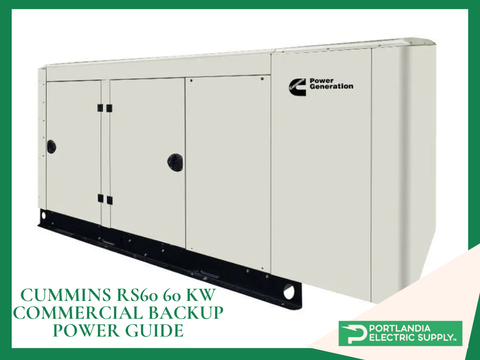
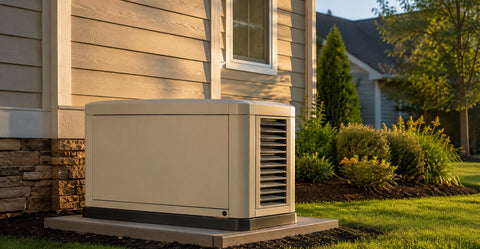
Two families cover this class. The gaseous QuietConnect-generation commercial units run natural gas or propane with sound-attenuated enclosures in the mid-60s dBA at 23 feet — the right answer for buildings near neighbors, schools, and offices. The diesel PowerCommand line (the C60D6 platform and its successors) brings heavier alternators, PMG excitation options, paralleling capability, and the PowerCommand control ecosystem that larger facilities standardize on. Both carry Cummins' two-year base standby warranty with extensions available, and both run on the service network that — frankly — is the biggest reason we sell the brand. When a unit faults at 2 a.m., parts and a factory-trained tech being one county over matters more than anything on the spec sheet.
| Attribute | Gaseous 60 kW (NG/LP) | Diesel PowerCommand C60-class |
|---|---|---|
| Fuel | Natural gas or LP vapor | ULSD diesel, sub-base tank options |
| Runtime limit | Unlimited while gas pressure holds | Tank capacity; refuel logistics |
| Sound (approx.) | ~66 dBA @ 23 ft | ~72–78 dBA standard, quieter with Level 2 enclosure |
| Motor starting | Good | Excellent — diesel torque handles inrush better |
| Cold-weather readiness | Battery warmer recommended | Block heater + battery warmer essential below freezing |
| Best setting | Commercial near occupants, estates | Industrial, ag, telecom, critical facilities |
Outage budgeting starts from the load-duration product: how many kilowatts, for how many hours, from how much stored fuel. Manufacturer curves for the 60 kW diesel class typically look like this — always confirm against the datasheet for your exact engine:
| Load | Diesel (typical) | Natural Gas (typical) | Runtime on 300-gal Tank |
|---|---|---|---|
| 25% (15 kW) | ~1.7 gal/hr | ~290 cu ft/hr | ~176 hr |
| 50% (30 kW) | ~2.8 gal/hr | ~470 cu ft/hr | ~107 hr |
| 75% (45 kW) | ~3.9 gal/hr | ~640 cu ft/hr | ~77 hr |
| 100% (60 kW) | ~4.9 gal/hr | ~780 cu ft/hr | ~61 hr |
Three hard-won fuel lessons. First, gaseous units at this size need serious gas service — 780 cubic feet per hour at full load is roughly 800,000 BTU/hr, which usually means a 2-inch dedicated run and a utility pressure letter before the permit issues. Second, diesel tanks grow algae; polish or treat fuel annually, because the fuel you tested last year is not the fuel in the tank today. Third, don't run diesels light for months — wet stacking below 30% load is real, and the cure (a load-bank day) costs less than the injector job it prevents. Our sizing guide includes the altitude and temperature derating worksheet for gaseous units.
Verify the gas meter before you sign anything.
A standard residential meter passes about 250–400 cubic feet per hour. A 60 kW gaseous unit at full load wants roughly double that. We've seen beautiful installs sit dead because nobody asked the gas utility for a meter and service-line upgrade. Get the utility's written confirmation of available capacity — at the generator's full-load BTU/hr, at the required delivery pressure — during design, not after the pad is poured.
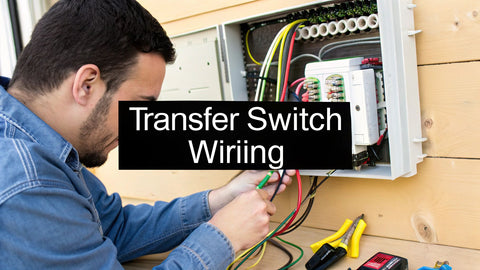
At 60 kW the transfer switch is a serious piece of gear: 300 A service-rated for single-phase, 250 A at 208V three-phase, or a compact 100–150 A at 480V. NEC 700/701/702 all demand a listed transfer means; service-rated ATS units with integral disconnects simplify inspection because the service disconnect and transfer live in one cabinet. The checkpoints we verify on every job in this class:
- Neutral switching: If the ATS switches the neutral, the generator becomes a separately derived system under NEC 250.35 and needs its own grounding electrode conductor. Mixing this up creates parallel neutral paths and ground-fault nuisance trips.
- Fault current: Verify the ATS withstand rating against available fault current at the service. Downtown services can exceed 42 kAIC — a 22 kAIC switch is scrap metal there.
- NEC 445.13 feeder sizing: 115% of nameplate, applied before derating.
- NFPA 110 for healthcare: Level 1 facilities need 96 hours of fuel (or equivalent), 10-second transfer, and documented monthly testing. Budget the testing labor, not just the hardware.
- Working clearances: NEC 110.26 applies to the ATS and any generator-mounted breakers — 3 feet minimum in front, more at higher voltages.
We stock transfer switch kits, monitoring and alarm accessories, and cold-weather kits matched to this class — block heaters, battery warmers, and louvers that keep a diesel honest in January.
Installation Timeline and Budget Reality

A clean 60 kW commercial project runs ten to fourteen weeks from order to commissioning. The generator itself is rarely the long pole; gas-service upgrades, permit review, and utility witness requirements are. Budget bands we quote honestly at the counter: equipment $30,000–$45,000 depending on fuel and enclosure; installation $12,000–$25,000 covering pad, crane set, feeders, ATS, gas or fuel work, and permits; annual ownership $800–$1,500 for maintenance, exercise fuel, and testing. A full turnkey 60 kW project lands between $45,000 and $70,000 for most sites, and anyone quoting dramatically less is leaving something out — usually the gas service or the feeder copper.
If the load study says 60 kW but the budget says otherwise, two honest paths exist. Load-manage down to a 48 kW class unit with intelligent shedding panels, or phase the project: generator and ATS now, service upgrade later. What never works is hoping the peaks won't overlap. They will, during the worst storm of the year, with the freezer bank and the HVAC starting together.
Related guides from the counter
The number that kills under-spec'd 60 kW jobs isn't running load — it's starting kVA. An across-the-line motor demands roughly 2 kVA per horsepower for the first half-second. A 60 kW set at 0.8 PF makes 75 kVA, which starts about a 30–35 HP motor on a lightly loaded bus, less if the building is already at 60% load. We've commissioned sites where a 20 HP fire-pump jockey or a big refrigeration compressor had to start under load; the answer was never a bigger generator, it was a soft starter on the motor and a PMG-excited alternator on the generator. PMG (permanent magnet generator) excitation keeps the alternator's field stiff through the voltage dip — Cummins offers it across the PowerCommand line, and on any job with meaningful motor or VFD content we consider it mandatory, not optional. VFDs themselves cut inrush to near nothing but feed harmonics back into the alternator; PMG plus a 2/3-pitch winding keeps the waveform clean enough that the building's electronics never notice.
| Motor Size (across-the-line start) | Starting kVA | Starts on 60 kW (75 kVA)? | Recommended Fix |
|---|---|---|---|
| 10 HP | ~20 kVA | Easily | None needed |
| 20 HP | ~40 kVA | Yes, light bus | Stagger other loads during start |
| 30 HP | ~60 kVA | Marginal | PMG alternator + start sequencing |
| 40 HP | ~80 kVA | No | Soft starter or VFD required |
| 50 HP+ | ~100+ kVA | No | Soft starter/VFD, or step to 80–100 kW |
A 60 kW standby is a commercial asset and it wants commercial-grade care. The cadence we hand every customer — and the one warranty adjusters expect to see documented:
| Interval | Task | Who |
|---|---|---|
| Weekly | Automatic exercise, 15–20 min; review remote monitoring alerts | Automatic |
| Monthly | Fluid levels, battery terminals and float voltage, enclosure and louvers, leak check; NFPA 110 facilities log this formally | Staff |
| 6 months | Gaseous units: oil and filter, spark plugs inspection, battery load test | Tech |
| 12 months / 250 hr | Diesel units: oil, oil and fuel filters, coolant test, air filter; fuel polishing for stored diesel | Tech |
| 12 months | Full building-load or load-bank test, 30%+ load for 1–2 hours; transfer test with utility witness where required | Tech |
| 24–36 months | Coolant replacement, valve lash (diesel), ATS contact inspection and torque re-check | Tech |
Two habits separate units that start from units that don't. Keep a logbook in the enclosure — date, hours, pressures, anything odd — because it's the first document a warranty claim demands. And exercise under real load at least annually; a no-load weekly spin proves the engine turns, not that it carries the building. For the sites we service, the annual load test is the day we find the weak battery, the stuck louvers, and the mouse nest in the control panel — better in October than during the ice storm.
Battery failure deserves its own sentence because it causes the majority of no-start calls we take: starter batteries in standby sets live a hard life — weeks of float charge, then a demand for full cranking amps at 4 a.m. in a blizzard. Replace them on a three-year calendar regardless of how they test, keep a maintenance-free AGM spare on the shelf for critical sites, and put the float voltage on the monthly checklist. A $180 battery on a schedule beats a $1,500 emergency service call every single time, and it beats the five-figure inventory loss that follows a no-start by an even wider margin.
Municipal sound ordinances trip up more 60 kW commercial projects than any electrical issue. Typical codes cap daytime noise at 60–65 dBA at the property line — and a standard diesel enclosure at 25 feet already sits at 72–78 dBA. The fixes are physical: distance (sound falls roughly 6 dB per doubling of distance), barrier walls on the neighbor side, Level 2 or Level 3 factory enclosures, and hospital-grade mufflers. A gaseous QuietConnect-class unit with an upgraded enclosure at 40 feet usually passes; an open-set diesel at 20 feet from a residential property line never will. Measure the site before you order the enclosure, because retrofitting sound attenuation costs three times what specifying it does.
Siting has its own checklist: 5 feet from openings and combustibles per most AHJs and manufacturer instructions, prevailing wind away from air intakes, flood elevation above the hundred-year mark — we've replaced flood-damaged units and it's a total loss every time — and crane access on delivery day. A 60 kW package weighs 4,000–6,000 pounds wet; the delivery path matters as much as the pad. Check gate widths, overhead service drops, and septic laterals before the crane is booked. One more line item people forget: snow-drift management. Northern installs want the exhaust and intake faces oriented away from drift-prone corners, and the pad raised 6 inches above grade where plows stack snow. A generator buried under a plowed drift is a generator that overheats or starves for air exactly when you need it most.
Last spring a specialty grocer brought us their utility interval data: 15-minute peaks over twelve months, and the honest peak was 51.4 kW on a July Saturday with both freezer banks in defrost and the rooftop units staging. Their electrician had spec'd a 50 kW unit off square footage — 3.5% of headroom against the measured peak, which is no headroom at all once you add the 115% feeder factor and the reality that loads only grow. We moved them to the 60 kW gaseous package at 208Y/120V with a 250 A service-rated ATS, and the summer it was commissioned they rode out a nine-hour outage at a measured 47 kW peak without shedding a single circuit. The lesson repeats across every commercial job we touch: interval data first, brochure second. Square-footage rules of thumb — "3 watts per square foot for retail" and cousins — are fine for cocktail-napkin budgeting and useless for purchase orders.
Run the same logic on your own facility: pull twelve months of interval data from your utility portal (nearly every commercial meter in the US provides it free), take the 99th-percentile peak rather than the absolute max — one anomalous spike shouldn't drive a $15,000 upsize — add 20–25% for growth and power-factor slop, and buy the class above that number. If the answer lands at 52–55 kW, buy the 60. If it lands at 44–47 kW with a gas constraint, look hard at 48 kW with load management instead.
PowerCommand and remote monitoring capabilities
Remote monitoring is a few hundred dollars on a $50,000 project and it is the single best money in the whole budget. A cellular telematics module reporting run status, battery voltage, fluid alarms, and exercise history catches the three failures that actually strand buildings: a slowly dying battery (visible in float-voltage drift weeks before failure), a missed exercise cycle (usually a tripped control breaker), and a fuel or gas-pressure fault that only shows when the unit tries to start. Cummins' connected options integrate with the PowerCommand controls and email or text the moment anything drifts out of band. For NFPA 110 facilities, the logged history doubles as testing documentation. We fit monitoring to every 60 kW unit we sell at this point; the only customers who decline are the ones who already learned the lesson the hard way.
How many amps does a 60 kW generator produce?
250 A at 240V single-phase, 208 A at 208V three-phase, 180 A at 240V three-phase, and 90 A at 480V three-phase — all at 0.8 power factor. Size feeders at 115% of nameplate per NEC 445.13.
What size building can a 60 kW generator run?
Typically a 15,000–25,000 sq ft commercial building with mixed loads, a grocery or clinic, or an estate home over 6,000 sq ft. Measured peak demand — not square footage — makes the final call.
How much fuel does a 60 kW generator use?
Typical diesel burn is ~1.7 gal/hr at quarter load up to ~4.9 gal/hr at full load. Natural gas units draw roughly 290–780 cubic feet per hour across the same range. Verify against the datasheet for your exact engine.
Natural gas or diesel for a 60 kW standby?
Natural gas wins where utility service can deliver ~800,000 BTU/hr and unlimited runtime matters. Diesel wins for utility independence, motor-starting performance, and sites that already store fuel. Cold climates favor diesel with proper cold-weather kits.
What does a 60 kW Cummins cost installed?
Most turnkey projects land between $45,000 and $70,000: $30k–$45k equipment, $12k–$25k installation. Gas-service upgrades, long feeders, and NFPA 110 requirements push toward the top of the range.
How long can a 60 kW generator run continuously?
Gaseous units run indefinitely with utility pressure, limited only by oil service intervals — plan an oil check every 24–48 hours of continuous running during long outages. Diesel runtime is tank-limited: a 300-gallon sub-base tank delivers roughly 60–100 hours depending on load.
Spec your 60 kW the way we do
Send us your utility interval data or panel schedule. We'll return a sized recommendation — voltage, fuel, ATS, and feeder schedule — before you spend a dollar on equipment.
Shop 60 kW Generators