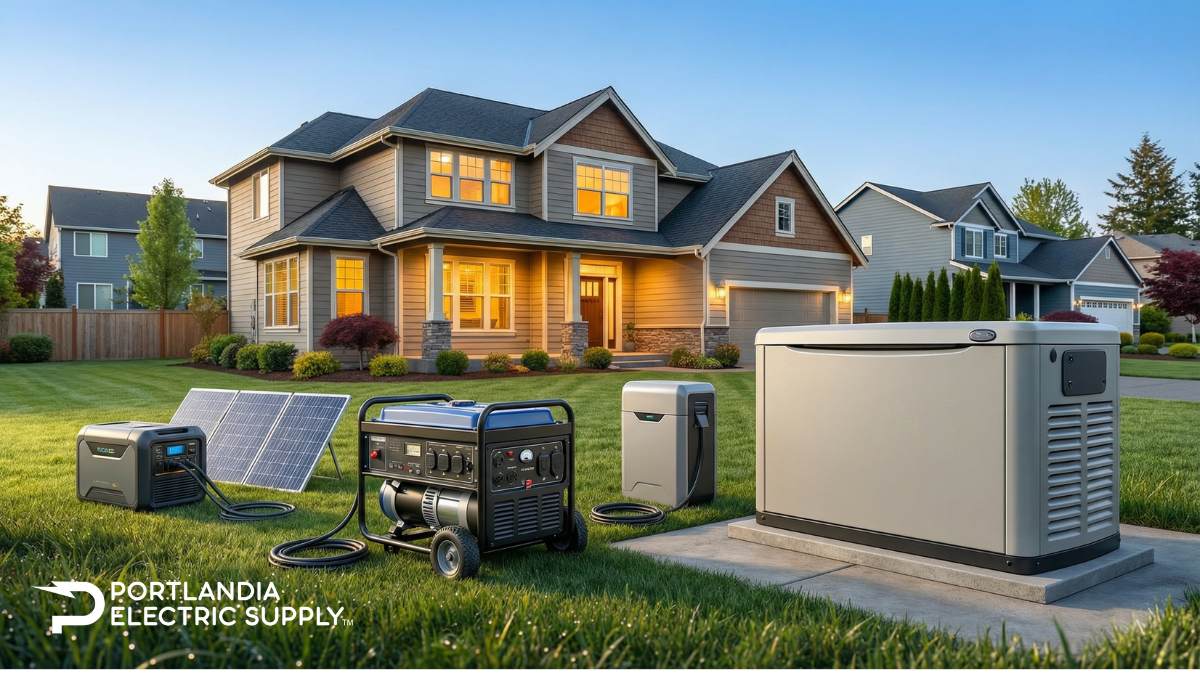
Updated September 2026 — refreshed against the live PES catalog; product pricing verified 2026-09-26.
Every September the calls start: a storm took out half the county, someone's freezer full of elk is warming up, and the question lands on my counter — "what's the best backup power for my house?" After two decades of answering it, I've learned the honest reply is a matrix, not a product. Fuel access, outage duration, budget, medical loads, and how you feel about maintenance all push the answer toward a standby generator, a portable generator with an interlock, a battery system, or — increasingly — a hybrid of two. This guide lays out the best backup power solutions for homes in 2025–2026 with the real numbers: costs, runtimes, fuel math, and the code work that makes any of it legal and safe.

The four legitimate options, ranked by what they actually do
| Solution | Installed cost (typical) | Runtime ceiling | Transfer speed | Maintenance | Best fit |
|---|---|---|---|---|---|
| Standby generator (NG/LP, 14–26 kW) | $9,000–$18,000 | Weeks (NG) / tank-limited (LP) | ~10 seconds, automatic | Annual service, weekly exercise | Multi-day outages, whole house, medical loads |
| Portable generator + interlock/ATS | $1,500–$4,500 | 8–24 hr per refuel | Manual, minutes | Fuel rotation, carb care | Budget backup, selected circuits |
| Battery ESS (13.5–40 kWh) | $12,000–$40,000 | Hours to 2 days (load-dependent) | <20 ms, seamless | Near zero | Frequent short outages, solar pairing, silence |
| Hybrid: battery + generator | $20,000–$45,000 | Effectively unlimited | Seamless + auto gen start | Generator service only | Serious resilience, off-grid-capable homes |
Notice what's not on the table: "solar generator" power stations under 3 kWh for whole-house duty. They're excellent for CPAPs and refrigerators during short outages, and they are not a whole-home solution no matter what the ad says.
Option 1: Standby generators — the workhorse answer
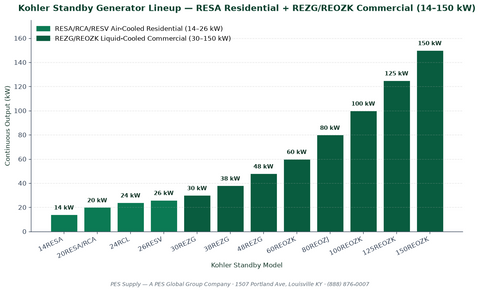
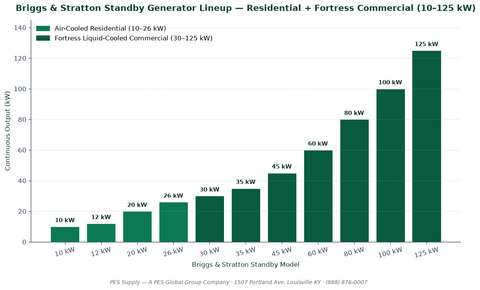
A permanently installed standby unit on natural gas or propane with a service-rated automatic transfer switch is still the gold standard for real outage country. It starts itself in about ten seconds, carries your whole panel, and on natural gas runs until the grid comes back — two hours or two weeks. The current best-in-class lineup: Generac's Guardian 22–26 kW air-cooled series for value and dealer coverage, Kohler's 20RESC/26RCA for build quality and corrosion-proof enclosures, Cummins QuietConnect for the quietest operation and best cold-weather kits, and Briggs & Stratton PowerProtect for the 6-year warranty. We cover the model-by-model pick in the best whole house generators guide and the brand-level detail in the Generac, Kohler, and Cummins brand guides.
Fuel math for planning, from manufacturer-published consumption figures:
| Unit class | NG @ half / full load | LP @ half / full load | 3-day outage, NG cost @ $1.20/therm (avg 40% load) | 3-day outage, LP gallons (avg 40% load) |
|---|---|---|---|---|
| 14 kW air-cooled | ~135 / ~200 ft³/hr | ~1.4 / ~2.3 gal/hr | ~$140 | ~125 gal |
| 22 kW air-cooled | ~180 / ~306 ft³/hr | ~2.1 / ~3.6 gal/hr | ~$210 | ~180 gal |
| 26 kW air-cooled | ~210 / ~350 ft³/hr | ~2.4 / ~4.0 gal/hr | ~$240 | ~210 gal |
Two field notes on fuel. On natural gas, confirm the meter capacity with your utility before install day — a 22 kW at full load draws ~300 ft³/hr and I've torn out installs where the meter couldn't feed the generator and the furnace at once. On propane, size the tank for the outage you fear, not the average: 500 gallons minimum for a 22 kW, 1,000 if you run a well pump.
Option 2: Portable generator + interlock — the honest budget path
A 7,500–9,500W portable on gasoline or dual-fuel, connected through a listed interlock kit or a manual transfer switch, legally and safely powers your well pump, furnace blower, refrigerator, and a few circuits of lights for $1,500–$4,500 all-in. The interlock matters: it's a mechanical plate that makes backfeeding your panel through a dryer outlet impossible, and it's the difference between a $200 code-compliant install and a method that kills utility linemen. The Champion brand guide covers the dual-fuel and tri-fuel portables we stock, and our maintenance guide covers the fuel rotation and carb care that decides whether a portable starts when you need it. Gasoline's shelf life is the hidden spec here: 3–6 months untreated, 12–24 with stabilizer. Propane-fueled portables sidestep the whole problem, which is why I steer carburetor-allergic customers toward dual-fuel units run on LP.
Option 3: Battery energy storage — the silent contender
A 13.5 kWh Tesla Powerwall 3, a stack of Enphase IQ 5P units, a Generac PWRcell cabinet, or a wall of EG4/SimpliPhi LFP modules gives you seamless, silent, instant backup with zero maintenance — and a hard runtime ceiling. The math is stark: the average US home idles at 1–1.5 kW overnight but spikes to 5–8 kW with cooking and HVAC. A single 13.5 kWh battery carries an efficient, gas-appliance house through a night; it carries an all-electric house for about four hours. The fix is either more batteries or solar recharging them daily — which is why battery systems shine brightest paired with PV. Our battery vs generator comparison runs a real outage week against both options, the PWRcell cost guide prices Generac's cabinet, and the battery runtime calculator lets you run your own loads. For homes where outages average under 12 hours and silence matters — home offices, CPAP users, dense neighborhoods — battery-first is genuinely the better answer in 2026.
Option 4: Hybrid systems — battery plus generator
The architecture I now recommend for anyone serious about resilience: a battery ESS handles every outage under 6–8 hours instantly and silently, and a generator auto-starts only when the battery hits 30% — running at efficient 70% load to recharge, then shutting off. Generator runtime drops 70–80%, fuel use collapses, the battery covers the 95% of outages that never needed an engine at all, and the weekly exercise cycle keeps the generator healthy against the rare long event. Sol-Ark and Schneider hybrid inverters orchestrate this natively; Generac sells it as PWRcell-plus-generator ecosystems. It's the most expensive path and the one my own house runs.
Critical-loads math: sizing to the loads that matter
Whichever technology you pick, the sizing worksheet is the same. List your must-run loads with running and starting watts:
| Load | Running watts | Starting watts (surge) | Daily kWh (typical outage duty) |
|---|---|---|---|
| Refrigerator (modern, 21 cu ft) | 150–200 | 600–1,200 | 1.5–2.0 |
| Chest freezer | 100–150 | 500–900 | 1.0–1.4 |
| Gas furnace blower (1/2 HP ECM) | 300–600 | 800–1,500 | 3.0–7.0 (heating season) |
| Well pump (1/2 HP, 240V) | 800–1,100 | 2,100–3,300 | 1.0–2.0 |
| 3-ton central AC | 3,000–3,600 | 8,000–12,000 (LRA) | 25–40 (cooling season) |
| Sump pump (1/3 HP) | 600–800 | 1,300–2,000 | 0.5–1.5 |
| Internet + laptops + LED lighting circuit | 200–400 | — | 2.0–4.0 |
| Medical devices (CPAP, oxygen concentrator) | 60–300 | — | 0.5–2.4 |
Add running watts of everything that runs simultaneously, then add the single largest starting surge — that's your generator kW floor. For batteries, sum the daily kWh column for your autonomy target and divide by 0.9 (usable capacity and inverter losses). The generator sizing guide and best backup generator picks work this math across whole product lines.
Transfer equipment: the part that makes it legal
Every connection between a generator and your home's wiring must make utility backfeed physically impossible — NEC 702 and 700/701 (for emergency and legally required systems) are unambiguous, and inspectors check. Three compliant paths:
- Service-rated ATS (200A typical). Between meter and main panel. Whole house, automatic, ~10-second transfer. Required for true standby installs.
- Sub-panel ATS or manual transfer switch (50–100A). Moves 6–16 selected circuits. Right answer for portables and partial-home standby.
- Interlock kit + backfeed breaker. Listed mechanical interlock on your existing panel, a dedicated 2-pole generator breaker, and an inlet box. Cheapest compliant path for portables — typically $150–$400 in parts plus the breaker.
Sizing the generator breaker and feeder lands on NEC 310.16 ampacities and 240.6(A) standard ratings: a 9,500W portable at 240V pulls 40A, so a 50A inlet, 8 AWG copper (50A at 75°C), and a 50A backfeed breaker; a 22 kW standby needs 2 AWG (115A) on a 100A OCPD into a 200A service-rated ATS. Our NEC wire sizing guide has the full chart, and breaker sizing covers the 125% continuous rule that applies to any generator feeding loads for three-plus hours. If the project involves bumping a 100A service to 200A, read the service upgrade guide first — generator and panel work together save a second mobilization.
What backup power actually costs in 2026, all-in
| Path | Equipment | Install (typical) | 10-year fuel + maintenance (moderate outage profile) | 10-year total |
|---|---|---|---|---|
| Portable + interlock (7.5–9.5 kW) | $1,200–$2,000 | $500–$1,500 | $1,500–$3,500 | $3,200–$7,000 |
| Standby 14 kW | $4,500–$6,000 | $3,000–$5,000 | $2,000–$4,000 | $9,500–$15,000 |
| Standby 22–26 kW | $6,000–$9,500 | $3,500–$6,500 | $2,500–$5,000 | $12,000–$21,000 |
| Battery 13.5 kWh (single unit) | $9,000–$12,000 | $3,000–$5,000 | ~$0–$500 | $12,000–$17,500 |
| Battery 27–40 kWh + solar recharge | $22,000–$38,000 | $5,000–$9,000 | ~$0–$1,000 | $27,000–$48,000 |
| Hybrid (battery + 14 kW generator) | $16,000–$24,000 | $5,000–$9,000 | $1,500–$3,500 | $22,500–$36,500 |
Two honest caveats on that table. Battery systems paired with solar earn back through daily bill arbitrage and the 30% federal credit (confirm current IRS guidance — the residential credit landscape shifted in 2025), which generators never do. And generator "maintenance" lines assume you actually do the annual service; skip it and the 10-year total includes a $4,000 replacement engine instead.
Decision matrix: which backup power is yours
| Your situation | Best answer | Why |
|---|---|---|
| Rural, well pump, multi-day outages 2–4×/year | Standby 22 kW on propane, 500–1,000 gal tank | Water and heat can't wait for sun |
| Suburban, outages under 8 hours, home office | 13.5–27 kWh battery | Seamless transfer, zero noise complaints, daily solar value |
| Tight budget, needs furnace + fridge only | Dual-fuel portable + interlock | $2,500 solves the real problem |
| Medical equipment, can't gamble | Standby generator + UPS/battery ride-through | Generator covers duration, battery covers the 10-second gap |
| Off-grid or grid-optional property | Hybrid: solar + battery + generator | Each technology covers the other's worst case |
| Coastal or corrosive environment | Kohler standby (composite enclosure) | Steel cabinets rust; I've replaced them at year 7 |
The install sequence, done right
For a standby unit, the order of operations that passes inspection the first time:
- Load calculation — NEC 220 calc on the actual panel schedule, then pick the kW class with 20% headroom.
- Site and pad — level pad (composite or poured concrete), manufacturer clearances from windows/vents (typically 5 ft), 18 inches minimum from the structure, flood-zone-aware elevation.
- Gas or propane rough-in — size the line for full-load BTU plus house load; pressure-test before the generator arrives. For LP, set and fill the tank first.
- Electrical rough-in — ATS location, feeder conduit, and the control wiring. Utility disconnect/reconnect coordination happens here.
- Set, connect, commission — torque lugs to spec, program the exercise cycle, full-load test with a load bank or the house, verify transfer time and voltage/frequency stability.
- Inspection and handoff — AHJ sign-off, then walk the owner through the weekly exercise, the app, and the annual service schedule.
Step 2's clearances are the ones DIYers blow past. Exhaust within five feet of an operable window is a carbon-monoxide machine — CO sends roughly 400 Americans to the ground every year from generators alone, almost all from placement and backfeed mistakes. This is the section of the job where professional install pays for itself.
Field notes: what twenty years of storm calls taught me

Three patterns repeat. First, the generator that fails in the storm has a battery older than four years — replace on schedule, not on symptoms. Second, the customers happiest with their backup power sized one class up from the calculator's minimum; the ones calling me mid-outage sized to the penny. Third, nobody has ever complained that their transfer was too fast or their fuel tank too big. Backup power is the rare purchase where the regret curve only runs one direction. If you're on the fence between a 20 and a 26 kW, or between one battery and two, the market has already told you the answer: used listings are full of too-small systems. I've never seen a listing that said "selling, it was too reliable."
How long are outages, really? Plan for the tail, not the average
Utility reliability data (the EIA's SAIDI figures) puts the average US customer at roughly 5–8 hours of interruption per year — and that average lies, because it's the average. Outage duration is a tail distribution: most events last under two hours, and then a hurricane, ice storm, or heat-dome load-shed event runs three to ten days. Design your backup for the tail event you actually fear. If your memory of the last decade includes one week-long outage, your design point is a week, and the options narrow to natural gas standby, big propane, or hybrid. If your worst memory is a six-hour windstorm, battery-first with a portable as insurance is the economically sane answer. I keep a folder of customer outage logs; the families who bought for the average call me during the tail. The families who bought for the tail call me after, to say the freezer never noticed.
Portable generator safety: the rules that prevent the tragedies
Portable generators kill more Americans in an average year than hurricanes' winds do — carbon monoxide, nearly always, from units run in garages, on porches, or near windows. The rules are short and absolute: minimum 20 feet from the house, exhaust pointed away, never in an attached garage even with the door open, and CO detectors on every floor when any combustion backup is running. Refuel only stone-cold. Store gasoline in approved cans, treated with stabilizer, rotated every six months — or buy a dual-fuel unit and run propane, which stores indefinitely and burns clean enough to double carburetor life. Every portable we sell leaves with a CO reminder card in the box. Read it.
Permits, inspection, and insurance — the paperwork that protects you
Standby generator installs require electrical and (for gas) mechanical/plumbing permits in essentially every US jurisdiction, plus utility notification for the service disconnect. The permit isn't bureaucracy for its own sake: the inspection catches the reversed neutral, the undersized gas line, and the missing bonding jumper while they're fixable. Insurance matters too — notify your carrier after a permanent install. An unpermitted generator that starts a fire is a denied claim with a rotor spinning; I've watched that conversation happen and you don't want to. Keep the permit card, the inspection sign-off, the commissioning sheet, and the load calc together in one folder with the warranty. That folder is worth real money at resale, at claim time, and the day you sell the house.
Special cases: medical loads, sump pumps, and second refrigerators
Medical equipment deserves its own sentence: if anyone in the house runs oxygen, a ventilator, or refrigerated medication, design to a zero-interruption standard — battery or UPS ride-through in front of the generator, and register with your utility's medical baseline or priority restoration program (every US utility has one; the form takes ten minutes). Sump pumps are the sneaky one: they only matter exactly when the grid is most likely down, and a 1/3 HP unit's 1,300–2,000W starting surge must be in your sizing math. Second refrigerators and garage freezers add 2–3 kWh/day each to battery math that most worksheets forget. Walk your own house with the loads table above before you buy anything — the loads that matter are the ones in your basement, not the ones in a brochure.
Load management: the feature that buys you a smaller generator
Modern ATS platforms — Generac's Smart Management Modules, Briggs' Symphony II, Kohler's RDC2 logic — don't just transfer power; they sequence it. The switch watches total generator load and locks out the electric water heater while the AC compressor runs, then re-admits it when the compressor cycles off. Field result: houses that calculate to 26 kW run comfortably on 22 kW, and houses on the 18/22 fence run on 18. The savings compound — smaller unit, smaller gas line, smaller pad, less fuel per hour. When I quote, I price it both ways and let the customer see the trade: two load-shed modules at ~$100 each versus a $2,000 jump in generator class. Load management wins almost every time.
Whole-house surge protection: the $300 insurance nobody buys until after
Grid restoration after a major outage is electrically violent — reclosure spikes, transformer taps banging, neighbors' loads snapping on. A Type 1 or Type 2 SPD at the service (80–100 kA per phase, SCCR matched to the panel) protects the generator's control board, the ATS electronics, and every ECM blower and variable-speed compressor in the house. NEC 2020's 230.67 already requires SPDs on new and replaced dwelling services; if your panel predates that, a backup-power project is the natural moment to add one. I've replaced exactly zero surge-protected generator control boards and several unprotected ones at $900 a pop.
What an outage actually costs: the case for acting before the storm
Run the household math once and the payback conversation changes. A freezer and refrigerator of food: $400–$800. A flooded basement from a dead sump pump: $8,000–$25,000 and a mold conversation. A week in a hotel for four people: $1,500–$3,500. Burst pipes in an unheated house: $5,000–$30,000. A single spoiled batch of insulin or a missed week of remote work: real money or real consequences. Against those numbers, a $2,500 portable-plus-interlock is the cheapest insurance in the hardware store, and a $12,000 standby system amortized over 20 years is $600 a year — less than one moderate outage. Customers frame backup power as a luxury until the first event; after that they frame it as obvious. Buy it in the calm. Every generator I've ever installed during an active outage watch cost more, arrived later, and served a family that had already lost a freezer.
Used and surplus generators: when it's smart and when it's a trap
A low-hour liquid-cooled commercial unit from a telecom decommission or a hospital upgrade can be a legitimate value — these machines lived indoors on maintenance contracts. A used air-cooled residential unit is usually a trap: unknown exercise history, a controller platform two generations back, and no warranty, priced at 60% of new. My rule: buy used only with verifiable run hours (under 500 for a residential-class unit), a load-bank test before money moves, and a local dealer willing to service the brand. Otherwise the $3,000 you saved buys you a $4,000 problem with a 10-day parts lead time.
Fuel storage and rotation: the unglamorous core of preparedness
Every backup plan that depends on stored fuel lives or dies on rotation discipline. Gasoline: 3–6 months untreated, 12–24 months with stabilizer, stored in approved cans out of the sun — and mark the purchase date on the can with a paint pen, because nobody remembers. Propane: stores indefinitely, needs only valve and tank inspection discipline. Diesel: 6–12 months untreated, longer with biocide and polishing, and cold-weather gelling becomes the issue below ~15°F without additives. Natural gas: no storage at all, which is its entire advantage and its entire risk — it depends on the gas utility staying up, which historically it does even when the grid falls. Whatever your fuel, the rule is the same: the day you need it is the wrong day to discover a problem with it. Rotate on a calendar reminder, not on memory.
A word on transfer speed and sensitive electronics
Standby generators transfer in about ten seconds; your computers, DVRs, and some medical devices see that as a blackout. A small UPS (850–1,500 VA) on the electronics that matter bridges the gap cleanly. Battery ESS transfers in under 20 milliseconds — effectively seamless — which is one of its genuine technical advantages, not marketing. And modern ECM furnace blowers and variable-speed HVAC equipment want the clean sine wave of a quality standby or inverter generator; running them on a cheap open-frame contractor generator's dirty power is how control boards die. If your house is full of electronics, power quality belongs in your selection criteria alongside watts.
The homework list before you buy anything
Five items, one evening, and every quote you collect gets sharper. First, pull twelve months of utility bills and note your peak month in kWh. Second, walk the house with the critical-loads table and mark must-run versus nice-to-run. Third, check your outage history honestly — call the utility if you need the data; they track it by address. Fourth, locate your gas meter and note its BTU rating plate, and your electrical panel's bus rating and main breaker size — photograph both. Fifth, decide your real budget including installation, because the equipment-only number lies by 40–60%. Bring that packet to any supplier conversation — ours included — and you'll get a real design instead of a brochure recital. The customers who do this homework buy once. The ones who skip it buy twice.
Final field note on sizing philosophy. Every backup system I've installed that earned a thank-you call was sized one step above the minimum the math allowed — the next generator class, the extra battery, the bigger tank. Every regret call traced to a system sized to the penny. Backup power is insurance with a motor or a battery attached; nobody has ever stood in a dark kitchen wishing they'd bought less of it.
One planning resource worth bookmarking before storm season: your utility's outage map and historical reliability reports. Most US utilities publish SAIDI/SAIFI reliability data annually, and a five-minute review of your county's numbers sharpens the standby-versus-battery decision better than any salesperson's pitch. Pair it with your own outage log — date, duration, cause — and after one year you'll have the exact design brief a professional would build. That is genuinely all the homework the decision requires.
Frequently asked questions
What is the best backup power source for a home?
For multi-day outages and whole-house loads, a natural gas or propane standby generator (14–26 kW) with a service-rated ATS is the proven answer. For outages under 8–12 hours with solar on the roof, a battery system is cleaner, silent, and maintenance-free. The strongest setup is a hybrid: battery for short events, generator auto-starting for long ones.
How much does whole-house backup power cost installed?
A portable generator with a code-compliant interlock runs $1,500–$4,500 all-in. A standby generator system (14–26 kW with ATS) installs for $9,000–$18,000. A single 13.5 kWh battery installs for $12,000–$17,000, and multi-battery systems with solar run $27,000–$48,000 before incentives.
How long can a battery back up a house?
A single 13.5 kWh battery carries an efficient home's critical loads (fridge, furnace blower, lights, internet — roughly 8–10 kWh/day) through one night. All-electric homes with cooking and HVAC drain the same battery in 3–5 hours. Pairing with solar extends runtime indefinitely on sunny days; without solar, runtime is a simple division of battery capacity by your load.
Is a transfer switch required for a home generator?
Yes — NEC 702 requires that a generator connection make utility backfeed impossible. The compliant options are a service-rated automatic transfer switch, a manual transfer switch or sub-panel ATS for selected circuits, or a listed interlock kit with a dedicated backfeed breaker. Backfeeding through a dryer outlet is illegal and lethal to line workers.
How big a generator do I need for critical loads only?
Add the running watts of everything that runs simultaneously — typically refrigerator (200W), furnace blower (400W), well pump (1,000W), lights and internet (400W) — then add the largest motor's starting surge (well pump ~3,000W). Most critical-loads-only homes land at 5–7.5 kW, which a quality 7,500W portable or a 14 kW standby covers with headroom.
Generator or battery for a house with solar panels?
With solar already installed, a battery converts your array from fair-weather equipment into a daily asset and covers most outages silently; a generator alone leaves the solar dark during outages (grid-tie inverters shut down without a reference). If your outage history includes multi-day events, add a compact generator as the battery's recharger — the hybrid uses 70–80% less fuel than a generator-only design.
Need pricing or availability on anything in this guide?
Portlandia Electric Supply dropships direct from the manufacturer — most items Ship Direct with lead times stated up front, no surprises.
Get a quote from PESBulk, pallet and contractor pricing available.