Updated September 2026 — content reviewed and refreshed by the PES team. For current pricing and availability, see the linked product pages or request a quote.
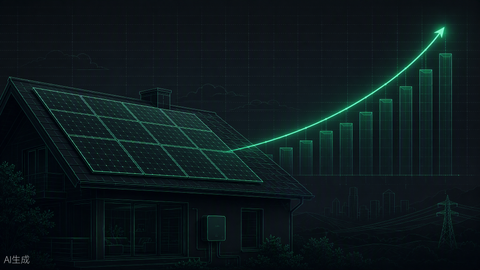
The phone calls that stick with me aren't the ones asking about panel wattage. They're the ones after an ice storm or a fire-season shutoff: "The neighborhood was dark for four days. What would it take to never do that again?" Solar backup power answers that question, but only when it's sized with real math instead of hope. A system that runs the refrigerator and furnace blower through a night is a different machine than one that runs central air through a week — and the price difference is not linear. This guide walks the components, the sizing math, the architecture choices (grid-tied, off-grid, hybrid), and the cost/ROI picture, with the numbers we use when we design these systems for customers.

For the storage-specific deep dives, keep our home battery bank sizing guide, the battery sizing calculator, and the solar battery buyer's guide open alongside this one. Ready to browse hardware? Solar batteries, hybrid inverters, and battery backup kits are the starting categories.
Understanding the Core System Components
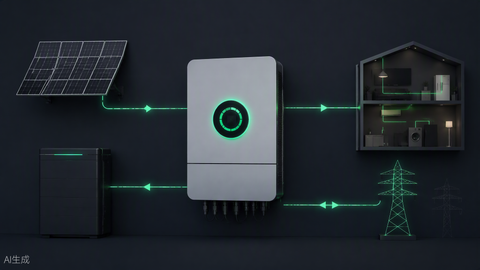
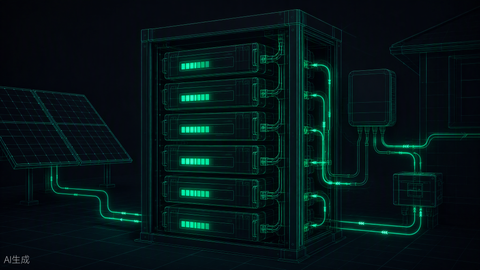
A solar backup system is a standard PV array plus two things: batteries, and an inverter architecture that can island from the grid. Every component choice cascades:
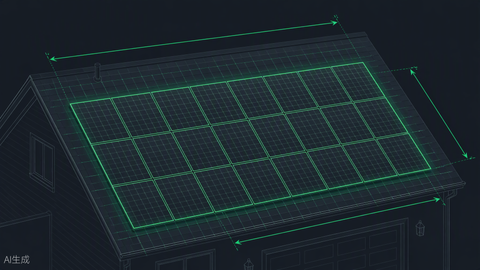
Solar Panels: The Energy Collectors
The Battery Bank: Your Personal Energy Reservoir
| Component | Primary Function | Key Consideration for Installers | Key Consideration for Owners |
|---|---|---|---|
| Solar panels | Convert sunlight to DC electricity | Roof space, structural capacity, and local irradiance dictate array size and layout | Efficiency (output per sq ft) and warranty terms drive long-term value |
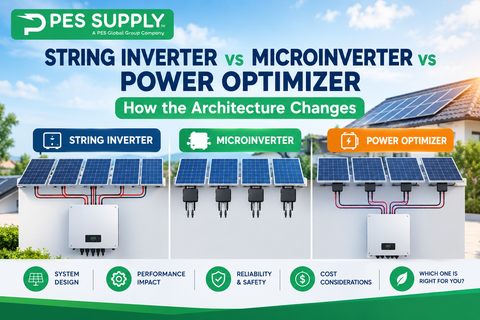
| Inverter (hybrid or AC-coupled) | Converts DC to AC; manages energy flow between array, battery, loads, and grid | Must be sized for simultaneous loads and listed compatible with the specified battery | Hybrid vs micro determines backup capability, surge capacity, and future expansion |
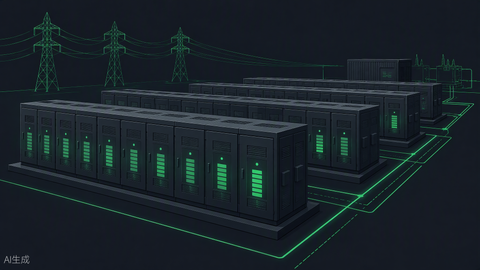
| Battery bank | Stores energy for outages, evenings, and peak shaving | Chemistry (LFP vs NMC), usable kWh, continuous/surge kW, and ambient temperature limits | Usable capacity and warranty cycles matter more than nameplate kWh |
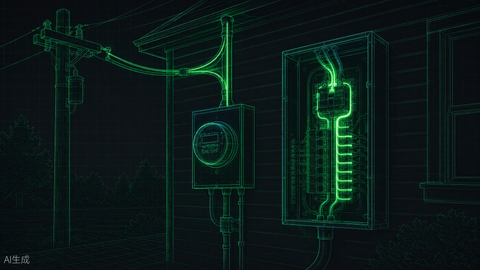
| Transfer/islanding equipment | Separates the home from the grid during outages | ATS or MID device rated for service amperage; NEC 705/702 compliance | Determines whole-home vs critical-loads backup and switchover speed |
| Critical loads panel | Segregates backed-up circuits from non-essential loads | Load calculation per NEC 220 for the backed-up subset | The single biggest lever on system cost |
| Monitoring & controls | State-of-charge management, storm modes, load shedding | Configure reserve percentages and generator-integration logic | The app you'll actually live with during outages |
How to Size Your Solar Backup System Correctly
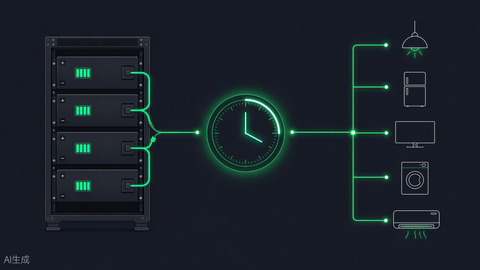
Sizing is two separate numbers that people constantly conflate: power (kW) — what you can run at once — and energy (kWh) — how long you can run it. A 10 kW / 13.5 kWh battery runs a 3 kW load set for about 4.5 hours. Both numbers must clear their own bar.
Step 1 — Define the backed-up load set. Be ruthless. Refrigerator (150–200W running, ~1,200W start), furnace blower (600–1,200W), some lighting and outlets (300–800W), internet (30W), a well pump if rural (1,000–2,500W with a big surge). A disciplined critical-loads set for a typical home lands at 1.5–4 kW continuous. Central air (3–5 kW running, 12–18 kW LRA surge) and electric resistance anything (water heater 4.5 kW, range 8+ kW) usually stay off the backup side — or the battery budget triples.
Step 2 — Compute daily energy need. Multiply each load by its realistic daily runtime:
| Load | Running Watts | Hours/Day (outage mode) | Daily kWh |
|---|---|---|---|
| Refrigerator (cycles ~40%) | 180 | 9.6 (effective) | 1.7 |
| Gas furnace blower | 800 | 6 | 4.8 |
| Lighting (LED, 10 fixtures) | 150 | 5 | 0.75 |
| Internet + networking | 40 | 24 | 1.0 |
| Phone/laptop charging, misc outlets | 200 | 4 | 0.8 |
| Sump pump (seasonal) | 900 | 1.5 | 1.35 |
| Total critical loads | ~2.3 kW peak | — | ~10.4 kWh/day |
Step 3 — Size battery kWh with days of autonomy and depth of discharge. For one day of autonomy at 90% usable (LFP): 10.4 ÷ 0.9 ≈ 11.6 kWh → one 13.5 kWh class unit (the Powerwall 2 class, or modular LFP like the Fortress eFlex 5.4 kWh stacked ×3). For two days, double it. Our battery runtime calculator article has the formula-driven version.
Step 4 — Verify surge and continuous kW. The inverter must start the largest motor while carrying everything else. Furnace blower + fridge + well pump simultaneously can demand 6–8 kW surge. A single 5 kW inverter won't do it; a Sol-Ark 8K-class hybrid or stacked inverter setup will. Check both continuous and 5-second surge ratings.
Step 3: Calculate the Required Solar Array Size
Step 5 — Size the array to recharge during outages. Storage without recharge is a countdown timer. Rule of thumb: array daily harvest (kW × peak sun hours × 0.8 system factor) should cover daily outage consumption. For the 10.4 kWh/day example at 4.5 peak sun hours: 10.4 ÷ (4.5 × 0.8) ≈ 2.9 kW minimum array dedicated to outage survival — but since the same array also served your normal loads, real designs land at 6–10 kW. Run your address through the solar system calculator.
| Backup Target | Continuous Load | Battery (usable kWh) | Inverter Class | Array for Outage Recharge | Ballpark Installed Cost |
|---|---|---|---|---|---|
| Essentials, 1 day (fridge, furnace, lights, internet) | 2–3 kW | 10–13.5 kWh | 5–8 kW hybrid | 4–6 kW | $18,000–$32,000 (with PV) |
| Essentials + some comfort, 2 days | 3–5 kW | 20–27 kWh | 8–12 kW hybrid | 6–8 kW | $30,000–$48,000 |
| Whole-home including AC (managed), 1 day | 5–8 kW | 27–40 kWh + load management | 12–15 kW hybrid or stacked | 8–12 kW | $45,000–$70,000+ |
| Off-grid, multi-day autonomy | 3–8 kW | 40–80+ kWh | Stacked hybrid/off-grid | 10–15+ kW | $60,000–$120,000+ |
Choosing Your Architecture: On-Grid, Off-Grid, or Hybrid?
Grid-Tied Systems With Battery Backup
Fully Off-Grid Systems
| Feature | Grid-Tied with Backup | Off-Grid | Hybrid (grid-interactive storage) |
|---|---|---|---|
| Grid connection | Yes, fully integrated | None — fully independent | Yes, but operates independently on demand |
| Ideal use case | Suburban homes wanting bill reduction plus outage protection | Remote properties, critical infrastructure, energy independence | Homes and facilities optimizing ROI via peak shaving plus backup |
| Primary pro | Lowest storage requirement; net metering credits | No utility bill, total outage immunity | Best economics plus resilience; participates in grid services |
| Primary con | Backup capacity limited by battery size | Largest battery + array; generator backup usually still required | Highest complexity and upfront cost |
| Typical storage | 10–27 kWh | 40–100+ kWh | 13–40 kWh |
| Generator role | Optional supplement | Required for dark-week stretches | Optional; integrates via hybrid inverter |
Most of our customers land on hybrid. The economics flipped around 2023–2025: as net metering got watered down in state after state, storing your own midday production for evening use started beating exporting it. The same battery that does peak-shaving Tuesday does storm duty Thursday. Architectures in this class pair units like the EG4 FlexBOSS21 or Sol-Ark hybrids with LFP banks from EG4, Fortress Power, or Pylontech — see the EG4 vs Tesla Powerwall comparison for the two dominant philosophies (modular open-standard vs integrated appliance).
Battery Chemistry and the 20–80 Rule
Lithium iron phosphate (LFP) has effectively won the stationary storage market: 6,000+ cycle life, thermal stability, no cobalt. NMC survives in space-constrained integrated units where its energy density matters. Either way, longevity is governed by how you cycle it. The short version of our 20–80 battery rule: daily cycling between roughly 20% and 80% state of charge materially extends calendar and cycle life versus 0–100% swings. Good hybrid inverters expose reserve and charge-limit settings — set them once and the battery thanks you for a decade. Maintenance and monitoring habits live in how to extend solar battery life.
Costs, Incentives, and Honest ROI

Installed pricing in 2026, all-in with PV: essentials-only systems $18,000–$32,000; robust hybrid whole-home-ish systems $35,000–$70,000; true off-grid $60,000 and up, fast. Batteries alone retrofit at $800–$1,200 per usable kWh installed, trending down.
On incentives: the residential 25D credit ended after December 31, 2025, which changed the homeowner math materially — state, utility, and storage-specific programs now carry most of the incentive load. Some states offer storage rebates ($200–$500/kWh) or demand-response payments for grid participation. Check current programs on solar incentives by state (storage programs tracked there too) and model payback with the ROI calculator. For the policy mechanics, our 2026 tariff and policy update stays current.
The honest ROI framing: bill savings plus demand-charge management plus outage-loss avoidance. For a home office or a household with medical equipment, the avoided-loss term dominates and payback is immediate the first multi-day outage. For pure bill arbitrage, paybacks run 8–14 years depending on rate structure. Anyone promising 4 years is modeling a utility rate that doesn't exist.
Generator + Battery: The Resilience Sandwich
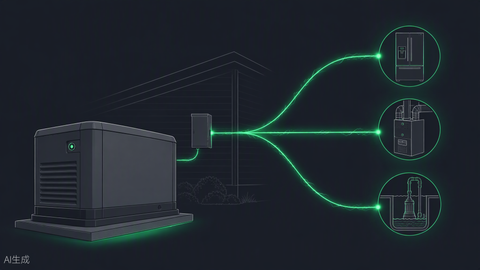
The most bulletproof residential design we deploy isn't battery-only — it's battery-first with a small generator behind it. The battery carries every short outage silently and instantly (no 10-second ATS gap, no fuel runs at hour six), and a modest standby generator or even a portable unit recharges the bank during extended dark stretches. Modern hybrid inverters integrate generator input natively with configurable start logic. Sizing the generator half lives in our generator sizing guide and whole-home generator guide; the kVA/kW math behind it in kVA to kW.
Common Design Mistakes We Unwind
- Sizing to nameplate instead of usable kWh. A "13.5 kWh" battery at 90% DoD delivers ~12.2. Budget degradation: plan year-one capacity at 95% of spec and design autonomy against that.
- Forgetting surge on motors. The well pump or compressor that starts fine on the grid stalls a battery system whose surge rating nobody checked. Soft-starts solve most of this for a few hundred dollars.
- Backing up loads that don't deserve it. Every unnecessary circuit on the critical panel is battery capacity bought and never used. The load-shed conversation is cheaper than the extra battery.
- No recharge math. A 40 kWh bank on a 4 kW array is a one-day battery with a long recovery. Array and storage must be sized as a pair.
- Ignoring temperature. LFP doesn't charge below freezing without heating; garages in cold climates need conditioned enclosures or self-heating battery models.
- Skipping the critical loads panel discipline. "We'll just be careful what's on" fails at 2 a.m. during the actual storm. Physical load segregation is the fix.
Whole-Home vs Critical Loads: The Decision That Sets the Budget
This choice moves the project cost by tens of thousands of dollars, so it deserves a framework rather than a vibe. A critical-loads approach backs up a segregated subpanel — refrigeration, heating fans, lighting, communications, selected outlets, maybe a well pump. A whole-home approach backs up the service, with load management deciding what can run when. The honest comparison:
| Factor | Critical Loads Panel | Whole-Home with Load Management |
|---|---|---|
| Battery needed (typical home) | 10–27 kWh | 27–54+ kWh |
| Inverter requirement | 5–8 kW hybrid | 12–15 kW, often stacked |
| AC and electric cooking in an outage | No (by design) | Yes, managed — smart panels shed them at low state of charge |
| Outage experience | "Essentials mode" — comfortable but deliberate | Nearly normal, with guardrails |
| Installed cost premium | Baseline | +$15,000–$35,000 over critical loads |
| Behavior required during outages | Minimal | Some — heavy loads may defer automatically |
Our default recommendation: critical loads for outage-frequency buyers (a few events per year, hours to a day), whole-home only where the outage pattern is severe or the household has loads that can't shed — medical equipment, home businesses, wells plus septic in flood-prone areas. The middle path that's grown fast: critical loads now, with an inverter and panel architecture that accepts a second battery stack later. Modular LFP systems (EG4, Fortress, Pytes, server-rack batteries) exist precisely for this expansion path.
Load Management: The Software Side of Surviving an Outage
Modern backup systems earn their keep between the panels and the app. The features that matter in an actual outage:
- Reserve settings: The battery holds a minimum state of charge for grid-down events while still arbitraging daily. Set it by your outage risk — 20% in calm seasons, 50–80% when weather is forecast. Good systems automate this with storm-watch modes.
- Load shedding tiers: Smart panels and relay kits (our load management modules) drop big loads at configurable SOC thresholds — water heater at 40%, EV charger at 60%, and so on. This is how a 27 kWh bank impersonates a 54 kWh bank.
- Generator integration: Hybrid inverters with gen inputs start the generator at a set SOC and run it at efficient load to recharge — burning fuel at the generator's best BSFC point instead of idling it against a house load.
- Time-of-use shifting: Outside outage season, the same battery buys cheap and serves peak. On aggressive TOU tariffs this can be $500–$1,500/year — the quiet payback that funds the storm capability.
Installation Logistics: Codes, Clearances, and Permits

Energy storage permitting tightened considerably and 2026 AHJs check specific items:
| Requirement | Source | Field Reality |
|---|---|---|
| UL 9540 listing for the ESS | NEC 706.5 / IFC 1207 | Non-listed battery assemblies get rejected at plan review — verify listing before purchase |
| Clearances (typically 3 ft between units and from openings) | IFC 1207 / manufacturer instructions | Garage wall layouts get tight fast; measure before the truck arrives |
| Vehicle impact protection in garages | IFC 1207.5.3 | Bollards or barriers where the car shares space with the battery |
| Maximum energy per location (often 40 kWh residential indoor without extra measures) | IFC 1207 / NFPA 855 | Big banks may need splitting across locations or fire-rated separation |
| Labeling and emergency information | NEC 706.10, 690.56 | Placards at the service; first-responder shutdown information |
| Interconnection & export limits | Utility tariff | Some utilities cap or forbid export from storage; configure before PTO, not after |
Lifecycle: What Ownership Looks Like at Years 2, 7, and 12
Year 2: The system is invisible — which is the risk. Owners who never check monitoring miss degraded strings and failing CTs. Quarterly production-vs-model checks catch problems while they're warranty-simple. Year 7: Batteries have typically cycled 1,500–2,500 times; a healthy LFP bank shows single-digit capacity loss. Firmware updates have likely added features — worth a review of settings you configured on day one. Year 12: Plan for inverter replacement economics (string/hybrid inverters commonly carry 10–12 year warranties; batteries 10–15). The array itself should be at ~90% of original output and boringly fine. The maintenance habits that get systems to year 12 gracefully are catalogued in battery life extension practices.
Warranty Math: Reading the Cycle-Life Fine Print
Battery warranties quote three numbers that interact: years (usually 10–15), cycles (often 6,000+ for LFP), and end-of-warranty capacity (typically 60–70% of original). The interaction is what matters. A 10-year warranty at 70% retention and 6,000 cycles covers roughly 1.6 full cycles per day, every day, for a decade — deeper daily cycling than most homes will ever do, which means the years and retention terms bind first in practice. Read the throughput clause: some warranties cap total energy throughput (MWh) instead of cycles, and heavy TOU-arbitrage users can hit throughput caps in year seven on a 10-year warranty. Also check what's excluded: most warranties void for ambient temperatures outside rated ranges (another argument for conditioned garages or self-heating models in cold climates), for firmware left un-updated, and for DIY installation where the manufacturer requires certified installers. The modular rack batteries in our server-rack category publish their throughput terms clearly; the integrated appliance-style units bury them deeper. Ask before you sign.
Codes and Chemistry: Why LFP Won the Garage
The market's consolidation on lithium iron phosphate wasn't only about cycle life. Fire codes (NFPA 855, IFC 1207) evaluate energy storage by thermal-runaway behavior, and LFP's thermal stability translates directly into easier permitting, fewer suppression requirements at residential scales, and insurance carriers that don't surcharge the project. NMC retains density advantages where space is the binding constraint, and the integrated premium units built on it carry the UL 9540A test data to prove their mitigation works — but for the detached-garage, wall-mounted, expand-later market that most of our customers live in, LFP's combination of 6,000-cycle life, flat degradation curve, wide temperature tolerance (charging aside), and calm failure mode has made it the default spec. Older chemistries — flooded lead-acid and AGM — still make sense at the budget end of off-grid (see AGM and Trojan deep-cycle lines), accepting the 50% depth-of-discharge ceiling and 5–8 year replacement cycle as the price of a lower entry ticket.
Temperature deserves its own paragraph because it's the most common way storage underperforms its brochure in our region. LFP cells cannot accept charge below freezing without internal heating — BMS protection simply blocks charging, which means an unheated garage bank in a January cold snap can sit at 30% SOC through exactly the storm that brought the outage. Self-heating models solve it for a few hundred dollars of premium; conditioned enclosures solve it for a bit more; ignoring it solves nothing and shows up as the angriest support tickets we see all year. Specify the thermal strategy on the quote, in writing, next to the kWh number.
One more ownership reality that belongs in this section: expansion math changes after install. Batteries installed in the same system but years apart cycle differently, age differently, and in some architectures can't be mixed freely with newer modules. If your plan is "start with 13 kWh, add more later," choose the architecture for the final state — modular rack systems designed for field expansion, with the inverter sized for the future bank, not today's. Retrofitting capacity into a system designed as final is where budgets go sideways; we've watched customers pay more to expand a closed appliance-style unit than the original battery cost, when an open modular design would have taken four more modules and an afternoon. The EG4 vs Powerwall comparison frames exactly this architectural fork, and it's worth reading before the first purchase rather than before the second.
If you take only three numbers from this entire guide, take these: your critical loads' daily kWh (measure, don't guess), your inverter's surge kW against your largest motor, and your array's worst-month harvest against your outage-day consumption. Every backup system that has ever disappointed its owner failed on one of those three numbers, and every one we've designed that started with them has come through its first real outage without a single apology phone call. That's the standard to hold your design — and your designer — to. If a proposal lands without a load audit, a surge analysis, and a worst-month production figure, send it back. The equipment is the easy part; the arithmetic is the engineering, and the arithmetic is what keeps the furnace blower running on the third dark night of the outage that made you buy the system in the first place. Bring us the load list and the address, and we'll run those three numbers with you before any hardware gets quoted — that conversation is free, and it's the cheapest insurance in the whole project. Bring the last two utility bills too; twelve months of usage history beats any questionnaire, and it makes the autonomy conversation concrete instead of theoretical.
Case Study: A Four-Day Outage, Post-Mortem
February ice event, Pacific Northwest: a customer with an 8.5 kW array, a Sol-Ark 8K-class hybrid, and 20.5 kWh of LFP (four stacked 5.12 kWh rack modules) rode out 94 hours grid-down. Critical loads panel: fridge, gas furnace blower, lights, internet, one kitchen outlet circuit — measured 9.8 kWh/day average draw. Daytime solar contribution during the storm: 4–9 kWh/day (heavy overcast, panels partly cleared by the customer on day two). The battery bank cycled between 30% and 80% and never hit reserve floor; no generator was connected. The two lessons the owner reported: the internet staying up mattered more than expected (remote work continued), and the electric range being on the non-backed-up side was the only real lifestyle hit — a $30 induction hotplate on a backed-up outlet solved it on day one. Total fuel burned: zero. That's what correct sizing looks like.
Where to Start

Common Questions About Solar Backup Power
Sequence we'd recommend: run your loads through the battery sizing calculator, sanity-check array size on the solar system calculator, compare battery philosophies on EG4 vs Powerwall, then look at pre-engineered backup kits or energy storage systems — including 10 kWh-class and 15–30 kWh banks. Off-grid properties should start from off-grid kits and the off-grid storage sizing guide.
A Complete Sizing Walkthrough: From Utility Bill to BOM
Putting every step together with one worked home — 2,400 sq ft, gas heat, well pump, Pacific Northwest climate (4.0 peak sun hours annual average, 2.5 in December), utility use 11,400 kWh/year, outage history: two multi-day events in three years.
- Critical loads audit: fridge 1.7 kWh/day, furnace blower 4.8, lights 0.75, internet 1.0, outlets/misc 0.8, well pump 2.2 (40 gal/day × realistic duty) = 11.25 kWh/day outage consumption; coincident peak 3.4 kW, worst surge 7.5 kW (well pump start with blower running).
- Autonomy decision: two days without any solar (dark December storm) → 11.25 × 2 ÷ 0.9 usable = 25 kWh installed battery.
- Inverter: must carry 3.4 kW continuous and 7.5 kW surge → an 8 kW-class hybrid with 12 kW 10-second surge. Fits with margin; a 5 kW unit would not.
- Array recharge check: December production from the existing/planned array: 8 kW × 2.5 PSH × 0.75 system factor = 15 kWh/day worst month — exceeds the 11.25 kWh/day outage draw, so the system is self-sustaining in the worst month. Pass.
- Normal-times value: the same 25 kWh bank does TOU arbitrage and self-consumption the other 363 days, worth roughly $700–$1,100/year on the local tariff.
- Resulting BOM shape: 8 kW array, 8 kW hybrid inverter, 25 kWh LFP (five 5.12 kWh rack modules), critical loads panel, load-management relays for the water heater and dryer. Installed budget: $34,000–$42,000 in 2026 pricing.
Change any input and the design moves: electric heat instead of gas roughly doubles outage consumption and pushes the battery to 40+ kWh or forces a generator; a Florida site with 4.5 December PSH needs less array for the same resilience; a medical-device household skips the autonomy debate and goes straight to three days.
EVs and Backup: Can the Car Help Run the House?
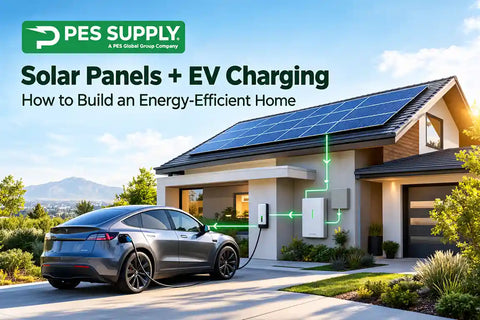
Vehicle-to-home (V2H) is real but narrow in 2026. Bidirectional-capable EVs paired with compatible home integration equipment can contribute meaningfully — a 60–100 kWh EV battery dwarfs any residential battery bank — but the ecosystem is vehicle-, charger-, and utility-specific, and permitting pathways vary by AHJ. Practical guidance: treat EV backup as a bonus layer, not the plan. The dependable architecture remains PV + stationary storage + optional generator; if your next vehicle happens to support bidirectional export through listed equipment, excellent — the EV charger and home fast-charging categories track what's actually shipping. Meanwhile, the disciplined move during outages is the opposite direction: put EV charging on the managed/shed list, because a 7–11 kW car charger will drain a house battery faster than everything else combined.
Solar+Battery vs Generator-Only: The Total-Cost Comparison
| Factor | Solar + Battery (hybrid) | Standby Generator Only |
|---|---|---|
| Upfront (typical whole-home-ish) | $30,000–$50,000 | $10,000–$18,000 (26 kW class installed) |
| Fuel cost per outage day | $0 (solar recharges) | $30–$80 (propane/NG at 50–75% load) |
| Daily value when grid is up | Bill savings / TOU arbitrage every day | None — it waits |
| Switchover | Seamless (ms-scale) — computers never notice | 10–30 second gap |
| Runtime limit | Indefinite if array covers load; battery-limited otherwise | Indefinite with fuel supply (NG) or refills (propane) |
| Maintenance | Minimal | Weekly self-tests, annual service, battery and oil schedule |
| Dark-week winter storms (no solar for days) | Struggles without generator backstop | Excels — this is the generator's home turf |
The mature answer for severe-outage regions is both, and the hybrid inverter makes them cooperate instead of compete. For mild-outage regions where events run hours, not days, the battery-only path wins on daily economics alone.
Frequently Asked Questions
How big a battery do I need? Daily critical-load kWh ÷ 0.9 usable ÷ days of autonomy. Essentials-only for one day: ~12–13.5 kWh installed.
Can it run my whole house? Yes with 27–40+ kWh and a 12–15 kW inverter — but most owners back up critical loads and halve the battery budget.
Grid-tied vs hybrid vs off-grid? Grid-tied backup for bill savings plus outages; off-grid for no-utility independence with big storage; hybrid for the modern default — daily arbitrage plus storm duty.
How long does 13.5 kWh last? 6–12 hours at typical critical-load draw; about a day with solar recharge; 3–4 hours if you run central AC.
Is it worth it? Frequent outages or medical/home-office loads: yes, immediately. Pure bill arbitrage: 8–14 year payback depending on your tariff.
Do I still need a generator? Not for typical grid-tied backup. For multi-day or off-grid resilience, a small generator integrated with the hybrid inverter is the recommended backstop.
Shop Related Products
- Solar batteries and energy storage
- Hybrid inverters
- Battery backup kits
- LiFePO4 batteries
- Standby generators
- Complete solar kits
Sources & Standards
- NFPA 70, National Electrical Code (2023): Articles 690, 702, 705, 706 (energy storage)
- UL 9540 / UL 9540A — energy storage system listing and thermal runaway test data
- Manufacturer datasheets: usable kWh, DoD, surge ratings, cycle-life warranties
- Utility tariff and net metering successor program documentation (state-by-state)