Wholesale Solar Panels: The Complete B2B Procurement Guide for EPCs and Commercial Installers
Tier-1 module sourcing, pallet-level pricing mechanics, credit terms, freight math, and the distributor relationships that keep commercial pipelines moving — from a team that ships wholesale solar every week.

We sell solar panels by the container, the pallet, and the single replacement unit — and the buyers who get the best outcomes at each volume tier behave very differently. The EPC who locks a 2 MW module allocation nine months before mechanical completion operates in a different world than the installer calling us on a Tuesday because a homeowner's HOA finally approved the array and the crew is free Thursday. Both are wholesale buyers. Both deserve real pricing. But the procurement playbook that wins at 2 MW will actively hurt you at 2 kW, and vice versa.
This guide is the playbook we wish every new account read before their first PO. It covers how module pricing actually moves, how to read a datasheet the way a purchasing agent does, how credit and payment terms work at each volume tier, what freight does to your landed cost per watt, and how to structure distributor relationships so your supply holds when the market tightens. If you're sourcing solar panels for commercial work, bookmark this — it's the conversation we'd otherwise have over the first three orders.
I've been on both sides of this table. Early in my career I watched a GC eat a $40,000 liquidated-damages clause because his module supplier slipped delivery six weeks on a school project with a hard August energization date. The panels were $0.04/watt cheaper than the quote I'd given him. That four cents cost him forty grand. Cheap panels are expensive, as the old purchasing saying goes — and nowhere is that truer than in commercial solar procurement.
How Wholesale Module Pricing Actually Works
Spot Pricing vs. Contract Pricing
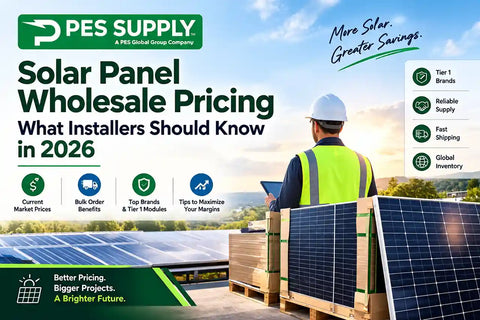
Module pricing is quoted in dollars per watt ($/W), and the number you see advertised is almost never the number you pay — or the number your competitor pays. The spread between a spot-market pallet price and a committed volume contract can exceed $0.10/W on the same module in the same month. Understanding what moves that number is the foundation of procurement.
Four forces drive wholesale module cost:
- Polysilicon and wafer pricing. Polysilicon is the feedstock. When poly runs $8/kg versus $30/kg, module prices move by dimes per watt. You don't need to trade commodities, but you should know which direction the feedstock is moving before you sign a 12-month price lock.
- Cell technology transitions. The industry's shift from PERC to TOPCon — and now early BC (back-contact) volume — reprices everything. When a technology generation matures, the outgoing tech gets cheap fast, and the incoming tech carries a premium that erodes over 12–18 months.
- Tariffs and trade policy. AD/CVD actions, Section 201/301 duties, and UFLPA enforcement can move landed cost on Southeast-Asian modules by double digits overnight. Domestic-content provisions in the IRA added a parallel pricing track for US-made modules that often runs $0.07–0.12/W above imported equivalents.
- Volume and payment terms. This is the lever you actually control. A cash-in-advance container buy and a net-60 pallet buy on the same module can differ by 8–15%.
Wholesale $/W Reference Table by Technology (Q1 2026)
The table below shows realistic wholesale price bands by purchase volume as of mid-2026 for mainstream TOPCon modules in the 570–610 W class. These are representative bands, not a quote — actual pricing moves weekly.
| Purchase volume | Typical $/W band (TOPCon, 570–610 W) | Common payment terms | Typical lead time | Freight basis |
|---|---|---|---|---|
| Single pallet (31–36 modules, ~18–22 kW) | $0.30 – $0.42 | Card / prepay / net-30 established | 3–10 business days (warehouse stock) | LTL, $250–$700 per pallet |
| 5–10 pallets (~100–200 kW) | $0.26 – $0.36 | Net-30 with credit file | 1–4 weeks | LTL or partial FTL |
| Full truckload (~650–800 kW) | $0.23 – $0.32 | Net-30/60, deposit on order | 2–6 weeks | FTL, $1,800–$4,500 per truck |
| Container direct (~620–750 kW per 40'HC) | $0.19 – $0.27 | 30% TT deposit, balance before ship / LC | 6–14 weeks | Ocean + drayage + delivery |
| Annual contract (2+ MW committed) | $0.18 – $0.25 with escalators | Framework agreement, milestone billing | Scheduled quarterly releases | Negotiated delivered price |
Read that table the way a CFO does: the pallet buyer at $0.38/W pays a 60–90% premium over the contract buyer at $0.22/W — but the pallet buyer carries zero inventory risk, zero storage cost, and zero exposure to a price collapse between order and install. Neither is "wrong." The mistake is buying pallet quantities at contract expectations, or signing contract volumes with pallet-level cash flow.
Field note from our warehouse dock
We've unloaded thousands of pallets of modules over the years, and I can usually tell within thirty seconds whether a buyer priced the job right. The tell is the freight question. Buyers who ask "what's the panel price?" and stop there get surprised by a $580 liftgate LTL charge on a residential drop. Buyers who ask "what's my landed cost per watt to this zip code, on this date, with this payment method?" are the ones whose margins survive.
Reading a Datasheet Like a Purchasing Agent
Installers read datasheets for Voc and dimensions. Purchasing agents read them for risk. Both matter. A wholesale module evaluation should score every candidate on the following axes before price even enters the conversation:
| Datasheet field | What installers check | What procurement checks | Red-flag threshold |
|---|---|---|---|
| Module efficiency | Fits the roof / ground area | W/m² affects racking, BOS, labor per kW | Below 20.5% for C&I in 2026 |
| Temp coefficient of Pmax | Hot-climate output | Energy yield over 25 yr, PPA bankability | Worse than −0.35%/°C |
| First-year degradation | Rarely checked | Warranty math starts here | >2.0% (TOPCon should be ≤1.0%) |
| Annual degradation | Rarely checked | Year-25 output guarantee | >0.55%/yr for n-type |
| Product warranty | Years on the brochure | Who stands behind it; claim process; labor coverage | <15 yr product on Tier-1 claims |
| Mechanical load ratings | Snow/wind zone fit | AHJ approval, insurance, racking compatibility | <5400 Pa front / 2400 Pa rear for northern commercial |
| Max system voltage | String sizing | 1000 V vs 1500 V architecture cost | 1000 V-only on utility-scale BOS |
| Bifacial gain spec | Ground-mount yield | Albedo assumptions in the financial model | Unverified bifacial claims without rear-side datasheet |
One line we repeat constantly: wattage is a marketing number; degradation is an engineering number. Two modules both rated 590 W will not produce the same kWh over 25 years, and the delta compounds. A module with 1.0% first-year and 0.40% annual degradation is guaranteed at least 87.4% of nameplate in year 25. A PERC-era module at 2.0% first-year and 0.55% annual is at 84.8%. On a 1 MW site, that 2.6-point gap is roughly 40 MWh of lifetime energy per year of operation by year 25 — real money in any PPA or net-metering model.
If you want to go deeper on the cell architectures behind those numbers, our brand guides break down each manufacturer's platform: JA Solar's DeepBlue TOPCon line, Jinko's Tiger Neo series, LONGi's Hi-MO family with BC cells, and Mission Solar's US-made modules are the four we get asked about most. We also stock Qcells, Silfab, Trina, REC, Aptos, and Axitec for buyers who want alternates in the same performance class.
Tier-1, Bankability, and What Those Words Actually Mean
Tier 1 Classification — What It Means and What It Doesn't
"Tier-1" is a BloombergNEF bankability classification, not a quality grade. It measures whether banks will lend against projects using that manufacturer's modules — based on the manufacturer's financial health and deployed track record. A Tier-1 badge tells you the factory will probably exist in year 12 of your 25-year warranty. It does not tell you the module is well-built; that's what independent testing (PVEL scorecards, RETC reports) is for.
For procurement purposes, we coach buyers to think in three buckets:
The Wholesale Solar Supply Chain — From Manufacturer to Job Site
- Bankable Tier-1 (global top-10 by shipments): Jinko, JA Solar, LONGi, Trina, Canadian Solar. Required for financed C&I and utility projects. Deepest wholesale liquidity — you can always find supply, and you can always sell excess inventory.
- Premium Western brands: Qcells (US/Korea manufacturing), REC, Silfab, Panasonic legacy lines. Higher $/W, strong residential pull-through, easier warranty service for small installers.
- Domestic-content plays: Mission Solar, certain Qcells Georgia production, Solar4America. The 10-point ITC domestic-content adder can pay for the entire price premium on qualifying projects — run the math before dismissing the premium.
The domestic-content math deserves its own paragraph because it's the most-misunderstood number in procurement right now. On a $1.00/W total installed cost commercial project, the ITC at 30% is worth $0.30/W. Qualifying for the domestic-content bonus raises the credit to 40% — $0.40/W. That extra ten cents per watt typically exceeds the entire premium for US-made modules (usually $0.07–0.12/W). In other words, on a qualifying project, domestic modules are effectively cheaper than imports even at a higher sticker price. We walk customers through this calculation weekly, and roughly half the time the "expensive" domestic option pencils better.
Credit, Terms, and the Cash-Flow Side of Procurement
Module price is half the procurement equation. The other half is when the cash moves. Here's how the terms ladder typically works for installer accounts:
| Account stage | Typical terms | What unlocks the next tier | Cash-flow effect |
|---|---|---|---|
| New account | Credit card or prepay | 2–3 clean prepaid orders | 100% cash out at order |
| Established (3–6 months) | Net-30 up to a credit limit | Credit file: trade refs, bank ref, financials | Material lands before cash leaves |
| Volume account | Net-30/60, higher limits | Consistent order history, no slow-pays | Aligns material payment with progress billing |
| Contract / project account | Deposit + milestone billing | Executed framework agreement | Deposits fund allocation; balance at delivery |
The strategic point most installers miss: terms are worth real money, and you should price them. Net-30 terms on a $40,000 module order at a 10% annual cost of capital is worth about $330. Net-60 is worth double that. When you compare distributor quotes, a $0.01/W difference on a 100 kW order is $1,000 — less than the value of a 90-day terms swing. Ask for terms improvements with the same energy you ask for price improvements.
Deposits deserve a caution. On project-scale orders, a 20–30% deposit to lock allocation is standard and legitimate. A 100% prepayment to an entity you haven't traded with before, at a price 20% below market, is how installers get burned in tight markets. We've taken the panicked phone calls after a too-good-to-be-true broker disappears with a deposit — more than once. Verify the entity, verify the inventory physically exists, and never wire full payment against a PDF of a bill of lading you can't independently confirm.
Freight, Landed Cost, and the Math That Decides Where You Buy
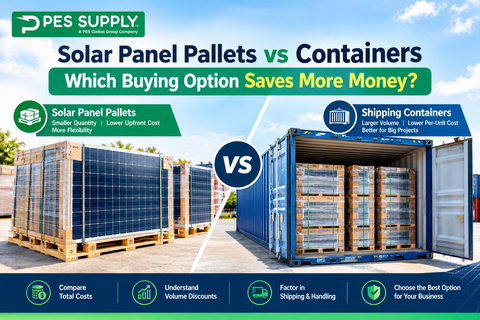
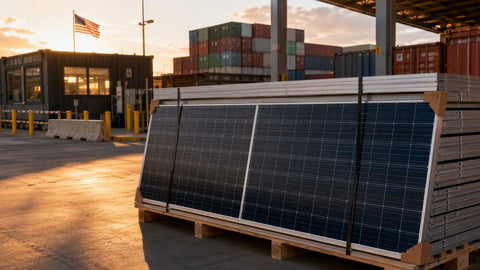
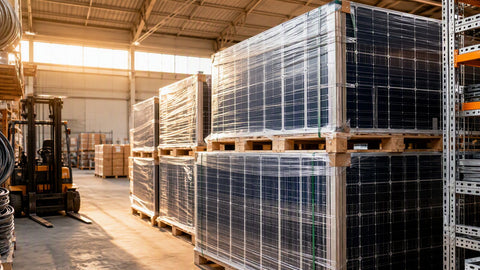
A module is a large, fragile, heavy piece of glass. A standard 580 W pallet holds 31–36 modules and weighs 1,800–2,400 lbs. Freight is never free, and at pallet scale it is a material percentage of landed cost. Our rule of thumb:
- LTL pallet freight: $250–$700 per pallet depending on distance and liftgate/residential surcharges. On an 18 kW pallet, that's $0.014–0.039/W.
- Full truckload: $1,800–$4,500 for 22–26 pallets (650–800 kW), or $0.0025–0.007/W. FTL is 5–10× cheaper per watt than LTL.
- Container direct: ocean + drayage + final delivery commonly lands at $0.008–0.015/W all-in, but adds 6–14 weeks of lead time and port/congestion risk.
| Worked example: 580 W TOPCon, 2 pallets (62 modules, 35.96 kW) | Amount | $/W impact |
|---|---|---|
| Module cost @ $0.34/W | $12,226 | $0.340 |
| LTL freight, 2 pallets, liftgate, 900 miles | $980 | $0.027 |
| Landscaping of cash: card vs net-30 (30 days @ 10% APR) | ~$102 | $0.003 |
| Landed cost per watt | $13,308 | $0.370 |
Now the same modules bought differently: the identical panel at $0.30/W in a full-truckload buy with net-60 terms lands near $0.307/W. Six cents a watt — on this small order alone that's over $2,100, roughly a 17% swing in material cost. This is why we push growing installers toward consolidated buys: either batch your own projects into monthly truckload releases, or buy through a distributor (like us) whose truckload pricing you can access at pallet quantities. Our whole business model exists because that freight math doesn't work for a single installer at pallet scale.
Freight damage protocol matters too. Inspect pallets before the driver leaves. Note any damage on the BOL — "subject to inspection" is not a damage notation. Photograph everything. A documented freight claim recovers cost; an undocumented one is a donation. We replace damaged modules from our own stock when claims get slow, because an installer with a crew standing around can't wait 45 days for a carrier's claims department.
Procurement Workflow: A Repeatable Process for EPCs
The EPCs with the healthiest margins run procurement as a documented process, not a series of phone calls. Here is the seven-step workflow we've seen work at firms installing 5–50 MW/year:
Lock the design basis before you shop
Module wattage class, cell technology, dimensions, and racking compatibility freeze first. Shopping "590 W-class TOPCon" rather than one specific SKU preserves negotiating leverage and protects you against a single-SKU shortage. Cross-reference your racking plan — our racking systems guide covers the clamp-zone and rail considerations that constrain module choice.
Build a three-source RFQ
Quote every material package against at least three channels: your primary distributor, one alternate distributor, and (at scale) one direct/manufacturer channel. Even if you never switch, the quotes keep your primary honest. At PES we expect to be quoted against — that's the business.
Quote landed cost, not panel price
Every RFQ response should be normalized to $/W delivered to the site, including freight, fuel surcharges, liftgate fees, and payment-terms value. The cheapest sticker price routinely loses on landed cost.
Verify allocation, not just availability
"In stock" and "allocated to you" are different states. Get written confirmation of reserved quantity with a hold period. In tight markets, unallocated inventory sells out from under a verbal confirmation in days.
Sequence delivery to the construction schedule
Modules arriving three months early create storage, insurance, and damage risk. Modules arriving late create liquidated damages. Schedule releases against mechanical completion, with a two-week buffer — not against the day you signed the contract.
Document the receiving inspection
Count pallets, photograph labels and serial ranges, note damage on the BOL before the driver leaves. Serial-range documentation also feeds your warranty file and any future insurance claim.
Close the loop with a post-order review
Compare quoted vs actual landed cost, promised vs actual delivery, and damage rate. Feed the results into the next RFQ. Procurement quality compounds; firms that skip this step re-learn the same lessons annually.
BOS, Storage, and the Rest of the Bill of Materials
Modules are 25–35% of a commercial system's material cost. The same procurement discipline applies to the rest of the BOM, and bundling categories with one distributor simplifies freight and terms. The categories we see bundled most effectively:
- Inverters: string inverters for distributed C&I, central or high-power string for larger sites. Browse our inverter catalog and commercial inverter lines; our solar inverter explainer and hybrid inverter guide cover architecture choices.
- Storage: attach rates on commercial solar keep climbing. Pair procurement with battery storage and lithium battery lines, and size systems with our battery bank sizing guide and off-grid storage sizing walkthrough.
- Racking: racking and mounting, IronRidge, Unirac, and SnapNrack cover most roof and ground applications.
- Electrical BOS: wire sizing per our NEC ampacity guide, ampacity charts, conduit fill calculations, and NEC 690 disconnect requirements.
Market Timing: When to Buy in 2026

Module prices follow a seasonal and policy rhythm. The patterns that have held over the last several years:
| Period | Typical price behavior | Procurement posture |
|---|---|---|
| Q1 (Jan–Mar) | Soft; post-holiday inventory flush, factory discounts | Aggressive buying window for stock |
| Q2 (Apr–Jun) | Firming as install season ramps | Lock Q3 needs by late May |
| Q3 (Jul–Sep) | Peak demand; spot premiums on popular SKUs | Buy from allocation, not spot |
| Q4 (Oct–Dec) | Mixed; year-end ITC deadlines pull demand, factories clear lines | Opportunistic buys on outgoing wattage classes |
Policy overlays can swamp the seasonal pattern. Tariff rulings and tax-credit guidance move prices more than seasons do. Assign someone on your team to track trade actions and IRS guidance, or lean on a distributor whose procurement desk does it for you. Our commercial installation cost breakdown gets updated as these inputs shift, and it's a reasonable proxy for which way the wind is blowing.
Common Procurement Mistakes (And What They Cost)
The five most expensive mistakes we see installers make
1. Buying on sticker price instead of landed $/W. 2. Locking a specific SKU instead of a spec class, then paying a ransom when that SKU goes short. 3. Wiring large prepayments to unverified sellers in tight markets. 4. Accepting delivery without documenting damage on the BOL. 5. Ignoring payment-terms value when comparing quotes. Each of these routinely costs more than the entire price delta between competing quotes.
I'll add a sixth from personal experience: treating your distributor as an adversary instead of an information source. The installers who call us in February to talk through their year get first call when a distressed container of 585 W panels shows up at $0.04 under market. The installers who only call to beat us up on price get quoted list. That's not spite — it's just how humans allocate scarce inventory. Procurement is a relationship business wearing a spreadsheet costume.
Inventory Strategy: How Much Module Stock Should You Hold?
Once a firm crosses roughly ten installs a month, the make-or-buy inventory question arrives. Hold too little stock and every job carries freight premiums and schedule risk; hold too much and working capital sits in a warehouse depreciating against falling module prices. The framework we coach:
- Fast-mover stocking rule: stock only the one or two module SKUs that make up 70%+ of your volume, in the wattage class your market actually buys. Everything else flows through distributor stock per job.
- Days-of-cover target: 3–5 weeks of consumption for your fast-mover. Beyond that, price erosion (module prices historically decline several percent per quarter) eats the freight savings you bought with volume.
- Safety stock for commitments: any module promised to a signed contract within 60 days should be in your warehouse or in written allocation — not "expected."
- Never speculate: buying extra containers because "prices will rise" is a trading position, not procurement. We've watched installers become accidental module dealers twice in five years; both times ended with discounted liquidation.
| Inventory policy (installer at ~40 kW/week module consumption) | Working capital tied up | Freight savings vs per-job LTL | Price-erosion risk exposure | Verdict |
|---|---|---|---|---|
| Pure just-in-time (buy per job) | ~$0 held | None — pays $0.02–0.04/W LTL | Minimal | Right answer under ~10 installs/month |
| 3-week cover, 2 SKUs (~120 kW) | ~$33,000 @ $0.28/W | Saves $0.015–0.03/W via FTL | ~1%/quarter on held value | Sweet spot for most growing installers |
| 8-week cover, 4 SKUs (~320 kW) | ~$90,000 | Marginal additional savings | Doubled erosion exposure + storage cost | Only with contracted backlog to consume it |
| Speculative container buy (~700 kW) | ~$150,000+ | Best per-watt freight | Full market exposure | Don't, unless it's pre-sold |
The hidden cost in that table is storage and handling. Modules need dry, flat, indoor storage; pallets shouldn't be stacked more than two high unless the manufacturer explicitly allows it; and every forklift touch is a damage lottery ticket. Budget $0.003–0.008/W per month of hold for space, insurance, and damage allowance, and inventory math gets honest fast.
Incoterms and Import Mechanics for Direct Buyers
If you do graduate to container-direct buying, the vocabulary matters because it allocates risk. The three terms you'll actually encounter:
- FOB (port of origin): you own the risk once the container crosses the ship's rail. You book and pay ocean freight, insurance, and everything after. Cheapest headline price, most work, most risk — appropriate only with a freight forwarder you trust.
- CIF (your destination port): seller covers freight and insurance to the port. You handle customs, duties, drayage, and final delivery. The common middle ground for first-time direct buyers.
- DDP (delivered duty paid): seller delivers to your door, duties paid. Simplest and most expensive; also the one where you must verify the seller actually cleared customs properly, because UFLPA detention risk doesn't disappear just because someone else filed the paperwork.
Two hard-won cautions. First, tariff exposure is a moving target: a container quoted before an AD/CVD determination can land after it, and the duty bill follows the entry date, not the order date. Second, detention and demurrage — port storage and container-use fees — turn a cheap container expensive when a trucker misses an appointment. Build $500–$1,500 of slack into every container budget for port friction, and you'll rarely be surprised.
For most installers reading this, the correct conclusion is: buy domestic warehouse stock from a distributor until your annual volume demonstrably justifies direct, then start with one CIF container of your single fastest SKU. The distributors (us included) exist to absorb exactly the risks described above, and the $0.03–0.05/W premium for warehouse stock is often the cheapest insurance policy in your supply chain.
Supplier Diversification and Risk Management
The procurement failures that hurt most aren't price failures — they're supply failures. A single-source dependency feels efficient until the source stumbles: a factory retooling, a logistics strike, an allocation cut when demand spikes, or a credit insurer quietly reducing the manufacturer's limits. The resilient posture for a mid-size installer looks like this: one primary distributor carrying 60–70% of volume, one secondary distributor at 20–30% kept warm with regular orders, and one direct or manufacturer relationship tested annually with a real purchase. Keeping the secondary warm costs you a little margin; discovering it's cold during a shortage costs you a project.
Brand diversification deserves the same treatment. Spec'ing a spec class ("580–600 W TOPCon dual-glass, Tier-1") instead of a single SKU lets you swap between Jinko, JA Solar, and Trina mid-pipeline when one tightens. The discipline required is in the engineering documents: keep module-specific values out of structural and electrical design until procurement locks the SKU, and note the acceptable alternates in the spec. We've seen a project re-permit because a module substitution changed the plan set — an entirely self-inflicted wound that a spec-class approach prevents.
Reading the Contract: Terms That Bite Later
Wholesale module contracts contain a handful of clauses that deserve redline attention before signature. Price-adjustment clauses tied to index movements can reopen "locked" pricing — cap the adjustment band or tie it symmetrically. Delivery windows written as "estimated" are not commitments; negotiate a firm window with remedies, or at minimum a cancellation right with deposit return if the window slips past a defined date. Damage and title transfer points determine who eats a destroyed pallet — know whether risk passes at origin dock or your dock. And force-majeure language has expanded since 2020; read what's actually excused.
One clause installers rarely negotiate but should: restocking terms. Pipeline reality means projects die after modules are ordered. Knowing whether a cancelled order returns 100%, 85%, or nothing changes how aggressively you can pre-buy. Distributors vary enormously here, and it's a better negotiating target than another half-cent per watt, because you only need it when things have already gone wrong.
Finally, keep a paper trail culture. Every verbal commitment — allocation holds, price locks, delivery promises — gets a same-day confirming email. The procurement professionals we admire aren't the ones with the best memories; they're the ones whose inboxes are the memory. When a dispute arrives eighteen months later, the person with the email wins.
The Landed-Cost Master Checklist
Before any module purchase order leaves your desk, every line in this checklist should have a number or an answer. Installers who institutionalize this list stop having procurement surprises:
| # | Checklist item | Where it bites if skipped |
|---|---|---|
| 1 | Landed $/W computed including freight, surcharges, and liftgate | "Cheap" quotes that lose by $0.03/W after freight |
| 2 | Payment-terms value priced at your cost of capital | Ignoring $300–600 of value on mid-size orders |
| 3 | Written allocation confirmation with hold period | Inventory sold out from under verbal confirmations |
| 4 | Delivery window matched to construction schedule + buffer | Storage cost on early arrivals; LD exposure on late ones |
| 5 | Datasheet verification of the exact SKU (not the family brochure) | Spec drift between generations with similar names |
| 6 | Lender/AHJ acceptance confirmed for financed or permitted work | Mid-project brand swaps that re-open engineering |
| 7 | Racking compatibility checked: frame dims, clamp zones, load ratings | Field modifications that void module warranty |
| 8 | Damage claims process and timeline confirmed in writing | 45-day carrier limbo with a crew waiting |
| 9 | Serial documentation plan at receiving | Unprovable warranty claims years later |
| 10 | Restocking and cancellation terms known before order | Dead projects turning into owned inventory |
Print it, laminate it, hang it by the purchasing desk. Every item on that list is in there because someone — often us — paid tuition to learn it.
A closing note on ethics in the channel: the wholesale market periodically surfaces "deals" on modules of murky provenance — rebranded B-grade stock, panels with scraped serials, warranty-void gray imports. The prices are tempting and the risks are total: no warranty, potential UFLPA exposure, and in scraped-serial cases, potential possession of stolen goods. The verification habit costs nothing: buy through authorized channels, confirm the distributor's authorization status with the manufacturer when in doubt, and treat any price 25%+ under market as a prompt for questions, not a purchase order. We turn down brokered stock that can't document provenance; you should too.
Working with PES as Your Procurement Partner
A word on how we run our side of this relationship, since transparency is cheaper than salesmanship. PES Supply stocks modules across the major Tier-1 brands plus domestic options, prices pallet-to-truckload with landed-cost quotes as standard practice, confirms allocation in writing, and runs replacement-module cross-referencing for repair work. Our procurement desk tracks tariff and policy movement so customers get a heads-up before price-impacting events, not after. Dealers graduate to net terms on a standard credit review, and project volumes get milestone billing structured around construction draws.
What we ask in return is equally plain: forecasts. The installers who share their 90-day pipeline get better allocation, better pricing, and first call on opportunistic buys — the distressed container, the cancelled-project surplus, the factory overstock at a discount. Procurement is a two-sided information market, and the dealers who treat it that way consistently land three to five cents ahead of the ones who treat every order as a hostage negotiation. That, in the end, is the whole secret: the spreadsheet shows you the score, but the relationship decides how the game gets played.
Seasonality applies to inventory too: the installers who build stock in Q1's soft pricing window and draw it down through the Q3 peak consistently beat both the just-in-time buyers (who pay peak-season spot premiums) and the year-round stockpilers (who pay carrying costs in the off-season). Procurement calendars are free alpha; almost nobody uses one.
Financing Modules: Cash, Credit Lines, and Floor Planning
Warranty Structures in B2B Solar Procurement
Beyond distributor terms, three financing structures show up in module procurement, and each has a real cost that belongs in your landed-cost math. Cash purchases earn the best pricing — typically 1–3% early-payment discounts where offered — but consume working capital that might earn more deployed in crews and trucks. Business lines of credit at 8–12% annualized convert to roughly 0.7–1.0% per month of carry; holding $50,000 of modules for 60 days on a line costs about $700–1,000, which frequently exceeds the volume discount that justified the stock. Floor-plan financing (inventory-specific credit secured by the inventory itself) exists in solar through specialty lenders and some manufacturer programs; it smooths cash flow for growing installers but adds administrative overhead and audit requirements that make it a poor fit below roughly $1M in annual material volume.
The rule we share: match the financing term to the consumption rate. Material that ships to a job within 30 days belongs on distributor terms or a card; strategic stock held 60–120 days belongs on a line you've already priced; and anything longer means you're running an inventory business inside your installation business — make sure the margin math knows it.
Frequently Asked Questions
What Drives Wholesale Solar Panel Prices in 2026
Bulk Solar Panel Pricing Tiers at PES
Top Wholesale Solar Panel Brands Available at PES
What is the minimum order for wholesale solar panel pricing?
True wholesale pricing generally starts at pallet quantity — 31 to 36 modules, roughly 18–22 kW depending on wattage class. Below pallet quantity you're paying retail-adjacent prices plus disproportionate freight. Most distributors (PES included) will sell single modules for replacements and small additions, but the $/W is meaningfully higher. If your projects don't naturally batch to pallet scale, ask about will-call consolidation with other orders.
How do I qualify for net-30 terms with a solar distributor?
Expect to provide three trade references, a bank reference, and sometimes financial statements. Most distributors want 2–3 clean prepaid or card orders first, then open a modest net-30 limit that grows with payment history. The fastest path: pay every invoice early for six months, then ask for a limit increase and extended terms in the same conversation — that request is almost always granted to clean payers.
Is it cheaper to buy containers direct from the manufacturer?
At steady volumes above roughly 1–2 MW per year, yes — direct container pricing can run $0.03–0.06/W below distributor truckload pricing. Below that volume, the answer is usually no once you add working-capital cost, 6–14 week lead times, damage claims handled solo, and the loss of mixed-SKU flexibility. Most installers under 5 MW/year land cheaper through a distributor even at a nominally higher panel price.
What does "bankable" mean and why do lenders care?
Bankability is a lender's judgment that a module manufacturer will survive to honor its 25–30 year warranty. Lenders typically require BloombergNEF Tier-1 status or equivalent for financed projects. If you're building merchant or PPA-financed C&I, confirm the module brand with your lender's engineering advisor before issuing a PO — swapping brands mid-project is painful and sometimes impossible.
Should I buy domestic modules for the ITC adder?
How to Choose the Right Solar Panels for Commercial Projects
Run the math per project. The domestic-content bonus adds 10 percentage points to the ITC (30% → 40%). On a typical commercial install that's worth $0.08–0.12/W of tax credit, often more than the domestic price premium. But "domestic content" is calculated on total manufactured-product cost, not just modules — your tax counsel should confirm qualification before you pay the premium. We stock US-made options from Mission Solar and Solar4America for exactly these projects.
How far ahead should commercial modules be ordered?
From distributor stock: 2–4 weeks ahead of need. On allocation or project pricing: 8–12 weeks. Container direct: 14–20 weeks including ocean transit and customs. Whatever the channel, sequence delivery to mechanical completion with a two-week buffer, and never schedule crane day tighter than a confirmed delivery appointment plus one weather day.
One last procurement truth from twenty-plus years of watching this market: the buyers who do best are rarely the ones who squeeze the hardest on any single order. They're the ones whose suppliers pick up the phone on the first ring in a shortage, because a decade of straight dealing built credit that no line of credit can buy. Reputation is an inventory item. Stock it accordingly.
Source Your Next Project with PES Supply
Pallet to truckload pricing on Tier-1 modules, net terms for qualified accounts, and a procurement desk that answers the phone. Send us your BOM for a landed-cost quote.
Shop Commercial Solar Panels →The checklist and the contract rules share one root principle: procurement quality is process quality. None of the steps in this guide require special talent — they require repetition. The EPC that runs the same ten checks on every PO for five years will outperform the one that improvises brilliantly on each order, because solar procurement punishes variance harder than it rewards genius. Build the process once, run it every time, and let the compounding do the work.
Related resources: Solar panel kits buyer's guide · Solar panel wiring basics · PV wire selection guide · Grounding & bonding per NEC 690.43/250 · Commercial category
Good hunting — and when the next container question, allocation scramble, or landed-cost puzzle lands, the procurement desk answers the phone on the first ring, every business day, with current pricing in hand.
PES Supply (https://www.portlandiaelectric.supply) is a B2B electrical and solar distributor offering 50,000+ SKUs from 169 authorized brands. Pricing bands in this guide are representative market ranges as of August 2026, not quotes; verify current pricing and all specifications before purchase.