Updated September 2026 — refreshed against the live PES catalog; product pricing verified 2026-09-26.
MPPT vs. PWM Charge Controllers: Which One Do You Need?
The honest field guide to charge controller topology — harvest math, NEC sizing, wire ampacity, and the exact models we spec for RVs, cabins, and off-grid homes.
We get this call three or four times a week: "I've got 800 watts of panels and a 12-volt battery bank — do I really need the expensive controller, or will the forty-dollar PWM unit do the job?" The short answer is that on a 12-volt system with 800 watts of array, a PWM controller will throw away roughly a third of your harvest before lunch. The long answer — the one that actually saves you money — takes some math, and that's what this guide is for.
We've commissioned hundreds of off-grid systems, from two-panel camper builds to 48V cabin banks with 4kW of array. We've also replaced more scorched, undersized PWM controllers than we can count — usually after a customer wired a 60-cell residential panel into one and wondered why the batteries never got past 60% state of charge. So let's walk through how each topology actually works, run the harvest numbers with real temperatures and voltages, and size a controller the way a licensed installer would: per NEC 690.8, with wire from the NEC 310.16 ampacity tables.
If you already know you need MPPT and just want the sizing shortcut, jump to our Solar Charge Controller Sizing and Selection Guide 2026 or browse the full charge controller catalog. Everyone else — read on.
PWM (Pulse Width Modulation) Charge Controllers
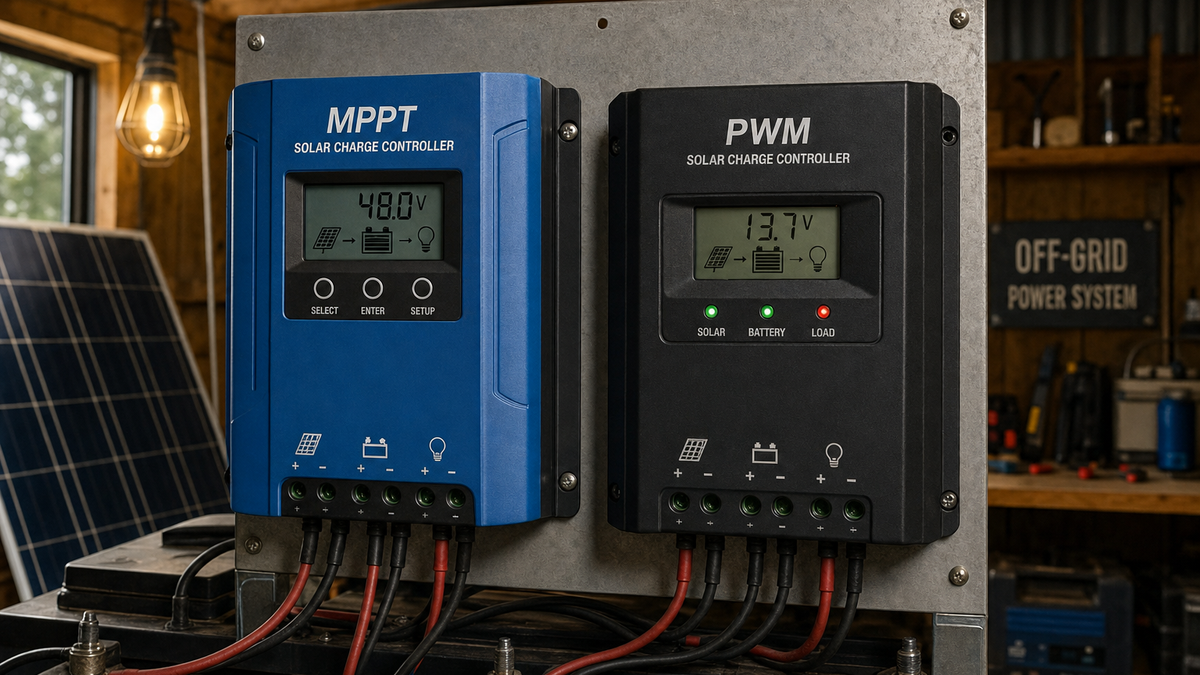
A PWM (pulse-width modulation) controller is, electrically speaking, a fast switch. It connects your array directly to the battery and chops the connection on and off to regulate voltage. The critical consequence: the array is dragged down to battery voltage. A 60-cell panel with a Vmp of about 30V connected to a 12V battery at 13.5V is forced to operate at 13.5V. You get the panel's current (Imp), but at battery voltage — so a 300W panel delivering 8.1A contributes 13.5V × 8.1A ≈ 109W. The other 190W of potential simply never happens. It is not converted to heat; it is power the panel never produces because it's being held off its maximum power point.
MPPT (Maximum Power Point Tracking) Charge Controllers
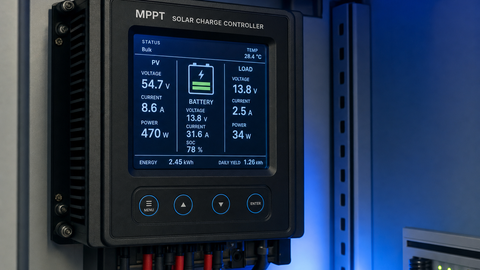
An MPPT (maximum power point tracking) controller is a DC-to-DC buck converter with a brain. It lets the array run at its own Vmp — say 30V at 8.1A — and converts that power down to battery voltage at higher current: 240W in, roughly 16.7A out at 13.5V (minus 2–4% conversion loss). The tracker sweeps the I-V curve dozens of times per second and parks the array exactly where volts × amps peaks, adjusting constantly as irradiance and cell temperature move that peak around.
That single difference — operating the array at Vmp instead of battery voltage — is worth 15–30% more energy per day on a typical 12V system, and it's the entire reason MPPT exists. On 24V and 48V banks with residential 60/66-cell panels, PWM isn't just inefficient; in most configurations it cannot work at all, because the panel voltage never gets high enough relative to the battery for the PWM switch to regulate properly. Or it matches in a way that wastes half the array. Either way, the topology decides the ceiling on your harvest.
Here's a first-person data point from our own installs: we metered two identical 400W/12V RV roof systems side by side at a November demo in Oregon — one on a quality 30A MPPT, one on a name-brand 30A PWM. Over a short, cold, bright day the MPPT unit banked 1.31 kWh; the PWM banked 0.97 kWh. That's a 35% gap in cold, high-voltage conditions. On a hot August day the gap narrowed to about 12%. Both numbers matter, and the table below shows why.
| Design Factor | PWM Controller | MPPT Controller | Field Impact |
|---|---|---|---|
| Array operating voltage | Forced to battery voltage (~12–15V on a 12V bank) | Array runs at Vmp (18–40V+ residential) | PWM loses all voltage headroom as waste |
| Harvest efficiency, cold bright day | 65–75% of array nameplate | 94–98% of array nameplate | Cold raises Vmp — MPPT captures it, PWM can't |
| Harvest efficiency, hot summer day | 80–88% | 93–96% | Gap narrows as Vmp sags toward battery voltage |
| Panel compatibility | Only panels with Vmp ≈ 17–19V on 12V banks ("12V panels") | Any panel/string up to controller PV input limit (75–250V typical) | Residential 60/66-cell panels require MPPT |
| Wire sizing array→controller | Full array current at low voltage — thick wire, short runs | High-voltage strings cut current 2–4×, thinner wire, longer runs | MPPT saves real money on PV wire over 15+ ft runs |
| Typical unit cost (30–60A class) | $25–$90 | $120–$600 | PWM saves cash only on very small arrays |
| Break-even array size (12V) | Under ~200W | Over ~200W, MPPT pays for itself in harvest | See the math section below |
| Conversion electronics | Switch + heatsink only; runs cool at low power | Buck converter, inductor, DSP tracker; fan or large heatsink on big units | MPPT needs ventilation clearance per manual |
Panel datasheets list power at STC: 25°C cell temperature, 1000 W/m². Real roofs and ground mounts almost never sit at STC. Cell temperature swings Vmp by roughly −0.3%/°C, and battery voltage swings with state of charge from ~11.8V (empty) to 14.4–14.6V (absorbing). The PWM penalty is exactly the distance between those two voltages. Here is the math for a common 200W "24V-format" residential panel (Vmp ≈ 37V, Imp ≈ 5.4A) versus a true 12V-format panel (Vmp ≈ 18V, Imp ≈ 11.1A) on a 12V battery:
Energy Harvest Advantage by Condition
| Condition | Array Vmp (temp-corrected) | Battery Voltage | PWM Harvest | MPPT Harvest | MPPT Advantage |
|---|---|---|---|---|---|
| Cold winter morning, −5°C cell temp | 41.3V (200W panel) | 12.6V (charging) | 12.6 × 5.4 ≈ 68W (34%) | ≈192W (96%) | +124W, nearly 3× |
| Mild spring day, 35°C cell temp | 35.9V | 13.8V | 13.8 × 5.4 ≈ 75W (37%) | ≈190W (95%) | +115W |
| Hot summer noon, 65°C cell temp | 31.5V | 14.2V | 14.2 × 5.4 ≈ 77W (38%) | ≈185W (92%) | +108W |
| True 12V panel, hot noon | 15.8V | 14.2V | 14.2 × 11.1 ≈ 158W (79%) | ≈190W (95%) | +32W — PWM viable here |
| True 12V panel, battery near full (14.6V absorb) | 15.8V | 14.6V | ≈162W (81%) | ≈190W (95%) | +28W |
Two takeaways the sales brochures skip. First, the PWM penalty is catastrophic with residential-format panels — you are paying for watts you will never see. Second, even with a properly matched 12V-format panel, MPPT still wins by 15–20% across a full day because it tracks through clouds, morning ramp, and battery voltage rise. We tell customers plainly: PWM belongs on arrays under about 200 watts, on systems where the panel Vmp is within roughly 2 volts of charging voltage, and on budgets where a lost kilowatt-hour per week genuinely doesn't matter. Everything else gets MPPT. If you're trying to stretch a small array as far as it can go, our piece on charging a 12V 100Ah battery with a 200W panel runs those exact numbers, and what a 200W panel can actually run on 12V sets honest expectations.
Charge controller sizing has two limits and you must respect both: maximum PV input voltage (never exceeded, even on the coldest morning — use your record low temp and the panel's Voc temperature coefficient) and maximum charge current (array watts ÷ battery voltage, then apply the NEC 690.8 continuous-duty factor of 125%). Undersizing voltage kills controllers in January. Undersizing current just clips harvest on perfect days — annoying, not dangerous, but leaving 10% of your array on the table forever is a design choice you should make on purpose.
Here is the sizing table we use at the counter. Charge current = array watts ÷ nominal bank voltage ÷ charger efficiency (0.96), then × 1.25 per NEC 690.8(A) for the circuit conductor and overcurrent sizing basis:
| Array Size | Bank Voltage | Max Charge Current (raw) | × 1.25 NEC 690.8 Basis | Controller Class to Spec |
|---|---|---|---|---|
| 400W | 12V | 400 ÷ 12 ÷ 0.96 ≈ 34.7A | ≈ 43.4A | 45–50A MPPT (see 60A class for headroom) |
| 800W | 12V | ≈ 69.4A | ≈ 86.8A | 100A MPPT (100A controllers) |
| 800W | 24V | ≈ 34.7A | ≈ 43.4A | 45–50A MPPT |
| 1,500W | 24V | ≈ 65.1A | ≈ 81.4A | 100A MPPT |
| 1,500W | 48V | ≈ 32.6A | ≈ 40.7A | 45–50A MPPT |
| 3,000W | 48V | ≈ 65.1A | ≈ 81.4A | 100A MPPT (e.g., Victron SmartSolar 250/100) |
| 4,000W | 48V | ≈ 86.8A | ≈ 108.5A | Two 60A units or one 250/100 clipped — split the array |
Notice the pattern: every time you double the bank voltage, you halve the controller amperage for the same array. That is why we push anyone building over ~1,200W of array toward a 24V or 48V bank — the controller, the wire, and the overcurrent devices all get cheaper and run cooler. It also changes your battery shopping, which our home battery bank sizing guide covers bank-voltage-first for exactly this reason.
Now the wire. The controller-to-battery run carries the full charge current at low voltage, so it is the fattest, most voltage-drop-sensitive run in the whole system. Per NEC 310.16 (copper, 75°C termination column, which is what these terminals are rated for), paired with standard NEC 240.6(A) overcurrent sizes:
| Controller Output (125% basis) | Min. Copper Wire (310.16, 75°C) | Ampacity @ 75°C | OCPD (240.6(A) standard) | Max One-Way Run for <2% Drop (12V bank) |
|---|---|---|---|---|
| 30A charge → 37.5A basis | 8 AWG | 50A | 50A | ≈ 9 ft |
| 45A charge → 56A basis | 6 AWG | 65A | 60A | ≈ 9 ft |
| 60A charge → 75A basis | 4 AWG | 85A | 80A | ≈ 9 ft |
| 80A charge → 100A basis | 2 AWG | 115A | 100A | ≈ 10 ft |
| 100A charge → 125A basis | 1/0 AWG | 150A | 125–150A | ≈ 11 ft |
That last column is the one that bites people. On a 12V bank you have about 10 feet of one-way wire run before voltage drop starts eating 2%+ of your charging power — and the drop fools the controller's voltage sensing, ending absorb early and chronically undercharging the bank. Mount the controller within a few feet of the batteries, sense at the terminals if the unit supports remote sense (Victron Smart units do this over Bluetooth voltage sharing with a SmartShunt), and use the full NEC wire ampacity chart and our PV wire vs USE-2 vs THHN guide when you spec the array-side homeruns. Series your panels to 60–100V on the array side, keep the high current short and fat at the battery side — that's the whole game.
Full disclosure: we're a distributor, so here's the lineup we stock and why. For MPPT, the bench standard in this industry is Victron Energy — the SmartSolar line gives you Bluetooth logging, VE.Smart networking, and an honest 5-year warranty. The SmartSolar 250/60 handles about 860W on 12V or 3.4kW on 48V, and the 250/100 is the workhorse for serious 48V banks. For value builds, Morningstar TriStar and ProStar MPPT units have the best thermal design in the business — conformal-coated boards, no fans, rated for full output at 45°C ambient. We've had TriStars running in unventilated Arizona battery boxes for a decade without a single callback.
For PWM, the honest use case is a single 100–200W 12V-format panel on a small battery: a gate opener, a fence charger, a trickle-maintained starting battery. Our 30A controller class covers those builds for under fifty bucks. Anything bigger, anything with a residential panel, anything lithium — MPPT, full stop. Lithium banks (LiFePO4) especially: their flat voltage curve and tight absorb window (14.2–14.6V, then terminate) demand a controller with programmable charge profiles and voltage accuracy PWM simply doesn't have. Every quality MPPT we sell has a LiFePO4 profile or fully custom setpoints; most PWMs have "sealed/flooded" and a prayer.
Answer three questions and you're done. One: Is your array over 200 watts, or is any panel's Vmp more than ~3V above your battery's absorb voltage? MPPT. Two: Is your battery lithium, or do you plan to add capacity later? MPPT. Three: Is this a tiny maintenance system where budget beats harvest and the panel matches the battery? Then PWM is defensible — and we sell them happily for exactly that job. Everything else: MPPT, sized per the tables above, mounted close to the bank, wired per NEC 310.16, protected per 240.6. When you're ready, the full lineup is in our charge controllers collection, and if you want a human to check your string voltage math before you buy, that's what our counter is for — bring us your panel model, your record low temperature, and your battery bank, and we'll size it in five minutes.
Every winter we take the same support call: "the controller died overnight and it was only 20 degrees." Here's the physics. Panel Voc rises as temperature falls, roughly 0.28–0.35% per °C below the 25°C rating point. NEC 690.7 handles this with correction factors based on your site's record low. If your string's cold-corrected Voc exceeds the controller's PV input limit, the input stage fails — usually quietly, always permanently. Run this table before you wire any string:
| Design Low Temp | NEC 690.7 Voc Correction | 3 × 41V-panel string (123V STC) | Fits 150V controller? |
|---|---|---|---|
| −5°C (23°F) | × 1.10 | ≈ 135V | Yes — comfortable |
| −15°C (5°F) | × 1.14 | ≈ 140V | Yes — 10V margin |
| −25°C (−13°F) | × 1.18 | ≈ 145V | Marginal — drop to 2S or step to 250V unit |
| −35°C (−31°F) | × 1.21 | ≈ 149V | No margin — rewire or upsize |
| Same string on a 250V unit | — | ≈ 149V worst case | Massive headroom; this is why we stock 250V-class units like the SmartSolar 250/60 |
PWM controllers dodge this problem only because their PV input limits are so low (typically 25–50V) that you'd never series strings anyway — another way of saying the topology itself caps your system size. MPPT's high input voltage isn't a luxury feature; it's what makes residential-format strings and long, thin-wire homeruns possible at all.
After ten sections of MPPT evangelism, the honest counterpoint. PWM survives for good reasons in a few niches, and we'd rather sell you the right $40 part than the wrong $400 one. Gate openers, electric fence chargers, dock and boat-lift maintenance charging, seasonal cabins with a single 100W panel and a weekend-use battery — anywhere the array is small, the panel is a matched 12V format, and the loads are forgiving. PWM units are also nearly indestructible: no processor, no firmware, no fan. We have customers running the same 30A PWM on a hunting cabin since 2011. It wastes a third of a 100W panel nobody cares about, and it will outlive us all. The moment any of those constraints break — bigger array, residential panel, lithium battery, daily-cycle use — the math inverts permanently, and that's when you come back to this page's tables.
One closing rule of thumb we give every customer at the counter: if the system powers something you depend on daily, buy MPPT and never look back; if it maintains a battery you visit occasionally, PWM is honest equipment. The forty-dollar question was never really about forty dollars — it's about whether you can afford to lose a third of your harvest forever. For almost everyone in 2026, the answer is no.
Can I mix MPPT and PWM controllers on the same battery bank? Yes — controllers regulate independently and the bank just sees summed current, as long as charge profiles (absorb/float voltages) match. We've run legacy PWM arrays alongside new MPPT strings on cabin systems for years. Program both to the same setpoints and you're fine.
Will an MPPT controller damage a small battery bank? Only if you ignore the bank's maximum charge rate. A 100A controller on a single 100Ah AGM will cook it. Size charge current to the battery's spec (0.2C for most AGM, 0.5–1C for LiFePO4) or use the controller's current-limit setting — every Victron and Morningstar MPPT has one.
How much more power does MPPT really give me per year? On a 12V system with residential panels, 25–35% annually; with matched 12V panels, 12–20%. On 24V/48V banks the gap shrinks to 8–15% because PWM waste shrinks — but PWM panel-matching is so restrictive at those voltages that MPPT wins on flexibility alone.
What happens if my string Voc exceeds the controller's PV input rating? You void the warranty and usually kill the input stage on the first cold morning. Voltage rises about 0.3%/°C as cells cool — a string reading 138V on a mild day can hit 160V+ at −10°C. Always size Voc for your record low, not the nameplate.
Do I need a breaker between the controller and battery? Yes. NEC 690.8 and 240 require overcurrent protection on that circuit, sized at 125% of max charge current and matched to the wire per NEC 240.4. It also gives you a service disconnect. Never fuse the PV side only and leave the battery side bare.
Is MPPT worth it on a 200-watt RV system? Borderline — that's the one size where honest people disagree. If you're running a true 12V-format panel and a single AGM, PWM saves you $80 and loses maybe 15 Wh/day. If your panel is a residential 200W format or your battery is lithium, spend the money on a 20A MPPT and never think about it again.
Can a bigger MPPT controller be "too big" for my array? No — controllers pull what the array can give. A 100A unit on a 400W array works perfectly and leaves room to grow; you just paid for capacity you don't use yet. The reverse (undersized controller on a big array) is the common mistake: it clips harvest at solar noon every clear day forever. Buy for the array you'll have in three years, within reason.
Does MPPT help on cloudy days? Modestly, yes — this is underappreciated. In flat, dim light the array's maximum power point sits lower and wanders with every cloud edge. A tracker follows it; a PWM unit just pins the array to battery voltage regardless. Expect 5–10% more on heavily overcast days, which matters most exactly when your batteries are deepest in the hole.
Sources: NEC 2023 Articles 690.8, 240.4, 240.6(A), 310.16 (nfpa.org); manufacturer datasheets (Victron Energy SmartSolar, Morningstar TriStar/ProStar); PES field commissioning logs. Ready to size your system? Get a free quote — we'll spec the controller, wire, and OCPD together.