Ampacity — the maximum current a conductor can carry continuously without exceeding its temperature rating — is the number that decides every wire purchase. This reference puts the NEC 310.16 ampacities for the most common building wire (THHN/THWN-2, copper and aluminum) in one chart, explains the termination-temperature rule that overrides the table in real installs, and shows worked examples including the question we hear weekly: what size wire do I need for my generator?
Wire Ampacity Calculator
NEC 2023 Table 310.16 with ambient-temperature correction — copper & aluminum, 60°C / 75°C / 90°C columns.
We stock Southwire and Cerro THHN/THWN-2 by the spool — plus breakers, lugs and conduit. Values assume not more than 3 current-carrying conductors in raceway/cable, NEC 310.16. The 90°C column may be used for derating math only — the final ampacity cannot exceed the termination-temperature column per NEC 110.14(C). Always confirm with the current NEC and your AHJ.
Looking for the NEC 310.16 table itself? Here it is in full: allowable ampacities for not more than three current-carrying conductors in raceway or cable, based on 30°C (86°F) ambient. The 75°C column is the one most equipment terminations require — but the 90°C column is what you start from when derating for conduit fill or high ambient temperature.
Copper conductors (NEC 310.16):
| Wire size | 60°C column | 75°C column | 90°C column |
|---|---|---|---|
| 14 AWG | 15 | 20 | 25 |
| 12 AWG | 20 | 25 | 30 |
| 10 AWG | 30 | 35 | 40 |
| 8 AWG | 40 | 50 | 55 |
| 6 AWG | 55 | 65 | 75 |
| 4 AWG | 70 | 85 | 95 |
| 3 AWG | 85 | 100 | 110 |
| 2 AWG | 95 | 115 | 130 |
| 1 AWG | 110 | 130 | 145 |
| 1/0 AWG | 125 | 150 | 170 |
| 2/0 AWG | 145 | 175 | 195 |
| 3/0 AWG | 165 | 200 | 225 |
| 4/0 AWG | 195 | 230 | 260 |
| 250 kcmil | 215 | 255 | 290 |
| 300 kcmil | 240 | 285 | 320 |
| 350 kcmil | 260 | 310 | 350 |
| 400 kcmil | 280 | 335 | 380 |
| 500 kcmil | 320 | 380 | 430 |
| 600 kcmil | 350 | 420 | 475 |
| 750 kcmil | 400 | 475 | 535 |
| 1000 kcmil | 455 | 545 | 615 |
Aluminum and copper-clad aluminum conductors (NEC 310.16):
| Wire size | 60°C column | 75°C column | 90°C column |
|---|---|---|---|
| 12 AWG | 15 | 20 | 25 |
| 10 AWG | 25 | 30 | 35 |
| 8 AWG | 30 | 40 | 45 |
| 6 AWG | 40 | 50 | 55 |
| 4 AWG | 55 | 65 | 75 |
| 3 AWG | 65 | 75 | 85 |
| 2 AWG | 75 | 90 | 100 |
| 1 AWG | 85 | 100 | 115 |
| 1/0 AWG | 100 | 120 | 135 |
| 2/0 AWG | 115 | 135 | 150 |
| 3/0 AWG | 130 | 155 | 175 |
| 4/0 AWG | 150 | 180 | 205 |
| 250 kcmil | 170 | 205 | 230 |
| 300 kcmil | 190 | 225 | 255 |
| 350 kcmil | 210 | 250 | 280 |
| 400 kcmil | 225 | 270 | 305 |
| 500 kcmil | 260 | 310 | 350 |
| 600 kcmil | 285 | 340 | 385 |
| 750 kcmil | 320 | 385 | 435 |
| 1000 kcmil | 375 | 445 | 500 |
Values below are for not more than three current-carrying conductors in raceway or cable, 30°C ambient, using the 75°C column — the column that applies to most modern breaker and equipment terminations:
| Wire size | Copper ampacity (75°C) | Aluminum ampacity (75°C) | Max breaker (standard pairing) |
|---|---|---|---|
| 14 AWG | 20A* | N/A* | 15A |
| 12 AWG | 25A* | 20A* | 20A |
| 10 AWG | 35A* | 30A* | 30A |
| 8 AWG | 50A | 40A | 40–50A |
| 6 AWG | 65A | 50A | 60A |
| 4 AWG | 85A | 65A | 70–80A |
| 3 AWG | 100A | 75A | 100A |
| 2 AWG | 115A | 90A | 100–110A |
| 1 AWG | 130A | 100A | 110–125A |
| 1/0 AWG | 150A | 120A | 125–150A |
| 2/0 AWG | 175A | 135A | 150–175A |
| 3/0 AWG | 200A | 155A | 175–200A |
| 4/0 AWG | 230A | 180A | 200–225A |
| 250 kcmil | 255A | 205A | 225–250A |
| 350 kcmil | 310A | 250A | 300A |
| 500 kcmil | 380A | 310A | 350–400A |
*NEC 310.16 does not list aluminum conductors smaller than 12 AWG — there is no 14 AWG aluminum ampacity. Copper 14 AWG is listed at 20A (75°C), but NEC 240.4(D) caps its overcurrent device at 15A.
*Small-conductor rule: per NEC 240.4(D), overcurrent protection is capped at 15A for 14 AWG, 20A for 12 AWG, and 30A for 10 AWG copper (and one step lower for aluminum), even though the insulation's 75°C ampacity is higher.
THHN is a 90°C insulation, but you almost never get to use the 90°C column. NEC 110.14(C) says the conductor ampacity can't exceed the lowest temperature rating of any termination in the circuit:
- Circuits 100A and less (or 1 AWG and smaller): use the 60°C column unless every termination is listed and marked 75°C — most modern breakers are 75°C, which is why the chart above uses that column.
- Circuits over 100A: equipment is assumed 75°C-rated.
The 90°C column still matters for one thing: derating math. When you apply ambient-temperature correction or more-than-three-conductor adjustment factors, you start from the 90°C ampacity — the final number just can't exceed the 75°C value.
- Ambient above 30°C: a rooftop conduit at 45°C cuts allowable ampacity roughly 13–18% depending on the column.
- More than 3 current-carrying conductors in one raceway: 4–6 conductors = 80% adjustment; 7–9 = 70%; 10–20 = 50%. This is why electricians split big jobs across multiple conduits.
- Continuous loads: conductors must be sized at 125% of continuous load (NEC 210.19(A)(1)), same as the breaker.
- Calculate the load in amps (watts ÷ volts). Apply the 125% continuous-load multiplier when it runs 3+ hours.
- Pick the conductor whose 75°C ampacity meets or exceeds that number — after any ambient or bundling derating.
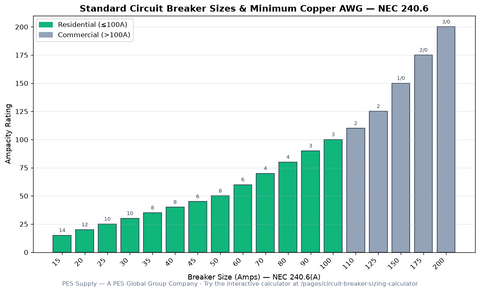
- Check the breaker-to-wire pairing in our standard breaker sizes chart.
- Check voltage drop on runs over ~100 feet (aim for under 3% on feeders and branch circuits).
Worked example: wire size for a 26kW generator
A 26kW air-cooled standby generator at 240V single-phase delivers 26,000 ÷ 240 = 108.3 amps. Generator feeders are sized per NEC 445.13 at 115% of nameplate: 108.3 × 1.15 = 124.5A. Reading the chart: 1 AWG copper at 130A is the minimum; most installers step up to 1/0 AWG copper (150A) or 2/0 aluminum for margin and cooler operation. That answers one of the most common questions we get — "wire size for a 26kW generator" — and the same math scales: an 18kW unit (75A × 1.15 = 86A) lands on 3 AWG copper, and a 14kW unit (58.3A × 1.15 = 67A) lands on 4 AWG copper. Don't forget the generator's output breaker and the transfer switch rating have to match the conductor, and check our generator fuel consumption chart for what that unit will burn per hour.
Worked example: 240V outlet for a welder or EV charger
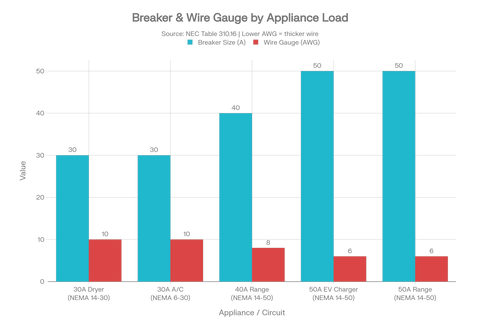
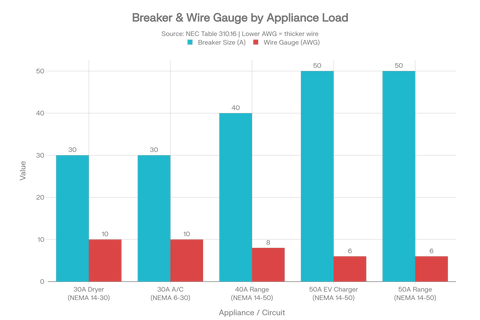
A 240V, 40A continuous load needs 40 × 1.25 = 50A of conductor → 8 AWG copper THHN (50A at 75°C) in conduit, or 6 AWG NM-B cable since Romex is limited to its 60°C ampacity (55A). This is the standard answer for "240V outlet wire gauge" at 40–50 amps; for a 30A circuit it's 10 AWG copper.
The ampacity chart assumes you know which cable family you're buying — they are not interchangeable:
- THHN/THWN-2 (individual conductors in conduit): the pro default. 75°C ampacities apply with modern breakers, pulls are repairable, and you can add circuits later. Required in commercial work and anywhere conduit is already specified.
- NM-B (Romex): the residential default for dry, indoor, concealed locations. Caught a lot of people off guard: even though the individual conductors inside are THHN, the cable assembly is limited to the 60°C column by NEC 334.80 — so 12 AWG Romex is a 20A wire, 10 AWG is 30A, 8 AWG is 40A, 6 AWG is 55A. Never in conduit outdoors, never in wet locations.
- SER (service entrance, aluminum): the standard 100–200A subpanel and service cable. Use the 75°C column for the aluminum conductors with listed lugs; add antioxidant compound and torque to spec.
- PV Wire / USE-2: sunlight-resistant, for exposed solar array wiring only — transition to THHN in conduit after the array boundary. See our MC4 and solar wire guide.
One more real-world factor: voltage drop. Ampacity keeps the wire from overheating, but a 150-foot run of 12 AWG on a 20A load loses over 6% of voltage — lights dim and motors run hot. The field rule is to upsize one gauge whenever a 120V branch run exceeds ~75 feet or a 240V run exceeds ~125 feet, and to check any feeder over 100 feet with an actual voltage-drop calculation (target ≤3% per circuit, ≤5% total).
What is the ampacity of 12 gauge wire?
25 amps at 75°C for THHN/THWN-2 copper — but NEC 240.4(D) caps the breaker at 20A. For 12 AWG aluminum, 20A ampacity with a 15A cap.
What size wire do I need for 100 amps?
3 AWG copper or 1 AWG aluminum at 75°C. Most installers upsize to 2 AWG or 1/0 copper for voltage drop and future headroom.
Is THHN the same as THWN-2?
Virtually all modern THHN is dual-rated THHN/THWN-2 — dry-location 90°C and wet-location 75°C. That's what we stock.
Can I use the 90°C column for THHN?
Only for derating calculations, and only when every termination in the circuit is 90°C-listed — almost never the case with standard breakers and equipment.
Copper or aluminum for feeders?
Aluminum is roughly half the cost per amp on large feeders (2 AWG and up) and is code-accepted for services and subpanels; use CO/ALR-rated lugs, antioxidant paste, and proper torque. Copper wins on smaller branch circuits and tight conduit fills.
Portlandia Electric Supply carries THHN/THWN-2 by the spool — like the Cerro 8 AWG THHN/THWN-2 stranded copper 500' and Cerro 1/0 AWG THHN/THWN-2 5000' — plus conduit, breakers, and lugs in the Electrical Supplies collection. Not sure which gauge your job needs? Call the counter with your load and run length — we'll size it while you're on the phone.
Below the NEC chart: For signal and control circuits that fall outside Table 310.16, see our guide to 22 AWG Wire: Ampacity, Uses & Specs — covering ampacity for chassis wiring, Class 2/3 power-limited circuits, and solar monitoring applications.