Updated September 2026 — refreshed against the live PES catalog; product pricing verified 2026-09-26.
The question that decides most generator purchases isn't wattage — it's "what will this thing cost me per hour, and how long will my fuel last?" I field that call at the Portlandia Electric Supply counter at least twice a week, and the honest answer always starts the same way: with a consumption chart and a load percentage. This guide gives typical fuel consumption for air-cooled and liquid-cooled standby generators by size class, across propane (LP), natural gas (NG), and diesel, at 25%, 50%, 75%, and 100% load — plus the tank-runtime and outage-cost math that turns the chart into a decision. Figures are typical published field values for planning; your unit's spec sheet is the final word, and load percentage moves the numbers a lot.
Generator fuel consumption chart (typical, by size)


| Generator size | Propane, 50% load | Propane, 100% load | Natural gas, 100% load | Diesel, 75% load |
|---|---|---|---|---|
| 7.5–10 kW air-cooled | ~1.0 gal/hr | ~1.6 gal/hr | ~120–140 ft³/hr | N/A* |
| 14 kW air-cooled | ~1.4 gal/hr | ~2.2 gal/hr | ~180–200 ft³/hr | N/A* |
| 18 kW air-cooled | ~1.6 gal/hr | ~2.8 gal/hr | ~230–250 ft³/hr | N/A* |
| 22 kW air-cooled | ~1.7 gal/hr | ~3.2 gal/hr | ~280–300 ft³/hr | N/A* |
| 26 kW air-cooled | ~2.1 gal/hr | ~3.9 gal/hr | ~330–400 ft³/hr | N/A* |
| 30 kW liquid-cooled | ~2.4 gal/hr | ~4.3 gal/hr | ~380–420 ft³/hr | ~1.8 gal/hr |
| 48 kW liquid-cooled | ~4.6 gal/hr | ~7.7 gal/hr | ~570–620 ft³/hr | ~2.7 gal/hr |
| 60 kW liquid-cooled | ~5.7 gal/hr | ~9.6 gal/hr | ~700–770 ft³/hr | ~3.3 gal/hr |
| 80 kW liquid-cooled | ~7.6 gal/hr | ~12.8 gal/hr | ~900–1000 ft³/hr | ~4.4 gal/hr |
| 100 kW liquid-cooled | ~9.5 gal/hr | ~16.0 gal/hr | ~1,100–1,250 ft³/hr | ~5.5 gal/hr |
| 125–150 kW liquid-cooled | ~12–14 gal/hr | ~20–24 gal/hr | ~1,400–1,800 ft³/hr | ~6.9–8.3 gal/hr |
*Air-cooled standby units (≤26 kW) are not offered in diesel — LP/NG only. Liquid-cooled propane figures scale from manufacturer data at ≈0.095 gal/hr per kW at 50% load and ≈0.16 gal/hr per kW at 100% load (e.g., 48 kW: 48 × 0.095 ≈ 4.6 gal/hr at 50%; 100 kW: 100 × 0.16 ≈ 16.0 gal/hr at 100%).
Rules of thumb behind the chart: air-cooled units burn roughly 0.12–0.15 gallons of propane per kW of rated output per hour at full load, natural gas runs about 10–13 ft³/hr per rated kW, and diesel sips about 0.055–0.07 gallons per rated kW at 75% load. Diesel is the efficiency king, which is why it dominates commercial standby above 30kW.
Diesel engines earn their keep at partial load, but they don't scale linearly — fixed losses (friction, cooling fans, excitation) mean the 25% column is never a quarter of the full-load column. Typical liquid-cooled diesel standby figures, interpolated from manufacturer spec sheets:
| Diesel generator | 25% load | 50% load | 75% load | 100% load |
|---|---|---|---|---|
| 20 kW | ~0.7 gal/hr | ~1.0 gal/hr | ~1.3 gal/hr | ~1.7 gal/hr |
| 30 kW | ~0.8 gal/hr | ~1.2 gal/hr | ~1.8 gal/hr | ~2.4 gal/hr |
| 48 kW | ~1.2 gal/hr | ~1.8 gal/hr | ~2.7 gal/hr | ~3.5 gal/hr |
| 60 kW | ~1.5 gal/hr | ~2.2 gal/hr | ~3.3 gal/hr | ~4.3 gal/hr |
| 80 kW | ~2.0 gal/hr | ~2.9 gal/hr | ~4.4 gal/hr | ~5.7 gal/hr |
| 100 kW | ~2.5 gal/hr | ~3.6 gal/hr | ~5.5 gal/hr | ~7.1 gal/hr |
| 125 kW | ~3.1 gal/hr | ~4.5 gal/hr | ~6.9 gal/hr | ~8.9 gal/hr |
| 150 kW | ~3.7 gal/hr | ~5.4 gal/hr | ~8.3 gal/hr | ~10.7 gal/hr |
Notice the pattern: dropping from full load to half load cuts fuel use by roughly 40–45%, not by half. And below ~30% load, diesel efficiency falls off a cliff while wet-stacking risk climbs — unburned fuel and carbon foul the rings and exhaust because the combustion chamber never reaches full temperature. I've seen a 100kW unit at a farm store spend three years running one walk-in cooler at 15% load; the exhaust stack looked like a coal stove's. If your real load is small and steady, buy the smaller generator or add load banking to your maintenance plan.
Air-cooled residential standby units (the 10–26kW class most homes get) run LP or NG from the same engine with a fuel selector. Here's how consumption moves with load on propane:
| Air-cooled unit (LP) | 25% load | 50% load | 75% load | 100% load |
|---|---|---|---|---|
| 10 kW | ~0.7 gal/hr | ~1.0 gal/hr | ~1.3 gal/hr | ~1.6 gal/hr |
| 14 kW | ~0.9 gal/hr | ~1.4 gal/hr | ~1.8 gal/hr | ~2.2 gal/hr |
| 18 kW | ~1.1 gal/hr | ~1.6 gal/hr | ~2.2 gal/hr | ~2.8 gal/hr |
| 22 kW | ~1.3 gal/hr | ~1.7 gal/hr | ~2.5 gal/hr | ~3.2 gal/hr |
| 26 kW | ~1.5 gal/hr | ~2.1 gal/hr | ~2.9 gal/hr | ~3.9 gal/hr |
Natural gas on the same units runs roughly 10–13 ft³/hr per rated kW at full load — a 22kW unit pulls 280–300 ft³/hr wide open, around half that at half load. One meter conversion to keep in your pocket: 1 therm ≈ 100 ft³ of natural gas ≈ 100,000 BTU, so that 22kW at full load is burning about 3 therms an hour. At $1.50/therm, that's $4.50 an hour — cheap insurance while the gas main is live.
"How much propane does a 26kW Generac use per hour?" is one of the most-asked questions in this category — here's the straight answer. A 26kW air-cooled standby at half load burns about 2.0–2.2 gallons of propane per hour; at full load, roughly 3.8–4.0 gallons per hour. On natural gas, expect around 330–400 cubic feet per hour at full load. Real outages rarely run at full load — most homes average 30–50% of rated capacity once the compressor inrush is over — so the half-load number is your planning figure. The full deep-dive on that unit class is in our 26kW generator guide, and the 22kW sibling gets the same treatment in our 22kW generator guide.
A gallon of propane and a gallon of diesel are not the same amount of energy, and a cubic foot of natural gas is something else again. This is the table that explains why diesel wins on runtime per gallon and why NG bills look so small:
| Fuel | Energy content | Storage | Shelf life |
|---|---|---|---|
| Propane (LP) | ~91,500 BTU/gal | On-site tank, 80% fill rule | Decades — doesn't degrade |
| Natural gas | ~1,030 BTU/ft³ (~100 ft³ per therm) | Utility main, no storage | Unlimited while utility is up |
| Diesel #2 | ~138,000 BTU/gal | On-site tank | ~12 months untreated; polish or treat for longer |
| Gasoline (portables) | ~120,000 BTU/gal | Cans / small tank | 3–6 months without stabilizer |
Do the division and the efficiency picture snaps into focus: per BTU burned, diesel converts to kWh more effectively than LP in the same size class, and both lose to the "free" storage of a utility NG connection. But the gas main can die in the same disaster that kills the power — earthquakes, floods, and excavation accidents don't respect utility boundaries. Customers in wildfire and hurricane country keep choosing propane for exactly that reason: full rated output, no derating, and fuel that sits politely in a tank for twenty years waiting its turn.
A 500-gallon propane tank is filled to 80% (400 usable gallons) for thermal expansion. Runtime = usable gallons ÷ burn rate:
| Scenario | Burn rate | 400 gal runtime |
|---|---|---|
| 26kW at 50% load | ~2.1 gal/hr | ~190 hours (~8 days) |
| 26kW at 100% load | ~3.9 gal/hr | ~103 hours (~4.3 days) |
| 22kW at 50% load | ~1.7 gal/hr | ~235 hours (~9.8 days) |
| 18kW at 50% load | ~1.6 gal/hr | ~250 hours (~10.4 days) |
Worked example: sizing the tank for a week of autonomy
You want seven full days of runtime on a 22kW unit, assuming half-load average and 12 hours of runtime per day (you shut it down overnight): 12 hr/day × 7 days × 1.7 gal/hr = 143 gallons — a 250-gallon tank (200 usable) covers it with margin. Running 24/7 instead: 24 × 7 × 1.7 = 286 gallons → you need the 500-gallon tank. The math scales linearly, so keep the chart above handy. One field note: schedule your propane delivery for when the tank hits 30%, not empty — suppliers get slammed for days after every major outage, and the truck that refills your neighbor at 20% may not reach you at 5%.
- Natural gas: unlimited runtime while the utility is up, no tank, no refills — but roughly 8–10% output derating versus LP on the same unit, and useless if the gas main goes down in a disaster.
- Propane: full rated output, stores for decades, works off-grid — but you're bounded by tank size and delivery logistics.
- Diesel: best fuel economy, longest engine life, standard above 30kW commercial — but fuel has a shelf life (~12 months untreated), gels in extreme cold without additives, and on-site storage raises permitting questions.
Altitude derates everything: expect roughly 3–4% less output per 1,000 feet above ~500 feet on naturally aspirated air-cooled engines. A 22kW unit in Denver is really an 18–19kW unit — size accordingly, and check our whole-house generator sizing guide before falling in love with a nameplate number. Turbocharged liquid-cooled units hold their rating much better with altitude, which is one of the quiet reasons commercial buyers stop shopping air-cooled equipment above 5,000 feet.
One more trade-off that never makes the brochures: noise follows fuel. Diesel units are louder and their exhaust smell carries; LP and NG units are noticeably quieter, and the difference between a 67 dB and a 72 dB machine is the difference between a neighbor who waves and a neighbor who calls the county. If the generator pad has to sit near a bedroom window or a property line, factor acoustics into the fuel decision — and remember that the loudest hour of a generator's year is the weekly exercise you scheduled yourself.
Fuel math gets real when you price an actual outage. Using mid-2020s US residential averages (~$2.50–$3.50/gal propane, ~$1.20–$1.80/therm natural gas, ~$3.50–$4.50/gal diesel) and 72 hours of runtime:
| Scenario | Fuel burned (72 hrs) | Outage fuel cost |
|---|---|---|
| 22kW on propane, 50% load | 1.7 gal/hr × 72 = ~122 gal | $300–$430 |
| 26kW on propane, 50% load | 2.1 gal/hr × 72 = ~151 gal | $380–$530 |
| 22kW on natural gas, 50% load | ~140 ft³/hr × 72 ≈ 100 therms | $120–$180 |
| 60kW diesel, 75% load (small facility) | 3.3 gal/hr × 72 ≈ 238 gal | $830–$1,070 |
| Same 22kW propane, 12 hr/day only | 1.7 × 36 = ~61 gal | $150–$215 |
Natural gas is the fuel-cost winner by a wide margin, which is why NG units dominate suburban installs. Against those numbers, the "expensive" standby generator is usually the cheapest line item in the outage: a single truckload of spoiled food, a flooded basement from a dead sump pump, or three nights of hotel rooms for a family of four all cost more than the fuel. The real comparison isn't generator versus nothing — it's generator versus what you lose without one. If your outages are short and your loads are modest, a battery backup system covers the first hours silently and the generator only runs for extended events — our battery runtime calculator sizes that side of the pair.
- Cycle, don't idle. Running 8–12 hours a day instead of 24 nearly doubles tank life, and the house holds temperature fine overnight in most climates. Set a household rule before the outage: generator off at bedtime, on again with the coffee pot.
- Shed the big loads. Electric water heaters, dryers, and ranges can triple your burn rate. Load-management modules or plain discipline — your call, but the tank doesn't care which.
- Keep the unit maintained. A filthy air filter and worn plugs cost measurable fuel. The generator accessories shelf — batteries, warmers, maintenance kits — is cheaper than an emergency service call at hour 40 of an outage.
- Dual-tank with changeover. Two 500-gallon LP tanks with an automatic changeover regulator give a 26kW unit roughly 16 days of half-load runtime, and you can refill one bank while running on the other.
Not everyone needs a standby unit, and the gasoline portable in the garage plays by the same rules with different numbers. Typical consumption at 50% load for common portable classes:
| Portable size (gasoline) | 25% load | 50% load | Rated runtime (mfr, 50%) |
|---|---|---|---|
| 2,000W inverter | ~0.08 gal/hr | ~0.16 gal/hr | 6–10 hrs on ~1 gal |
| 3,500W open-frame | ~0.20 gal/hr | ~0.30 gal/hr | 8–12 hrs on 3–4 gal |
| 5,500W open-frame | ~0.30 gal/hr | ~0.45 gal/hr | 9–11 hrs on 5 gal |
| 7,500W open-frame | ~0.40 gal/hr | ~0.60 gal/hr | 8–10 hrs on 6–8 gal |
| 10,000–12,000W | ~0.55 gal/hr | ~0.80 gal/hr | 7–9 hrs on 8 gal |
Two truths about portables and gasoline. First, fuel stabilizer is not optional — untreated pump gas starts going stale in 30–60 days, and the carburetor gum it leaves behind is the number-one reason portables won't start in year two. I've rebuilt enough varnished carburetors to say this plainly: run it dry or treat the fuel, every single time. Second, the rated runtime on the box assumes 50% load and a fresh engine; real-world numbers run 15–20% worse, and altitude shaves them again.
The chart only pays off if you know where your house actually sits on the load curve. Three ways to find out. The lazy way: check your generator's controller after it's been running an outage for an hour — most modern standby units display real-time kW output in the app or on the faceplate, so divide that by rated output. The better way: clamp each service leg with an amp meter during a normal evening peak (HVAC running, water heater recovered, cooking done) and multiply amps × 240V; a house pulling 45A is a 10.8kW load, which is 49% of a 22kW unit. The honest way: pull your utility's interval data if your smart meter exposes it — your highest 15-minute demand all year is the number your generator and your transfer switch both need to respect.
Why it matters for fuel: if your measured peak is 8kW, your shiny 26kW unit will spend its life at 30% load — right at the edge where air-cooled engines run fine but fuel-per-kWh gets ugly, and where a diesel would be wet-stacking itself to death. Right-sizing the generator to the measured load is the single biggest fuel decision you make; the chart just confirms what you chose.
Tank sizing questions come second only to burn-rate questions. Standard residential LP tanks and what they mean for a standby generator:
| Tank size | Usable gallons (80%) | 22kW @ 50% load | 26kW @ 50% load | Best fit |
|---|---|---|---|---|
| 120 gal (vertical) | ~96 gal | ~56 hrs | ~46 hrs | Occasional short outages, small units |
| 250 gal | ~200 gal | ~118 hrs (~5 days) | ~95 hrs (~4 days) | Mild climates, intermittent operation |
| 500 gal | ~400 gal | ~235 hrs (~9.8 days) | ~190 hrs (~8 days) | The residential standard |
| 1,000 gal | ~800 gal | ~470 hrs (~19.6 days) | ~380 hrs (~15.8 days) | Rural / long-outage country |
One regulatory note: generators are vapor-withdrawal loads, and a cold tank delivers less vapor. A 500-gallon tank at 20°F supports roughly half the BTU/hr withdrawal it does at 60°F — so in cold climates, a nearly empty tank on the coldest night of the year is exactly when the generator starves. That's the engineering reason behind the "refill at 30%" habit, and why cold-climate installs lean toward the 1,000-gallon tank.
Standby generators burn fuel when nothing is wrong. Every unit runs a weekly self-test — typically 5 to 12 minutes — to keep the engine seals wet, the battery charged, and the controller honest. A 22kW unit running a 12-minute weekly exercise at no load burns roughly 0.3–0.4 gallons of propane each time, which adds up to 16–20 gallons a year just to stay healthy. On natural gas it's a rounding error on the bill; on propane it's a noticeable slice of a small tank. Most controllers let you pick the exercise day and time, and quieter low-speed exercise modes shave the fuel further — worth setting up at commissioning, because the factory default is usually mid-day Sunday at full RPM, which is how generators get a bad reputation in quiet neighborhoods. Cold-climate owners should also know the battery warmer and oil warmer on the accessories list draw grid power continuously, not generator power — they don't touch your fuel tank, but they do show up on the electric bill.
Shop this guide
Frequently asked questions
How much propane does a 22kW generator use per hour?
About 1.6–1.8 gallons per hour at half load, and roughly 3.2 gallons per hour at full load.
Is it cheaper to run a generator on natural gas or propane?
Per hour of runtime, natural gas is typically 30–50% cheaper than propane at recent US residential prices — but propane avoids the output derating and works when the gas utility is down.
How long will a 500-gallon propane tank run a whole-house generator?
For a 22–26kW air-cooled unit at typical half-load operation, 8–10 days of continuous runtime. Intermittent operation stretches that to two weeks or more.
Do generators burn more fuel at higher load?
Yes, but not linearly — most engines are most efficient per kWh between 50–75% load. Running a 26kW unit to power one refrigerator is the least efficient way to make electricity; that's what load management is for.
How much diesel does a 100kW generator use per hour?
Roughly 5.5 gallons per hour at 75% load, around 7 gallons at full load. Diesel's efficiency advantage grows with size.
Can I extend propane runtime with a second tank?
Yes — dual-tank setups with an automatic changeover regulator are standard practice. Two 500-gallon tanks give a 26kW unit roughly 16 days of half-load runtime, and the changeover lets you refill one bank while running on the other.
Pick your unit — we stock the fuel-flexible ones
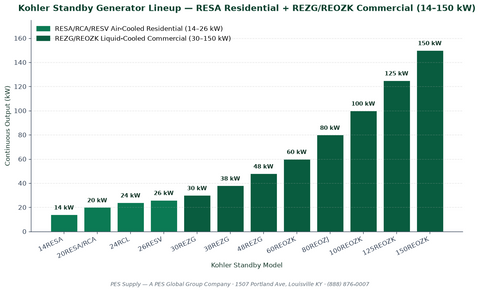
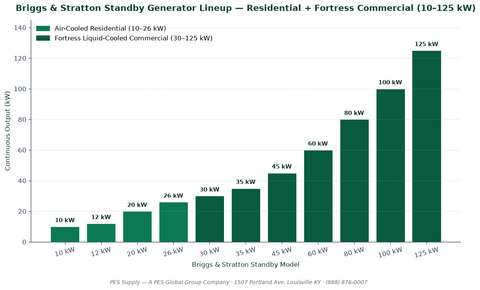
Portlandia Electric Supply carries NG/LP standby units from 10kW to 150kW, like the Generac Guardian 18kW home standby, the Generac 22kW with 200A service-entrance transfer switch, the Generac 26kW with 200A SE transfer switch, and liquid-cooled workhorses like the Briggs & Stratton 30kW Fortress LPV/NG. Browse home standby generators and the full Standby Generators collection, and don't forget the transfer switch — our transfer switch sizing chart matches it to your panel.
Still sizing? Read the backup generator overview first, then call the counter with your square footage and fuel type. We'll tell you the burn rate before you buy the unit.