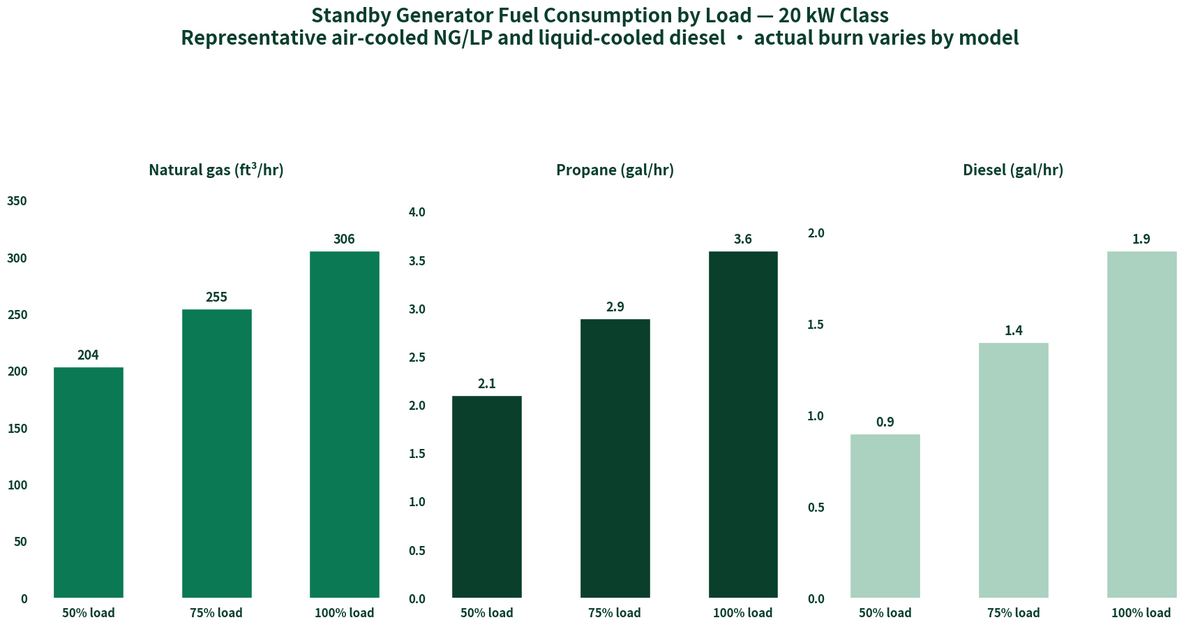
Standby Generator Fuel Consumption Chart: NG, Propane & Diesel
Reading time: ~9 min read
📋 Key Takeaways
- Rule-of-thumb burn rates at half load: natural gas ≈ 9 ft³/hr per kW, propane ≈ 0.095 gal/hr per kW, diesel ≈ 0.055 gal/hr per kW. Full load pushes them to roughly 13 ft³, 0.16 gal, and 0.11 gal per kW respectively.
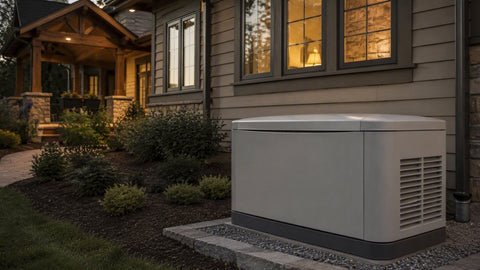
- A 22kW air-cooled standby on propane burns ~2.1 gal/hr at half load — a 500-gallon tank (400 gal usable) lasts about 8 days at that rate, ~4.5 days at full load.
- Natural gas has no tank and no runtime limit, but confirm the gas meter and service line can deliver the generator's full-load demand (a 22kW wants ~280 ft³/hr) plus the furnace and water heater.
- Diesel is the fuel-efficiency king per kWh and the only option for large three-phase commercial units — but it brings tank maintenance, fuel polishing, and cold-weather gelling management.
- Load percentage is the biggest swing factor: most standby units run 30–60% loaded in real outages, so size the fuel budget at half-load numbers, not nameplate.
Fuel consumption is where generator sizing meets the real world. The kW rating tells you what the unit can power; the fuel chart tells you how long it can keep doing it — and for propane and diesel customers, whether the tank on site survives a week-long outage. The chart and calculator below give planning-grade burn rates for the three standby fuels across the common residential and light-commercial sizes, a runtime answer against your actual tank, and a cost-per-day figure at editable fuel prices. Use them for proposals and tank-sizing conversations; always confirm against the manufacturer's spec sheet for the exact model, since burn rates vary 10–15% between engine platforms.
Quoting a standby unit? Our generators collection stocks air-cooled and liquid-cooled units from 169 authorized brands, and electrical supplies covers the transfer switches and gas plumbing fittings to complete the install.
Generator Fuel Consumption Calculator
Propane tanks fill to 80% by code — usable is 80% of nameplate. NG is continuous, no runtime limit.
$/gal propane (typical 2026 ~$2.00–3.00)
Fuel consumption: —
Runtime on tank: —
Fuel cost per day (24h): —
Planning-grade burn rates interpolated from typical air-cooled standby curves (NG ≈ 6/9/11/13 ft³/hr per kW at 25/50/75/100% load; LP ≈ 0.060/0.095/0.130/0.160 gal/hr per kW; diesel ≈ 0.030/0.055/0.080/0.110 gal/hr per kW). Verify against the manufacturer's fuel data for the exact model — engine platforms vary 10–15%. Fuel prices are editable planning estimates, not quotes.
Fuel Consumption Chart by Generator Size
Planning averages for air-cooled standby units (diesel shown for the liquid-cooled sizes where diesel is the norm). "50%" columns reflect how these units actually run in most outages:
| Generator | NG @ 50% (ft³/hr) | NG @ 100% | Propane @ 50% (gal/hr) | Propane @ 100% | Diesel @ 50% (gal/hr) | Diesel @ 100% |
|---|---|---|---|---|---|---|
| 10 kW | 90 | 130 | 0.95 | 1.6 | — | — |
| 14 kW | 126 | 182 | 1.3 | 2.2 | — | — |
| 20 kW | 180 | 260 | 1.9 | 3.2 | 1.1 | 2.2 |
| 22 kW | 198 | 286 | 2.1 | 3.5 | 1.2 | 2.4 |
| 26 kW | 234 | 338 | 2.5 | 4.2 | 1.4 | 2.9 |
| 36 kW | 324 | 468 | 3.4 | 5.8 | 2.0 | 4.0 |
| 48 kW | 432 | 624 | 4.6 | 7.7 | 2.6 | 5.3 |
| 60 kW | 540 | 780 | 5.7 | 9.6 | 3.3 | 6.6 |
| 100 kW | 900 | 1,300 | 9.5 | 16.0 | 5.5 | 11.0 |
Cross-check against your spec sheets — a Generac 22kW, for example, publishes ~203 ft³/hr NG and ~2.1 gal/hr LP at half load, right on these planning numbers. Liquid-cooled units and different engine families can run 10–15% either way.
BTU Content: Why the Three Fuels Aren't Interchangeable
Fuel consumption differences trace back to energy density. Keep this table handy when a customer asks why the propane tank empties so much faster than the diesel tank on the same-size unit:
| Fuel | Energy content | Common billing unit | Notes |
|---|---|---|---|
| Natural gas | ≈1,030 BTU / ft³ | Therm (100,000 BTU ≈ 97–100 ft³) | Continuous supply; meter/regulator capacity is the constraint |
| Propane (LP) | ≈91,500 BTU / gal | Gallon | Tank fills to 80%; vaporization rate limits cold-weather output |
| Diesel (#2) | ≈138,700 BTU / gal | Gallon | Highest density; best kW-per-gallon; storage maintenance required |
Diesel carries ~52% more energy per gallon than propane, and diesel engines run higher compression efficiency on top of that — together explaining why the diesel column burns roughly half the gallons of the LP column for the same kW. Natural gas looks weak per cubic foot, but it's delivered continuously and cheaply per BTU; its constraint is plumbing, not storage.
Tank Sizing and Runtime: Propane and Diesel Logistics
For propane, the 80% fill rule is non-negotiable (expansion space, NFPA 58), so a "500-gallon" tank holds 400 usable gallons. Against a 22kW at half load (~2.1 gal/hr), that's 190 hours — about 8 days. At full load it's 4.5 days. The second constraint is vaporization: propane leaves the tank as vapor, and cold weather collapses the rate at which liquid boils off. A 500-gal tank near freezing may only sustain 100–150 ft³/hr of vapor — enough for half-load operation of a large unit, not full load. Cold-climate installs on 24kW+ units should spec 1,000-gal tanks or manifolded pairs.
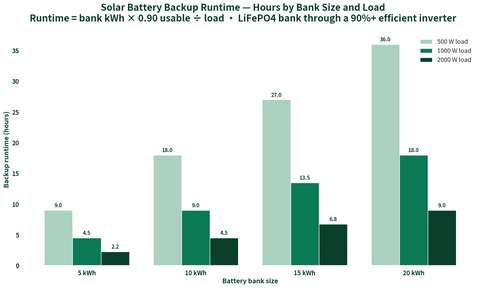
Diesel runtime is simpler arithmetic — no fill rule, no vaporization — but trades it for fuel management: #2 diesel degrades, grows microbial contamination, and gels around 10–15°F without treatment. Commercial standby specs typically call for 24–72 hours of on-site fuel at full load; a 60kW at full load drinks 6.6 gal/hr, so 72 hours means a 500-gal tank. For residential customers weighing fuels, the honest summary is: NG if the street has adequate gas, propane if it doesn't and the customer wants clean storage, diesel when runtime per gallon and three-phase power matter. Pair any of them with the right transfer equipment from electrical supplies, and for hybrid resilience projects, batteries & storage increasingly share the backup role.
Frequently Asked Questions
How much propane does a 22kW generator use per day?
A 22kW air-cooled standby burns roughly 2.1 gal/hr at half load and 3.5 gal/hr at full load. Over 24 hours that's about 50 gallons at half load or 84 gallons at full load. Real outages average 30–60% loading, so plan around 40–55 gallons per day — a 500-gallon tank (400 usable) gives you roughly 7–8 days at that pace.
How long will a 500-gallon propane tank run a generator?
A 500-gallon propane tank holds 400 usable gallons (80% fill rule). Runtime depends on generator size and load: a 14kW at half load (~1.3 gal/hr) runs about 12 days; a 22kW at half load (~2.1 gal/hr) about 8 days; a 36kW at half load (~3.4 gal/hr) about 5 days. At full load, cut those roughly in half. In cold weather, vaporization limits may cap output before the tank is empty.
Is natural gas, propane, or diesel cheaper to run on a standby generator?
Per kWh produced, natural gas is typically cheapest — a 22kW at half load burns ~200 ft³/hr, about $3/hour at $1.50/therm. The same unit on propane (~2.1 gal/hr at $2.50) costs about $5.25/hour, and diesel (~1.2 gal/hr at $4.00) about $4.80/hour but produces power more efficiently at heavier loads. Diesel wins on fuel density and large-unit efficiency; NG wins on price and convenience where service is adequate; propane wins where there's no gas line and clean long-term storage matters.
How much natural gas does a whole-home generator use?
Plan on about 9 ft³/hr per kW at half load and 13 ft³/hr per kW at full load. A 22kW whole-home unit therefore draws roughly 200 ft³/hr at half load (~2 therms) and 280+ ft³/hr at full load. Over a 24-hour outage at typical loading, expect 4,000–5,000 ft³ (40–50 therms). Verify the gas meter and service line can supply the generator's full-load demand plus the furnace, water heater, and range simultaneously.
Does load percentage really change fuel consumption that much?
Yes — it's the single biggest variable after unit size. Standby generators run 25–60% loaded in typical residential outages (fridge, lights, furnace blower), and burn rates roughly double from 25% to 100% load. That's why fuel budgets sized from nameplate full-load numbers overspend, and why correct generator sizing (not oversizing "just in case") saves fuel money every outage hour for the life of the unit.
Quoting a Standby Generator Install?
PES Supply stocks air-cooled and liquid-cooled standby generators, transfer switches, and install accessories from 169 authorized brands. Send the load calc and fuel type — we'll quote the complete package at contractor pricing.
Shop Generators Contact Us for Bulk PricingRelated Resources
- Standby generators: NG, propane, and diesel
- Transfer switches and installation supplies
- Batteries and hybrid backup systems
- Solar panels for hybrid resilience