Generator Propane Tank Sizing Calculator: Runtime, Gallons per Hour, and Vaporization
Reading time: ~9 min read
📋 Key Takeaways
- A 20–26kW standby generator burns roughly 2–2.5 gal of propane per hour at half load and 3.5–4 gal/hr at full load — call it 0.1 gal/hr per nameplate kW at 50% load.
- Tanks only fill to 80%. A 500-gal tank holds 400 usable gallons; a 250-gal holds 200. Runtime math must use the usable figure.
- Tank size is limited by vaporization, not just capacity. Liquid propane must boil into gas fast enough to feed the engine — a 500-gal tank in cold weather may not sustain a 22kW generator at full load even when half full.
- Natural gas has no tank, but the meter and piping have a BTU budget. A 22kW NG unit draws roughly 280,000–330,000 BTU/hr at full load — often more than the furnace and water heater combined.
- For a 3-day outage at 50% average load, a 22kW unit needs roughly 150 gal of usable propane — a 250-gal tank is the practical minimum.
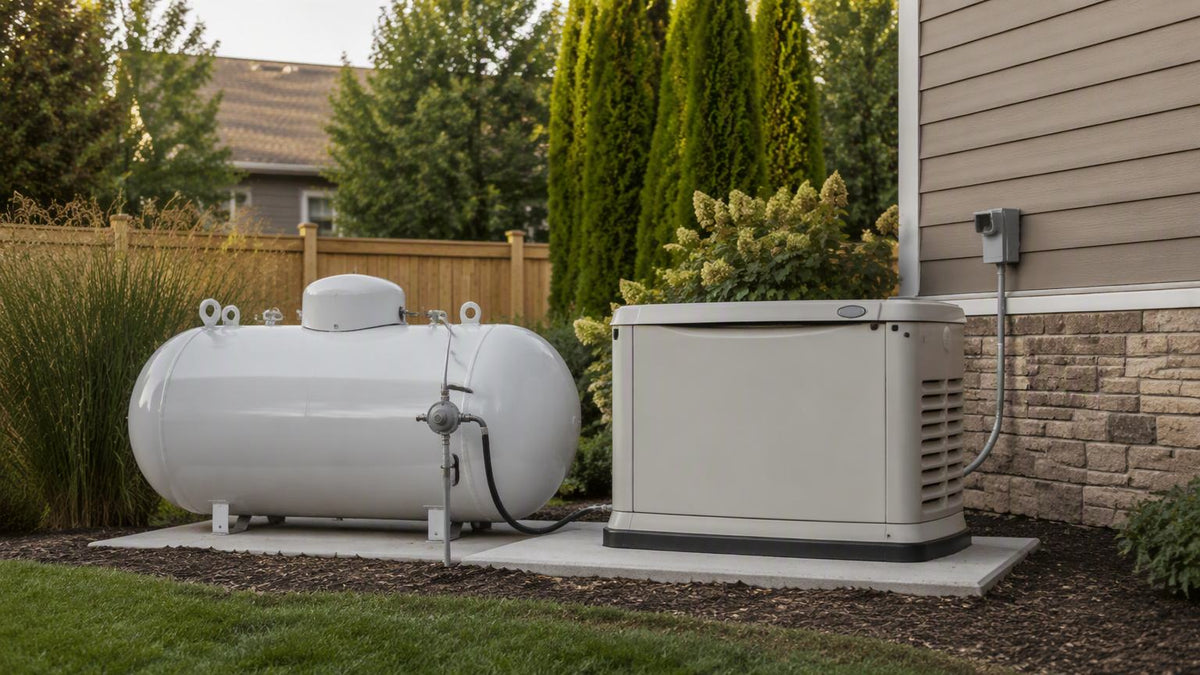
Fuel consumption — gallons per hour — is only half the propane question. The other half is the tank: how many usable gallons it holds after the 80% fill rule, how many days of outage that buys, and whether the tank can physically vaporize liquid propane fast enough to feed a thirsty engine on a cold night. A tank that is big enough on paper can still starve a generator in January because vaporization rate falls with temperature and with liquid level. The calculator below handles both sides: it converts your generator's size, expected load, and target runtime into total fuel required, recommends a standard tank size, and runs a vaporization sanity check at winter temperatures. It also converts to natural gas cubic feet for meter and piping checks.
Shopping the generator itself or the transfer gear? Browse our standby and portable generators and electrical supplies. For hourly burn rates across NG, propane, and diesel, see the generator fuel consumption chart; for matching kW to your house, the generator sizing calculator.
Propane / Natural Gas Supply Calculator
Air-cooled standby ratings.
Most outages average ~50%.
Continuous run hours = days × 24.
NG mode converts to ft³ and BTU.
Drives the vaporization check.
Burn rate: —
Fuel needed for runtime: —
Recommendation: —
Basis: manufacturer-published consumption curves for air-cooled standby units, averaged (~0.095 gal/hr per kW at 50% load, ~0.165 at 100%; NG ≈ 91,500 BTU/gal propane equivalent ÷ 1,000 BTU/ft³). Tanks fill to 80%. Vaporization limits are typical values at 25% liquid level. Informational — generator and tank nameplates and your LP supplier govern.
Propane Tank Sizes: Capacity and What They Really Hold
The 80% fill rule exists because liquid propane expands with temperature — the vapor space above the liquid is a safety margin, not wasted capacity. All runtime math must start from usable gallons:
| Tank size | Usable gallons (80%) | Max continuous draw @ 20°F* | Best fit |
|---|---|---|---|
| 120 gal | 96 gal | ~65k BTU/hr | 10–14kW units, short outages |
| 250 gal | 200 gal | ~110k BTU/hr | 14–22kW at light-moderate load |
| 500 gal | 400 gal | ~235k BTU/hr | 18–26kW, the residential standard |
| 1,000 gal | 800 gal | ~470k BTU/hr | 26–48kW or long-duration autonomy |
*Vaporization capacity at ~25% liquid level; roughly 60% higher at 40°F and about half at 0°F. A full tank vaporizes noticeably faster than a quarter-full one — another reason to schedule refills early in a storm forecast.
How Long Will a 500-Gallon Tank Run a 22kW Generator?
The most-asked question in standby power. Usable fuel: 400 gal. At 50% average load a 22kW burns about 2.1 gal/hr — 400 ÷ 2.1 ≈ 190 hours, or about 8 days of continuous run. At full load (≈3.6 gal/hr) the same tank lasts ~4.6 days; at 25% load (~1.3 gal/hr) nearly 13 days. Real outages average far below nameplate load because the generator cycles with demand — most homeowners with a 500-gal tank and a 22kW unit ride out a week-plus outage with margin, provided the house load is managed (electric water heater and range deferred, AC on a schedule). A 250-gal tank halves those numbers: about 4 days at 50% load, which covers typical storm outages but not extended grid events.
The Vaporization Wall: Why Big Engines Need Big Tanks
Propane leaves the tank as vapor boiled off the liquid surface, and boiling takes heat — from the tank walls, which take it from the air. Three things throttle the rate: temperature (colder air delivers less heat), liquid level (less wetted surface as the tank drains), and draw rate itself (heavy draw chills the liquid further, a feedback loop). When demand exceeds vaporization, pressure at the regulator falls and the generator stumbles or shuts down on low fuel pressure — with hundreds of gallons still aboard. This is why sizing guides pair engines to minimum tank sizes: a 22kW unit pulling 300k+ BTU/hr at full load is already near the winter limit of a 500-gal tank at quarter level, and 36–48kW units genuinely need 1,000 gallons (or two manifolded 500s) to run at full load in cold climates. Warm-climate installs get more slack, but the check costs nothing and prevents the worst surprise in standby power.
Natural Gas: No Tank, but a BTU Budget
NG eliminates the tank and the refill truck, but moves the constraint upstream to the gas meter, regulator, and piping. Convert the generator's appetite to BTU/hr — a 22kW unit at full load wants roughly 280,000–330,000 BTU/hr (280–330 ft³/hr), a 26kW up to 390,000. Now add everything else on the meter: a 100k furnace, 40k water heater, and 65k range can stack another 200k. Many residential meters deliver 250k–425k BTU/hr at standard ¼-psi pressure; when the total exceeds the meter, the utility upgrades the meter and regulator, sometimes at no charge, but only if you ask before the install. Pipe sizing matters just as much: long runs at low pressure starve the engine exactly like a vaporizing tank, and the generator's required inlet pressure (3.5–7 in. w.c. for most air-cooled units) must hold at full load with every other appliance running.
Frequently Asked Questions
How long will a 500-gallon propane tank run a generator?
A 500-gal tank holds 400 usable gallons (80% fill rule). A 22kW standby unit at 50% average load burns about 2.1 gal/hr — roughly 190 hours or 8 days of continuous run. At full load (~3.6 gal/hr) expect about 4.6 days; at light 25% load, nearly 13 days. Smaller units stretch further: a 10kW at half load sips ~0.95 gal/hr for about 17 days.
What size propane tank do I need for a 22kW generator?
500 gallons is the standard pairing: 400 usable gallons gives about 8 days at typical 50% average load, and its vaporization rate can feed the engine in most conditions. A 250-gal tank works for mild climates and short outages (~4 days), but in cold weather at low liquid level it may not vaporize fast enough for full-load operation. For 36kW and up, plan on 1,000 gallons minimum.
Why is my propane tank only filled to 80%?
Liquid propane expands significantly as it warms — about 1.5% per 10°F. The 20% vapor space left at fill time is the safety margin that keeps the tank from going liquid-full (hydrostatic) on a hot day, which would force the relief valve to vent. Practically, it means every runtime calculation must use 80% of the nameplate capacity: a 500-gal tank is a 400-gal fuel supply.
Can a propane tank be too small even if it holds enough gallons?
Yes — vaporization rate is the hidden limit. The engine draws vapor boiled off the liquid surface, and that rate drops with temperature and liquid level. A tank can hold weeks of fuel yet fail to supply the BTU/hr a large generator demands on a cold night, causing low-pressure shutdowns with fuel remaining. Always check both numbers: usable gallons for runtime, and vaporization capacity against the generator's full-load BTU/hr.
How many BTU does a standby generator use on natural gas?
Roughly 10,000–13,000 BTU/hr per kW of nameplate rating at moderate load. A 22kW unit draws about 200,000–230,000 BTU/hr at half load and 280,000–330,000 at full load; a 26kW approaches 390,000. Add that to the home's other gas appliances and compare against the meter's rated capacity — the meter, regulator, and piping are the "tank" in an NG system.
Pairing a Tank with a New Standby Unit?
PES Supply stocks air-cooled standby generators, transfer switches, and the electrical gear to land them — 169 authorized brands at contractor pricing. Send your load worksheet and target runtime and we'll quote the package.
Shop Generators Contact Us for Bulk PricingRelated Resources
- Standby generator fuel consumption chart: NG, propane, diesel
- Generator sizing calculator: running and starting watts
- Transfer switch sizing guide: ATS vs manual
- Battery backup runtime calculator
- Standby and portable generators