Transformer Sizing Calculator: kVA, Load & Voltage Selection
Reading time: ~10 min read
📋 Key Takeaways
- Required kVA = load kW ÷ power factor, times (1 + growth margin). Motors add HP × 0.746 ÷ efficiency ÷ motor PF before the demand factor.
- Standard three-phase sizes step 15, 30, 45, 75, 112.5, 150, 225, 300, 500 kVA; single-phase steps 3, 5, 7.5, 10, 15, 25, 37.5, 50, 75, 100, 167 kVA.
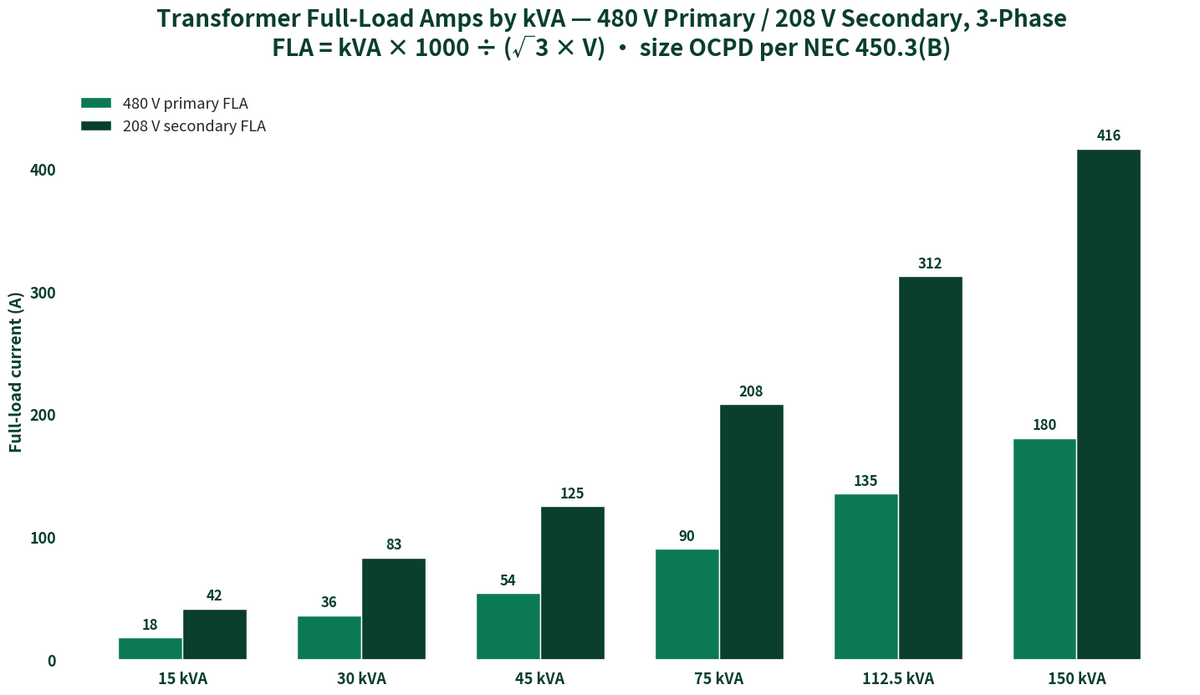
- Full-load amps: three-phase I = kVA × 1000 ÷ (1.732 × V); single-phase I = kVA × 1000 ÷ V. A 45 kVA at 480→208Y/120 pulls 54 A primary, 125 A secondary.
- Size for the load, protect per NEC 450.3: primary-only protection is typically 125% of primary FLA for currents of 9 A or more.
- Inrush on energization runs 8–12× FLA for a few cycles — breakers need time-delay or the next permitted size up per 450.3 to avoid nuisance trips.
Undersize a dry-type transformer and it runs hot, hums, and dies early. Oversize it and you're paying for core losses around the clock on capacity nobody uses. The right size is one line of math — kW divided by power factor — plus an honest look at what's actually on the load schedule. The calculator below handles it: enter your load in kW with a power factor (add motor horsepower if the load is motor-heavy), choose single or three-phase and a voltage pair, and it returns the required kVA, the next standard transformer size, and full-load amps on the primary and secondary. Below the calculator you'll find the formulas, the voltage-pair cheat sheet, and the NEC 450 protection and inrush notes.
Need a transformer, disconnects, or panel gear quoted? Browse our electrical supplies collection — 50,000+ SKUs with trade pricing.
Transformer Sizing Calculator
Required kVA: — · Selected size: —
Primary FLA: — · Secondary FLA: —
Motor conversion uses 0.746 kW/HP at 85% efficiency and 0.85 motor PF. Protection guidance follows NEC Table 450.3(B) for transformers 1000 V and under with primary-only protection. Verify against the current NEC and the transformer nameplate.
The Sizing Formula
Transformer sizing is apparent-power arithmetic:
kVA = kW ÷ PF · FLA (3Φ) = kVA × 1000 ÷ (1.732 × V) · FLA (1Φ) = kVA × 1000 ÷ V
Power factor is where estimates go wrong. Lighting and receptacle loads in modern commercial buildings run 0.9–0.95 with LED drivers and electronic ballasts; older magnetic-ballast and motor-heavy floors can sit at 0.8. If you don't have a measured PF, 0.9 is a defensible default — and it's what the calculator starts with. Motors convert at 0.746 kW per horsepower, then divide by efficiency (~0.85 for a small NEMA motor) and motor PF (~0.85 at full load). A 10 HP motor is not 7.46 kVA on the transformer — it's closer to 10.3 kVA before the demand factor.
The demand factor is your honesty check: not everything runs at once. Office floors demand 70–85% of connected load; a machine shop with duty cycling can be 50–70%. Apply demand to the sum, then apply your growth margin — 20–25% is standard for commercial tenant spaces. The result rounds up to the next standard size, never down.
Standard Sizes and Where Each One Lives
| Size (3Φ) | Typical job | Secondary FLA @ 208Y/120 |
|---|---|---|
| 15 kVA | Small tenant panel, lighting circuit group | 41.6 A |
| 30 kVA | Small office suite, retail bay | 83.3 A |
| 45 kVA | Mid-size tenant space, small kitchen | 124.9 A |
| 75 kVA | Office floor, restaurant, light shop | 208.2 A |
| 112.5 kVA | Multi-tenant floor, small industrial bay | 312.3 A |
| 150 kVA | Large commercial floor, light manufacturing | 416.4 A |
| 225 kVA | Industrial bay, warehouse with equipment | 624.6 A |
| 300 kVA | Manufacturing floor, data room support | 832.7 A |
Single-phase standard sizes (3–167 kVA) cover residential services, irrigation panels, and small commercial: 15–25 kVA feeds a house or small shop, 37.5–50 kVA handles a large home or duplex, and 75–167 kVA serves small commercial services and farm loads.
Voltage Pairs You'll Actually Spec
| Pair | Use case |
|---|---|
| 480 Δ → 208Y/120 | The workhorse: steps 480 V distribution down to 208 V three-phase with 120 V line-to-neutral for panels, receptacles, and lighting. |
| 480 Δ → 240 Δ | Machine shops and industrial equipment needing 240 V three-phase; add a high-leg or a separate 1Φ unit for 120 V. |
| 480 → 120/240 (1Φ) | Single-phase panels in 480 V buildings: offices, break rooms, small services. |
| 600 Δ → 208Y/120 | Canadian and heavy-industrial 600 V distribution stepping down to utilization voltage. |
| 480 Δ → 480Y/277 | Creating a neutral for 277 V lighting where the service is delta — or isolating a lighting load group. |
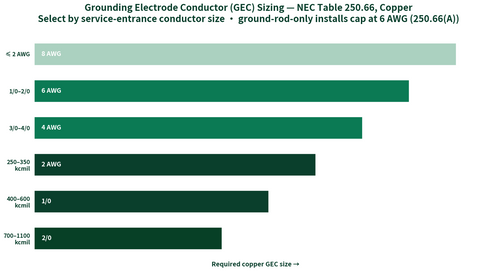
One trap worth naming: a 480→208Y/120 transformer fed from a 480Y/277 system is fine, but always confirm whether the primary is delta or wye on the nameplate and whether the secondary neutral needs to be solidly grounded per NEC 250.30 — separately derived systems have their own grounding electrode requirements. Our grounding guide (NEC 250) covers the electrode side of that install.
Inrush, Impedance, and Protection (NEC 450.3)
Energizing a transformer looks like a dead short for the first few cycles: magnetizing inrush runs 8–12× full-load current depending on where in the waveform the contacts close. That's why NEC Table 450.3(B) permits primary-only protection at 125% of primary FLA (for currents of 9 A or more), with the next standard OCPD size up allowed when 125% lands between ratings — and why secondary protection at 125% opens the door to 250% primary protection. If a correctly sized breaker still trips on energization, the fix is a time-delay fuse class or a breaker with adjustable instantaneous pickup, not a bigger transformer.
Impedance (%Z) sets fault current on the secondary. Typical dry-type units run 2–5% Z. Available fault current at the secondary is roughly FLA ÷ %Z — a 75 kVA, 208 V, 3% Z unit can deliver about 208 A ÷ 0.03 ≈ 6,940 A before you add motor contribution and utility stiffness. Every downstream panel and breaker must carry an interrupting rating above that number; check it against the gear you're buying, not the gear you wish you had.
K-factor is the last spec check: non-linear loads (VFDs, LED drivers, server PSUs) push harmonic currents that overheat standard transformers. K-4 is standard; K-13 for offices dense with electronics; K-20 for data and broadcast. If the load schedule says "computers and drives," price the K-rated unit the first time.
Ready to quote? Send the load schedule with your voltage pair and we'll return a sized transformer, primary/secondary protection, and disconnects from our electrical supplies inventory. Pairing with a backup source? See our generator collection for units matched to transformer-fed services.
Frequently Asked Questions
How do you calculate transformer kVA?
Divide the real-power load (kW) by the power factor to get apparent power: kVA = kW ÷ PF. For motor loads, convert horsepower first (HP × 0.746 ÷ efficiency ÷ motor PF), then apply your demand factor and growth margin, and round up to the next standard size — 15, 30, 45, 75, 112.5, 150 kVA and up for three-phase.
What size transformer do I need for a 100 amp, 208 V three-phase panel?
Work backward from amps: kVA = 1.732 × V × I ÷ 1000 = 1.732 × 208 × 100 ÷ 1000 = 36 kVA. The next standard size is 45 kVA, which delivers 125 A at 208Y/120 — enough for the panel plus margin. Never size a transformer to exactly the panel rating without headroom.
What is the difference between kW and kVA for transformers?
kW is real power doing work; kVA is apparent power the transformer must carry, including reactive current that does no work but still heats the windings. The ratio is the power factor: kW = kVA × PF. Transformers are rated in kVA because their losses depend on total current, not on how useful the current is.
How much inrush does a dry-type transformer have?
Magnetizing inrush at energization typically runs 8–12 times full-load current for a few cycles, worst when switched at the wrong point on the voltage waveform. Size and coordinate the primary OCPD per NEC 450.3 — 125% primary-only, with the next standard size up permitted — and use time-delay fuses or adjustable-instantaneous breakers to ride through it.
Can I load a transformer to 100% of its kVA rating?
Continuously, no — dry-type transformers can carry nameplate kVA, but losses and heat rise steeply near full load, and insulation life roughly halves for every 10 °C over rated hot-spot temperature. Best practice designs to 60–85% loading at peak, leaving room for growth and keeping the unit in its efficient, cool-running band.
Need a Transformer, Disconnects, or Protection Package?
PES Supply stocks dry-type transformers, fused disconnects, and breakers from 169 authorized brands. Send your load schedule and voltage pair — we'll quote the transformer and both sides of protection.
Shop Electrical Supplies Contact Us for Bulk PricingRelated Resources
- Electrical supplies: transformers, disconnects, breakers, and panels
- Generators and transfer equipment
- Solar panels and array equipment