What Can a Generator Run? Load Capacity Calculator by kW
Reading time: ~9 min read
📋 Key Takeaways
- Amps = kW × 1,000 ÷ volts. A 10kW generator makes 83A at 120V or 41.7A at 240V; a 22kW makes 91.7A at 240V — the number that matters for your transfer switch and wire.
- Plan to 80% of rated watts for anything running hours. A 10kW unit is a 10kW sprinter but an 8kW marathon runner; sustained full-load running shortens engine life.
- Starting watts, not running watts, decide what starts. A 3-ton AC that runs on 3,500W can demand 9,000W+ for a second at startup without a soft starter.
- A 10kW generator runs the essentials — refrigerator, furnace blower, sump pump, lights, and electronics — but not central AC plus an electric range at the same time.
- A 22–26kW air-cooled standby runs a whole average home, including one central AC, if you stagger the biggest motor starts.
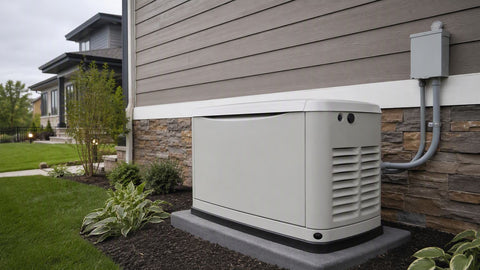
"Is a 10kW generator enough?" and "what will a 22kW generator run?" are the same question from opposite ends: you have a number in kilowatts and you need to know what it buys you in real appliances. The answer is arithmetic, not marketing. Convert kW to amps at your system voltage, subtract the 20% continuous-duty margin, then stack your loads — running watts first, starting surges second — until the budget runs out. The calculator below does that math for any generator from a 2kW inverter unit to a 26kW air-cooled standby, and the charts after it show worked examples for the sizes people ask about most.
Shopping the hardware side of this answer? Browse our generators, and once you know your kW, the companion reads are the generator sizing calculator (loads → generator size, the reverse direction), the transfer switch sizing guide, and the generator fuel consumption chart for what that kW costs per hour.
Generator Load Capacity Calculator
Rated (running) kilowatts, not surge.
Most standby units deliver both via a 120/240V output.
Sum of running watts you want to power.
Highest starting surge among your loads.
Rated output: —
Continuous budget (80%): —
Load verdict: —
Formulas: amps = kW × 1,000 ÷ volts (single-phase). Continuous planning budget = 80% of rated watts. Surge check assumes the generator can absorb a momentary motor start equal to roughly 200% of rated kW for one second — verify against the unit's surge rating on its spec sheet.
kW to Amps: The Output Chart Worth Memorizing
Every "what will it run" question starts here. Amps are what your transfer switch, breaker, and generator cord actually carry, and the amp number changes completely with voltage:
| Generator (running) | Amps @ 120 V | Amps @ 240 V | Continuous budget (80%) |
|---|---|---|---|
| 2 kW inverter | 16.7 A | 8.3 A | 1,600 W |
| 5 kW portable | 41.7 A | 20.8 A | 4,000 W |
| 7.5 kW portable | 62.5 A | 31.3 A | 6,000 W |
| 10 kW standby | 83.3 A | 41.7 A | 8,000 W |
| 14 kW standby | 116.7 A | 58.3 A | 11,200 W |
| 18 kW standby | 150 A | 75 A | 14,400 W |
| 22 kW standby | 183.3 A | 91.7 A | 17,600 W |
| 26 kW standby | 216.7 A | 108.3 A | 20,800 W |
Notice how a 22kW unit at 240V lands at 91.7A — just under a 100A transfer switch rating. That is not a coincidence; air-cooled standby units in the 20–26kW class are engineered to backfeed a typical 100A or 200A residential panel through a service-rated ATS. For the wire that carries those amps from generator to switch, see the transfer switch wire sizing chart by kW.
What the Popular Sizes Actually Run
Running watts add up; starting watts ambush you. The honest way to answer "is a 10kW generator enough for a house" is to stack real appliance numbers:
| Appliance | Running watts | Starting surge |
|---|---|---|
| Refrigerator | 700 W | 2,200 W |
| Gas furnace blower (½ HP) | 800 W | 2,350 W |
| Sump pump (⅓ HP) | 1,050 W | 2,900 W |
| Central AC, 3 ton (no soft start) | 3,500 W | 9,000 W |
| Central AC, 3 ton (with soft start) | 3,500 W | 4,200 W |
| Electric water heater | 4,500 W | 4,500 W |
| Electric range (one oven + burner) | 3,000 W | 3,000 W |
| Microwave | 1,000 W | 1,000 W |
| LED lighting, whole house | 400 W | 400 W |
| Internet, TV, laptops, chargers | 300 W | 300 W |
A 10kW generator (8,000W continuous) comfortably carries the survival stack: refrigerator 700W + furnace blower 800W + sump pump 1,050W + lights 400W + electronics 300W + microwave 1,000W ≈ 4,250W running, with 3,750W of headroom to absorb any one of those motors starting. Add a soft-started 3-ton AC at 3,500W and you are at 7,750W — possible but at the ceiling, so the water heater and range stay off. A 22kW generator (17,600W continuous) runs that same essential stack plus the 3-ton AC, the electric water heater, and still leaves roughly 8,000W of margin — enough that most families never think about load management unless the electric range and dryer run together during an AC start.
Why Starting Watts Wreck the Paper Math
Motors are the problem. A compressor or pump draws two to three times its running current for the first half-second to three seconds while the rotor gets moving. On paper a 3-ton AC at 3,500 running watts fits under 8,000W continuous — but its 9,000W locked-rotor demand can stall a 10kW generator the moment it kicks on, which is why so many "big enough" generators trip offline the first hot night of an outage. Three fixes exist: a soft starter on the condenser (cuts the surge roughly in half), load-shed modules in the ATS that drop the AC for the seconds a bigger motor needs, or simply sequencing — let the fridge and pump start before the thermostat calls for cooling. Running the surge check in the calculator above with your largest motor's starting watts tells you which fix you need.
Where the Fuel and Switch Limits Join the Math
Capacity is not only electrical. A 10kW air-cooled unit burns roughly 1.6 gallons of propane per hour at half load and over 2.5 gallons at full tilt — running at 100% for days is both a fuel problem and an engine-wear problem, one more reason the 80% continuous budget exists. The full burn-rate table is in the fuel consumption chart, and if propane is your fuel, the propane tank sizing calculator converts those gallons per hour into days of autonomy by tank size. Finally, your capacity is capped by the weakest link: a 22kW generator behind a 60A transfer switch is a 14.4kW generator, period. Match the ATS to the generator's rated amps, not the other way around.
Frequently Asked Questions
How many amps is a 10kW generator?
A 10kW generator produces 83.3 amps at 120V or 41.7 amps at 240V (amps = kW × 1,000 ÷ volts). Most 10kW standby and portable units output 120/240V split-phase, so the 240V figure — 41.7A — is the one that sizes the transfer switch and cord. For continuous loads plan on 80%: about 8,000W or 33A at 240V.
Is a 10kW generator enough for a house?
Enough for the essentials, not the whole house. A 10kW unit runs a refrigerator (700W), furnace blower (800W), sump pump (1,050W), lights (400W), electronics (300W), and a microwave (1,000W) together — about 4,250W running with headroom for motor starts. It cannot also carry central AC plus an electric water heater and range; for whole-home coverage with one central AC, most homes need 18–22kW.
What will a 22kW generator run?
A 22kW air-cooled standby delivers 17,600W of safe continuous power — enough for a typical 2,000–3,000 sq ft home running a 3- or 4-ton central AC (with a soft starter), refrigerator, freezer, furnace blower, lights, electronics, and an electric water heater, with margin left over. The loads that still need staggering are the electric range, dryer, and a second AC starting at the same instant.
What is the difference between running watts and starting watts?
Running watts are what an appliance draws once it is up to speed; starting watts are the two-to-three-times-bigger surge a motor pulls for the first one to three seconds. Generators list both numbers — a unit rated 10kW running may carry 12–20kW momentarily. Size the generator so running loads fit under 80% of the running rating, and verify the biggest motor's starting watts fit under the surge rating.
Can I run my generator at full capacity continuously?
You can, but you should not. Air-cooled engines are rated for standby duty: sustained 100% loading raises oil temperature, accelerates wear, and can trigger thermal shutdowns. The trade rule is to plan long-duration loads at 80% of rated watts — 8kW on a 10kW unit, 17.6kW on a 22kW — and keep the last 20% as headroom for motor starts and hot-weather derating.
Know Your kW? Get the Whole Package Quoted
PES Supply stocks standby generators from 10kW to 150kW, transfer switches, and the wire and disconnects between them — 169 authorized brands at contractor pricing. Send your load list and we will quote the complete backup system.
Shop Generators Contact Us for Bulk PricingRelated Resources
- Generator sizing calculator: running watts and starting watts
- Transfer switch sizing guide: ATS vs manual
- Transfer switch wire sizing: ampacity chart by kW
- Standby generator fuel consumption chart
- Propane tank sizing for generators: calculator
- Standby and portable generators