Box Fill Calculator: NEC 314.16 Conductor & Device Allowances
Reading time: ~10 min read
📋 Key Takeaways
- NEC 314.16 requires every conductor, ground, clamp, and device in a box to earn a volume allowance; the box's stamped cubic inches must meet or exceed the total.
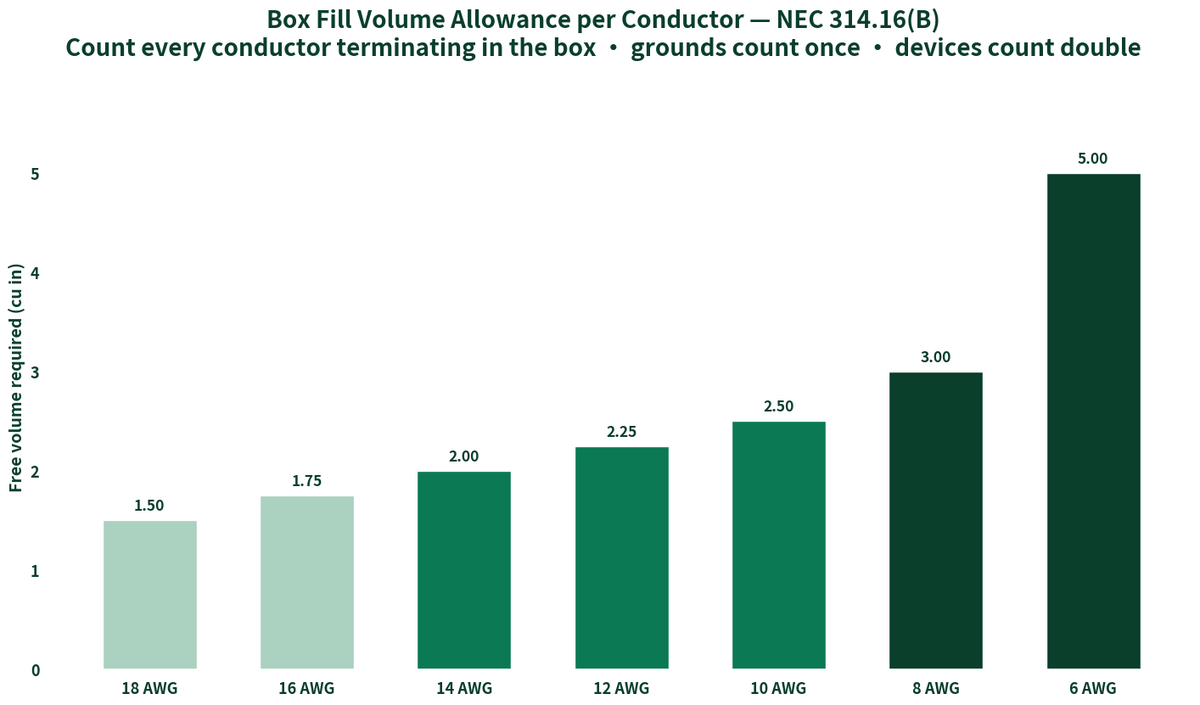
- Volume allowances per conductor from Table 314.16(B): 14 AWG = 2.00 in³, 12 AWG = 2.25 in³, 10 AWG = 2.50 in³, 8 AWG = 3.00 in³, 6 AWG = 5.00 in³.
- All equipment grounding conductors together count as one allowance, sized by the largest ground present. Each device yoke counts as two allowances of the largest conductor connected to it.
- A single-gang 3×2×2-1/2" box (12.5 in³) fails with two 12/2 NM cables and a receptacle — you need an 18 in³ box or a 4" square with a mud ring.
- Pigtails that start and end inside the box, and connectors outside the box, don't count. Conductors passing straight through count once each.
Box fill is the calculation most electricians skip and most inspectors check. Stuff a single-gang box with two cables, a ground bundle, and a receptacle, and you're over the NEC 314.16 limit before the drywall goes up — conductors overheat, devices won't seat, and the red tag follows. The calculator below does the 314.16 count for you: pick a standard box (or enter its stamped cubic inches), add your conductors by AWG, grounds, clamps, and devices, and it returns the required volume and a pass/fail against the box you chose. Below the calculator: the counting rules in plain language, the full standard-box volume table, and worked examples.
Need boxes, mud rings, or devices to finish the rough-in? Browse our electrical supplies collection — 50,000+ SKUs with trade pricing.
Box Fill Calculator (NEC 314.16)
Required volume: — · Box volume: —
Result: — · Margin: —
Volumes from NEC Table 314.16(A) (metal boxes) and allowances from Table 314.16(B). Add a mud ring's stamped volume when using one, and count any box extension. Verify against the current NEC and local amendments.
How NEC 314.16 Counts Everything in the Box
The rule is one sentence: the box's volume must be at least the sum of the allowances for everything inside it. The counting rules in 314.16(B):
| What's in the box | Allowance | Sized by |
|---|---|---|
| Each conductor originating outside and terminating or spliced inside | 1 | Its own AWG |
| Each conductor passing through unbroken (12" or longer loop = 2) | 1 | Its own AWG |
| All equipment grounding conductors combined (up to 4; add 1/4 allowance per extra ground beyond 4) | 1 | Largest ground present |
| Internal cable clamps (one or more) | 1 | Largest conductor present |
| Each device yoke (receptacle, switch) | 2 | Largest conductor connected to the device |
| Luminaire studs or hickeys (each) | 1 | Largest conductor present |
| Pigtails starting and ending inside the box | 0 | — |
The allowances themselves come from Table 314.16(B), per conductor:
| Conductor size | 18 AWG | 16 AWG | 14 AWG | 12 AWG | 10 AWG | 8 AWG | 6 AWG |
|---|---|---|---|---|---|---|---|
| Free volume (in³) | 1.50 | 1.75 | 2.00 | 2.25 | 2.50 | 3.00 | 5.00 |
Two details save rework. First, the ground rule: since the 2020 NEC, up to four equipment grounding conductors share one allowance, with a quarter-allowance added for each ground beyond four — the calculator above uses the single-allowance rule, which covers the overwhelming majority of residential and light commercial boxes. Second, the device rule: a receptacle or switch on a yoke counts double, and it's sized by the largest conductor connected to that device, not the largest in the box. A GFCI on 12 AWG in a box full of 14 AWG still claims 2 × 2.25 in³.
Standard Box Volumes (NEC Table 314.16(A))
| Box | Depth | Volume (in³) | Max 14 AWG | Max 12 AWG | Max 10 AWG |
|---|---|---|---|---|---|
| 3×2" device | 1-1/2" | 7.5 | 3 | 3 | 3 |
| 3×2" device | 2" | 10.0 | 5 | 4 | 4 |
| 3×2" device | 2-1/4" | 10.5 | 5 | 4 | 4 |
| 3×2" device | 2-1/2" | 12.5 | 6 | 5 | 5 |
| 3×2" device | 2-3/4" | 14.0 | 7 | 6 | 5 |
| 3×2" device | 3-1/2" | 18.0 | 9 | 8 | 7 |
| 4×2-1/8" handy | 1-7/8" | 10.3 | 5 | 4 | 4 |
| 4×2-1/8" handy | 2-1/8" | 13.0 | 6 | 5 | 5 |
| 4×2-1/8" handy | 2-1/2" | 14.5 | 7 | 6 | 5 |
| 4" octagonal | 1-1/4" | 12.5 | 6 | 5 | 5 |
| 4" octagonal | 1-1/2" | 15.5 | 7 | 6 | 6 |
| 4" octagonal | 2-1/8" | 21.5 | 10 | 9 | 8 |
| 4" square | 1-1/4" | 18.0 | 9 | 8 | 7 |
| 4" square | 1-1/2" | 21.0 | 10 | 9 | 8 |
| 4" square | 2-1/8" | 30.3 | 15 | 13 | 12 |
| 4-11/16" square | 1-1/2" | 29.5 | 14 | 13 | 11 |
| 4-11/16" square | 2-1/8" | 42.0 | 21 | 18 | 16 |
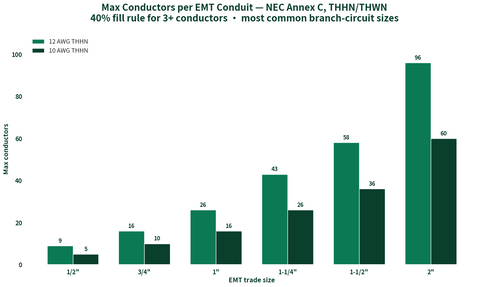
"Max conductors" is the Table 314.16(A) conductor maximum — conductors only, no devices, clamps, or grounds. Real-world boxes with devices always hold fewer; that's what the calculator is for. Non-standard and plastic boxes use the manufacturer's stamped volume instead of this table.
Worked Examples
Example 1: Single-gang receptacle, two 12/2 NM cables (the classic failure)
A bedroom receptacle with power in and power out: two 12/2-with-ground NM cables in a 3×2×2-1/2" device box (12.5 in³):
- 4 current-carrying 12 AWG conductors (hot/neutral × 2 cables): 4 × 2.25 = 9.00 in³
- 2 grounds: one allowance at 12 AWG = 2.25 in³
- 1 receptacle yoke: 2 × 2.25 = 4.50 in³
- Internal clamps (NM box with clamps): 1 × 2.25 = 2.25 in³
- Total required: 18.00 in³ vs. 12.50 in³ available — FAILS by 5.5 in³.
The fix is a 3×2×3-1/2" deep box (18.0 in³) — right at the limit, so many crews jump straight to a 4" square with a single-gang mud ring (21.0 in³ + ring volume) for fold-in room. This exact scenario is why deep boxes outsell standard boxes at the counter.
Example 2: Ceiling fan box with a switch leg
A 4" octagonal 2-1/8" deep box (21.5 in³) feeding a fan/light: one 14/3 in (3 conductors + ground), one 14/2 out to the switch loop (2 conductors + ground):
- 5 × 14 AWG conductors: 5 × 2.00 = 10.00 in³
- Grounds: 1 × 2.00 = 2.00 in³
- Clamps: 1 × 2.00 = 2.00 in³
- Total: 14.00 in³ vs. 21.5 in³ — passes with 7.5 in³ spare. Room left for the fan brace's hardware and a smart-fan receiver.
Example 3: 4-11/16" square box as a junction for a subpanel feed tap
A 4-11/16" box (42.0 in³) splicing three 6 AWG THHN conductors through, unbroken, plus a grounding pigtail:
- 3 × 6 AWG through-conductors: 3 × 5.00 = 15.00 in³
- Ground allowance: 1 × 5.00 = 5.00 in³
- Total: 20.00 in³ vs. 42.0 in³ — passes easily. Even doubling the splice with a second set of conductors (40 in³) still fits.
Plastic Boxes, Mud Rings, and Extensions
Table 314.16(A) covers standard metal boxes. Everything else gets its volume from the manufacturer's stamp — plastic old-work and new-work boxes are marked in cubic inches right inside the box, and 314.16(A)(2) requires the marking. Use the custom option in the calculator with the stamped number. Mud rings (raised covers) add their stamped volume on top of the box, which is why a 4" square with a deep single-gang ring beats most device boxes. Box extensions add their volume too — handy when a remodel adds a cable to an existing box that's suddenly over. And remember the companion rule in 314.16(A): no box may be used with more conductors than its Table 314.16(A) maximum for that size, regardless of the cubic-inch math.
Roughing in a full house or a TI build-out? Get boxes, rings, devices, and NM/connectors quoted together from our electrical supplies collection — and if the project includes a subpanel or service work, see our breakers and panel gear in the same aisle.
Frequently Asked Questions
How do you calculate box fill per NEC 314.16?
Add up volume allowances: one per conductor that enters the box and terminates or splices inside (sized by its AWG from Table 314.16(B)), one allowance for all grounds combined (sized by the largest ground), one for internal clamps, and two per device yoke (sized by the largest conductor on the device). The box's stamped or Table 314.16(A) volume must equal or exceed the total.
Do ground wires count in box fill?
Yes, but generously: up to four equipment grounding conductors together count as a single volume allowance, sized by the largest ground present. Under the 2020 NEC and later, each ground beyond four adds a quarter allowance. Ground pigtails that start and end inside the box count toward that single allowance, not separately.
How many 12/2 Romex cables fit in a single-gang box?
In a standard 3×2×2-1/2" box (12.5 in³) with a receptacle: one 12/2 cable fits comfortably (2×2.25 + 2.25 + 2×2.25 = 11.25 in³ without clamps), but two cables plus the receptacle require 18 in³ — you need a deep 3×2×3-1/2" box or a 4" square with a mud ring.
Do wire nuts and pigtails count toward box fill?
No. Wire connectors, including wire nuts and push-in connectors, don't count, and pigtails that originate and terminate inside the box are free per 314.16(B)(1). What counts is every conductor entering from outside the box, the grounds allowance, clamps, and devices.
What size box do I need for a GFCI with two cables?
A GFCI on 12 AWG with two 12/2 cables needs 4×2.25 (conductors) + 2.25 (grounds) + 2×2.25 (device) = 15.75 in³, plus 2.25 in³ if the box has internal clamps. A 3×2×3-1/2" deep box (18 in³) is the minimum; given a GFCI's depth, most electricians spec a 4" square box with a mud ring (21+ in³) for a clean install.
Need Boxes, Devices, or a Full Rough-In Package?
PES Supply stocks device boxes, 4" and 4-11/16" squares, mud rings, and receptacles from 169 authorized brands. Send your floor plan or takeoff and we'll quote the whole package.
Shop Electrical Supplies Contact Us for Bulk PricingRelated Resources
- Electrical supplies: boxes, devices, breakers, and panels
- Generators and transfer equipment
- Solar panels and array equipment