Battery Bank Sizing Calculator: kWh, Days of Autonomy & DoD (2026)
Size an off-grid or backup battery bank in four inputs — daily kWh, days of autonomy, depth of discharge by chemistry, and system voltage — with the math contractors actually use on site.
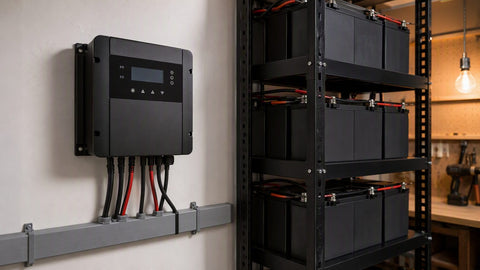
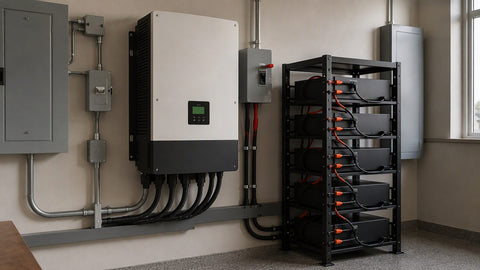
Most battery banks we see fail on paper before they ever fail in the field. The customer sized the bank off the battery label instead of the usable kilowatt-hours, ignored inverter losses, or picked a 12V architecture for a 4 kW load and then wondered why the cables were melting. Bank sizing is three lines of arithmetic — but the inputs have to be honest. This guide gives you the working calculator, the formula behind it, a chemistry-by-chemistry depth-of-discharge comparison, and two fully worked installs. Everything here reflects how we spec systems from our batteries & storage racks paired with inverters we actually stock.
Enter your numbers. Results update as you type. DoD auto-fills from the chemistry you select — override it if your manufacturer specs something different.
From a load audit or kWh meter, not the utility bill's monthly average if seasons differ.
Days the bank must carry loads with no solar or generator input. 1–3 is typical.
Sets the recommended depth of discharge below.
LFP 80–90%, AGM/flooded 50% for rated cycle life.
48 V for anything over ~2 kW of inverter load. See the voltage section below.
The calculator runs the standard off-grid sizing chain. Each step exists because a real loss or limit lives there:
Sizing chain
- Step 1 — Energy demand: daily kWh × days of autonomy = the AC energy the bank must deliver through the worst stretch you design for.
- Step 2 — Inverter efficiency: divide by 0.95. Every AC kilowatt-hour your loads see costs about 1.05 kWh out of the battery because inverters burn 3–7% in conversion. Skip this step and your bank is 5% undersized on day one.
- Step 3 — Depth of discharge: divide by DoD. A 10 kWh LFP battery at 90% DoD gives you 9 kWh; a 10 kWh AGM bank at 50% gives you 5 kWh. This is where lead-acid banks double in size on paper.
- Step 4 — Amp-hours: nameplate kWh × 1,000 ÷ system voltage = Ah. Ah is how batteries are sold, but it's only meaningful at a stated voltage — 200 Ah means 2.4 kWh at 12V and 9.6 kWh at 48V.
One input the calculator deliberately leaves to you: days of autonomy. Grid-tied backup with solar recharge usually needs one day or less — the array refills the bank every morning. True off-grid cabins in cloudy climates get specced at 2–3 days. Beyond 3 days, a generator almost always beats more batteries on cost per delivered kWh; the hybrid designs we build run the generator a few efficient hours to refill instead of stacking a week of lithium.
Chemistry choice moves the required bank size more than any other variable. Here is the honest comparison for stationary storage in 2026:
| Spec | LiFePO4 (LFP) | AGM | Flooded lead-acid |
|---|---|---|---|
| Recommended DoD (daily cycling) | 80–90% | 50% | 50% |
| Cycle life at that DoD | 4,000–6,000 cycles | 400–800 cycles | 500–1,200 cycles |
| Round-trip efficiency | 95–98% | 80–85% | 75–85% |
| Usable kWh per 10 nameplate kWh | 8–9 kWh | 5 kWh | 5 kWh |
| Weight per usable kWh | ~13–15 lb | ~55–65 lb | ~55–70 lb |
| Maintenance | None (BMS-managed) | None, but ventilation advised | Watering, equalization, venting required |
| Charge acceptance | 0.5–1C, no absorption tail | 0.2–0.3C, long absorption | 0.1–0.2C, long absorption |
| Typical warranted life | 10–15 years | 2–5 years | 3–8 years |
Read the "usable kWh" row twice. A 10 kWh LFP module and a 10 kWh AGM string are not the same product — the AGM string delivers barely half the energy and wears out in a fraction of the cycles. That's why our batteries & storage lineup has gone overwhelmingly LFP for new builds: the higher sticker price buys 8–10× the lifetime energy throughput. Lead-acid still earns its place in two niches — cold-climate unheated spaces where lithium BMS units restrict charging below freezing, and float-duty standby banks that cycle a handful of times per year.
A practical LFP note: running 90% DoD daily is within spec for quality cells, but holding the bank between roughly 10% and 90% state of charge (an 80% window) measurably slows calendar aging. If the budget allows, size the bank at 80% DoD and treat the last 10% as emergency reserve. The calculator lets you do exactly that by overriding the DoD field.
Scenario
- Load audit: 3.5 kWh/day — LED lighting, 16 cu ft fridge, well pump cycles, Starlink, device charging, no electric heat.
- Autonomy target: 2 days (Pacific Northwest winter solar is unreliable; generator backup exists but the owner wants silence).
- Chemistry: LFP at 90% DoD. System voltage: 48V.
Step 1: 3.5 kWh × 2 days = 7.0 kWh of AC demand.
Step 2: 7.0 ÷ 0.95 = 7.37 kWh out of the battery.
Step 3: 7.37 ÷ 0.90 = 8.2 kWh nameplate.
Step 4: 8.2 kWh × 1,000 ÷ 48V = ≈171 Ah at 48V.
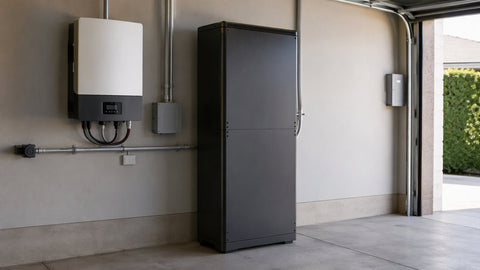
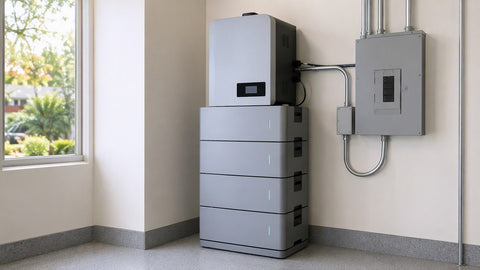
Spec: two 5.12 kWh (100 Ah / 51.2V) server-rack LFP modules in parallel — 10.24 kWh nameplate, about 9.2 kWh usable. That lands ~25% over the math, which is exactly right: it covers battery aging, the inverter's idle draw, and the cloudy week when day three shows up uninvited.
Scenario
- Critical-loads panel: 10 kWh/day — fridge, freezer, furnace blower, internet, lighting, one bedroom mini-split at night.
- Autonomy target: 1 day (grid-tied with 8 kW solar that recharges the bank daily; this is outage ride-through, not off-grid).
- Chemistry: LFP at 80% DoD for longevity. System voltage: 48V (hybrid inverter DC bus).
Step 1: 10 kWh × 1 day = 10 kWh.
Step 2: 10 ÷ 0.95 = 10.5 kWh from the battery.
Step 3: 10.5 ÷ 0.80 = 13.2 kWh nameplate.
Step 4: 13.2 × 1,000 ÷ 48 = ≈274 Ah at 48V.
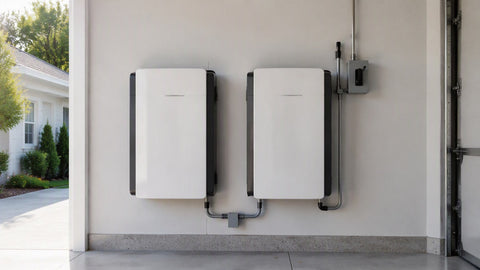
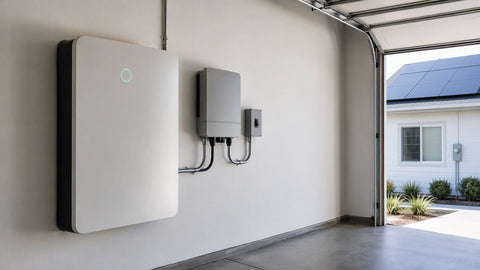
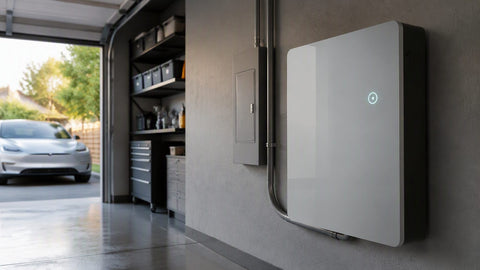
Spec: three 5.12 kWh rack modules (15.36 kWh nameplate) or one 14.3 kWh wall-mount unit, paired with a hybrid inverter from our inverter lineup sized for the surge — the furnace blower and mini-split decide the inverter's kW rating, the bank decides its runtime. Size energy and power separately; confusing them is the most common spec error we correct.
Voltage choice is an amperage decision wearing a disguise. The same 4 kW inverter draws ~370A from a 12V bank, ~185A at 24V, and ~92A at 48V. Conductor size, fuse class, terminal torque, and resistive loss all scale with current, not watts. At 12V and 4 kW you're buying 4/0 copper, Class T fuses the size of a deck of cards, and accepting voltage sag every time the well pump kicks. The same system at 48V runs on 2 AWG with comfortable margins. Our rule of thumb: 12V under 1 kW (RVs, small marine), 24V to about 2 kW, 48V for anything residential. NEC Article 706 covers energy storage systems generally, and the 2023 code's requirements for listed ESS equipment in dwellings are another push toward factory-integrated 48V LFP modules over field-built 12V strings.
One more sizing reality: the bank and the inverter are a matched pair. A 15 kWh bank feeding a 3 kW inverter is a marathon runner; the same bank behind a 12 kW hybrid inverter is a sprinter that can also carry central AC with a soft starter. Check the battery's continuous discharge rating (often 0.5C–1C) against the inverter's full-load DC draw before you commit — a 5.12 kWh module rated at 100A continuous tops out around 5 kW, so two modules are the floor behind any 6+ kW inverter regardless of what the energy math says.
How many days of autonomy do I really need? Grid-tied backup with daily solar recharge: one day, sometimes less. Off-grid with a generator in the system: two days is the sweet spot. Off-grid with no generator in a cloudy climate: three days, and accept that a few times a year you'll still be short. Beyond three days, batteries lose to generators on cost per delivered kWh every time we run the numbers.
Can I mix old and new batteries in one bank? Don't. In a parallel lead-acid bank the weakest string drags the rest down with it, and even LFP modules from different production batches can diverge in internal resistance. Expand within the same model line, ideally within a year of the original purchase, and always parallel at the busbar — never series-mix ages.
Is 100% DoD on LFP really a problem? Quality LFP cells survive 100% DoD, but cycle life drops measurably — typically from 6,000+ cycles at 80% DoD to 2,500–3,500 at 100%. Reserve the last 10–20% as longevity margin and emergency headroom. Your BMS low-voltage cutoff should sit above true empty regardless.
Why does my 10 kWh battery only deliver 8 kWh on my monitoring app? That's the math working as designed: reserve buffers at top and bottom of the charge window, plus 4–7% inverter conversion loss between battery DC and your AC panel. Nameplate kWh is a marketing number; usable AC kWh is what pays the bills. Size from usable, always.
Should I oversize the bank? 20–30% over the calculated value, yes — it absorbs capacity fade, inverter idle draw, and load creep, and LFP longevity improves when daily cycles stay shallower. Beyond ~50% oversize you're buying capacity that sits idle; that money usually works harder in more solar panels.
Does temperature change the sizing? Charging does: LFP cells must not be charged below freezing without heating, and most BMS units block it outright. Discharge capacity also dips in the cold — figure 10–20% less available energy at 0°F. If the bank lives in an unheated space, either buy modules with internal heaters or add that margin to the kWh number.
What size inverter pairs with my bank? Two checks: the inverter's continuous kW must cover your largest simultaneous load combination (with surge headroom for motors and compressors), and the bank's continuous discharge amps at system voltage must cover the inverter's full-load DC draw. A 48V, 10 kWh bank of 100A modules delivers about 5 kW continuous per module — match accordingly from our inverter selection.
Do I need a permit or inspection for a battery bank? For anything grid-interactive or installed in a dwelling, assume yes. NEC Article 706 governs energy storage, Article 705 covers interconnection, and most AHJs want listed ESS equipment, proper disconnects, and labeled working clearances. Portable and RV systems under certain thresholds are typically exempt — check your local AHJ before the wire gets pulled, not after.
Sources: manufacturer datasheets and warranty terms for the LFP and AGM lines we stock, NEC 2023 Articles 705/706, and PES Supply system specs from commissioned installs. Ready to turn the math into a bill of materials? Get a free system quote — bank, inverter, and balance-of-system priced together, with bulk and contractor pricing on batteries & storage.