🇺🇸/🇲🇽 Versión en español →
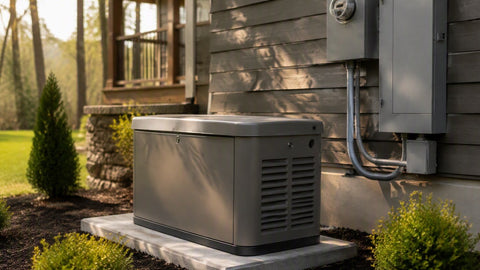
Generac sells more residential standby generators than every competitor combined, which means contractors field the same warranty question on nearly every quote: is the extended warranty worth it, and what does the 5, 7, or 10-year coverage actually include? The marketing line — "up to 10 years of coverage" — hides a tiered structure where parts, labor, and travel are covered differently in different years, and where installation quality determines whether a claim gets paid at all. This explainer breaks down the standard factory terms by product line, what the extended limited warranties add, the activation windows you cannot miss, and the cost-versus-risk math. Always verify current terms against the warranty statement shipped with the specific model — Generac revises terms periodically — but the structure below reflects how the program works today.
Spec Sheet — Generac Warranty Essentials
- Standard Guardian coverage: 5 years limited — parts + labor + limited travel years 1–2, then parts-only on major components
- Extended options: 7-year and 10-year limited warranties, sold through dealers, typically purchasable within 12 months of unit purchase
- What extended really buys: a deeper parts + labor window — labor is where generator repairs get expensive
- Claim path: authorized service dealer network only — not the retailer, not a homeowner phone call
- Fastest way to void it: DIY standby installation, missed maintenance records, non-Generac parts
Standard Factory Warranty by Product Line


Coverage varies significantly across the Generac portfolio. The headline number is never the whole story — the year-by-year breakdown of parts, labor, and travel is what matters.
| Product Line | Standard Limited Warranty | Typical Structure |
|---|---|---|
| Guardian series air-cooled standby (10–26 kW) | 5 years | Years 1–2: parts + labor + limited travel. Years 3–5: parts only, major components (engine, alternator) |
| Protector / liquid-cooled standby (22–150 kW) | 5 years (residential); shorter for commercial use | Front-loaded parts + labor, tapering to parts-only on major components |
| Portable generators (GP, XT, iQ series) | 2–3 years residential; 1 year commercial/rental | Year 1 parts + labor; remaining years parts only, engine/alternator |
| PWRcell / clean energy products | 10 years (battery throughput-limited) | Separate program — not part of generator extended warranty offers |
Planning a standby install? Get a whole-home generator quote — units in stock at 12+ PES hubs, or browse our generator lineup.
Two things contractors should internalize from that table: the standard Guardian warranty goes parts-only after year 2, and labor is where generator repairs get expensive. A stator or control board might be a $400 part with $900 of labor and travel attached. That gap is exactly what extended coverage sells.
Generac's extended limited warranties — sold through dealers and, on some promotions, bundled with the unit — extend the parts + labor window deeper into the unit's life. The representative structure for a Guardian-series air-cooled unit:
| Coverage Year | Standard 5-Year | 7-Year Extended | 10-Year Extended |
|---|---|---|---|
| Years 1–2 | Parts + labor + limited travel | Parts + labor + travel | Parts + labor + travel |
| Year 3 | Parts only (major components) | Parts + labor | Parts + labor |
| Years 4–5 | Parts only (major components) | Parts + labor (major components) | Parts + labor (major components) |
| Years 6–7 | — | Parts (major components), labor limited | Parts + limited labor (major components) |
| Years 8–10 | — | — | Parts only (engine, alternator, controller) |

The honest summary: the 10-year extension is really a 5–7 year parts-and-labor upgrade plus a long tail of parts-only protection on the expensive hard parts. That is still meaningful — engines and alternators are the costly failures — but it is not "bumper-to-bumper for a decade," and quoting it that way to a customer creates a warranty dispute in year 8.
The paperwork calendar is part of the product. Miss a window and coverage degrades or vanishes regardless of what was paid:
| Requirement | Guardian Air-Cooled Standby | Protector Liquid-Cooled | Portable (GP/XT/iQ) |
|---|---|---|---|
| Product registration | At install; sets warranty start date | At install; sets warranty start date | Recommended at purchase |
| Dealer activation / commissioning code | Required at startup | Required at startup | Not applicable |
| Extended warranty purchase window | Typically within 12 months of unit purchase | Typically within 12 months of unit purchase | Limited programs; check current offers |
| First maintenance due | Break-in oil change per manual (~25 hrs), then annual / 100–200 hr intervals | Per manual; longer intervals, documented | Break-in oil change, then per hours run |
| Records to keep | Invoice, registration confirmation, activation record, every maintenance receipt, firmware update log | ||
If a unit sits in a warehouse or on a dealer's floor for months before installation, unregistered coverage silently burns from the manufacture date. Register at install, every time, same day.
Miss the paperwork window and the extended coverage is void regardless of what the customer paid:
- Product registration: The generator itself must be registered with Generac (serial number, install date, installer info) — registration establishes the warranty start date. No registration, and Generac defaults to the manufacture date, which can silently burn months of coverage sitting in a warehouse.
- Extended warranty purchase window: Extended limited warranties must typically be purchased within 12 months of the original unit purchase date. You generally cannot buy a 10-year extension in year 4 after the first expensive repair quote.
- Commissioning: Standby units require activation with a dealer-issued code at startup. Unactivated units create claim headaches later — the activation record is Generac's proof the unit was installed and started correctly.
- Proof of purchase: Keep the invoice. Every claim starts with it.
This is where contractors protect their customers — and themselves:
- DIY installation of a standby unit. Generac requires installation per the installation manual by a qualified installer; a homeowner-set unit with an undersized gas line and no permit is a denied claim waiting to happen. This is the single most common warranty fight in the residential standby market.
- Missed maintenance. Oil and filter changes, valve adjustments at the specified hours, battery replacement, firmware updates. Keep records. "Recommended maintenance" becomes "required maintenance" the moment a claim is filed.
- Non-Generac parts and unauthorized repairs. Aftermarket controllers, third-party oil filters that starve the engine, or repair attempts by non-authorized techs can void the affected systems.
- Improper application. Using a residential Guardian for commercial prime power, overloading the unit, or installing outside the manual's environmental specs (unprotected coastal salt exposure, enclosed spaces causing overheating).
- Relocation without dealer involvement. Moving an installed unit to a new property typically requires re-commissioning to keep coverage intact.
Patterns we see across the counter, anonymized but real:
- The unregistered rental house. A landlord installed a 22 kW Guardian at a rental, never registered it, and filed a stator claim in "year 3." Generac dated coverage from manufacture — the unit had sat in a distributor's warehouse 14 months — and ruled the failure past the parts+labor window. Customer paid $1,800 in labor that registration would have covered. Lesson: register at install, same day, with the install date documented.
- The eBay filter kit. A homeowner changed his own oil with a third-party filter that collapsed internally, starved the bearings, and destroyed the crank in year 2. Engine damage was traced to the non-OEM filter and denied. Lesson: the $12 saved on a filter cost an engine. Use Generac maintenance kits and keep the receipts.
- The beach house with no enclosure. A unit installed 200 ft from the surf with no corrosion protection ate its stator and enclosure in year 4. The manual's environmental specs exclude unprotected direct salt exposure; the claim was reduced and the enclosure replacement was out of pocket. Lesson: coastal installs need the corrosion-resistant enclosure option documented on the invoice from day one.
- The maintenance log that didn't exist. A restaurant's liquid-cooled unit threw a rod at year 3. The owner swore the service company "handled everything" but could produce no invoices, and the service company had folded. Claim denied for undocumented maintenance. Lesson: keep your own copy of every service record, independent of any contractor.
Generac warranty claims run through the authorized service dealer network, not through the retailer and not directly with a homeowner phone call. The sequence: dealer diagnoses on site, files the claim with Generac, gets parts authorized, performs the repair, and bills Generac at warranty labor rates. Two practical realities: warranty labor rates are below retail labor rates (some dealers charge the customer the difference on non-covered items like travel beyond the allowance), and parts-only coverage years mean the customer pays labor out of pocket. As a stocking distributor, we see the smoothest outcomes when the installing dealer is also the servicing dealer — the install documentation and the maintenance records live in one place. For unit pricing and current bundles, see our Generac collection and standby generator lineup; standby home generators are also available with matched transfer switches.
Extended limited warranties on Guardian-series units typically run from a few hundred dollars (7-year) to roughly a thousand dollars (10-year), depending on model and promotion. Now the risk side of the ledger, using field failure patterns rather than marketing:
| Repair Event | Typical Cost (parts + labor + travel) | Peak Failure Window | Covered by Standard 5-Yr? |
|---|---|---|---|
| Control board / controller | $1,200–$2,500 | Years 2–6 (surge events, moisture) | Parts only after year 2 — labor out of pocket |
| Stator / alternator | $1,500–$2,800 | Years 3–7, harsher climates earlier | Parts only after year 2 |
| Battery, charger, stepper, sensors | $150–$600 | Continuous; batteries every 2–4 years | Often excluded as wear items |
| Major engine repair | $2,500–$4,500 | Years 5–10, maintenance-driven | Parts only through year 5; nothing after |
Run the expectation: if a unit in a harsh climate (heat, humidity, salt air, long outage duty) has, conservatively, a one-in-three chance of a $1,500+ failure in years 3–7 — the window where the standard warranty pays parts only — the expected uncovered exposure is $500 or more in labor alone, with a tail risk of a $3,000+ engine job. Against a ~$1,000 ten-year extension, Gulf Coast, Florida, and rural-grid customers come out ahead on expected value. For mild climates with short, rare outages, the extension is closer to break-even insurance. Quote it as a line item, show the customer this table, and let them decide with real numbers.
Contractor takeaway: The standard 5-year Guardian warranty goes parts-only after year 2 — labor is what extended coverage actually buys. Register every unit at install, activate at commissioning, buy the extension inside the 12-month window, and document maintenance like you expect a claim. Verify current terms on the warranty statement for the exact model before quoting coverage to a customer.
Warranty coverage gets the attention, but fuel is the line item that shows up in every long outage. Using representative published figures for a 22 kW air-cooled standby class (verify your exact model's spec sheet), here is the math we walk customers through at the counter:
| Fuel Scenario | Burn Rate | Fuel Cost Assumption | Cost per Hour | 72-Hour Outage Cost |
|---|---|---|---|---|
| Natural gas, full load | ~280 ft³/hr (≈2.8 therms/hr) | $1.50/therm | $4.20 | ≈$302 |
| Natural gas, half load | ~200 ft³/hr (≈2.0 therms/hr) | $1.50/therm | $3.00 | ≈$216 |
| Propane, full load | ~3.4 gal/hr | $2.75/gal | $9.35 | ≈$673 |
| Propane, half load | ~2.1 gal/hr | $2.75/gal | $5.78 | ≈$416 |
Two field realities behind those numbers. First, I have watched a five-day ice-storm outage turn a $1,000 propane refill into the real cost of ownership — customers on LP should size tanks for multi-day events, not the delivery driver's schedule. Second, natural-gas units only run as long as the gas utility's pressure holds; we tell every customer to ask their gas provider whether the meter and service line can deliver full-load volume, because a starved unit under load is a warranty claim and a service call rolled into one.
Frequently Asked Questions
How long is the standard Generac generator warranty?
Guardian-series air-cooled standby units carry a 5-year limited warranty: parts, labor, and limited travel in years 1–2, then parts-only coverage on major components (engine, alternator) through year 5. Portable generators run 2–3 years residential, and PWRcell battery products carry a separate 10-year throughput-limited program.
Is the Generac 10-year extended warranty worth it?
In harsh climates (heat, humidity, salt air) and for units that run long outages, usually yes — one covered stator or control-board job ($1,500–$2,800 with labor) exceeds the extension's cost. In mild climates with rare, short outages it is closer to break-even. The decision should be made with the repair-cost table above, not the brochure.
Can I buy the extended warranty after the first year?
Generally no. Extended limited warranties typically must be purchased within 12 months of the original unit purchase date. You cannot wait for the first expensive repair quote in year 4 and then buy coverage retroactively.
Does installing my own standby generator void the warranty?
It is the single most common cause of denied claims. Generac requires installation per the installation manual by a qualified installer, with permitting and inspection. A DIY-set unit — especially one with undersized gas piping or an improper transfer switch — gives the manufacturer straightforward grounds to deny.
Does the warranty transfer to a new homeowner?
Standard coverage on residential standby units generally follows the unit at the installed address, subject to the original registration and maintenance records. Relocating the unit to a different property typically requires dealer re-commissioning to keep coverage intact. Confirm the transfer terms on the specific model's warranty statement before promising it in a home sale.
What maintenance is required to keep the warranty valid?
Follow the model's maintenance schedule: break-in oil change, oil and filter at the specified hours or annually, valve adjustments where specified, battery replacement as needed, and controller firmware updates. Keep every receipt and a written log — undocumented maintenance is the second most common denial reason after DIY installation.
- Generac limited warranty statements by product line (generac.com)
- NEC Article 702 — Optional Standby Systems (installation context) (nfpa.org)
- NFPA 37 — Stationary Combustion Engines installation standard (nfpa.org)
Ready to price your project? Quote My System — free from PES.
- Generac Extended Warranty Guide
- Generac Power Systems Brand Guide for Contractors
- Generac vs. Briggs & Stratton (2026)
- Generac vs. Kohler Standby Generators
- Generac Protector 80 kW Standby Generator
- Standby Generator Sizing: How to Choose the Right kW
- Generac Generators & PWRcell — Collection