Last Updated: August 2026 • A Procurement Guide for Installers, EPCs, and Contractors
Panel pricing is rarely the line item installers get wrong on a bid — it's usually the one they get imprecise on, because wholesale solar pricing moves on variables that have nothing to do with the panel itself: tariff classification, domestic content thresholds, freight class, and how a distributor structures volume breaks. Two installers buying the same Tier 1 module from two different suppliers can see a real per-watt difference that has nothing to do with panel quality.
This guide covers how wholesale solar panel pricing actually works in 2026 — the trade policy and supply factors moving prices, current price ranges by technology, how volume tiers and purchasing channels affect what you pay, and what to check before trusting a quote.
⚡ Quick Answer
Wholesale residential and commercial solar panel pricing in 2026 generally runs $0.20–$0.55 per watt depending on cell technology, wattage class, and domestic content status, with N-type TOPCon panels representing the volume standard and commanding a modest premium over legacy P-type PERC clearance stock, while premium HJT panels sit meaningfully higher. Domestic content and U.S.-assembled panels typically carry a $0.03–$0.10/W premium over imported product, reflecting both manufacturing cost and the value of avoiding tariff and antidumping/countervailing duty exposure. Volume tiers matter more than brand loyalty: pallet-level, truckload-level, and container-level purchasing each unlock meaningfully lower per-watt pricing, and distributor relationships with committed volume typically beat one-off spot purchases even at the same nominal list price.
Key Takeaways for Wholesale Panel Buyers
- Trade Policy Moves Pricing More Than Manufacturing Cost: Section 201 safeguard tariffs, antidumping/countervailing duties (AD/CVD) on panels sourced through certain Southeast Asian manufacturing, and domestic content bonus provisions all directly affect landed cost.
- N-Type TOPCon Is the 2026 Volume Standard: P-type PERC is functionally end-of-life and available mainly as discounted clearance inventory; HJT/back-contact commands a premium tier above TOPCon.
- Volume Tiers Compound: pallet, truckload, and container-level purchasing each step down per-watt pricing — buying in the right unit size matters as much as negotiating the unit price itself.
- Domestic Content Isn't Just a Compliance Checkbox: for projects seeking the domestic content adder on applicable tax credits, sourcing must meet specific manufacturing thresholds documented by the manufacturer, not just be "assembled in the USA" in a general sense.
- Freight Class and Delivery Terms Affect Total Landed Cost: a lower per-watt panel price can be erased by freight, liftgate fees, or unfavorable delivery terms — always compare total landed cost, not just the panel line item.
- Payment Terms Shift Effective Cost: net-30 or net-60 terms from an established distributor carry real financing value compared to prepayment required by smaller or overseas suppliers.
- PES Supply: Tier 1 panels from 229+ brands at wholesale pricing with pallet and truckload tiers, transparent freight quoting, and contractor payment terms.
In This Guide
- What "Wholesale" Actually Means in Solar Distribution
- 2026 Price Ranges by Cell Technology
- Trade Policy: The Biggest Lever on Landed Cost
- Domestic Content: What Actually Qualifies
- Volume Tiers: Pallet, Truckload, Container
- Distributor vs. Manufacturer-Direct Purchasing
- Total Landed Cost: Beyond the Per-Watt Number
- Red Flags When Evaluating a Quote
- Frequently Asked Questions
What "Wholesale" Actually Means in Solar Distribution
"Wholesale" in solar distribution isn't a single fixed discount tier — it's a purchasing relationship where pricing scales with volume, payment reliability, and the buyer's standing as a licensed contractor or EPC rather than a one-time residential buyer. A distributor extends wholesale pricing because it's buying in bulk from manufacturers and reselling with a margin that's smaller per unit but sustained across recurring volume, rather than the one-off retail margin a homeowner buying a handful of panels would pay.
This means wholesale pricing is inherently relationship- and volume-dependent. A contractor with a documented history of consistent monthly purchasing typically negotiates better standing pricing than a new account making a first-time inquiry, independent of the specific panel being purchased.
2026 Price Ranges by Cell Technology
| Technology | Typical Wholesale Price | Market Position (2026) |
|---|---|---|
| P-Type PERC | $0.18–$0.28/W | End-of-life; clearance stock only, limited new production |
| N-Type TOPCon | $0.22–$0.38/W | Volume standard across residential and commercial |
| HJT (Heterojunction) | $0.35–$0.55/W | Premium tier — best temperature coefficient and degradation profile |
| Domestic-Content Bonus (any tech) | +$0.03–$0.10/W | Premium for U.S.-manufactured product meeting content thresholds |
Prices are illustrative wholesale ranges and vary by wattage class, order volume, and current market conditions. Always confirm current pricing directly with a supplier.
Trade Policy: The Biggest Lever on Landed Cost
More than manufacturing cost, trade policy has been the dominant driver of U.S. wholesale panel pricing volatility over the past several years. Three mechanisms matter most for a buyer to understand:
- Section 201 safeguard tariffs: a global tariff structure on imported crystalline silicon PV cells and modules, applied broadly regardless of country of origin, with periodic renewal and rate adjustment reviews.
- Antidumping and countervailing duties (AD/CVD): country- and company-specific duties applied when a manufacturer is found to be selling below fair value or benefiting from foreign government subsidies — these have specifically targeted panels manufactured in certain Southeast Asian countries using Chinese-origin materials routed to avoid direct China-origin tariffs.
- Domestic content provisions: tax credit bonus structures that reward projects using U.S.-manufactured equipment meeting specific content percentage thresholds, creating demand-side pressure that supports pricing for verified domestic product even when it's not the cheapest option on paper.
⚠ Country of Origin Documentation Matters
A panel's marketing country ("assembled in Country X") is not the same as its tariff and AD/CVD classification, which depends on where cells and wafers were manufactured, not just final assembly. Request specific country-of-origin and manufacturing-location documentation from any supplier before committing to a large order, particularly for commercial projects where a duty reclassification after the fact can materially change project economics.
Domestic Content: What Actually Qualifies
Domestic content bonus eligibility depends on manufacturer-provided documentation showing the percentage of a project's total costs attributable to components manufactured in the United States, calculated using specific Treasury guidance formulas rather than a general "made in USA" claim. For solar modules specifically, this typically requires documentation of where cells, not just final module assembly, were manufactured.
Buyers pursuing the domestic content adder on an applicable project should request this documentation in writing from the manufacturer before finalizing a purchase, not after — reclassification disputes after equipment is installed are far harder to resolve than confirming eligibility upfront.
Volume Tiers: Pallet, Truckload, Container
| Purchase Unit | Typical Volume | Pricing Impact |
|---|---|---|
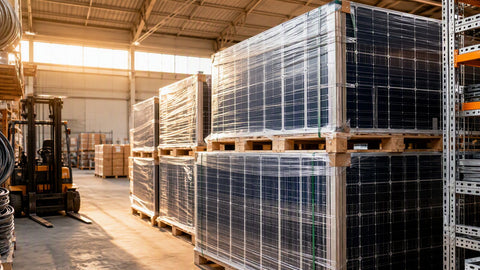
| Single Pallet | ~30–36 panels depending on model | Baseline wholesale pricing; the standard small-job purchase unit |
| Multi-Pallet / Partial Truckload | 3–10 pallets | Modest per-watt reduction, often 1–3 cents/W |
| Full Truckload | ~26 pallets | Meaningful step-down; freight cost amortized across full load |
| Container / Direct Import | Multiple truckloads equivalent | Lowest per-watt pricing; requires significant capital and storage capacity |
For most residential and small commercial installers, the practical decision isn't whether to buy a full container — it's whether aggregating several projects' worth of panel need into a single truckload order, rather than buying pallet-by-pallet as each job is signed, is worth the inventory carrying cost. For installers running consistent monthly volume, most distributors will also extend standing account pricing that approaches truckload-tier rates without requiring a single truckload purchase, in exchange for a documented purchasing history.
Distributor vs. Manufacturer-Direct Purchasing
| Channel | Advantages | Trade-Offs |
|---|---|---|
| Wholesale Distributor | Faster delivery from domestic stock, smaller minimum order quantities, payment terms, multi-brand access on one PO, warranty and RMA support | Per-watt price typically higher than direct container import |
| Manufacturer-Direct / Container Import | Lowest theoretical per-watt cost at high volume | Large minimum order quantities, upfront capital, customs/logistics complexity, longer lead times, buyer bears import compliance risk |
For the majority of residential and mid-size commercial installers, a distributor relationship delivers better effective economics than direct import once carrying costs, storage, customs brokerage, and warranty administration are factored in — the theoretical per-watt savings of container-direct buying rarely survives contact with the actual logistics and capital requirements at typical installer volumes.
Total Landed Cost: Beyond the Per-Watt Number
A quote's headline per-watt price is only useful once compared on a true landed-cost basis. Always confirm what's included and what's added separately:
- Freight terms: whether shipping is included, freight-collect, or quoted separately, and whether liftgate or residential delivery fees apply.
- Minimum order quantities: a lower headline price sometimes requires a volume commitment that doesn't match your actual near-term need.
- Payment terms: net-30/60 terms have real financing value compared to prepayment or credit card surcharges that some smaller suppliers apply.
- Warranty administration: confirm whether the seller — not just the manufacturer — provides responsive RMA support, since a technically valid manufacturer warranty is only as useful as the process for actually invoking it.
- Restocking and return policies: relevant if a project scope changes after panels are ordered.
Red Flags When Evaluating a Quote
| Red Flag | Why It Matters |
|---|---|
| Price significantly below prevailing market range | Often signals unclear country-of-origin risk, undisclosed duty exposure, or grey-market/salvage inventory |
| No documented country of origin or cell manufacturing location | Creates tariff reclassification risk and disqualifies domestic content claims |
| Vague or unverifiable warranty terms | A warranty from a manufacturer with no established U.S. claims process is difficult to enforce years into the field |
| Freight and delivery terms not itemized separately | Makes true landed-cost comparison across suppliers impossible |
| Requires full prepayment with no established distributor track record | Elevated counterparty risk on large orders |
Frequently Asked Questions
What is a typical wholesale price per watt for solar panels in 2026?
Wholesale pricing generally runs $0.18–$0.55 per watt depending on cell technology, with N-type TOPCon panels — the current volume standard — typically landing between $0.22 and $0.38 per watt before any domestic content premium.
Why does the same panel model sometimes have different prices from different suppliers?
Differences usually trace back to country-of-origin and tariff/AD-CVD classification, volume tier purchased, payment terms, and whether freight is included. Two suppliers selling a nominally identical model can have real cost basis differences that justify a price gap.
Is it worth buying panels direct from an overseas manufacturer instead of a domestic distributor?
For most residential and mid-size commercial installers, no — once minimum order quantities, customs brokerage, storage, and warranty administration burden are factored in, the theoretical per-watt savings of direct import rarely outweighs the practical advantages of an established domestic distributor relationship.
How do I know if a panel qualifies for the domestic content tax credit bonus?
Request written documentation from the manufacturer or distributor confirming the specific domestic content percentage the module qualifies for under current Treasury guidance, before finalizing a purchase for a project where the bonus is part of the financial model.
What volume do I need to order to get better pricing?
Pricing typically steps down at multi-pallet, full truckload, and container volume tiers. Installers with consistent monthly purchasing volume can often negotiate standing account pricing that approaches truckload-tier rates without a single large purchase, based on documented purchase history.
Ready to Price Your Next Project?
PES Supply stocks Tier 1 panels from 229+ brands at wholesale pricing, with transparent freight quoting, documented country-of-origin information, and contractor payment terms. Get pallet, truckload, and standing-account pricing on the same quote.
Request a Wholesale Quote Set Up a Pro AccountRelated Guides
- Best Solar Panels 2026 — Buyer's Guide
- Qcells vs Trina vs JA
- Pro Account — Wholesale Pricing
- PowerLink Network — Contractor Program
- Solar Incentives by State
- Solar Panels
- Request a Quote - Wholesale pricing on Tier 1 panels and complete kits
About PES Supply
PES Supply is a nationwide distributor of Tier 1 solar panels, commercial inverters, battery storage systems, EV charging hardware, racking, switchgear, circuit breakers, generators, and complete electrical project kits. With 12+ distribution hubs, thousands of in-stock SKUs from 229+ authorized brands, NABCEP-certified design support, and a network of 8,500+ solution providers, PES Supply serves contractors, EPCs, developers, and businesses with fast delivery, wholesale pricing, and expert procurement guidance.
Location: 1507 Portland Ave, Louisville, KY, United States | Phone: 1 888-876-0007 | Website: www.portlandiaelectric.supply
Article: Solar Panel Wholesale Pricing: What Installers Should Know in 2026
Category: Procurement | Contractor Resources | Solar Panels
Last Updated: August 2026
Disclaimer: Pricing ranges, tariff descriptions, and domestic content information in this guide reflect general market conditions and publicly available trade policy information as of August 2026. Trade policy, duty rates, and tax credit eligibility rules change; always confirm current terms with your supplier and a qualified tax advisor before finalizing a large purchase or project financial model.