EPA 608 Certification Guide: Type I, II, III, and Universal Testing Paths for HVAC Contractors
Which cert type your techs actually need, how to test, what it costs, and how to think about crew-wide credentialing.

Every technician who buys, handles, recovers, or services equipment containing more than 2 lb of a Class I or Class II ODS or HFC refrigerant in the United States is required to hold an EPA Section 608 certification. This is not an OSHA card, a state license, or a factory certification -- it is a specific federal credential issued under 40 CFR Part 82 Subpart F, and it is a lifetime certification (no renewal required).
The certification is testing-based. There is no coursework requirement, no apprenticeship, no experience gate. A candidate pays a test fee, sits an EPA-approved exam, and if they pass, they receive a wallet card that grants legal authority to purchase refrigerant in cylinders larger than 2 lb from any wholesaler. Distributors like PES are legally obligated to verify the card on file before selling.
The question is not whether your techs need to be certified -- they all do -- but which of the four cert types is optimal, whether to test in-person or online, and how to structure the credentialing across a growing crew. This guide covers the practical answers.
| Type | Covers | Typical technicians | Test format | First-attempt pass rate | Exam fee (average) |
|---|---|---|---|---|---|
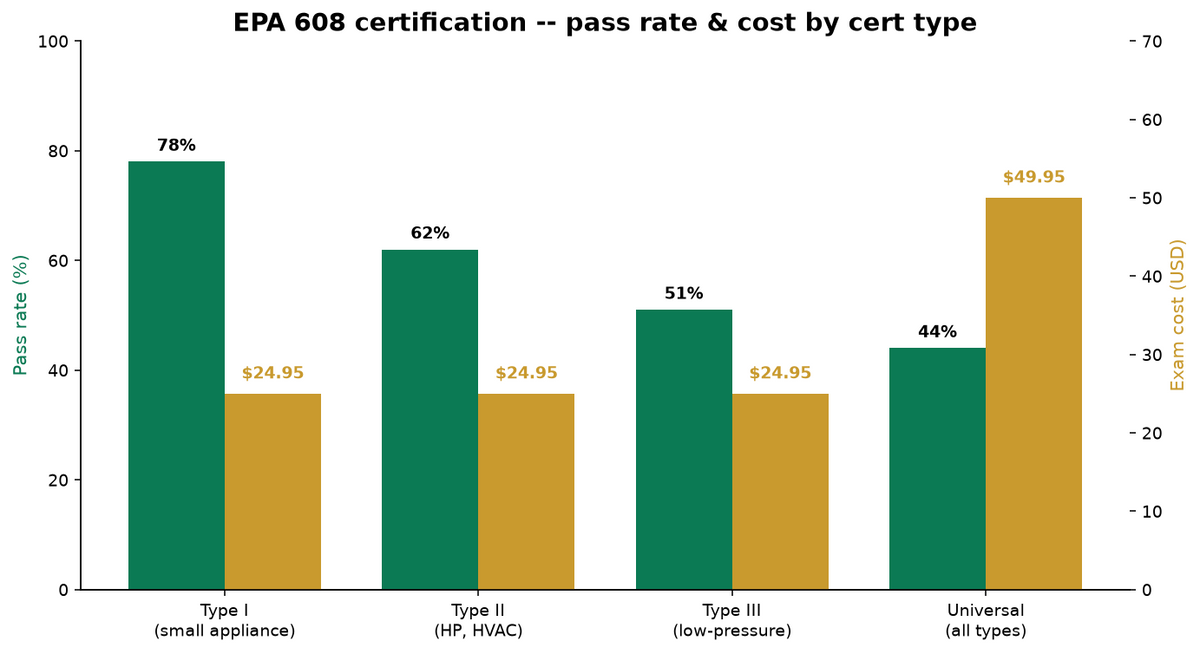
| Type I | Small appliances (window units, dehumidifiers, drinking fountains, <5 lb charge) | Property maintenance, appliance repair | 25 questions, open-book online allowed | 78% | $24.95 |
| Type II | High-pressure and very-high-pressure appliances (residential AC, heat pumps, commercial split systems) | Residential HVAC, light commercial | 25 questions, proctored required for cert | 62% | $24.95 |
| Type III | Low-pressure appliances (centrifugal chillers) | Commercial and industrial chiller techs | 25 questions, proctored required | 51% | $24.95 |
| Universal | All three types plus core section | Journey-level HVAC, senior service techs | 100 questions total (25 core + 25 x3) | 44% | $49.95 |
| Core (prereq) | Refrigerant management fundamentals | All candidates take this section | 25 questions | 89% | Bundled with type exam |
For most contracting businesses, Universal is the right answer, but the sequencing matters. Universal is a 100-question exam (Core + Type I + Type II + Type III). At a 44% first-attempt pass rate, roughly 56% of candidates fail at least one section on the first sitting and need to re-test only the failed sections. This makes Universal cheaper on average than testing each type separately -- if a candidate fails Types II and III on Universal, they only pay $24.95 to re-test each failed section, not the full Universal fee again.
For techs who will only service residential and small commercial equipment (no chillers), Type II alone is legally sufficient and has a higher pass rate. Type III is only relevant for commercial chiller technicians -- if you don't service centrifugal chillers or low-pressure equipment, skip it.
For maintenance techs, apartment building maintenance, or facilities crews who only touch window units and dehumidifiers, Type I alone is legally sufficient and can be taken online without a proctor. This is the fastest path -- a maintenance tech can get certified in a single afternoon for $24.95.
-
1
Choose an EPA-approved testing organization
The EPA maintains a list of approved testing organizations at epa.gov/section608/section-608-technician-certification. Major providers include ESCO Institute (largest), Mainstream Engineering, RSES, Ferris State, and HVACR Learning Solutions. Test format varies -- some offer full online proctoring, some require in-person testing centers. ESCO is the most flexible for distributed crews.
-
2
Set up group testing accounts if you have 5+ techs
Most testing organizations offer volume pricing at 10-15% off retail once you commit to 5+ candidates. ESCO's HVAC Excellence program bundles Universal cert with 10 hours of prep material at $89/candidate (vs $49.95 exam-only). For growing shops this is often worth it -- the prep material significantly boosts first-attempt pass rates.
-
3
Sequence Core first, then type-specific
The Core section is a prerequisite for all types and has an 89% pass rate. Have candidates take Core first (online, unproctored acceptable for practice), then schedule the proctored type exam within 30 days while the material is fresh.
-
4
Book a proctored test slot for Type II or Universal
Type II and Type III require proctored testing (either in-person at a testing center or via live-video online proctoring). Online proctoring services like PSI, ProctorU, and Kryterion charge $25-45 on top of the exam fee. In-person testing centers are typically no additional fee but require scheduling.
-
5
Register the cert card in your company compliance system
Upon passing, the testing organization issues both a wallet card and a digital PDF cert. Upload the PDF to your compliance management system (or Google Drive) and file a copy in your distributor accounts (PES, refrigerant wholesalers). This eliminates the friction of re-verification on every refrigerant purchase.
| Line item | Cost per tech | Total for 5 techs |
|---|---|---|
| Universal exam fee | $49.95 | $249.75 |
| ESCO prep material (recommended) | $39.00 | $195.00 |
| Online proctoring (avg) | $35.00 | $175.00 |
| Re-test allowance (avg one section, ~55% of techs) | ~$14 (blended) | $70.00 |
| Labor time (paid at $28/hr blended, 4 hours prep + 2 hours exam) | $168.00 | $840.00 |
| Total | ~$305.90 | ~$1,529.75 |
Under current EPA rules, Section 608 certification does not expire. Once issued, the card is valid for the lifetime of the technician. This has been challenged periodically -- there have been legislative proposals to add continuing education requirements -- but as of 2026, no expiration or CE requirement exists.
Two practical implications: first, cards issued in 1994 are still legally valid, though most testing organizations recommend re-testing every 10-15 years to stay current with regulatory changes (the emergence of A2L refrigerants being the most recent example). Second, if a technician loses their card, they do not need to re-test -- they can request a replacement card from the original testing organization for a small fee ($15-25).
If the original testing organization has gone out of business (this happens occasionally with smaller providers), the EPA maintains a legacy verification database. The technician can request a letter of verification from the EPA that serves as legal equivalent to the card, though most distributors prefer the wallet-card form.
Cards do not transfer between individuals. If a tech leaves your company, their 608 cert goes with them. There is no company-level EPA 608 certification -- the cert is always issued to an individual person.
Do I need to renew my EPA 608 certification?
Can I take the EPA 608 exam online?
What if my technician fails part of the Universal exam?
Do I need EPA 608 to service a Freon-free system like R-290 (propane)?
Can I hire an EPA 608-certified subcontractor and skip certifying my own techs?
What's the fastest way to get a new hire certified?
Do NATE, HVAC Excellence, or state licenses substitute for EPA 608?
The gap between the 44% first-attempt Universal pass rate and the 89% Core-only pass rate reflects how much material Universal covers. Techs who fail Universal typically fail one specific type (usually Type III on low-pressure equipment they've never touched) while passing the other three sections. Understanding this helps structure a prep strategy.
For Core: Focus on refrigerant handling regulations, ozone depletion basics, and recovery/recycling/reclaim definitions. About 40% of Core questions are on regulatory content -- these are memorization questions. Most testing organizations include practice-quiz banks that cover the exact question format.
For Type I: Small-appliance-specific content on the 5-lb charge cutoff, disposal rules, and single-refrigerant systems. Most residential HVAC techs know this material intuitively; formal prep is minimal.
For Type II: High-pressure appliance content including R-410A operations, superheat/subcool concepts, evacuation to 500 microns, and refrigerant charge calculation. This is core HVAC service knowledge. Techs with 2+ years of field experience typically pass without dedicated prep; new techs benefit from 4-6 hours of review.
For Type III: Low-pressure appliance content specific to centrifugal chillers -- purge units, high-side pressure operation, R-123 handling. Most residential/light-commercial techs have zero exposure to this content in daily work, which is why the pass rate is 51%. If you don't service chillers, either skip Type III (test for II only) or invest in dedicated Type III study material.
The EPA has approved roughly 25 organizations to administer Section 608 testing. Five dominate the market by volume. Each has practical operational differences that matter for shops onboarding new techs at scale.
ESCO Institute. Largest testing organization by volume. Offers full online proctoring, in-person testing centers, and group testing programs for shops. Full Universal exam bundle with prep material is $89. Turnaround from test completion to cert card in hand is typically 5-7 business days for digital cert and 10-14 for physical card.
Mainstream Engineering. Similar market position to ESCO. Online proctoring is the primary format. Universal exam is $49.95; prep material sold separately at $35. Fast digital cert issuance (48-72 hours) but slower physical card mailing.
RSES (Refrigeration Service Engineers Society). Traditional industry association with in-person testing at chapter locations. Universal is $54.95. In-person format is slower for individual candidates but excellent for shop group testing days.
Ferris State University. University-based testing that offers Universal exam as part of a broader HVAC certification track. Higher cost ($125-195) but includes substantially more prep material and credit hours transferable to community college programs.
HVACR Learning Solutions. Online-first with a strong practice-quiz platform. Universal is $69.95 including practice material. Good option for shops that want their techs to have unlimited practice-quiz access.
Once a shop crosses about 8-10 field techs, EPA 608 credentialing becomes an ongoing operational concern rather than a one-time onboarding checkbox. Three practices help.
Centralized cert repository. Every tech's 608 card should be scanned as PDF and stored in a central compliance folder (Google Drive, SharePoint, or a compliance platform). Filed as first-name-last-name-608-typeX.pdf. When a distributor asks for cert verification, you don't have to chase the tech.
Onboarding checklist. Include EPA 608 verification (or a testing timeline for uncertified new hires) as a first-week onboarding requirement. A new tech without 608 can shadow for their first week but shouldn't be dispatched independently until certified.
Annual verification cycle. While the cert doesn't expire, most shops re-verify each tech's card on file annually just to catch name changes, address changes, and to confirm the card is still in the tech's possession. This is a 5-minute exercise per tech that catches administrative problems early.
A common misunderstanding is that if the employer pays for a technician's EPA 608 exam, the certification belongs to the employer. It does not. Under EPA rules, the cert is always issued to the individual tech and is legally the tech's personal credential. If the tech leaves the company, the cert leaves with them.
This creates a specific operational challenge for shops that pay for cert training. Best practice is a written training-cost recovery agreement -- typical structure is that the employer pays the exam cost, and if the tech leaves within 12-24 months of certification, they reimburse the employer on a pro-rata basis. This is enforceable in most states as a legitimate training-cost recovery.
Separately, the shop should keep a copy of every tech's cert on file (as a scanned PDF) for compliance recordkeeping and for distributor verification. The tech keeps their original card. When distributor verification questions arise, the shop uses its filed copy without needing to bother the tech.
Adding a service technician who claims 608 but the card is lost. The tech should request a replacement card from their original testing organization (ESCO, Mainstream, RSES, etc.) for a fee of $15-25. Turnaround is 5-10 business days. If the testing org is out of business, the EPA issues verification letters upon request.
Adding an apprentice who is not yet 608 certified. Apprentices can work under the direct supervision of a certified tech for training purposes. They cannot independently purchase refrigerant, recover refrigerant, or sign compliance records. Get them 608 certified within their first 60-90 days.
Contracting a specialist tech who's already certified. Verify their card, add it to your compliance folder, and enable them to purchase refrigerant on your account. This works well for occasional specialty work (chiller service, commercial refrigeration).
Selling the business. EPA 608 certifications are personal and don't transfer with a business sale. If the seller retains any owner-operator role post-sale, their cert continues to cover the business. If they exit fully, the buyer's team needs their own certified techs. Verify certification during due diligence.
Upload your crew's EPA 608 cards to your PES account
One-time verification unlocks pallet-tier pricing across all refrigerant SKUs for every certified tech in your business.
Register Now