Updated September 2026 — content reviewed and refreshed by the PES team. For current pricing and availability, see the linked product pages or request a quote.
EPA Section 608 Certification: Complete Study Guide
Type I, II, III, and Universal exam prep — 22 practice questions, recovery rules, and passing tips.

The EPA Section 608 Technician Certification is the federally required credential to legally purchase, handle, and dispose of most refrigerants in the United States. It comes from Section 608 of the Clean Air Act as amended in 1990, implemented under 40 CFR Part 82 Subpart F, with the current framework maintained after the 2020 AIM Act phasedown of HFCs.
Any HVAC/R technician who services, maintains, repairs, or disposes of appliances containing controlled refrigerants — CFC, HCFC, HFC, and now HFO — must hold a valid Section 608 certification. This includes residential AC installers, commercial refrigeration technicians, supermarket rack techs, and anyone recovering refrigerant during equipment retirement.
Varies by provider
Per Type + Core
No renewal required
Per 2024 EPA rule
The EPA divides Section 608 certification into four levels. Each covers a specific equipment class — the exam matches the level to the equipment you'll service.
| Type | Equipment Covered | Refrigerant Charge |
|---|---|---|
| Type I | Small appliances — hermetically sealed with 5 lbs or less of refrigerant. Includes household refrigerators, freezers, room air conditioners, vending machines, drinking fountains, dehumidifiers. | ≤ 5 lbs |
| Type II | High-pressure appliances — refrigerants with normal BP below -50°C at atmospheric pressure. Includes residential split-system AC, heat pumps, supermarket rack refrigeration, ice machines, water coolers over 5 lbs. | > 5 lbs, high-pressure |
| Type III | Low-pressure appliances — refrigerants with BP above 10°C at atmospheric pressure. Includes centrifugal chillers using R-11, R-113, R-123, R-1233zd, and R-514A. | Low-pressure only |
| Universal | All of the above. A single certification allowing service on any Section 608 equipment. This is the most-taken exam type. | All charges/pressures |
Every Section 608 exam includes the Core section (25 questions on general refrigerant handling, ozone science, and Clean Air Act law) plus one or more Type-specific sections (25 questions each). You must pass Core and each Type section individually — a 70% Core with a 65% Type II means you don't get Type II certification, just Core credit.
| Section | Questions | Passing Score | Format |
|---|---|---|---|
| Core | 25 (some providers 50) | 70% | Multiple choice, open book for approved providers |
| Type I | 25 | 70% | Multiple choice; may be mail-in for Type I only |
| Type II | 25 | 70% | Multiple choice, proctored |
| Type III | 25 | 70% | Multiple choice, proctored |
| Universal | Core + Type I + II + III = 100 total | 70% each section | Proctored, 3-4 hours |
The Section 608 Core exam heavily tests refrigerant chemistry: what makes a molecule a CFC, HCFC, HFC, HFO, or natural refrigerant, and which of these are still legal to produce.
| Class | Examples | ODP | GWP | Status (2026) |
|---|---|---|---|---|
| CFC (chlorofluorocarbon) | R-11, R-12, R-114, R-500 | 1.0 | 5,000+ | Production banned 1996 — recovery only |
| HCFC (hydrochlorofluorocarbon) | R-22, R-123, R-124, R-142b | 0.02–0.11 | 1,500–2,300 | R-22 production banned 2020; R-123 phasing out |
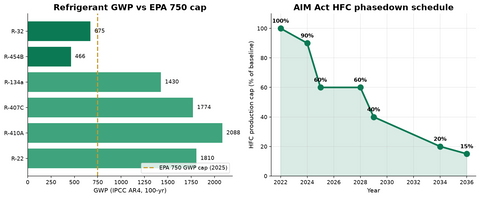
| HFC (hydrofluorocarbon) | R-134a, R-404A, R-410A, R-407C, R-507A | 0 | 1,300–4,000 | AIM Act phasedown 2022–2036; 85% cut by 2036 |
| HFO (hydrofluoroolefin) | R-1234yf, R-1234ze, R-1233zd | 0 | 1–7 | Approved replacement — used in new equipment |
| Natural refrigerants | R-717 (ammonia), R-744 (CO&sub2;), R-290 (propane), R-600a (isobutane) | 0 | 0–3 | Approved; growing use, esp. supermarkets |
| Blends (HFC/HFO) | R-448A, R-449A, R-454B, R-513A, R-32 | 0 | 150–1,400 | Approved current-generation replacements |
EPA 40 CFR 82.158 requires recovery equipment to be certified to ARI-740 or AHRI-740 standards. The required vacuum level after recovery depends on the appliance type and manufacture date. Memorize this table — you will see it on the exam.
| Appliance Type | Charge Size | Recovery Vacuum (Mfg before 11/93) | Recovery Vacuum (Mfg after 11/93) |
|---|---|---|---|
| HCFC-22 high-pressure | < 200 lbs | 0 in Hg | 0 in Hg |
| HCFC-22 high-pressure | ≥ 200 lbs | 4 in Hg vacuum | 10 in Hg vacuum |
| Other high-pressure | < 200 lbs | 4 in Hg | 10 in Hg |
| Other high-pressure | ≥ 200 lbs | 4 in Hg | 15 in Hg |
| Very high pressure | Any | 0 in Hg | 0 in Hg |
| Low-pressure | Any | 25 in Hg | 25 mm Hg absolute |
For appliances containing 50 lbs or more of refrigerant, the EPA 2020 leak-repair rule (40 CFR 82.157) sets threshold leak rates that trigger mandatory repair within 30 days:
| Appliance Type | Annual Leak Threshold |
|---|---|
| Commercial refrigeration | 20% annual leak rate |
| Industrial process refrigeration | 30% annual leak rate |
| Comfort cooling and other appliances | 10% annual leak rate |
Above these thresholds, the owner must either repair the leak, retrofit the equipment, or retire it within 30 days. Verification tests (initial and follow-up) are required, and records must be kept for three years.
Under Section 608, all refrigerant in an appliance must be recovered before disposal. The technician performing the final recovery must be Section 608 certified, and the disposal facility (scrap yard, landfill) has a duty to verify recovery has occurred.
- Small appliances (5 lbs or less) — the last person in the disposal chain (scrap yard, recycling facility) is responsible for recovery unless documentation of prior recovery exists.
- Motor vehicle A/C — governed by Section 609 (separate certification), not 608. Small MVAC appliances follow different rules.
- Recovered refrigerant — may be reused in the same owner's equipment, sent to a certified reclaimer, or destroyed by a permitted incinerator.
- Record keeping — technicians and facility owners must keep disposal records for 3 years.
| Violation | Maximum Penalty (2024) |
|---|---|
| Knowingly venting refrigerant | $58,328 per day, per violation |
| Sales to uncertified technician | $58,328 per day |
| Failure to repair a leaking appliance | $58,328 per day |
| Falsifying certification records | $58,328 per day + criminal referral |
| EPA "bounty" for reporting violators | Up to $10,000 award to informant |
The following practice questions are modeled on real Section 608 exam questions. Answers with explanations follow each question — cover the answer and try to work through each one before revealing.
1. What year did the U.S. ban CFC production?
A. 1990 · B. 1996 · C. 2000 · D. 2010
Answer: B. 1996
The Clean Air Act Amendments of 1990 set a 1996 phaseout for all CFC production in developed countries. Existing CFC stock remains legal to use — it just can't be manufactured or imported.
2. What is the ODP of R-134a?
A. 0 · B. 0.05 · C. 0.5 · D. 1.0
Answer: A. 0
R-134a is an HFC with zero ozone depletion potential — no chlorine or bromine atom in the molecule. However, its GWP is about 1,430, hence the AIM Act phasedown.
3. Which of the following is a Type II appliance?
A. Household refrigerator · B. Window A/C · C. Residential split-system heat pump · D. Centrifugal chiller with R-123
Answer: C. Residential split-system heat pump
Type II = high-pressure appliances over 5 lbs. A residential split system typically holds 5-15 lbs of R-410A or R-32. A centrifugal chiller with R-123 is Type III (low-pressure).
4. What is the recovery vacuum required for a 500-lb R-22 chiller manufactured in 2015?
A. 0 in Hg · B. 4 in Hg · C. 10 in Hg · D. 25 in Hg
Answer: C. 10 in Hg
For HCFC-22 high-pressure appliances 200 lbs or more manufactured after November 15, 1993, EPA 40 CFR 82.158 requires 10 in Hg vacuum. Non-HCFC-22 refrigerants of the same size require 15 in Hg.
5. Which refrigerant is a natural refrigerant?
A. R-134a · B. R-410A · C. R-717 · D. R-1234yf
Answer: C. R-717
R-717 is ammonia — a naturally occurring refrigerant used since the 1800s in industrial refrigeration. R-744 (CO&sub2;), R-290 (propane), and R-600a (isobutane) are the other main natural refrigerants.
6. What is the passing score on each Section 608 exam section?
A. 60% · B. 65% · C. 70% · D. 75%
Answer: C. 70%
You must score 70% on Core plus 70% on each Type section separately to earn that Type's certification. Fail one section and you must retake only that section.
7. How long is EPA Section 608 certification valid?
A. 1 year · B. 5 years · C. 10 years · D. Lifetime
Answer: D. Lifetime
Once earned, Section 608 certification does not expire and does not require renewal. This is different from state-level HVAC licenses, which may require continuing education.
8. What is the maximum penalty per day for knowingly venting a controlled refrigerant?
A. $10,000 · B. $28,000 · C. $58,328 · D. $100,000
Answer: C. $58,328
As of 2024, EPA civil penalties for Clean Air Act violations under Section 608 are up to $58,328 per day per violation. Amounts are inflation-adjusted annually.
9. Which of these is NOT a way to legally dispose of recovered refrigerant?
A. Reuse in the same owner's equipment · B. Send to a certified reclaimer · C. Vent slowly during service · D. Send to a permitted incinerator
Answer: C. Vent slowly during service
Venting is prohibited under any circumstance for controlled refrigerants. "Slow" venting is still venting. Only de minimis releases during good-faith service are exempt (see 40 CFR 82.154(a)).
10. What is R-410A composed of?
A. R-32 + R-125 · B. R-32 + R-134a · C. R-125 + R-134a · D. R-22 + R-134a
Answer: A. R-32 + R-125
R-410A is a near-azeotropic blend of R-32 and R-125 in a 50/50 mass ratio. This near-azeotropic behavior means both liquid and vapor can be charged, though vapor charging is preferred for accuracy.
11. What EPA rule created the AIM Act phasedown of HFCs?
A. Clean Air Act 1990 · B. AIM Act 2020 · C. Montreal Protocol 1987 · D. Kigali Amendment 2019
Answer: B. AIM Act 2020
The American Innovation and Manufacturing (AIM) Act was signed December 2020 and directs EPA to phase down HFC production and consumption 85% by 2036. This implements the Kigali Amendment domestically.
12. Which type of certification covers all Section 608 equipment?
A. Type I · B. Type II · C. Type III · D. Universal
Answer: D. Universal
Universal certification covers Type I, II, and III equipment — any equipment governed by Section 608. It requires passing Core plus all three Type sections.
13. What is the leak rate threshold for a 100-lb commercial supermarket rack system?
A. 10% · B. 20% · C. 30% · D. 35%
Answer: B. 20%
Commercial refrigeration under 40 CFR 82.157 has a 20% annual leak rate threshold above which the appliance must be repaired within 30 days. Applies only to systems with 50 lbs or more of refrigerant.
14. When can pressurized cylinders be transported in a passenger vehicle cab?
A. Always · B. Never · C. If less than 20 lbs · D. If secured
Answer: B. Never
DOT and OSHA prohibit compressed-gas cylinders in a passenger cab. Cylinders must be in a separate ventilated compartment, secured upright, with valve caps in place.
15. What is the GWP of R-32?
A. 5 · B. 675 · C. 1,430 · D. 2,088
Answer: B. 675
R-32 has a GWP of about 675, roughly half of R-410A (2,088) and less than R-134a (1,430). It's a key transitional refrigerant under the AIM Act phasedown.
16. What must you do before opening a system that has been contaminated with air and moisture?
A. Charge new refrigerant · B. Recover, evacuate, and change filter-drier · C. Purge with nitrogen only · D. Nothing special
Answer: B. Recover, evacuate, and change filter-drier
Air and moisture create hydrofluoric or hydrochloric acid inside the system. Full recovery, deep evacuation (500 microns or lower), and filter-drier replacement is standard procedure.
17. What is a hygroscopic refrigerant?
A. Contains chlorine · B. Absorbs moisture readily · C. Non-flammable · D. High GWP
Answer: B. Absorbs moisture readily
Some newer HFC/HFO blends are hygroscopic and will pull moisture from ambient air if the container is left open. Always use dedicated recovery cylinders and cap them immediately.
18. What device measures deep vacuum during evacuation?
A. Manifold gauge · B. Micron gauge · C. Amp meter · D. Bourdon tube
Answer: B. Micron gauge
Manifold gauges are only accurate down to about 29 in Hg. A micron (thermistor) gauge reads in micrometers of mercury and is required for verifying evacuation below 1000 microns.
19. What is the boiling point of R-22 at atmospheric pressure?
A. 40°F · B. 0°F · C. -41°F · D. -100°F
Answer: C. -41°F
R-22 boils at approximately -41.4°F (-40.8°C) at atmospheric pressure. It's classified as a high-pressure refrigerant because it operates above atmospheric pressure at typical evaporator temperatures.
20. Which refrigerant is A2L (mildly flammable) classified?
A. R-410A · B. R-32 · C. R-134a · D. R-22
Answer: B. R-32
R-32 and R-454B are A2L (mildly flammable). New UL 60335-2-40 requirements govern their use — leak detection, charge limits, and ventilation requirements apply.
21. What must be included on every refrigerant cylinder shipping label?
A. Cylinder color · B. DOT hazard class + refrigerant identification · C. Owner name · D. Nothing
Answer: B. DOT hazard class + refrigerant identification
DOT 49 CFR 172 requires the hazard class label, refrigerant identification (e.g., R-410A), and appropriate UN identification number. AHRI Guideline N standardizes cylinder colors as of 2020.
22. How long must a technician keep refrigerant recovery records?
A. 1 year · B. 3 years · C. 5 years · D. 10 years
Answer: B. 3 years
EPA requires 3-year retention of records showing refrigerant type, quantity, date, and appliance owner for each recovery, disposal, or sales transaction under 40 CFR 82.
Choose the right certification type
Universal is the most flexible. If you'll only ever service window ACs and fridges, Type I is fine and cheaper. If you'll service split systems, take Type II or Universal.
Study the EPA Manual
(Section 608 Technician's Manual, available free from EPA.gov). Read the Core chapter twice — it's about 40% of your questions and is where most fail.
Memorize the recovery vacuum table
3-5 questions on every Type II exam come directly from 40 CFR 82.158 recovery levels. Know all six rows cold.
Memorize refrigerant categories
CFC, HCFC, HFC, HFO, natural. Know at least three examples of each and their ODP/GWP order of magnitude.
Take 100+ practice questions
from ESCO, Mainstream Engineering, or HVAC Excellence. If you can hit 80%+ on practice, you'll hit 70%+ on the real exam.
Take the exam Core section first
(proctored providers usually let you order sections). If you fail Core, you don't certify anything and can retake it separately — no need to retake all four sections.
Watch the clock but don't rush
most sections give 60-90 minutes for 25 questions. That's 2-3 minutes each. Flag anything you're unsure of and return.
On the day: bring photo ID + payment
most proctors require government ID. Bring a calculator (basic non-programmable) if allowed.
Is EPA Section 608 certification required?
Yes. Under 40 CFR 82.161, no person may open an appliance containing a Class I or Class II refrigerant (CFC, HCFC, HFC, HFO) or purchase such refrigerant in a cylinder greater than 2 lbs without a valid Section 608 certification. HFC coverage was added in 2018 and remains in force under the AIM Act.
How long is Section 608 certification valid?
Lifetime. Section 608 certification does not expire and does not require renewal or continuing education. Once you pass, you're certified for life unless the EPA revokes it for a violation.
How much does the EPA 608 exam cost?
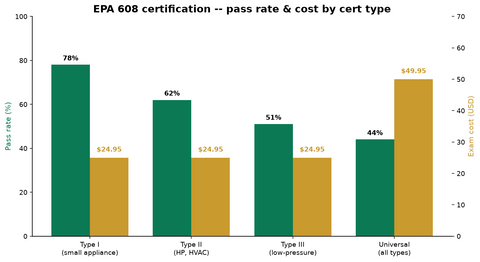
$20 to $150 depending on provider and type. ESCO, Mainstream Engineering, RSES, HVAC Excellence, and Ferris State are the largest providers. Universal typically costs $60-$120 including proctoring.
Can I take the EPA 608 exam online?
Only Type I can be mailed in as an open-book exam through some providers. Types II, III, and Universal must be proctored — some approved providers offer online proctored exams via webcam, others require in-person testing centers.
What is the difference between Section 608 and Section 609?
Section 608 covers stationary refrigeration and air conditioning. Section 609 covers motor vehicle air conditioning (MVAC) in cars, light trucks, and buses. Different exam, different rules, and technicians working on both need both certifications.
Is there study material provided?
Yes. The EPA publishes a free Section 608 Technician's Manual at epa.gov. Most training providers include a preparation manual with the exam fee. ESCO and Mainstream Engineering also sell practice-exam books that are widely considered the gold standard.
What if I fail one section?
You only retake the section you failed. Retake fees are typically $10-$30 per section. If you pass Core and Type I but fail Type II, you receive Type I certification and can retake just Type II when ready.
Can I sell refrigerant without certification?
No. Under 40 CFR 82.164, only Section 608 certified technicians (or purchasers acting on behalf of certified technicians) may purchase refrigerant in containers greater than 2 lbs. Refrigerant sellers must verify certification and keep records for 3 years.
What is the AIM Act and how does it affect Section 608?
The American Innovation and Manufacturing Act (December 2020) directs EPA to phase down HFC production and consumption 85% by 2036. It doesn't change Section 608 exam content directly, but the underlying regulations under 40 CFR 82 have been expanded to bring HFCs and HFOs under the same handling, recovery, and disposal rules as CFCs/HCFCs.
What refrigerants are being phased out next?
Under the AIM Act, R-410A and R-134a face restrictions in new equipment starting January 1, 2025 (residential AC and heat pumps) and 2028 (many commercial applications). Replacement refrigerants R-32, R-454B, R-513A, and CO&sub2; systems are already appearing in new equipment.
Do I need certification for R-32 or R-454B?
Yes. R-32 and R-454B are HFCs regulated under Section 608. Additionally, because they're A2L (mildly flammable), UL 60335-2-40 imposes additional training and equipment requirements — but the certification itself is standard Section 608 Type II or Universal.
Can I recover refrigerant without a recovery machine?
Only if the appliance is designed for it (integrated recovery or the appliance is small enough to weigh-in a portable cylinder). For most work, a UL-Listed and ARI-740 or AHRI-740 certified recovery machine is required by 40 CFR 82.158.
What is a de minimis release?
A trivial, unavoidable release during good-faith servicing — for example, the small amount trapped in a hose when disconnecting a manifold. De minimis releases are exempt from the venting prohibition; deliberate releases of any size are not.
How do I prove I'm Section 608 certified on a job site?
Carry your original certification card issued by your testing provider. Some providers also offer digital wallet cards. Employers, refrigerant suppliers, and EPA inspectors may request to see the card.
What is the difference between recovery, recycling, and reclaiming?
Recovery = removing refrigerant from an appliance in any condition and storing it in an external container. Recycling = cleaning the refrigerant on-site with filter-driers for reuse in the same owner's equipment. Reclaiming = returning the refrigerant to ARI-700 new-refrigerant specification, done only at a certified reclaimer facility.
Are natural refrigerants like ammonia or CO&sub2; regulated under Section 608?
No. Ammonia (R-717), CO&sub2; (R-744), propane (R-290), and isobutane (R-600a) are exempt from Section 608 because they don't contain fluorine or chlorine. However, OSHA and DOT regulations still apply, and industrial ammonia requires PSM process-safety-management compliance.
What if my certification card is lost?
Contact your original testing provider — most (ESCO, Mainstream, RSES) can issue a replacement for a small fee ($15-$25). The certification record is permanent in their database.
Most first-time takers pass Section 608 Universal with 15-20 total study hours spread over two weeks. Rushing the material to a single weekend leaves gaps on the leak-repair, recovery-vacuum, and Kigali/AIM Act policy questions that inspectors love to test.
| Week | Focus | Hours |
|---|---|---|
| Week 1 - Day 1-2 | Read EPA Section 608 Technician Manual Core chapter twice; take one practice Core test | 3 |
| Week 1 - Day 3-4 | Memorize refrigerant classes (CFC/HCFC/HFC/HFO/natural), examples, ODP/GWP | 2 |
| Week 1 - Day 5-6 | Study Type I: small appliance recovery, hermetic sealed systems, disposal | 2 |
| Week 1 - Day 7 | Practice test for Core + Type I; identify weak spots | 2 |
| Week 2 - Day 1-2 | Study Type II: high-pressure recovery vacuum table, leak rates, EPA 40 CFR 82.157/82.158 | 3 |
| Week 2 - Day 3-4 | Study Type III: low-pressure centrifugal chillers, R-11/R-123/R-1233zd handling | 2 |
| Week 2 - Day 5-6 | Full-length Universal practice exam (100 questions); target 80%+ | 2 |
| Week 2 - Day 7 | Review weak areas; light review only the day before exam | 1 |
The two most-failed section on Universal exams are (1) the recovery vacuum table for high-pressure appliances and (2) leak-repair thresholds for large appliances. Both are memorization — no shortcuts. Write the tables out from memory three times before test day.
Section 608 is a federal certification. Individual states, counties, and municipalities often layer their own HVAC contractor licensing on top of it. Section 608 authorizes you to legally purchase and handle refrigerant, but does not by itself authorize you to install or service HVAC equipment as a business.
- California — Class C-20 (Warm-Air Heating, Ventilating & A/C) contractor license from CSLB. Requires 4 years of journeyman experience and separate exam. Renews every 2 years.
- Florida — Class A or Class B HVAC contractor license from DBPR. Class A covers unlimited BTU, Class B is limited to 25 tons cooling / 500,000 BTU heating.
- Texas — TDLR Air Conditioning Contractor License Class A (unlimited) or Class B (under 25 tons / 1.5 MMBTU). Requires 48 months experience and passing an ACR exam.
- New York — Licensing is municipal (NYC has its own Master Fire Suppression Piping Contractor license; other counties vary).
- Washington — L&I 06A (Refrigeration Mechanic) or 06B (HVAC/R) certification, plus a contractor bond.
- Oregon — BOLI apprenticeship for HVAC/R (4-year program) plus state licensing.
The Section 608 card alone lets you legally buy refrigerant and open a system. To install a system or sell HVAC service, you also need the state or local contractor license. Always check with your state licensing board before starting a service business.
| Provider | Universal Fee | Format | Retake Cost |
|---|---|---|---|
| ESCO Institute | $60-95 | In-person or online proctored | $15-25/section |
| Mainstream Engineering | $20 Type I mail-in / $60-100 Universal proctored | Type I mail-in or proctored | $10-25/section |
| RSES (Refrig. Service Engineers Society) | $99-150 | In-person at RSES chapters | $20-30/section |
| HVAC Excellence | $75-125 | Proctored center or approved school | $15-25/section |
| Ferris State University | $65-95 | Online proctored | $15-25/section |
Most first-time takers spend $80-$150 total including study materials and one exam attempt. Second attempts on failed sections cost $10-$30 each. If you fail Universal entirely, you can retake only the failed sections rather than restart from Core.
PES Supply stocks the refrigerants Section 608 certified technicians need, along with recovery equipment, refrigerant scales, and micron gauges.
- Shop All Refrigerants at PES Supply
- R-32 Refrigerant — A2L, GWP 675, replacing R-410A
- R-410A Refrigerant — Legacy residential/commercial AC
- R-454B (Puron Advance) Refrigerant — Next-gen A2L replacement
- HVAC Recovery Equipment & Tools
Need the HVAC recovery and refrigerant tools for this job?
PES Supply stocks NEC-compliant electrical, HVAC, and solar SKUs — shipped from our Louisville, KY warehouse.
Get contractor pricing