Updated September 2026 — refreshed against the live PES catalog; product pricing verified 2026-09-26.
2026 product line update
| Product | Class | Price |
|---|---|---|
| Canadian Solar 710W TOPCon Bifacial Solar Panel | 710W | $340.80 |
| Hyundai 640W 156-Cell TOPCon Bifacial Solar Panel | 640W | $220.78 |
| Thornova Solar TS-BGT72(600) 600W Bifacial Solar Panel | 600W | $165.76 |
| Thornova Solar 595W Solar Panel 144 Cell Bifacial TS-BGT72(595) Wholesale 31 panels per pallet | 595W | $164.64 |
| ZNShine Solar 585W 144-Cell Bifacial Solar Panel | 585W | $246.99 |
| Hyundai HiS-S585OJ 585W Clear on Transparent156 Half-Cell Bifacial Solar Panel | 585W | $195.86 |
Live prices verified 2026-09-26. The current pallet line tops out at 550–640W, plus the Canadian Solar 710W TOPCon flagship panel.
Sizing a solar array comes down to one honest equation: your annual energy use, divided by the sun your roof actually receives, divided by the losses every real system suffers. Get any of the three wrong and you either overspend on panels you don't need or — worse — build a system that can't cover the bill it was sold to eliminate. This calculator takes your monthly kWh, your peak sun hours, and a realistic system efficiency, then returns the array size in kilowatts and the panel count at whatever wattage you're buying.
Our Solar System Size guide with charts covers the quick-lookup approach; this page is the deeper interactive version with full control over sun hours, derate, and panel wattage, plus the math to check any installer's proposal by hand.
Solar Panel Sizing Calculator
Monthly kWh × peak sun hours × system derate → array kW + panel count · grid-tie & off-grid
Method: Array kW = (monthly kWh ÷ 30 × offset) ÷ (peak sun hours × efficiency). Panels rounded up. Adding storage? Size the bank with the Battery Runtime Calculator.
The Sizing Formula, Term by Term
Array kW = (Monthly kWh ÷ 30 × offset target) ÷ (Peak sun hours × system efficiency)
Monthly kWh ÷ 30 converts your bill into a daily energy target. Use a full year of bills if you can — a single summer month over-sizes the system for the other nine months, and a winter month under-sizes it. Peak sun hours (PSH) is not daylight hours; it's the equivalent number of hours per day at full 1,000 W/m² test irradiance. A roof in Phoenix might see 6.5 PSH while Seattle sees 3.0 — the same panel produces more than twice the energy in Arizona. System efficiency bundles every real-world loss: inverter conversion (~3–5%), temperature derate (panels lose ~0.35–0.45% per °C above 25 °C), soiling, wiring, and mismatch. Eighty-six percent is a well-designed grid-tie system; off-grid systems lose another 10% or so to battery round-trip, which is why the 75% preset exists.
Worked Example 1: Average American Home, Texas Sun
A home using 900 kWh/month (~10,800 kWh/year, near the US average) in a 5.0 PSH region, targeting 100% offset at 86% efficiency with 400 W panels:
Array = (900 ÷ 30) ÷ (5.0 × 0.86) = 30 ÷ 4.30 = 6.98 kW DC → 18 × 400 W panels (7.2 kW)
That's roughly 325 square feet of roof — one clean residential array from our 400–459 W panel collection. Cross-check against our chart-based guides for 1,500 kWh/month and 3,000 kWh/year households.
Worked Example 2: Big Home, Cloudy Region
A 3,000 sq ft home burning 1,200 kWh/month in a 4.2 PSH northeastern location:
Array = 40 ÷ (4.2 × 0.86) = 40 ÷ 3.61 = 11.08 kW DC → 28 × 400 W panels (11.2 kW)
Same consumption in Phoenix (6.0 PSH) needs only 7.75 kW — 20 panels. Geography is destiny; see the 10,000 kWh/month guide for the high-consumption extreme.
Worked Example 3: Off-Grid Cabin
An efficient off-grid cabin using 600 kWh/month at an excellent 6.5 PSH site, but with battery round-trip losses (75% system efficiency) and 450 W panels:
Array = 20 ÷ (6.5 × 0.75) = 20 ÷ 4.875 = 4.10 kW DC → 10 × 450 W panels (4.5 kW)
Off-grid adds two constraints grid-tie never faces: the array must refill the battery even in the worst month (design to December PSH, not annual average), and the battery bank must carry the loads overnight — run the Battery Runtime Calculator for that half. Our complete off-grid design guide ties the whole chain together.
Peak Sun Hours Reference by Region
| Region | Annual avg PSH | Design PSH (worst month, off-grid) |
|---|---|---|
| Pacific Northwest (Seattle, Portland) | 3.0–3.5 | 1.0–1.5 |
| Northeast (NY, New England) | 3.5–4.2 | 1.8–2.5 |
| Midwest / Mid-Atlantic | 4.0–4.5 | 2.0–3.0 |
| Texas / Southeast / Florida | 4.8–5.5 | 3.0–4.0 |
| Southern California | 5.5–6.0 | 4.0–4.5 |
| Arizona / New Mexico / Nevada desert | 6.0–6.5 | 4.5–5.5 |
Panels Needed: Monthly Usage × Sun Hours (400 W panels, 86% efficiency, 100% offset)
| Monthly kWh | @ 3.5 PSH | @ 4.5 PSH | @ 5.5 PSH | @ 6.5 PSH |
|---|---|---|---|---|
| 500 | 14 | 11 | 9 | 8 |
| 750 | 21 | 16 | 13 | 11 |
| 1,000 | 28 | 21 | 18 | 15 |
| 1,500 | 42 | 32 | 26 | 22 |
| 2,000 | 55 | 43 | 35 | 30 |
System Efficiency: Where the Losses Go
| Loss source | Typical range | Mitigation |
|---|---|---|
| Inverter conversion | 2–5% | Quality inverter, correct sizing |
| Temperature derate | 3–10% | Air gap under array; cooler climates win |
| Soiling / dust / snow | 2–5% | Annual cleaning, steeper tilt |
| Wiring & connections | 1–3% | Proper gauge — check with the voltage drop calculator |
| Shading & orientation | 0–15% | Microinverters/optimizers, site survey |
| Battery round-trip (off-grid) | 8–15% | LFP chemistry, DC coupling |
Panel Wattage: What Changes and What Doesn't
| Panel class | Panels per 10 kW | Roof area | Best for |
|---|---|---|---|
| 300 W | 34 | ~610 sq ft | Budget builds, small roofs need not apply |
| 400 W | 25 | ~450 sq ft | Mainstream residential sweet spot |
| 450 W | 23 | ~415 sq ft | Premium residential, space-constrained |
| 500–550 W | 19–20 | ~380 sq ft | Commercial, ground mounts, max density |
Higher wattage doesn't change the kWh you need — it changes how many modules and how much racking you buy. On tight roofs, 450–500 W panels from the 400 W+ collections can be the difference between fitting and not fitting. Budget builds with ground space do fine on 300–399 W panels. One caution on mixing: never blend wattages or vintages within a single string — the string performs to its weakest module. If you're expanding an existing array, match the original panels or give the new ones their own string and MPPT input.
Annual vs. Monthly: Choosing the Right Usage Number
Net-metered grid-tie systems are sized against annual consumption because most utilities true-up yearly: overproduction in May banks credit against January. Average your last 12 bills. If your history is shorter, scale carefully — six months that include summer will overstate the annual number in cooling climates and understate it in heating climates. New construction with no history? Estimate from square footage and major appliances, then add margin for the loads people forget: pool pumps (1,500–2,500 kWh/yr), hot tubs (2,000–3,000 kWh/yr), and EVs (3,000–4,500 kWh/yr at typical mileage). The 115% offset preset exists precisely for known near-term additions — cheaper to build the capacity now than to add a second array later with new permitting, racking, and labor.
Grid-Tie, Hybrid, and Off-Grid: Same Array Math, Different Constraints
The array equation doesn't change with system type, but the boundary conditions do. Grid-tie cares about the utility interconnection cap and net-metering tariff. Hybrid systems add a battery the array must refill daily — size the array to December sun if backup matters, not the annual average. Off-grid is the strictest: the array must cover worst-month loads and battery round-trip losses, and a generator usually backstops the dark stretches — the Generator Sizing Calculator covers that half of the design. Whatever the architecture, conductor sizing between array, inverter, and panel is a two-part check: ampacity via the Wire Ampacity Calculator and drop via the Voltage Drop Calculator.
Checking an Installer's Proposal
This calculator doubles as an audit tool. When a proposal lands, plug your bill's kWh and your region's sun hours in, then compare: if the proposed array is more than ~10% smaller than the computed requirement at 86% efficiency, ask which loss assumptions justify it; if it's 25% larger, ask whether the oversize serves your tariff or their margin. Legitimate reasons for both exist — heavy shading justifies more watts, a premium design in a cool climate can justify fewer — but the answers should reference specific losses, not hand-waving. A proposal that can't survive the arithmetic on this page doesn't deserve a signature.
Common Solar Sizing Mistakes
- Sizing to one month's bill. Annual consumption is the only defensible input. Air-conditioning-heavy homes can swing 2:1 between July and March.
- Using daylight hours instead of peak sun hours. Twelve hours of daylight at a low sun angle is worth maybe 5 PSH. Confusing the two doubles your estimate and halves your real production.
- Ignoring efficiency losses. Nameplate kW × PSH assumes a lossless fantasy. Every real system gives back 14–25%; proposals that skip this are overselling.
- Forgetting the offset question. Many utilities pay poorly for exported power. Sizing to 100%+ of usage with bad net metering can be worse economics than sizing to 80% and self-consuming everything.
- Designing off-grid to annual-average sun. Off-grid arrays must cover December, not the yearly mean. Worst-month PSH is the number that keeps the lights on.
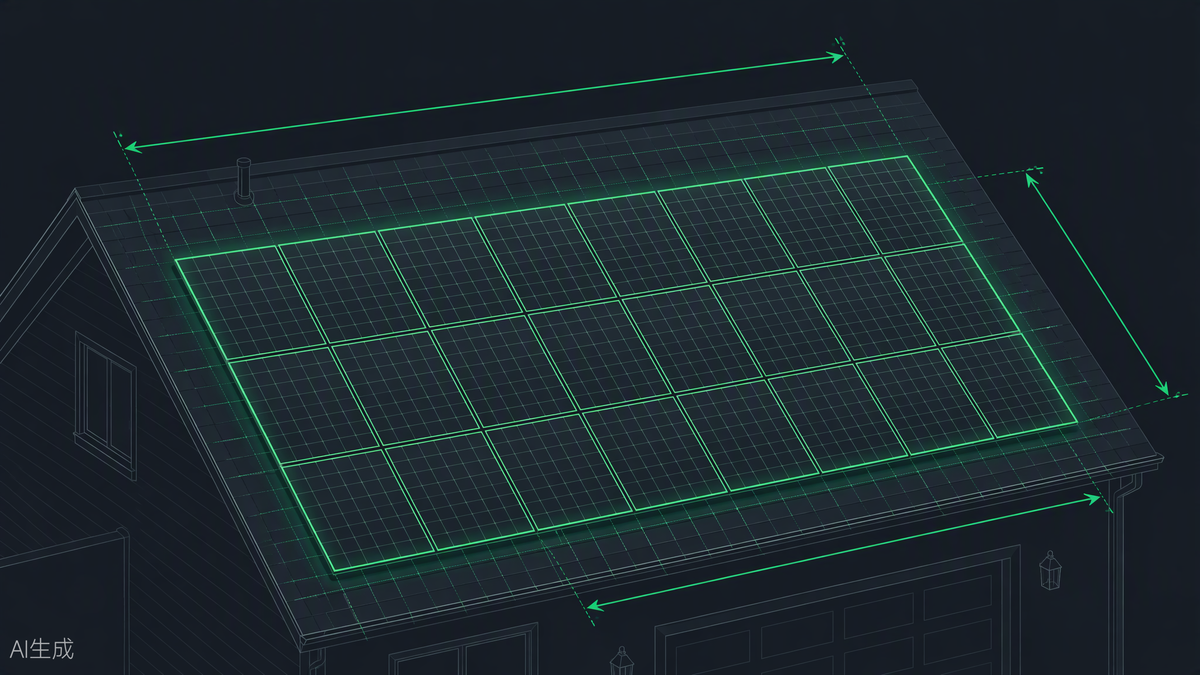
- Skipping the roof reality check. ~18 sq ft per panel including setbacks and access paths. A 28-panel design needs ~500 sq ft of usable, unshaded, code-compliant roof. Ground mounts and racking options solve what roofs can't.
From Array Size to Full System
The array is one line item. The inverter must match it (string sizing lives in our panel wiring guide), DC and AC wiring must pass both ampacity and voltage drop, and racking must survive your wind and snow loads. Package hunters can shortcut the matching exercise with our solar panel kits buyer's guide — kits pre-match panels, inverter, and racking. When you're ready, hit "Get this quoted" and your calculator inputs travel with the request, or browse 400 W panels to start pricing the array directly.
Frequently Asked Questions
How many solar panels do I need for a 2,000 sq ft house?
House size is a poor proxy — usage is what matters. A 2,000 sq ft home typically uses 800–1,200 kWh/month, which at 5 peak sun hours and 86% efficiency means a 6.2–9.3 kW array: 16–24 panels at 400 W. Pull your actual kWh from your bill and run the calculator above.
What are peak sun hours and where do I find mine?
Peak sun hours are the daily equivalent hours of full 1,000 W/m² irradiance. NREL's PVWatts tool and solar resource maps publish location-specific values. As a rule of thumb: 3–3.5 in the Pacific Northwest, 4–4.5 across the Midwest, 5–5.5 in Texas and the Southeast, 6+ in the desert Southwest.
Why is system efficiency only 75–90% instead of 100%?
Real systems lose energy to inverter conversion (2–5%), panel temperature (3–10%), soiling (2–5%), wiring (1–3%), and shading. Off-grid systems additionally lose 8–15% to battery round-trip efficiency. A well-designed grid-tie system nets about 86%; off-grid plans should use ~75%.
Should I oversize my solar system?
Modestly, if your utility's net metering is favorable — 110–115% of current usage covers an EV or heat pump you may add later. Under poor export rates, oversizing generates power the utility buys back cheap. Match oversizing to your tariff, not to optimism.
How much roof space does a 10 kW system need?
About 450–500 square feet of usable roof with 400 W panels (25 panels × ~18 sq ft including setbacks). Premium 450–500 W panels shrink that to ~400 sq ft. South-facing, unshaded, and structurally sound are the qualifiers that matter.
Do I need batteries with my solar array?
Grid-tie with good net metering: no — the grid is your battery. Off-grid or backup-critical: yes, and the battery bank must be sized separately based on overnight loads. Use the Battery Runtime Calculator linked above, and expect the array to grow ~15–25% to cover battery round-trip losses.
Shop the products mentioned in this guide and get everything you need for your project.