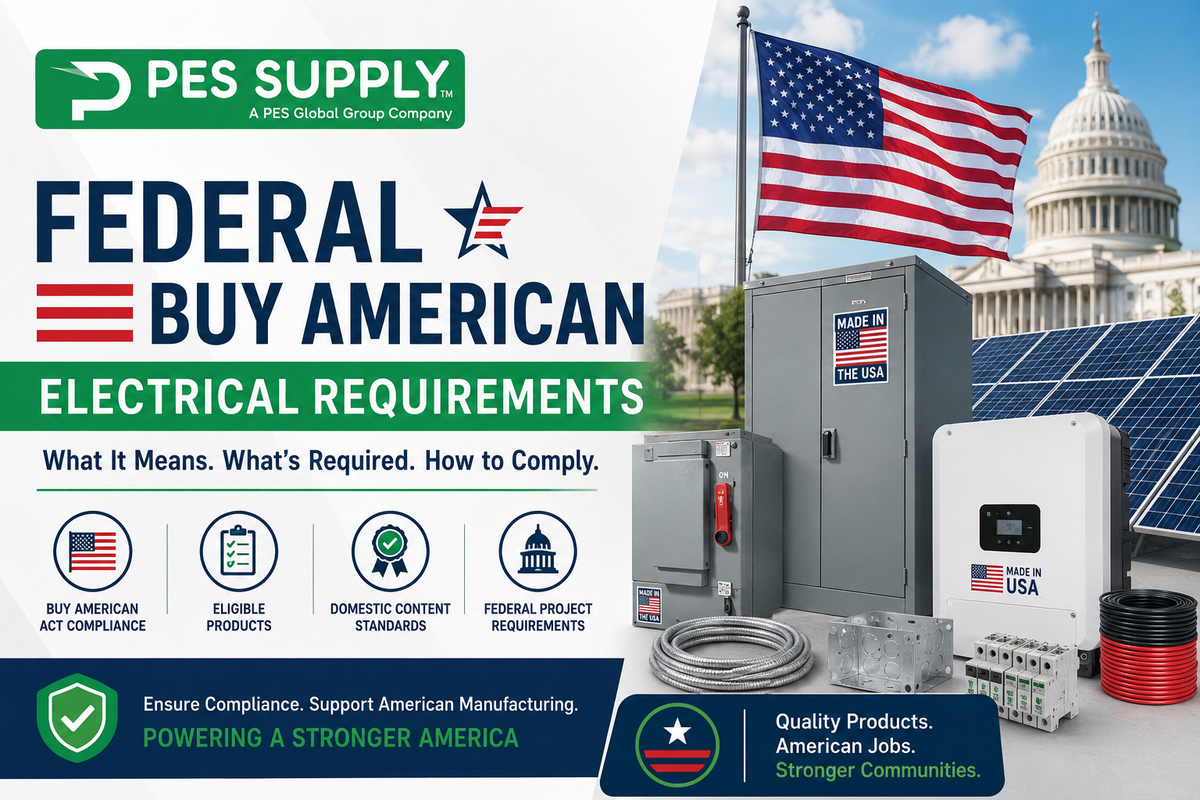
Federal Contractor Buy - American Electrical Requirements - FAR 52.225 Compliance for Electrical, Solar, and Grid Equipment
How Buy American Act (FAR 52.225-1) applies to electrical distribution equipment, solar modules, inverters, batteries, wire, and switchgear on federal direct procurement contracts. The 60/65/75% component test, waivers, trade agreements, and the certification chain contractors need to deliver - with sourcing tables by product category.

The Buy American Act, codified at 41 U.S.C. Chapter 83 and implemented by Federal Acquisition Regulation Part 25, is the primary domestic-preference regime for federal direct procurement of supplies. If a federal agency buys electrical or solar equipment directly - through a GSA Schedule task order, an open-market solicitation, a Federal Prison Industries requisition, or any other direct-procurement mechanism - the Buy American Act attaches to that acquisition.
Buy American is not the same as BABA, and the two get confused constantly. Here's the cleanest way to keep them straight:
| Buy American Act (BAA) | Build America Buy America (BABA) | |
|---|---|---|
| Statute | 41 U.S.C. Ch. 83 | Section 70914 of IIJA |
| Applies to | Federal direct procurement of supplies (Executive Branch) | Federal financial assistance for infrastructure projects |
| Primary FAR clause | 52.225-1 (Buy American - Supplies) | OMB 2 CFR 184 flowdown |
| Component cost test (manufactured product) | 60% (2022–2023), 65% (2024–2028), 75% (2029+) | 55% throughout |
| Iron/steel test | Applies through cost-of-components for the end product | Full manufacturing process (melt through coatings) in U.S. |
| Enforcement | Contracting officer at bid evaluation; termination for cause after award | Grant recipient obligation; cost disallowance |
| Waiver mechanism | Non-availability, unreasonable cost, public interest, information-technology COTS | Non-availability, unreasonable cost, public interest |
For an electrical distributor selling into federal direct procurement - GSA Schedule orders, DoD supply contracts, VA facility upgrades, NASA lab equipment - the Buy American Act framework governs the certification. For a contractor installing on a federally assisted infrastructure project - a school solar array funded by an EPA grant, a municipal EV charging plaza funded by NEVI - BABA governs. Both frameworks can attach to the same product on different projects.
Per 48 CFR 52.225-1 (current text at govinfo.gov) and the 2022 amendments implementation memo (DOE PF 2023-08), a "domestic end product" is:
"(1) For an end product that does not consist wholly or predominantly of iron or steel or a combination of both - (i) An unmanufactured end product mined or produced in the United States; (ii) An end product manufactured in the United States, if - (A) The cost of its components mined, produced, or manufactured in the United States exceeds 60 percent of the cost of all its components, except that the percentage will be 65 percent for items delivered in calendar years 2024 through 2028 and 75 percent for items delivered starting in calendar year 2029."
Two requirements, both must be met:
- Manufactured in the United States. Final manufacture (or, for unmanufactured products, mining or production) must occur in the U.S.
- Component cost test. The cost of domestic components must exceed the applicable threshold - 60% for items delivered in 2022–2023, 65% for items delivered 2024–2028, and 75% for items delivered starting 2029.
For predominantly iron or steel end products, the rule is stricter. Per the 2022 FAR final rule summary, an iron/steel-predominant end product is domestic only if its cost of iron and steel components not from the U.S. is less than 5% of the total cost of all components. There's no gradual threshold - steel-predominant products are essentially all-domestic or nothing.
For COTS items, per 41 U.S.C. §431, the component test is waived. A commercial-off-the-shelf electrical component that is manufactured in the U.S. qualifies as domestic without the cost fraction, provided the item meets the FAR 2.101 COTS definition. This is an important carve-out for standardized products like circuit breakers, panelboards, and common wiring devices - many stocking electrical items qualify as COTS.
The escalator matters more than it initially appears. A hybrid inverter that satisfied the 60% test for 2023 delivery may fail the 65% test in 2025. Contractors quoting multi-year contracts have to model the threshold at time of delivery, not time of contract award. PES tracks the applicable threshold by delivery year in our stocked-SKU compliance database.
Domestic-content status is determined per end product. Here's how the FAR 52.225-1 test lands on the categories PES stocks for federal buyers.
Wiring devices (receptacles, switches, plates)
Typically COTS items. Component test waived; final-manufacture-in-U.S. is the primary test. Multiple major manufacturers (Hubbell, Leviton, Legrand) offer U.S.-made lines. Per Legrand's Buy American guidance, their Buy American Act–compliant wiring devices have Country of Origin as the U.S. or Mexico (a qualifying country under NAFTA/USMCA).
Panelboards, switchgear, load centers
Manufactured products subject to full FAR 52.225-1 test. Domestic content ratios vary widely by SKU family. Schneider Electric (Square D), Eaton, ABB, Siemens all have U.S.-manufactured lines with domestic content data available on request. For federal buyers, request the domestic content declaration by catalog number.
Wire, cable, MC cable, THHN, PV wire
For most wire and cable, the manufactured-product analysis applies (except for raw copper/aluminum stock which is a mined/produced product). Southwire, Encore, and Cerro Wire have U.S. manufacturing with published domestic content data. Copper price fluctuations affect the cost fraction - the exact domestic percentage can shift year-to-year as raw commodity prices move.
Conduit (steel, aluminum, PVC)
Rigid metal conduit and EMT are typically iron/steel-predominant products under BAA - must be nearly all-domestic. Aluminum conduit is a non-ferrous manufactured product subject to the 60/65/75% test. PVC and HDPE conduit are manufactured products.
Solar modules (crystalline silicon)
Manufactured products. Component costs include cells, wafer/ingot, glass, backsheet, frame, junction box, encapsulant. With most U.S. module assembly still using imported cells or wafers, the domestic ratio for typical U.S.-assembled modules ranges from the low 30% to mid-40% range - below all three BAA thresholds. Contractors need modules with domestic cell or wafer sourcing to satisfy Buy American cleanly. First Solar's fully domestic thin-film satisfies BAA. Silfab's ELITE line and select Solarever USA SKUs are moving toward domestic-cell manufacturing.
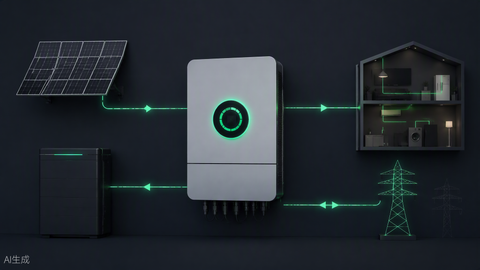
Solar inverters
Manufactured products. Sol-Ark (Texas assembly), OutBack Power (Washington assembly), MidNite Solar (Idaho assembly), and Enphase (partial U.S. assembly for microinverters) have domestic-manufacturing pathways. Domestic content ratios vary by SKU - always request a per-SKU declaration.
Battery ESS (LFP, NMC)
Cell-of-origin dominates the cost fraction. Cells are typically 40-60% of BOM cost - foreign cells make domestic compliance nearly impossible without extraordinary domestic component contributions in the pack. Fortress Power, Discover Battery, and select other integrators are moving pack assembly to the U.S., but full BAA compliance often requires domestic cell production, which is expanding but still constrained.
Solar racking and mounting
Rails, clamps, and post structures are typically iron/steel-predominant products. Must be nearly all-domestic (5% foreign iron/steel cost cap). IronRidge (California), Unirac (New Mexico), S-5! (Colorado) all have U.S. manufacturing pathways with mill certifications available.
Generators and standby power
Manufactured products. Cummins, Generac, Kohler, and Caterpillar all have U.S. manufacturing lines with domestic content data. Standby generators for federal facilities routinely pass BAA when specified from U.S.-manufactured lines. Engine of origin is the dominant cost driver.
Transformers (dry-type, oil-filled, pad-mount)
Manufactured products. Domestic transformer manufacturing has expanded materially with IRA-supported investment. ABB, Eaton, Cooper Power, ERMCO, and Howard Industries all have U.S. plants. Larger utility-scale transformers can have supply-chain constraints - plan lead times accordingly.
-
1
Read the solicitation for the Buy American clauses
Look for FAR 52.225-1 (Buy American - Supplies), 52.225-2 (Buy American Certificate), 52.225-3 (Buy American - Free Trade Agreements - Israeli Trade Act), 52.225-4 (BAA/FTA/Israeli Trade Act Certificate), 52.225-5 (Trade Agreements), or 52.225-6 (Trade Agreements Certificate). Which clauses attach depends on the estimated contract value and whether the solicitation is above the trade agreements dollar threshold.
-
2
Determine if Trade Agreements apply
Above certain dollar thresholds (adjusted every two years - $183,000 for supplies at time of writing), the Trade Agreements Act (TAA) applies instead of the pure Buy American Act. TAA is a country-of-origin test - products must be U.S.-made or made in a designated country. Chinese-origin products fail TAA. Which regime applies determines the certification you need to file.
-
3
Categorize every end product on the RFP by product type
Manufactured products, iron/steel-predominant products, unmanufactured products, or COTS. Each has a different test. Mis-categorizing an item on the certification can trigger a False Claims Act exposure.
-
4
Collect per-SKU country-of-origin and domestic-content declarations from your distributor
For every proposed SKU, get from your distributor: (a) country of manufacture, (b) COTS status if applicable, (c) domestic component cost ratio (for non-COTS manufactured products), and (d) for iron/steel-predominant items, the mill certifications. PES ships this pack with every federal quote.
-
5
Determine each end product's status
For each SKU: is it a domestic end product, a qualifying country end product (TAA countries), or a foreign end product? Foreign end products face price evaluation preferences (typically 20% penalty for large business, 30% for small business) or may be excluded entirely if the solicitation is restricted to domestic products.
-
6
File the Buy American Certificate (FAR 52.225-2) accurately
The certificate has a section listing foreign end products offered. Every foreign end product must be listed with country of origin. If you certify domestic and deliver foreign, that's a False Claims Act violation with treble damages exposure. If you list foreign end products in the certificate, the contracting officer applies the evaluation penalty and may still award.
-
7
For TAA-covered contracts, file the Trade Agreements Certificate (FAR 52.225-6)
Certify that each end product is a U.S.-made or designated country end product. Non-designated country origin (China, most notably) disqualifies the end product from TAA-covered acquisitions.
-
8
Preserve documentation for the audit trail
Store OEM declarations, country-of-origin certifications, mill test reports, and COTS attestations in the project file. Federal audits happen post-completion, sometimes years later. Missing documents create disallowance risk and, in bad cases, False Claims Act exposure.
-
9
Manage change orders as new Buy American exposures
Any change order that adds new supplies triggers a fresh Buy American analysis. Don't ambush yourself by ordering a substitute SKU that fails the domestic test - always run the substitution through the Buy American filter before ordering.
Buy American, like BABA, has three waiver grounds. Per FAR Part 25, an agency may deviate from Buy American when:
- Non-availability. The specific supply is not produced in the U.S. in sufficient and reasonably available commercial quantities of a satisfactory quality.
- Unreasonable cost. The cost of the domestic end product is unreasonable. The unreasonable cost determination for large business offers is 20%; for small business offers it's 30%. That means if the domestic offer is more than 20% (or 30%) higher than the foreign offer, the agency may buy the foreign end product.
- Public interest. The head of the agency determines that Buy American application is inconsistent with the public interest.
Additionally, 41 U.S.C. §431 (COTS component-test waiver) waives the component-cost analysis for COTS items. Many electrical supplies (wiring devices, standard boxes, common fittings) are COTS.
How the price-evaluation preference works. This is different from an outright ban. Under FAR 52.225-1, when a contract is estimated over the micro-purchase threshold but not restricted to domestic products, foreign end products are still acceptable - but the contracting officer applies a price evaluation penalty when comparing offers. The 20%/30% figures above are typical evaluation penalties for large/small business. In practice, this means that a foreign offer needs to be substantially lower than a domestic offer to win the award.
General applicability waivers are pre-approved for entire categories or programs. They're published on MadeInAmerica.gov with public comment periods before finalization. Contractors bidding federal work should check for active general applicability waivers relevant to their product categories.
The BAA/TAA interaction. When TAA applies (above the trade agreements threshold), Buy American's evaluation preference for domestic products becomes moot - TAA is a strict "designated country or bust" test. On TAA-covered contracts, contractors don't need to worry about the 60/65/75% test; they need to worry about country-of-origin. A U.S.-made product satisfies both frameworks; a designated-country product (Canada, Mexico, UK, EU member states, Japan, Israel, Korea, Australia, and others) satisfies TAA but not Buy American on its own. Whether the contractor's obligation is BAA or TAA depends on the solicitation's dollar value and the applicable clauses.
The Trade Agreements Act (TAA) is a separate statute that applies to federal direct procurements above certain dollar thresholds. Where TAA applies, end products delivered under the contract must be U.S.-made or made in a "designated country" - countries with which the U.S. has a trade agreement covering procurement.
Designated countries include (partial list): Australia, Bahrain, Belgium, Canada, Colombia, Denmark, Finland, France, Germany, Ireland, Israel, Italy, Japan, Mexico, Netherlands, Norway, Peru, Singapore, South Korea, Spain, Switzerland, UK. The full list is in FAR 25.003.
Countries NOT designated (partial list of importance): China, Russia, India, Brazil, Malaysia, Thailand, Turkey, and most of Southeast Asia. Products of non-designated country origin fail TAA on any TAA-covered contract.
The single largest practical impact of TAA on electrical and solar procurement is Chinese-origin products fail. That includes many solar modules, most lithium battery cells, many microelectronic components, and much of the value chain for inverters. TAA-compliant solar sourcing is much harder than BAA-compliant sourcing because TAA cares only about country of manufacture, not domestic content ratio.
For GSA Schedule holders, TAA is a persistent compliance obligation. Schedule prices must be for TAA-compliant products; delivering non-designated-country products under a Schedule task order is a contract violation. PES tracks TAA status per SKU alongside BAA and BABA declarations.
Registered contractors buying through PES for federal direct-procurement contracts receive the following documentation with every quote:
| Document | Purpose | What it enables |
|---|---|---|
| Country of manufacture per SKU | Basic country-of-origin fact | Buy American Certificate (FAR 52.225-2), TAA Certificate (FAR 52.225-6) |
| TAA designation per SKU | U.S.-made, designated country, or non-designated | Determines whether SKU is eligible for TAA-covered contracts |
| BAA domestic content ratio (non-COTS) | Cost fraction of domestic components | Determines if SKU is a domestic end product under FAR 52.225-1 at the applicable threshold |
| COTS attestation | Confirms COTS status | Waives component test under 41 U.S.C. §431 |
| Mill test report (iron/steel items) | Melt-through-coatings evidence | Iron/steel-predominant BAA compliance |
| BABA declaration (for federal-assistance projects) | 2 CFR 184.5 55% test | Federally assisted infrastructure projects (separate from BAA) |
| Environmental attributes | Energy Star, FEMP, EPEAT | Federal environmental purchasing preferences |
| Cybersecurity attestation (as applicable) | Section 889 compliance, CMMC alignment | DoD, GSA IT, and cyber-sensitive procurements |
Contractors filing certifications should attach the PES documentation pack as an appendix to the offer package. Every field on the Buy American Certificate and Trade Agreements Certificate maps to a data element PES publishes per SKU. Registered contractors on the Axis portal export the pack directly as a solicitation-specific PDF bundle.
Federal procurement has an expanding set of "prohibited source" rules that operate on top of Buy American and TAA. Contractors should know at least these three:
- Section 889 (John S. McCain NDAA of FY 2019) - prohibits federal agencies from procuring covered telecommunications equipment or services from Huawei, ZTE, Hytera, Hikvision, Dahua, and their subsidiaries/affiliates. Section 889(a)(1)(A) applies to direct procurement; Section 889(a)(1)(B) applies to any entity using covered equipment in the ordinary course of business - a much broader reach. Solar and electrical equipment with camera-enabled monitoring, communications modules, or wireless components must be checked against Section 889.
- Uyghur Forced Labor Prevention Act (UFLPA) - presumption that products manufactured in whole or part in Xinjiang, or by entities on the UFLPA Entity List, are made with forced labor and prohibited from importation. Broad impact on solar modules (poly-silicon supply chain) and lithium batteries. Contractors sourcing solar equipment should confirm supply-chain traceability upstream to the poly-silicon and cell manufacturing.
- Section 848 (NDAA FY 2020) - chinese-manufactured products in DoD acquisitions - restrictions on specific product categories procured by DoD from Chinese entities.
These prohibitions operate independent of Buy American and TAA. A product could satisfy Buy American Act domestic content, TAA country-of-origin, and still fail Section 889 or UFLPA. Contractors on federal contracts subject to these prohibitions need to attest compliance and, in some cases, produce affirmative evidence of supply-chain vetting.
For PES-stocked solar and electrical SKUs, we track Section 889 and UFLPA compliance status alongside BAA/TAA/BABA. Where a stocked SKU has an unresolved supply-chain issue for federal purchase, we flag it and either recommend a substitute or provide the specific vendor letter attesting compliance.
The certification chain on Buy American and TAA-covered contracts is where contractors get themselves in trouble even when they intended to comply. Here are the failure modes we see most often and how to avoid them:
- Relying on marketing 'Made in USA' claims. FTC's 'Made in USA' standard is 'all or virtually all' - different from FAR 52.225-1's 60/65/75% threshold. A product that FTC allows to be marketed 'Made in USA' certainly satisfies BAA, but a product satisfying BAA might not satisfy FTC 'Made in USA.' Cite the FAR clause, not the marketing.
- Assuming assembly location equals origin. Final manufacture in the U.S. is only half the BAA test. Assembly in a domestic plant of an inverter with 70% imported components fails the 65% threshold. Certifications based on assembly location without the component analysis are false certifications.
- Missing the escalator on multi-year contracts. A five-year IDIQ awarded in 2023 has deliveries in 2024, 2025, 2026, 2027, and 2028. The 65% threshold applies to those years' deliveries, not the 60% threshold that applied at award. OEM declarations need to be renewed each year against the current threshold.
- Certifying domestic and delivering foreign after a substitution. Substituting a SKU mid-contract without re-running the Buy American analysis is one of the fastest ways to create False Claims Act exposure. Every substitution needs a fresh certification.
- Confusing TAA-designated country with U.S. domestic origin. A UK-manufactured inverter is TAA-designated. It is not a domestic end product under BAA. On a contract with both TAA (above the trade agreements threshold) and Buy American compliance elements, the contractor has to certify each element separately.
- Ignoring the Section 889 supply-chain implications. A U.S.-manufactured inverter that includes a Huawei communications module fails Section 889 even if it satisfies BAA. Federal solicitations increasingly require Section 889 representations that certify not just at the end product level but at the covered-component level.
The remedy for all six is the same: get OEM declarations in writing, per SKU, per delivery year, referencing the specific FAR clause. PES's per-SKU documentation pack is designed to make this achievable without a full-time compliance analyst on staff.
What's the difference between Buy American and TAA?
Are COTS items exempt from Buy American?
What happens if I bid domestic and my actual delivery is foreign?
Does the Buy American Act apply to services?
What is the 'unreasonable cost' penalty in practice?
How do I know if my contract is TAA-covered?
Are Mexican-made products domestic under Buy American?
How does the Buy American escalator affect long-term contracts?
Where do I find the current thresholds?
Does PES sell Buy American-compliant products?
Selling Electrical Equipment to a Federal Agency? Register for the PES Federal Desk
Per-SKU country-of-origin, TAA designation, BAA domestic content ratios, COTS attestation, Section 889 status, and mill test reports - packaged as one solicitation-ready bundle.
Register Now