Refrigerant Recovery Equipment Buying Guide: Bacharach vs CPS vs Fieldpiece vs Yellow Jacket vs Appion
Which recovery machine actually pays for itself, which is A2L-ready for R-454B, and how to think about recovery-machine ROI across a service fleet.

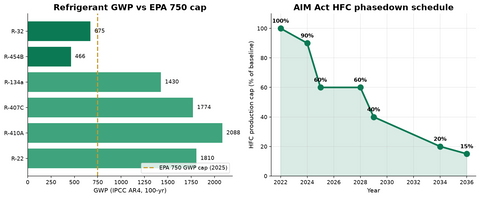
The core economics of refrigerant recovery flipped in 2020 when R-22 production ended and again in 2025 when the AIM Act cap on R-410A took effect. Reclaimed refrigerant is now a legitimate revenue line -- PES and other AHRI 700 reclaim programs pay $2-4/lb on qualifying recovered R-410A, R-22, and R-134a. For a service business recovering 40-60 lb per truck per month, that's $1,200-2,880 per truck per year in offsetting revenue that used to be a disposal expense.
The catch is that the recovery machine must be fast enough that recovery time doesn't eat into billable service time. A recovery machine that pulls 30 lb of R-410A in 90 minutes costs less to buy but costs more per year in tech-hour opportunity cost than a machine that pulls the same 30 lb in 22 minutes. The right recovery machine is a function of your service mix (residential vs commercial), refrigerant types you touch, and the number of trucks in the fleet.
This guide compares five recovery machines from Bacharach, CPS, Fieldpiece, Yellow Jacket, and Appion across performance, A2L readiness, price, and total-cost-of-ownership.
| Model | Peak liquid CFM | Weight | A2L-rated | Contractor price | Typical recovery time (30 lb R-410A) | Warranty |
|---|---|---|---|---|---|---|
| Bacharach 2020 | 0.66 | 28 lb | Yes (UL 60335-2-40) | $1,195 | 28 min | 3 yr |
| CPS TRS21 | 0.55 | 31 lb | Yes | $795 | 35 min | 2 yr |
| Fieldpiece MR45INT | 0.85 | 24 lb | Yes | $1,099 | 22 min | 3 yr |
| Yellow Jacket RecoverXLT-II | 0.60 | 32 lb | Yes | $925 | 32 min | 2 yr |
| Appion G5Twin | 1.20 | 35 lb | Yes | $1,435 | 15 min | 3 yr |
The Bacharach 2020 has been the workhorse of the recovery-machine market for the last decade. It moves 0.66 CFM of liquid refrigerant, weighs 28 lb (portable enough for a solo tech to carry into a residential mechanical room), and is UL 60335-2-40 A2L-rated for R-454B and R-32 work as of the 2023 refresh. At $1,195 in contractor pricing, it sits in the middle of the market.
What Bacharach does well: reliability. Field reports across service companies consistently show mean-time-to-failure north of 4,000 recovery cycles, which for a typical service tech is roughly 4-5 years of daily use. The dual-piston oil-less compressor is genuinely low-maintenance -- most techs report replacing only the intake filter and the moisture indicator over the machine's life. The 3-year warranty is unconditional and includes parts and labor at any Bacharach authorized service center.
Where Bacharach lags: recovery speed on liquid pulls. The 0.66 CFM peak is respectable but noticeably slower than the Fieldpiece MR45 or the Appion G5Twin. On a 30 lb liquid recovery from a residential 4-ton system, the Bacharach takes about 28 minutes; the Appion does the same job in 15. For a shop running 3-5 recoveries per week per truck, the Appion saves 40-60 minutes per week -- roughly one billable service call.
Fieldpiece has become the default recovery machine for growing service fleets over the last five years. The MR45INT moves 0.85 CFM of liquid, weighs just 24 lb (lightest in this comparison), and pulls a 30 lb R-410A charge in ~22 minutes -- 20-25% faster than the Bacharach and 40% faster than the CPS or Yellow Jacket. The A2L-rated variant (MR45INT-A2L) adds explosion-proof-rated electricals for R-454B and R-32 work.
The design decision that makes Fieldpiece stand out is the modular architecture. The compressor, motor, and gauges are all field-replaceable modules -- if a compressor fails, the tech doesn't ship the whole machine back to a service center, they order a replacement compressor module for ~$285 and swap it in the shop in 20 minutes. This dramatically reduces downtime for a shop running the MR45 across multiple trucks.
Contractor price is $1,099 for the standard MR45INT; the A2L variant is $1,249. Warranty is 3 years and follows the same modular parts logic (individual modules covered rather than the whole machine).
For commercial and industrial refrigeration technicians, the Appion G5Twin is the tool of choice. It moves 1.20 CFM of liquid (the fastest in this comparison and roughly double the Bacharach 2020) using a twin-piston design and a specifically engineered high-flow condenser. On a 30 lb R-410A residential job it finishes in 15 minutes; on a 200 lb commercial recovery it's usually done in under 2 hours.
Weight is the tradeoff -- the G5Twin comes in at 35 lb, which is at the upper limit of what one tech can carry up a ladder. Most Appion users have a dolly or hand truck dedicated to the machine. Contractor price is $1,435, roughly 20% above the Bacharach and Fieldpiece.
The Appion earns its price premium in two scenarios: commercial refrigeration (where recovery volumes are large enough that speed matters), and shops that dispatch a dedicated recovery truck to jobsite. In residential/light commercial applications with a single recovery per day, the Bacharach or Fieldpiece is usually the better economic choice.
-
1
Baseline your annual recovery volume and refrigerant mix
Pull the last 12 months of recovery logs (or estimate based on typical service calls). Total the lb recovered and break out by refrigerant. Most residential shops recover 500-1,200 lb per truck per year; commercial refrigeration shops recover 2,500-8,000 lb per truck per year. This baseline drives the speed-vs-cost tradeoff.
-
2
Verify A2L readiness for any machine you buy in 2026+
Every new recovery machine purchased in 2026 or later should be A2L-rated to UL 60335-2-40. Even if your current mix is 100% R-410A, the transition to R-454B is already underway and a non-A2L machine has a shrinking useful life. All five machines in this comparison ship A2L-rated in their current model year.
-
3
Calculate tech-hour opportunity cost
Take your loaded tech labor rate ($42-65/hr for most residential techs, $65-95 for commercial). Multiply by the recovery time savings between the machines you're comparing. Example: Fieldpiece MR45 saves 6 minutes per recovery vs Bacharach 2020. At 1,000 recoveries/year across a 5-truck fleet and $52/hr loaded, that's $260/year -- not enough to justify the price difference alone. But layer in higher billable throughput and it can add up.
-
4
Standardize the fleet on one machine to simplify training and parts
A 5-truck fleet running 5 different recovery machines carries 5 sets of spare parts, 5 warranty programs, and 5 different tech training curricula. Standardizing on one machine cuts inventory and training overhead substantially. Most shops pick Fieldpiece or Bacharach for residential/light commercial and Appion for commercial refrigeration.
-
5
Buy from a distributor with local warranty service
All five brands have national service networks, but response time varies. PES Supply provides in-stock spare parts (compressors, motors, gauges) for Bacharach, Fieldpiece, CPS, and Yellow Jacket with same-day ship on any part in inventory. Appion parts typically ship direct from the factory with 3-5 day lead time.
| Model | Purchase price | Est. maintenance (5 yr) | Recovery-time cost (@$52/hr loaded) | 5-yr TCO |
|---|---|---|---|---|
| Bacharach 2020 | $1,195 | $220 | $2,912 | $4,327 |
| CPS TRS21 | $795 | $310 | $3,640 | $4,745 |
| Fieldpiece MR45INT | $1,099 | $180 | $2,288 | $3,567 |
| Yellow Jacket RecoverXLT-II | $925 | $260 | $3,328 | $4,513 |
| Appion G5Twin | $1,435 | $285 | $1,560 | $3,280 |
How often should I service my recovery machine?
Can I use a non-A2L recovery machine on R-454B?
What's the difference between vapor and liquid recovery?
How do I know when the recovery cylinder is full?
Should I buy a used recovery machine?
Does the machine's warranty transfer if I sell it?
Can one recovery machine serve multiple trucks?
The CPS TRS21 is the price-point option in this comparison at $795 contractor pricing. It moves 0.55 CFM of liquid, weighs 31 lb, and is A2L-rated. Recovery time on a 30 lb R-410A load is ~35 minutes -- 25% slower than Bacharach and 60% slower than Appion, but adequate for residential service work with 1-3 recoveries per week.
CPS is a smaller manufacturer than the other four in this comparison, with a narrower parts and service network. The 2-year warranty is shorter than Fieldpiece or Bacharach's 3-year coverage. However, for a shop wanting to add a basic recovery machine to an occasional-use truck (like a comfort-technician van that mostly does maintenance work) at the lowest possible price, the TRS21 delivers.
The typical CPS user profile: shops adding a second or third recovery machine as backup or for lower-volume trucks. Not a primary-machine choice for high-volume service techs.
Yellow Jacket has been in refrigerant tools since 1959 and is the reference brand for analog manifold gauges and brass service fittings. The RecoverXLT-II is their mid-market recovery machine at $925 contractor pricing, positioned between the CPS TRS21 and the Bacharach 2020.
Performance is respectable: 0.60 CFM peak liquid, 32 lb weight, ~32 minutes for a 30 lb R-410A recovery. A2L-rated in the current model year. The value proposition is compatibility with the broader Yellow Jacket ecosystem -- the machine ships with Yellow Jacket brass fittings and works seamlessly with Yellow Jacket hoses, adapters, and refrigerant scales that shops with existing YJ investment already own.
Warranty is 2 years, shorter than Bacharach or Fieldpiece. Parts availability through Yellow Jacket's distribution network is strong -- next-business-day on most consumables.
Recovery machines are relatively low-maintenance but not zero-maintenance. A well-maintained machine will run for 5+ years without major issues; a neglected machine can fail in 18 months.
Oil. All five machines in this comparison use a specific compressor oil (typically POE or a manufacturer-proprietary formulation). Oil change interval is 250-500 recovery cycles or annually. Cost per change: $18-32 in oil plus 30 minutes labor.
Intake filter. Replace every 1,000-1,500 cycles or annually. Cost: $12-25 per filter plus 15 minutes labor.
Discharge check valve. Replace every 3,000-5,000 cycles. Cost: $45-95 per valve.
Compressor. Rebuild interval is 8,000-15,000 cycles depending on brand. Cost: $285-495 for a Fieldpiece modular compressor swap; $650-950 for a Bacharach or Appion factory rebuild; typically not repaired on CPS or Yellow Jacket (whole-machine replacement instead).
Budget planning for a 5-truck fleet: roughly $200-300 per machine per year in consumables (oil, filters) and every 4-6 years a compressor rebuild event at $300-500. Total 5-year maintenance TCO across the fleet: $2,500-4,500.
Recovery machines are one piece of the recovery workflow. The recovery cylinder is the other. Every recovered refrigerant charge lands in a recovery cylinder, and the flow from truck to reclaim happens through a defined logistics chain.
Recovery cylinder types. DOT-4BA refillable recovery cylinders in 30 lb size are standard. Every recovery job segregates by refrigerant type -- R-410A into one cylinder, R-22 into another, R-134a into a third. Mixed refrigerant cylinders fail AHRI 700 and are worthless for reclaim, so cylinder discipline matters.
Fill limits. Under DOT rules, recovery cylinders can be filled to 80% of gross weight. A 30 lb cylinder holds 24 lb of refrigerant. Overfilling creates pressure risk and voids the cylinder's DOT rating.
Cylinder handling. Recovery cylinders need to be transported upright with valve protected, just like virgin refrigerant cylinders. Same 130°F max storage temperature. A2L recovery cylinders require flammable-storage classification.
Return logistics. Full recovery cylinders go back to the distributor (PES or another reclaim provider) via reverse-LTL. PES schedules pickups on a rolling weekly basis for subscription customers, monthly for standard accounts. The cylinder is weighed, tested against AHRI 700, and the shop's reclaim credit is applied to the subscription balance.
Some larger commercial refrigeration contractors operate their own on-site reclaim -- filtering, drying, and reusing recovered refrigerant in their own service work rather than sending to a distributor. This is technically legal under EPA rules if the reclaimed refrigerant meets AHRI 700 in the shop's own testing.
The economics are marginal for most shops. On-site reclaim requires a dedicated reclaim machine ($2,800-6,500), a testing setup for AHRI 700 verification ($1,200-2,500), and technician time to run the process. Payback on typical service volumes is 3-5 years, which is a long horizon for equipment that may itself need replacement in that timeframe.
The specific case where DIY reclaim makes economic sense is a large commercial refrigeration contractor recovering 5,000+ lb/year of R-134a or R-22 from a stable customer base. At that volume, the reclaim machine pays back in 12-18 months and provides supply security on refrigerants where reclaim distributor pricing is volatile.
For most residential and light commercial contractors, sending recovery to a distributor reclaim program (like PES's) is the better economic and operational choice.
Order recovery machines and OEM spare parts from PES Supply
Same-day ship on Bacharach, Fieldpiece, CPS, and Yellow Jacket recovery machines and OEM-authorized service parts.
Register Now