kVA to Amps: Calculator & Conversion Guide
Single-phase and three-phase full-load current at any voltage — with NEC breaker sizing built in.
kVA-to-amps is the conversion behind nearly every transformer, generator, and commercial inverter specification. Unlike our kVA-to-kW guide — which is about power factor — this conversion ignores power factor entirely, because kVA already includes it. What you need instead is voltage. Enter kVA and volts in the calculator below and get full-load amps instantly, for both single-phase and three-phase systems.
⚡ kVA to Amps Calculator
Single-phase or three-phase — pick your system voltage and get full-load amps instantly, plus the NEC 240.6 breaker it points to.
Formula (1φ): A = kVA × 1,000 ÷ V · Formula (3φ): A = kVA × 1,000 ÷ (√3 × VLL)
Three-phase volts are line-to-line. Breaker suggestion = NEC 125% continuous rule rounded to the next standard rating (NEC 240.6). Instant results as you type.
Apparent power S (in VA) equals voltage times current. Solve for current and scale kVA up by 1,000:
Single-phase: A = kVA × 1,000 ÷ V
Three-phase: A = kVA × 1,000 ÷ (√3 × VLL)
The √3 (≈1.732) in the three-phase formula accounts for the 120° phase displacement between the three conductors: in a balanced three-phase system the total power is √3 × VLL × I, not 3 × V × I. Use line-to-line voltage — 208, 480, or 600 V — in that formula. If your nameplate shows line-to-neutral voltage (120, 277, 347 V), the equivalent form is A = kVA × 1,000 ÷ (3 × VLN), which returns the same per-phase amps.
The inverse conversion — amps to kVA — is the same algebra reversed: kVA = A × V ÷ 1,000 (single-phase) or kVA = A × V × 1.732 ÷ 1,000 (three-phase). And if you need the watts side of the story, that requires power factor: kW = kVA × PF, covered step-by-step in our kVA-to-kW conversion guide.
| kVA | 120 V | 208 V | 240 V | 277 V | 480 V | 600 V |
|---|---|---|---|---|---|---|
| 1 kVA | 8.3 A | 4.8 A | 4.2 A | 3.6 A | 2.1 A | 1.7 A |
| 5 kVA | 41.7 A | 24.0 A | 20.8 A | 18.1 A | 10.4 A | 8.3 A |
| 10 kVA | 83.3 A | 48.1 A | 41.7 A | 36.1 A | 20.8 A | 16.7 A |
| 15 kVA | 125 A | 72.1 A | 62.5 A | 54.2 A | 31.3 A | 25 A |
| 25 kVA | 208.3 A | 120.2 A | 104.2 A | 90.3 A | 52.1 A | 41.7 A |
| 37.5 kVA | 312.5 A | 180.3 A | 156.3 A | 135.4 A | 78.1 A | 62.5 A |
| 50 kVA | 416.7 A | 240.4 A | 208.3 A | 180.5 A | 104.2 A | 83.3 A |
| 75 kVA | 625 A | 360.6 A | 312.5 A | 270.8 A | 156.3 A | 125 A |
| 100 kVA | 833.3 A | 480.8 A | 416.7 A | 361 A | 208.3 A | 166.7 A |
Table 1 — Single-phase full-load amps: A = kVA × 1,000 ÷ V.
| kVA | 208 V 3φ | 240 V 3φ | 480 V 3φ | 600 V 3φ |
|---|---|---|---|---|
| 9 kVA | 25.0 A | 21.7 A | 10.8 A | 8.7 A |
| 15 kVA | 41.6 A | 36.1 A | 18.0 A | 14.4 A |
| 30 kVA | 83.3 A | 72.2 A | 36.1 A | 28.9 A |
| 45 kVA | 124.9 A | 108.3 A | 54.1 A | 43.3 A |
| 75 kVA | 208.2 A | 180.4 A | 90.2 A | 72.2 A |
| 112.5 kVA | 312.3 A | 270.6 A | 135.3 A | 108.3 A |
| 150 kVA | 416.4 A | 360.8 A | 180.4 A | 144.3 A |
| 225 kVA | 624.6 A | 541.3 A | 270.6 A | 216.5 A |
| 300 kVA | 832.7 A | 721.7 A | 360.8 A | 288.7 A |
| 500 kVA | 1,387.9 A | 1,202.8 A | 601.4 A | 481.1 A |
Table 2 — Three-phase full-load amps per phase: A = kVA × 1,000 ÷ (1.732 × V_LL). Rows use standard transformer sizes.
Transformers (NEC Article 450)
Every dry-type transformer nameplate is denominated in kVA, and NEC 450.3 protection rules key off rated current — which you must compute from kVA and voltage. A 75 kVA, 480 V three-phase transformer carries 90.2 A full-load secondary current. That number drives the secondary breaker (125 A at 125%), the conductor size (at least 1/0 AWG copper at 75 °C before adjustments), and the fault-current calculations downstream. Standard dry-type sizes — 15, 30, 45, 75, 112.5, 150, 225, 300, 500 kVA — exist precisely so these amp values land on serviceable equipment.
Generators
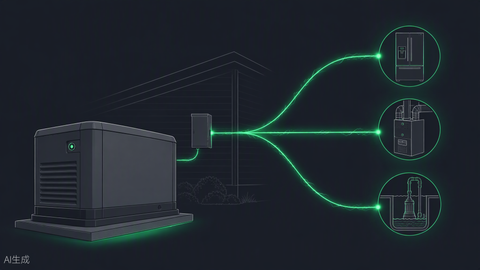
Standby generators are specified in kVA because the alternator's thermal limit is set by current, not real power. A 100 kW / 125 kVA unit (0.8 PF) at 480 V three-phase delivers 150.3 A — that is the figure your transfer switch, feeders, and breaker must carry. Undersizing here is one of the most expensive field mistakes; our generator sizing guide walks the full load-side process.
Commercial solar inverters
String and central inverters in the 50–350 kW class carry kVA ratings (typically kVA = kW at unity PF, with headroom for reactive support per IEEE 1547). A 125 kVA inverter at 480 V three-phase outputs 150.3 A AC — the input to your interconnection study, AC combiner sizing, and NEC 705.12 busbar loading calculation. Pair this with our NEC 690 disconnect guide for the protection side.
Example 1 — Single-phase transformer feeder
- Transformer: 25 kVA, 240 V single-phase secondary.
- Full-load amps: 25 × 1,000 ÷ 240 = 104.2 A.
- Continuous sizing: 104.2 × 1.25 = 130.2 A → 150 A next standard (NEC 240.6) or 125 A with NEC 240.4(B) rounding rules — check conductor ampacity first.
- Conductor: 1/0 AWG copper (150 A at 75 °C) covers the 125 A frame.
Example 2 — Three-phase generator output
- Generator: 200 kVA standby, 480 V three-phase.
- Full-load amps: 200,000 ÷ (1.732 × 480) = 240.6 A.
- Transfer switch: next standard frame above full load → 250–260 A class; see our 200–225 A and full transfer-switch lineup.
Example 3 — Commercial inverter AC current
- Inverter: 125 kVA, 480 V three-phase output.
- AC current: 125,000 ÷ (1.732 × 480) = 150.3 A.
- NEC 690.8 inverter output circuit: 125% continuous → 187.9 A → 200 A breaker, 3/0 copper at 75 °C.
A field note on nameplate literacy
Transformer and generator nameplates pack the inputs for this conversion into a few compact lines: kVA rating, primary and secondary voltages, phase, impedance (%Z), and frequency. The impedance percentage deserves a mention even though it does not enter the full-load conversion — it caps the available fault current, which is why a 75 kVA, 4%Z transformer at 208 V can only deliver about 5.2 kA into a bolted fault (208.2 A ÷ 0.04). Full-load amps tell you what the equipment carries; impedance-limited amps tell you what it can deliver into a short, and breaker interrupt ratings (AIC) are chosen against the latter.
- NEC 450.3 (Transformers): overcurrent protection is expressed as percentages of rated current — you must convert kVA to amps before the table means anything. Primary-only protection can reach 125% (with secondary protection) or up to 250% in supervised arrangements.
- NEC 240.6 (Standard ratings): after the 125% continuous multiplier (210.20, 215.3), round up to 15, 20, 25, 30, 35, 40, 45, 50, 60, 70, 80, 90, 100, 110, 125, 150, 175, 200, 225, 250, 300, 350, 400 A and beyond. The calculator above does this step automatically.
- NEC 220 (Load calculations): service and feeder loads are computed in VA; converting to amps at the service voltage is the final step before selecting service equipment.
- NEC 445 / 702 (Generators, optional standby): generator feeders are sized from nameplate current — derived from kVA and voltage exactly as above.
Once amps are known, conductor selection goes through the NEC 310.16 ampacity chart, and overcurrent devices through our breaker sizing guide.
| Standard transformer (kVA) | 480 V 3φ full-load A | 125% design | Next standard OCPD |
|---|---|---|---|
| 15 | 18.0 A | 22.6 A | 25 A |
| 30 | 36.1 A | 45.1 A | 50 A |
| 45 | 54.1 A | 67.7 A | 70 A |
| 75 | 90.2 A | 112.8 A | 125 A |
| 112.5 | 135.3 A | 169.2 A | 175 A |
| 150 | 180.4 A | 225.5 A | 250 A |
| 225 | 270.6 A | 338.3 A | 350 A |
| 300 | 360.8 A | 451.1 A | 500 A |
| 500 | 601.4 A | 751.8 A | 800 A |
Table 3 — Standard three-phase dry-type transformers at 480 V: full-load amps, 125% design current, and the NEC 240.6 overcurrent device.
| Full-load amps | 240 V 1φ | 480 V 3φ | 600 V 3φ |
|---|---|---|---|
| 20 A | 4.8 kVA | 16.6 kVA | 20.8 kVA |
| 50 A | 12 kVA | 41.6 kVA | 52 kVA |
| 100 A | 24 kVA | 83.1 kVA | 103.9 kVA |
| 150 A | 36 kVA | 124.7 kVA | 155.9 kVA |
| 200 A | 48 kVA | 166.3 kVA | 207.8 kVA |
| 400 A | 96 kVA | 332.6 kVA | 415.7 kVA |
| 600 A | 144 kVA | 498.8 kVA | 623.5 kVA |
| 800 A | 192 kVA | 665.1 kVA | 831.4 kVA |
Table 4 — Running the formula backward: kVA = A × V ÷ 1,000 (1φ) or A × V × 1.732 ÷ 1,000 (3φ). Useful when a switchgear schedule lists amps but the transformer catalog lists kVA.
⚠ The five errors that burn kVA-to-amps conversions
1. Forgetting √3 on three-phase. A 45 kVA load at 480 V is 54.1 A — not 93.8 A. Omitting 1.732 oversizes wire and breakers by 73%; using it on single-phase undersizes them.
2. Mixing line-to-line and line-to-neutral voltage. The √3 formula needs line-to-line volts (208/480/600). Feeding it 277 V returns nonsense. Either use V_LL with √3, or V_LN with 3 — never cross them.
3. Applying power factor twice. kVA already contains the reactive component. Converting kVA to amps requires no PF; that's only needed for kVA↔kW (see our kVA-to-kW guide).
4. Sizing the breaker to the load instead of 125%. Continuous loads (3+ hours — which transformers and inverters usually are) require conductors and protection at 125% of full-load current. A 90.2 A transformer secondary on a 100 A breaker violates 210.20; it needs 125 A.
5. Using the primary voltage to check the secondary. A 75 kVA, 480→208/120 V transformer draws 90.2 A on the 480 V side but delivers 208.2 A on the 208 V side. Protection and conductors on each side are sized from that side's voltage.
How do you convert kVA to amps?
Divide the kVA figure (times 1,000) by the system voltage. Single-phase: A = kVA × 1,000 ÷ V. Three-phase: A = kVA × 1,000 ÷ (1.732 × line-to-line voltage). For example, a 25 kVA load on a 240 V single-phase service draws 104.2 A; the same 25 kVA on a 480 V three-phase system draws only 30.1 A per phase.
How many amps is 1 kVA?
It depends entirely on voltage. At 120 V single-phase, 1 kVA is 8.33 A. At 240 V, 4.17 A. At 480 V three-phase, 1.2 A. kVA measures apparent power, so there is no voltage-independent answer — you must know the system voltage to convert.
What is the difference between kVA and kW?
kW is real power doing work; kVA is apparent power (real power plus reactive power). They are related by power factor: kW = kVA × PF. Generators and transformers are rated in kVA because their thermal limits depend on total current, not just the real-power component. Our kVA-to-kW guide covers the power-factor side of this in detail.
Why are transformers and generators rated in kVA instead of kW?
Because the limiting factor inside a transformer or generator is current through the windings, which creates heat regardless of the load's power factor. A purely reactive load draws real current while delivering zero kW, so kW ratings would hide the thermal stress. kVA captures the full current burden.
Does the three-phase formula use line or phase voltage?
Use line-to-line voltage (208, 480, 600 V) with the √3 factor: A = kVA × 1,000 ÷ (√3 × V_LL). If you only know line-to-neutral voltage (120, 277, 347 V), you can use A = kVA × 1,000 ÷ (3 × V_LN) — the results are identical because V_LL = √3 × V_LN.
What size breaker do I need for a 75 kVA transformer at 480 V?
Full-load secondary current is 75 × 1,000 ÷ (√3 × 480) = 90.2 A. Applying 125% for continuous duty gives 112.8 A, so the next standard size is 125 A (NEC 240.6). Primary protection follows NEC 450.3 — up to 125% or 250% depending on supervision and secondary protection arrangements.
- kVA to kW Conversion (Power Factor Guide)
- Amps to Watts Converter Guide
- kWh to Amps Guide
- Wire Ampacity Chart (NEC 310.16)
- NEC Wire Sizing Guide
- Breaker Sizing: NEC 125% Rule
- Whole-Home Generator Sizing Guide
- Transfer Switch Sizing Chart
- Solar Disconnects & Overcurrent Protection
- Shop Transfer Switches
- Shop Circuit Breakers
- Shop Commercial Standby Generators
- 100–125 A Transfer Switches
- Shop Commercial Solar Inverters
Sizing a transformer, generator, or commercial inverter? Get a quote from Portlandia Electric Supply — we stock commercial generators, transfer switches, and commercial inverters with full spec support.
Shop the products mentioned in this guide and get everything you need for your project.

Generac 20/17 kW Air-Cooled Standby Generator, Aluminum Enclosure - 3Ø 7077
Generac
$6,016.00
View Product

Outback Power 6kVA Rated Auto Transformer w/ Housing & Cooling Fan - PSX-240
OutBack Power
$1,045.32
View Product