Updated September 2026 — refreshed against the live PES catalog; product pricing verified 2026-09-26.
Last updated: August 2026. This guide is for HVAC contractors, mechanical engineers, and refrigerant buyers working through the AIM Act phase-down of R-410A. If you service residential or commercial air conditioning in the United States, the next five years of allocation cuts change what you buy, when you buy it, and how you scope replacement systems.
Quick answer: is R-410A being banned in 2026?
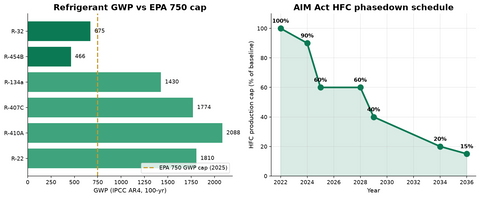
No. R-410A is not banned in 2026 or any specific year. The EPA's AIM Act phases down U.S. HFC production and consumption on a percentage schedule that runs through 2036. New residential and light-commercial air conditioning systems manufactured after January 1, 2025 must use a refrigerant with a Global Warming Potential (GWP) below 700 — which excludes R-410A (GWP 2,088) — but servicing, repairing, and topping off existing R-410A equipment remains fully legal for the operational life of that equipment. Virgin R-410A production continues under a shrinking allocation, and reclaimed R-410A has no phase-down cap.
The AIM Act phase-down timeline (2022–2036)
The American Innovation and Manufacturing Act of 2020 authorized the EPA to phase down HFCs on a specific schedule tied to a 2011–2013 baseline. Here is the actual production and consumption cap by year, in CO2-equivalent metric tons, and what each stage means for contractors sourcing R-410A.
| Year | Cap (% of baseline) | Cut vs. baseline | Contractor impact |
|---|---|---|---|
| 2020–2021 | 100% | — | Baseline consumption |
| 2022–2023 | 90% | −10% | Prices firm; no supply pressure yet |
| 2024–2028 | 60% | −40% | Wholesale prices climb 20–40% year over year; virgin R-410A allocations tighten quarter over quarter |
| 2029–2033 | 30% | −70% | Virgin R-410A becomes scarce and expensive; reclaimed refrigerant becomes the primary service supply |
| 2034–2035 | 20% | −80% | Virgin R-410A largely reserved for critical service; new equipment already 100% R-32/R-454B |
| 2036 onward | 15% | −85% | Steady-state phase-down floor |
The 2024 step-down from 90% to 60% was the sharpest single cut in the schedule and is the reason wholesale R-410A prices doubled between Q4 2023 and Q4 2024. The next cliff is 2029.
Servicing existing R-410A equipment: legal indefinitely
The AIM Act phases down bulk refrigerant production and import, not the operation of installed equipment. Every R-410A air conditioner, heat pump, mini-split, and chiller already in service can be legally repaired, recharged, topped off, and maintained for its full mechanical life. Ownership of R-410A cylinders is not restricted. Buyers still require EPA Section 608 certification for stationary equipment (or Section 609 for motor vehicle air conditioning).
The installed base of R-410A equipment in the U.S. is roughly 100 million units across residential and commercial applications. Servicing that fleet through mechanical end-of-life — typically 12–20 years per system — will drive R-410A service demand through at least 2040. Your service revenue on R-410A does not end when new manufacturing stops.
New equipment: R-32 vs. R-454B
The 2025 GWP-700 cutoff drove OEMs to consolidate around two next-generation refrigerants. Both are HFC-based, mildly flammable (A2L class), and share similar operating envelopes with R-410A but require different service equipment, gauges, and recovery procedures.
| Property | R-410A | R-32 | R-454B |
|---|---|---|---|
| Type | HFC blend (50/50 R-32/R-125) | Pure HFC | HFC blend (68.9/31.1 R-32/R-1234yf) |
| GWP (AR5) | 2,088 | 675 | 466 |
| ASHRAE safety class | A1 (non-flammable) | A2L (mildly flammable) | A2L (mildly flammable) |
| Ozone Depletion Potential | 0 | 0 | 0 |
| Discharge pressure | Baseline | ≈ +5% vs R-410A | ≈ equal to R-410A |
| Cooling capacity | Baseline | ≈ +5–10% | ≈ equal to R-410A |
| Glide | <0.2°F (near-azeotrope) | 0°F (pure) | 0.4°F (small glide) |
| Primary OEM adopters | — (legacy) | Daikin, Goodman, Amana, some Trane residential | Carrier, Bryant, Lennox, Rheem, Ruud |
| Field-service maturity | Complete | Growing rapidly (Asia/EU proven since ~2015) | New in NA market, still ramping |
Which is winning: R-32 vs R-454B
The residential split-system market is roughly split down the middle between the two. Daikin's global preference for R-32 and Carrier/Lennox's early commitment to R-454B has fragmented the industry. Contractors will need to stock both refrigerants and both sets of A2L-rated tools (recovery machines, hoses, manifold gauges rated for A2L operation, leak detectors specific to each blend) for at least the next decade.
Sourcing virgin R-410A during the phase-down
Under the current 60% allocation cap, wholesale R-410A supply is meaningfully tight but not empty. Virgin, factory-sealed 25 lb cylinders remain the standard SKU for stationary service work. Expect prices to continue climbing 15–25% year-over-year until the 2029 step-down, at which point supply gets meaningfully harder.
How to secure R-410A allocation for a service contractor
- Buy ahead when allocation windows open. Distributors receive their annual allocation from producers in Q1. If you know your typical R-410A consumption — measured in cylinders per service season — commit to an annual pallet purchase in January. Waiting until midsummer means paying spot-market prices with tight availability.
- Buy virgin, factory-sealed 25 lb cylinders. Reclaimed R-410A meets AHRI-700 specs and is legal for service, but availability is thinner and quality varies by reclaimer. Virgin is the safer default for warranty-critical work.
- Verify AHRI-700 compliance and DOT-39 or DOT-4BA cylinder certification. Every legitimate cylinder ships with a cert of analysis. Absence of the cert is a sign of gray-market repackaged product.
- Confirm EPA Section 608 certification at purchase, not shipping. Sellers who defer 608 verification to fulfillment are gambling on compliance audits. Purchase-gate verification is the modern standard.
- Ship hazmat ground only. R-410A is UN 3163, hazard class 2.2 (non-flammable gas). Air freight is not economical; ground DOT hazmat is the only sensible fulfillment path.
EPA Section 608 certification: what changed and what didn't
The 608 certification has been mandatory for anyone servicing stationary refrigeration since 1993. The AIM Act did not change 608 — it only tightened the enforcement environment. Distributors and online sellers now audit certification more aggressively because the EPA has been active in enforcement actions since 2023.
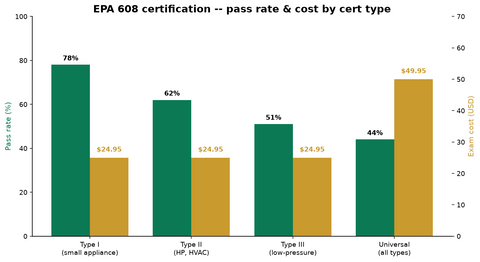
Section 608 certification levels
- Type I — small appliances (5 lb charge or less, hermetically sealed): window units, drinking fountains.
- Type II — high-pressure systems (over 5 lb, above atmospheric): residential and commercial air conditioning, heat pumps, most HVAC service work.
- Type III — low-pressure systems: centrifugal chillers.
- Universal — all three types.
For R-410A stationary work, Type II is the minimum requirement. Type Universal is preferred for contractors handling mixed refrigerant fleets. Section 609 is a separate certification governing motor vehicle air conditioning (MVAC) and applies to R-134a work — not R-410A.
Reclaimed R-22: still legal, still available, still cheaper than replacement
R-22 production ended in the U.S. on January 1, 2020, but reclaimed R-22 meeting AHRI-700 specifications remains legal to buy, sell, and use indefinitely. Roughly 20–30 million legacy R-22 systems remain in service in the U.S. Reclaimed R-22 typically prices lower than new R-410A on a per-pound basis and is the cost-optimal service option for pre-2010 residential systems still in service.
The physical difference between virgin and reclaimed R-22 is negligible if the reclaimer certifies AHRI-700 conformance. Reclamation removes acid, moisture, and non-condensables to the same purity specs as virgin production.
Frequently asked questions
Is it illegal to use R-410A in 2026?
No. Using R-410A in existing equipment is legal indefinitely. Only manufacturing new residential and light-commercial equipment that uses R-410A became prohibited on January 1, 2025 under the AIM Act's 700-GWP cap for new equipment.
Can I still buy R-410A cylinders?
Yes. Virgin R-410A in 25 lb factory-sealed cylinders is available from EPA-compliant distributors. You must hold EPA Section 608 (Type II or Universal) certification to purchase. Prices are climbing but supply remains available under the 60% allocation cap through 2028.
How much longer will R-410A be available?
Production continues under a shrinking cap through 2036 (15% of baseline) and beyond. Reclaimed R-410A has no production cap. Assume virgin R-410A availability tapers steeply after the 2029 step-down but remains obtainable for a decade after that as reclaimed volume grows.
What's the difference between R-32 and R-454B?
R-32 is a pure single-component refrigerant. R-454B is a blend of R-32 (68.9%) and R-1234yf (31.1%) engineered to match R-410A's operating pressures more closely. R-32 has slightly higher capacity but requires re-engineered equipment. R-454B is closer to a drop-in-feel replacement for R-410A. Both are A2L (mildly flammable) and require A2L-rated service tools.
Do I need new tools for A2L refrigerants?
Yes. A2L classification (mildly flammable, low toxicity) requires A2L-rated recovery machines, sensor-equipped leak detectors specific to each refrigerant, and manifold gauge sets rated for the higher operating pressures of R-32. Retrofitting your service tool kit is the largest capital cost most HVAC contractors face during the AIM Act transition. Budget $3,000–$7,000 per service technician for a full A2L-ready toolkit.
Can R-410A be topped off in a system after 2025?
Yes. Topping off, repairing leaks, and full recharges of existing R-410A systems are legal indefinitely. The AIM Act does not restrict service refrigerant use in installed equipment.
What is the GWP of R-410A vs R-32?
R-410A has a GWP of 2,088. R-32 has a GWP of 675 — approximately 68% lower. R-454B has a GWP of 466 — approximately 78% lower than R-410A. The AIM Act's 700-GWP cap on new residential equipment is specifically what drove the retirement of R-410A from new-equipment manufacturing.
Is reclaimed R-22 the same as virgin R-22?
Chemically, reclaimed R-22 meeting AHRI-700 specifications has the same molecular purity as virgin R-22 (typically 99.5% + ppm-level trace contaminants within AHRI limits). The difference is regulatory: reclaimed is legal to sell without production caps; virgin R-22 has been un-produced in the U.S. since 2020.
Where should HVAC contractors buy R-410A during the phase-down?
Distributors with direct producer allocations offer the most reliable supply. Verify hazmat ground fulfillment capability, EPA 608 verification at checkout (not shipment), AHRI-700 certification of analysis, and DOT-compliant cylinder specifications. Portlandia Electric Supply stocks virgin, factory-sealed 25 lb R-410A cylinders with all four compliance gates from our Louisville, KY warehouse. Order R-410A here.
Will R-32 or R-454B eventually be phased down too?
Not under the current AIM Act. Both are below the 700-GWP threshold and are the compliant successors in current EPA guidance. Future rulemaking could revisit these thresholds, but no active timeline for further HFC phase-downs is in force.
Bottom line for HVAC contractors
R-410A is not gone — it's constrained. Prices are climbing, virgin supply is tightening, and the smart move is to secure annual allocation early each year, service the existing installed base efficiently, and skill up on A2L equipment for new-installation work. Reclaimed R-22 remains the cost-optimal service option for pre-2010 systems still in the field. EPA 608 certification is still the gate every legitimate seller enforces.
PES Supply stocks virgin R-410A, virgin R-134a, and reclaimed R-22 with full compliance gates and hazmat ground fulfillment from Louisville, Kentucky. Browse the full refrigerant offering or read our refrigerant return and damage policy.
Need pricing or availability on anything in this guide?
Portlandia Electric Supply dropships direct from the manufacturer — most items Ship Direct with lead times stated up front, no surprises.
Get a quote from PESBulk, pallet and contractor pricing available.