Updated September 2026 — refreshed against the live PES catalog; product pricing verified 2026-09-26.
The rules governing federal solar tax credits changed more between July 2025 and July 2026 than in the previous fifteen years combined. The residential credit is dead. The commercial credit lives — but behind new commence-construction deadlines, new domestic-content math, and a legal fight over what "beginning construction" even means. This guide is the working version we hand to buyers, developers, and CFOs: what the deadlines are, what Safe Harbor requires, what counts as domestic content, and what to lock in writing before each window closes. It reflects the landscape as of mid-2026, including the June 2026 court ruling that restored the traditional 5% Safe Harbor test — and it comes with the standard warning that tax law is tax-adviser territory, with this article as the map, not the signature.
For program-level incentive stacking by state, see our solar incentives by state page and the companion battery storage incentives guide; for the residential side of the sunset, our 2026 20 kW cost guide runs the post-sunset homeowner math.
The Timeline: Every Date That Matters
Print this table. Every conversation about federal solar credits in 2026 is a conversation about one of these rows:
| Date | Event |
|---|---|
| July 4, 2025 | OBBBA signed (Pub. L. 119-21) |
| December 31, 2025 | Section 25D residential credit ENDS |
| August 2025 | IRS Notice 2025-42 issued (later vacated) |
| January 1, 2026 | FEOC / MACR rules take effect |
| February 2026 | IRS Notice 2026-15 issued (MACR guidance) |
| July 4, 2026 | BOC deadline for Long Runway 48E eligibility |
| June 6, 2026 | D.D.C. vacates Notice 2025-42 — 5% Safe Harbor restored |
| December 31, 2027 | Placed-in-service deadline for Short Runway projects |
| December 31, 2030 | Placed-in-service deadline for Long Runway projects |
Three rows deserve emphasis. The December 31, 2025 row is the one homeowners care about: Section 25D — the 30% residential credit that existed since 2006 in various forms — is gone for expenditures after that date, with no commence-construction rescue. The July 4, 2026 row is the one commercial buyers care about: projects that begin construction by that date keep the friendlier pre-FEOC rules and the longer runway. And the June 6, 2026 row is the one that changed planning mid-stream: when the D.C. District Court vacated IRS Notice 2025-42, the Physical Work Test and 5% Safe Harbor — the tests everyone used for a decade — returned to center stage.
The Two Runways for Commercial Projects (Section 48E)
| Path | Begin Construction By | Placed in Service By | Credit Rate |
|---|---|---|---|
| Long Runway | July 4, 2026 | December 31, 2030 | 30% base + bonuses |
| Short Runway | After July 4, 2026 | December 31, 2027 | 30% base + bonuses |
The distinction is simple to state and brutal in practice. Begin construction by July 4, 2026, and you have until the end of 2030 to place the project in service. Miss that date, and the placed-in-service deadline collapses to December 31, 2027 — barely eighteen months of runway for projects that routinely take two years to permit and interconnect. For anything above a few hundred kilowatts, the July 2026 beginning-of-construction date is the single most valuable deadline on the calendar, and it is the reason procurement departments have been pulling equipment orders forward all year.
What "Begin Construction" Actually Means
Two tests, either one sufficient, both rooted in a decade of IRS notices and now re-confirmed by the courts:
The Physical Work Test
Physical work of a significant nature, performed on-site or off-site under a binding written contract for specific components. On-site examples that count: installing racking posts, mounting modules, trenching for conduit, pouring ballast foundations. Off-site examples: a manufacturer producing custom transformers, racking, or skid assemblies under contract specifically for your project. Work that does not count: clearing land, building roads, fencing, or erecting a site office. The dividing line is whether the work is on components that become part of the energy property itself.
The 5% Safe Harbor
Pay or incur at least 5% of the total project cost, taking title or delivery of the equipment (or making qualifying progress payments under a binding contract). On a $500,000 commercial installation, that is $25,000 of properly structured spend. The details matter enormously: the costs must be includable in the project's depreciable basis, the contract must be binding (no refundable deposits on cancellable purchase orders), and delivery or title transfer must follow the economic-performance rules. After the June 2026 vacatur of Notice 2025-42, this is again the primary path most developers are using — a panel and inverter purchase order with proper payment terms, executed and documented before July 4, 2026.
Continuity — the requirement everyone forgets
Beginning construction is not enough; you must maintain a continuous program of construction (Physical Work path) or continuous efforts (Safe Harbor path) until completion. The four-year continuity safe harbor provides cover if the project is placed in service within four calendar years of the year construction began. Weather delays, permitting queues, and interconnection studies are excusable disruptions; a project mothballed for a year because financing lapsed is not. Document the program of work as you go — the file you build contemporaneously is the file that wins an audit.
Safe Harbor Paperwork: What to Lock in Writing
Whether you rely on physical work or the 5% test, the audit file should contain, at minimum:
- Executed binding written contracts with specific equipment identified by model and quantity, dated before the deadline.
- Proof of payment or cost incurrence — invoices, wire confirmations, canceled checks — clearing the 5% threshold with margin. We counsel clients to clear 6% or 7%, not 5.01%.
- Delivery or title-transfer documentation satisfying economic-performance rules — bills of lading, warehouse receipts, or manufacturer's certificates for contract-manufactured equipment.
- A cost-segregation-ready budget establishing total project cost so the 5% denominator cannot be gamed later.
- Contemporaneous construction records: dated photos, inspection reports, daily logs, and interconnection correspondence proving continuity.
- Board or authorization minutes for commercial entities showing when the project was approved and funded.
I have sat through two credit audits on Safe Harbor projects, and both turned on the same thing: not whether the work happened, but whether the paper proved it happened when it had to. The projects that document contemporaneously sail; the projects that reconstruct after the fact bleed. I tell every developer the same sentence: build the file in real time or pay someone to build it — there is no third option that ends well. And I have watched a $22,000 "safe harbor deposit" get disallowed because the purchase order was cancellable, a mistake that took five minutes to make and two years to unwind.
Domestic Content: The 10-Point Bonus and the FEOC Gate
Two separate regimes overlap here, and confusing them is expensive. The domestic content bonus adds 10 percentage points to the credit (40% total instead of 30%) for projects meeting thresholds of U.S.-manufactured content. Separately, the FEOC/MACR rules effective January 1, 2026 restrict credit eligibility for projects with material assistance from prohibited foreign entities — a gate, not a bonus. The thresholds phase up by beginning-of-construction date:
| BOC Date | Domestic Content Threshold | MACR Threshold |
|---|---|---|
| Jan 1 – July 4, 2026 | 50% | 40% |
| 2027 | 55% | 45% |
How do real bills of materials stack against those thresholds? The contribution table our procurement team uses (built from published guidance and safe-harbor cost percentages) shows a representative commercial project:
| Component | Domestic Content Contribution | MACR Contribution |
|---|---|---|
| US-made inverter (e.g., Enphase IQ8, SolarEdge US production) | ~24.8% | ~24.8% |
| US-made racking system | ~19.6% | ~19.6% |
| US-made modules (Qcells, Mission Solar) | ~5.6% | — |
| Total (inverter + racking + minimal modules) | ~50.0% ✓ | ~44.4% ✓ |
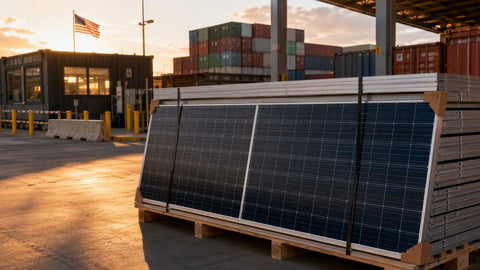
Read the table carefully: an American-made inverter plus American-made racking gets a project to roughly 44% manufactured-products content — enough for the MACR gate in 2026 and, with a modest U.S. module contribution, across the 50% domestic-content bonus line as well. That arithmetic is why U.S.-made solar panels and brands with domestic production — Qcells, Mission Solar, and U.S.-produced inverter lines from Enphase and SolarEdge — have moved from marketing bullet points to line items with a calculable dollar value. On a $500,000 project, the 10-point bonus is $50,000; the domestic premium on equipment is often less.
Residential Buyers: What's Left After the Sunset
Homeowners lost Section 25D at the end of 2025, full stop — no safe harbor, no commence-construction path, no grandfathering for contracts signed but not completed. What remains on the table:
| Incentive Type | Examples | Typical Value |
|---|---|---|
| State tax credits | NY (25% / $5K max), SC (25%), AZ (25% / $1K max), MA (15% / $1K max) | $1,000–$5,000 |
| Utility rebates | Austin Energy ($2,500), Oncor Take A Load Off ($2,000–$8,500 with storage) | $2,000–$8,500 |
| SRECs / performance | NJ SuSI, IL Shines, MD SREC market | $500–$900/year |
| Battery rebates | CA SGIP, NV Energy ($3,000), OR Solar + Storage | $150–$3,000+ |
| Property tax exemption | Available in 36+ states | Varies by assessed value |
| Sales tax exemption | AZ, FL, NJ, WA, and others | 5–10% of equipment cost |
| HEEHRA rebates | Federal point-of-sale electrification rebates | Up to $14,000/household |
Stack those rows aggressively and they recover a meaningful fraction of what the federal credit used to cover — a New York homeowner combining the 25% state credit, SREC-adjacent performance income, and property-tax exemption can still pull effective incentives into the 25–35% range. A homeowner in a no-incentive state cannot, and for them the honest 2026 answer is negotiated price discipline plus rate-based payback. The state landscape moves constantly; verify current programs before relying on any row.
Two structural alternatives keep partial federal value alive for residential customers. Third-party ownership (leases and PPAs) moves the system into commercial ownership, where 48E credits remain accessible — part of the value flows through as lower per-kWh pricing. And business-use property — rentals, home offices with legitimate allocation, farm operations — can claim commercial treatment on the business share. Both structures have fine print worth an hour with a CPA; both are real.
What to Do Before July 4, 2026: The Action List
For commercial and industrial projects not yet under construction, the checklist is short and urgent:
- Execute binding equipment contracts — modules, inverters, racking, transformers — with model-specific line items, before the deadline.
- Structure payments to clear the 5% Safe Harbor with margin, following economic-performance rules on title and delivery.
- Open the continuity file on day one: dated photos, logs, and correspondence, stored somewhere that survives staff turnover.
- Run the domestic-content and FEOC analysis on the exact bill of materials — vendor certifications in writing, not verbal assurances.
- Coordinate with the interconnection queue position; a Safe Harbored project that cannot place in service by December 31, 2030 has spent money to preserve a credit it cannot use.
- Get a written opinion or at least a documented memo from tax counsel on the structure chosen. The fee is trivial against the credit value.
We have helped customers pull procurement forward twice this spring for exactly this reason — buying panels and inverters in May for September construction is no longer a scheduling preference; it is a credit-preservation strategy. If you are speccing equipment for a Safe Harbor purchase, our commercial solar panels and solar inverters collections carry the documentation (invoices, model specificity, delivery records) that the 5% test demands.
How We Got Here: The OBBBA Mechanics in Plain English
The One Big Beautiful Bill Act (Public Law 119-21, signed July 4, 2025) rewired the Inflation Reduction Act's credit architecture in three moves. First, it repealed the residential Section 25D credit outright for expenditures after December 31, 2025 — no phase-down, no transition. Second, it converted the legacy Section 48 commercial ITC into the technology-neutral Section 48E and imposed new deadlines keyed to the bill's enactment date: begin construction within twelve months of enactment (by July 4, 2026) for the full runway, or place in service by December 31, 2027 on the short runway. Third, it layered on the FEOC (foreign entity of concern) restrictions and the MACR (material assistance cost ratio) test, which disqualify projects whose equipment relies too heavily on prohibited foreign supply chains — effective for construction beginning in 2026.
The IRS then issued Notice 2025-42 in August 2025, which attempted to narrow "beginning of construction" for wind and solar — most notably by curtailing the 5% Safe Harbor for many projects. Developers and trade groups sued, and on June 6, 2026 the U.S. District Court for the District of Columbia vacated the notice, restoring the Physical Work Test and 5% Safe Harbor standards that had governed since Notice 2013-29. IRS Notice 2026-15 (February 2026) separately delivered the MACR guidance. The practical result: the old rules are the rules again — but the deadlines in the statute did not move, and July 4, 2026 is now close enough to touch.
A Worked Safe Harbor Example With Real Numbers
A 400 kW commercial rooftop, total project cost $760,000, target placed-in-service Q3 2027:
| Step | Action | Amount / Evidence | Deadline |
|---|---|---|---|
| 1. Equipment contract | Binding PO: 690 modules × 585 W, 4 × 100 kW string inverters, racking — model-specific | Contract value $302,000 | Before July 4, 2026 |
| 2. Safe Harbor payment | Non-refundable payment with title/delivery terms satisfying economic performance | $53,200 (7.0% of $760,000 — margin over the 5% floor of $38,000) | Before July 4, 2026 |
| 3. Delivery documentation | Bills of lading, warehouse receipts, payment confirmations | Contemporaneous file | Within 3.5 months of payment (economic-performance rule) |
| 4. Continuity file | Permit submissions, interconnection study payments, engineering invoices | Quarterly activity, logged | Through placed-in-service |
| 5. Place in service | PTO + commissioning + utility approval | — | By Dec 31, 2030 (Long Runway; continuity safe harbor covers through 2030) |
| 6. Credit claim | Form 3468 with tax return for the placed-in-service year | 30% × $760,000 = $228,000 (40% = $304,000 if domestic content certified) | Tax year 2027 filing |
Check the margin math: 5% of $760,000 is $38,000 exactly, and we structured $53,200 — a 7% payment — because project costs drift upward and the denominator is final total cost, not the budget you wrote in May. If the project finishes at $800,000, a $40,000 payment retroactively fails the 5% test. Margin is cheap; failure is not.
What "Placed in Service" Requires
The second half of every deadline pair is the placed-in-service date, and it has its own five-factor test drawn from decades of case law: the permits and licenses are obtained, the equipment is operational and synchronized to the grid (or ready to produce), the testing is complete, the taxpayer has legal title and control, and the system is capable of producing and delivering power. In practice, permission to operate from the utility is the cleanest single proof point — which is why interconnection scheduling is a tax-planning activity in 2026, not merely a construction one. A project mechanically complete in November 2027 but waiting on a meter swap in January 2028 has a real problem on the Short Runway. Build utility schedules backward from the deadline with at least a quarter of buffer.
The Five Safe Harbor Mistakes That Kill Credits
Patterns from the audit and dispute side, in order of frequency:
- Refundable "deposits" treated as Safe Harbor payments. If the seller can refund it or the buyer can cancel without penalty, it is not a binding contract and the payment does not count. Structure terms with counsel, not with a sales rep's template.
- Equipment delivered into a void. Payment without title transfer, delivery, or qualifying economic performance within the required window fails the test even when the money moved. The delivery documents are the test, not the wire.
- The denominator trap. Paying 5% of a preliminary budget that later grows 15% means you paid 4.3% of the real number. Either pad the payment or re-document as costs firm up.
- Continuity gaps nobody logged. Eighteen months of silence between Safe Harbor and construction start invites the IRS to argue abandonment. Even modest, documented activity — engineering invoices, permit fees, interconnection payments — keeps the continuity story alive.
- Commingled contracts. One master PO covering three projects at three sites cannot be cleanly allocated when one project is challenged. Separate contracts per project, per site, per credit claim.
Every one of these is a paperwork failure, not an engineering failure. The expensive lesson of the post-OBBBA era is that tax structuring now deserves a seat at the procurement table from the first quote — which is exactly how we run commercial project costing on our side of the counter.
A Note on Timing This Article
This landscape is still moving: further Treasury guidance on MACR implementation is expected, litigation over related notices continues, and state programs adjust their rules in response to federal shifts every quarter. Treat any specific threshold or date in this article as correct as of mid-2026 and re-verify against current IRS guidance and counsel advice before signing contracts that depend on it. The structure of the analysis — deadlines, tests, documentation, margins — is durable even when the numbers move.
Frequently Asked Questions
Is the 30% solar tax credit still available in 2026?
For homeowners, no — Section 25D ended December 31, 2025. For businesses, yes: Section 48E still offers a 30% base credit (40% with the domestic content bonus) for projects that begin construction by July 4, 2026 or meet the later placed-in-service deadlines under the post-OBBBA rules.
What does "begin construction" mean for the solar tax credit?
Either starting physical work of a significant nature (installing racking, manufacturing project-specific equipment under contract) or paying/incurring at least 5% of total project cost under the Safe Harbor — followed by continuous construction efforts until the project is placed in service.
Did the courts change the commence-construction rules?
Yes. In June 2026 the D.C. District Court vacated IRS Notice 2025-42, which had narrowed the rules, restoring the traditional Physical Work Test and 5% Safe Harbor as the governing standards for Section 48E projects.
Can I still get solar incentives for my home in 2026?
Yes, but from state, utility, and local programs rather than the federal residential credit: state tax credits (NY, SC, AZ, MA among them), utility rebates, SREC markets, property and sales tax exemptions, and battery-specific rebates like California's SGIP.
What is the domestic content bonus worth?
10 additional percentage points — 40% total credit instead of 30% — for projects meeting the applicable U.S.-manufactured-content threshold (50% for projects beginning construction before July 4, 2026, rising to 55% in 2027 under the published schedule).
Does signing a contract in 2025 preserve the residential credit?
No. The residential 25D credit follows when the expenditure is made and the system is placed in service — both tied to dates after December 31, 2025 failing. Contracts, deposits, and construction progress in 2025 do not preserve the credit for a 2026 completion.
Need pricing or availability on anything in this guide?
Portlandia Electric Supply dropships direct from the manufacturer — most items Ship Direct with lead times stated up front, no surprises.
Get a quote from PESBulk, pallet and contractor pricing available.