Newest Solar Panels in 2026: Latest Models from Leading U.S. Solar Brands
Efficiency has pushed into the 21-24% range. Here's what actually changed in each brand's newest generation — and which panel belongs on your roof.
Based on Clean Energy Reviews, EnergySage, manufacturer product announcements, and our own stocking and RMA data as a national distributor.
Leading U.S. solar brands have pushed panel efficiency into the 21% to 24% range in 2026, with Maxeon's back-contact technology and Silfab's expanded N-type lineup setting the pace for domestically manufactured modules. This guide covers the newest models from the major American and North American-manufacturing brands homeowners and contractors are actually specifying this year: Maxeon (SunPower), REC, Silfab, Qcells, Panasonic, and Canadian Solar — plus the comparison math and buying criteria that matter more than the efficiency headline.
Maxeon 7 leads U.S.-associated brands at 24.1% efficiency using back-contact cell technology with no visible grid lines on the cell face. REC Alpha Pure-R follows at 22.3%, Silfab's new Elite and Prime N-type lines push into the low-to-mid 20% range, and Qcells Q.TRON BLK and Panasonic EverVolt round out the premium domestic-manufacturing tier at 21.4% and 21.6% respectively. If you're shopping by efficiency alone, stop there. If you're shopping by value, warranty, availability, or roof constraints — keep reading, because the right answer changes.
- Maxeon 7 holds the efficiency crown among U.S. brands: 24.1% at 445W, using interdigitated back-contact (IBC) architecture.
- Silfab expanded into N-type with new Elite and Prime lines, manufactured at Silfab's U.S. facilities and targeting both residential and commercial segments.
- Qcells continues its domestic manufacturing scale-up: the Q.TRON BLK series reaches 21.4% efficiency from the Georgia manufacturing campus.
- Panasonic EverVolt uses heterojunction (HJT) technology at 21.6% efficiency, with the best high-temperature behavior in this group.
- REC Alpha Pure-R offers near-premium performance at lower cost — 22.3% efficiency as the value-efficient alternative to back-contact.
- Canadian Solar HiKu7 uses latest-generation TOPCon cells and posts the widest power range in the group, from residential to utility formats.
Maxeon 7 sits at the top of the U.S.-brand efficiency table at 24.1% and 445W in its residential format. The differentiator is the cell architecture: interdigitated back-contact moves every metal conductor to the rear of the cell, so the front face is pure silicon with zero grid-line shading. The result is the highest production per square foot available from a U.S.-associated brand, a distinctive all-black aesthetic, and strong performance in partial shade because of the cell's tolerance to localized shading.
Maxeon backs the panel with the longest warranty in the residential industry — up to 40 years on product and performance through its certified installer network, with warranted output of 88.3% at year 40. The trade-offs are price (this is the most expensive panel in the comparison) and distribution: Maxeon sells through a certified installer channel, so availability for cash-and-carry buyers is limited. On space-constrained roofs where every square foot must produce, it remains the reference standard.
REC's Alpha Pure-R posts 22.3% efficiency using N-type heterojunction cells with lead-free construction, and the newer Alpha Pure-RX pushes the same platform into higher wattage classes (up to 470W in residential format). The Alpha family's calling card is the combination of HJT's excellent temperature coefficient — around -0.24%/°C — with a 25-year product, performance, and labor warranty (92% warranted output at year 25) through REC's certified installer program.
In our order book, REC Alpha is the panel contractors choose when the customer wants near-premium production without Maxeon pricing. The lead-free cell construction also matters for sustainability-focused buyers and certain European-import projects. Browse availability in our REC Solar collection.
Silfab's 2026 story is expansion: the new Elite and Prime N-type lines, built at the company's North American facilities, push into the low-to-mid 20% efficiency range with TOPCon cell architecture. The Elite 370W-420W N-type TOPCon all-black variants have been strong movers in our residential channel — PVEL Top Performer recognition, solid all-black aesthetics, and a North American supply chain that sidesteps tariff uncertainty.
For buyers who prioritize domestic content — whether for IRA domestic-content adder eligibility on commercial projects or simple supply-chain resilience — Silfab's U.S. manufacturing footprint is the pitch. We stock the line directly: see the Silfab Elite 370W N-Type TOPCon all-black panel and the full Silfab collection.
Qcells' Q.TRON BLK series reaches 21.4% efficiency and comes out of the largest solar manufacturing campus in the Western Hemisphere — the company's Georgia facilities. The current M-G2+ generation uses N-type cells and continues Qcells' strategy of pairing competitive specs with unmatched North American production scale, which is why Qcells panels show up on so many installer standard-offering lists.
The practical advantage of scale is availability: when other premium lines hit allocation, Qcells usually has product. Our Qcells collection includes current production, and the Qcells XL G11S covers the larger-format end of the line.
Panasonic's EverVolt line uses heterojunction (HJT) cell technology to reach 21.6% efficiency, and HJT's defining trait — the best temperature coefficient in this comparison, around -0.24 to -0.26%/°C — makes EverVolt the panel for hot climates. On a Phoenix rooftop where cell temperatures run 35°C above ambient, a better temperature coefficient is worth more than a point of nameplate efficiency.
EverVolt carries a 25-year product and performance warranty (92% at year 25 on current models) and strong low-light behavior from the HJT cell structure. Check our Panasonic collection for current stock.
Canadian Solar's HiKu7 family uses latest-generation TOPCon cells and spans the widest format range in this guide — from residential wattages through large-format commercial and utility modules, with efficiency from 21.0% up to 23.3% depending on format. The residential variants compete on value; the large-format variants are among the most commonly specified modules in North American commercial and utility pipelines.
For projects mixing rooftop and ground-mount segments, HiKu7's range means one manufacturer relationship covers the whole portfolio. See the Canadian Solar collection for current formats.
| Brand / Model | Efficiency | Cell Technology | Notable Strength |
|---|---|---|---|
| Maxeon 7 | 24.1% | Back-contact (IBC) | Top efficiency among U.S. brands |
| REC Alpha Pure-R | 22.3% | N-type heterojunction | Value-efficient near-premium |
| Silfab Elite/Prime | Up to ~23% | N-type | U.S.-manufactured, PVEL Top Performer |
| Panasonic EverVolt | 21.6% | Heterojunction (HJT) | High-temperature performance |
| Qcells Q.TRON BLK | 21.4% | N-type | Large-scale domestic manufacturing |
| Canadian Solar HiKu7 | 21.0% to 23.3% | N-type TOPCon | Wide U.S. availability |
Three cell architectures dominate the 2026 premium market, and the differences are real but narrower than marketing suggests:
| Attribute | Back-Contact (IBC) | TOPCon (N-type) | HJT (N-type) |
|---|---|---|---|
| Flagship example | Maxeon 7 (24.1%) | HiKu7, Q.TRON, Silfab Elite | EverVolt, Alpha Pure-R |
| Efficiency range (2026) | 23-24%+ | 21-23.3% | 21.5-22.6% |
| Temperature coefficient | ~ -0.27 to -0.29%/°C | ~ -0.29 to -0.30%/°C | ~ -0.24 to -0.26%/°C (best) |
| First-year degradation | ~1% | ~1% | ~1% |
| Annual degradation after year 1 | ~0.25-0.35% | ~0.40% | ~0.25-0.35% |
| Relative cost | $$$ (highest) | $-$$ (best value) | $$ |
| Why choose it | Max production per sq ft | Price-performance balance | Hot climates, low light |
The honest summary: IBC wins on nameplate efficiency and aesthetics, HJT wins on real-world hot-climate and low-light production, and TOPCon wins on cost per watt with nearly all of the N-type degradation benefit. Our N-type panels collection covers the TOPCon side in depth, and the comparison table above shows where each architecture lands on efficiency.
Panel warranties in 2026 split into product (defects) and performance (output retention) terms, and the spread between brands is wider than the efficiency spread. The figures below reflect published manufacturer warranty terms — always verify against the current datasheet and warranty document for the exact model you're buying:
| Brand / Line | Product Warranty | Performance Warranty | Warranted Output at Term |
|---|---|---|---|
| Maxeon 7 | Up to 40 years* | 40 years* | 88.3% at year 40* |
| REC Alpha Pure-R | 25 years* | 25 years | 92% at year 25 |
| Panasonic EverVolt | 25 years* | 25 years | 92% at year 25 |
| Silfab Elite/Prime | 25-30 years* | Up to 30 years* | Check current datasheet |
| Qcells Q.TRON | 25 years* | 25 years | Check current datasheet |
| Canadian Solar HiKu7 | Up to 25 years* | Up to 30 years* | Check current datasheet |
*Extended terms typically require registration and/or installation by a certified installer. The pattern that matters: premium N-type and back-contact panels now warrant roughly 85-92% output at the 25-year mark, versus the 80-85% that was standard a decade ago. Degradation guarantees have become a genuine differentiator — read them before the price sheet.
Efficiency matters only through two numbers: how much power fits on your roof, and how the electrical design works out. Here's both, with real arithmetic:
| Design Question | Calculation | Result |
|---|---|---|
| 8 kW system with 445W panels (Maxeon 7 class) | 8,000 W ÷ 445 W = 17.98 → round up | 18 panels (8.01 kW) |
| 8 kW system with 430W panels (Pure-RX class) | 8,000 W ÷ 430 W = 18.60 → round up | 19 panels (8.17 kW) |
| 8 kW system with 400W panels (value N-type) | 8,000 W ÷ 400 W | 20 panels (8.00 kW) |
| 8 kW system with 370W panels | 8,000 W ÷ 370 W = 21.62 → round up | 22 panels (8.14 kW) |
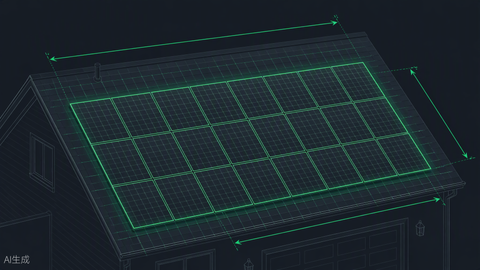
| Roof area: 18 premium panels ≈ 21.5 ft² each | 18 × 21.5 ft² | ≈387 ft² of roof |
| Roof area: 22 standard panels ≈ 19.5 ft² each | 22 × 19.5 ft² | ≈429 ft² of roof |
Eleven percent less roof for the same power — that's what the efficiency premium buys. On an unconstrained roof, it may not be worth it. On a roof chopped up by vents, chimneys, and setbacks, it's the difference between 8 kW and 6.5 kW of system.
The second calculation is string sizing under NEC 690.7. Residential modules in this class carry a Voc around 44V. At a -10°C design temperature, the Table 690.7(A) correction factor of 1.14 puts each module at 50.2V. On a 600V residential inverter input, that means a hard ceiling of 11 modules per string (11 × 50.2V = 552V); a 12th module would hit 602V on a cold morning and exceed the equipment rating. We see this exact error in plan sets every winter. The solar system calculator and inverter sizing calculator handle the first pass of this math.
I've sold panels through the poly-to-mono transition, the PERC transition, and now the N-type transition, and the pattern repeats: the newest architecture wins on the spec sheet eighteen months before it wins on the warehouse shelf. In 2026, N-type is finally the shelf. Premium PERC is now the discount bin, and we're clearing the last of it to buyers who know exactly why they're getting a deal.
The question I answer most from homeowners is “which of these is actually best?” and my honest answer is: the one that fits your roof, your climate, and your installer's certification tier. A Maxeon on a certified installer's truck beats a slightly-more-efficient datasheet you can't buy. Spec the panel your installer can warranty.
From the returns side: freight damage claims are down markedly since the industry moved to N-type glass-glass formats on premium lines, and early-life failure rates on the 2026 model year are the lowest we've logged. The newest generation isn't just more efficient — it's better built.
The 2026 model year is the first in which N-type architectures — TOPCon, HJT, and back-contact — hold a clear majority of the premium residential market. P-type PERC, which defined the last decade of panels, has moved to the value tier and is being phased out of premium lineups entirely. For buyers, that transition has two practical consequences.
First, degradation specs improved across the board. N-type cells suffer essentially no light-induced degradation (LID) and far less potential-induced degradation (PID) than the P-type cells they replace, which is why warranted year-25 output has climbed from the low 80s into the high 80s and low 90s across this guide's lineup. The 2026 panels don't just start stronger — they stay stronger.
Second, domestic manufacturing finally has real depth. Between Qcells' Georgia campus, Silfab's North American lines, and Canadian Solar's Texas assembly, a buyer can now spec a current-generation N-type panel with a U.S. factory address at multiple price points. Two years ago that was one product line; in 2026 it's a category. For commercial projects chasing domestic-content incentives, that changes the procurement math materially.
Every model in this guide passed the same checklist our purchasing team applies before we agree to stock a panel. If you're comparing models we didn't cover, steal the framework:
1. Datasheet verification. We check the published electrical specs against independent test data (PVEL, RETC, Kiwa) where available. Efficiency claims that don't survive third-party measurement don't make our catalog.
2. Warranty enforceability. A 25-year warranty is only as good as the company and the process behind it. We look at registration requirements, labor coverage, transferability on home sale, and the manufacturer's actual claim-handling history — including how they've treated our customers' claims.
3. Supply depth. A panel we can't restock is a panel we won't recommend for a multi-phase project. Manufacturing scale and U.S. distribution depth get scored, not just specs.
4. Mechanical fit. Dimensions, weight, frame design, and clamp zones decide which roofs and racking systems a panel actually works with. The prettiest datasheet in the world doesn't help if the module doesn't fit the layout. Our racking systems guide covers the mechanical side.
5. Total cost of ownership. Price per watt today, production per square foot, degradation over 25 years, and warranty risk — in that order. Cheap panels with fast degradation are the most expensive panels we've ever sold.
Maximum production on a tight roof: Maxeon 7 — nothing else from a U.S.-associated brand touches 24.1%.
Best value at near-premium efficiency: REC Alpha Pure-R — 22.3% with HJT temperature behavior at a meaningfully lower price.
Hot climates: Panasonic EverVolt or REC Alpha — HJT's temperature coefficient pays real dividends above 30°C ambient.
Domestic content priority: Silfab Elite/Prime or Qcells Q.TRON — North American manufacturing with current-generation N-type cells.
Portfolio or commercial projects: Canadian Solar HiKu7 — one TOPCon platform from rooftop to utility scale.
Whichever direction you go, buy through a channel that can honor the warranty — and compare live pricing across our solar panels catalog, 400-459W class, and 460-549W class. The best solar panels of 2026 page is updated as new models land in stock.
One closing piece of advice we give every caller: the 2026 lineup is good enough that there is no wrong choice on this list — only mismatched ones. Match the panel to the roof, the climate, and the installer's certification tier, and every brand in this guide will still be producing past its warranty date. Mismatch them — a premium IBC panel on an unconstrained barn roof, a bargain module crammed onto a vent-chopped bungalow — and even great hardware underperforms. Fit first, brand second, price third. That's the order that builds systems we're proud to have shipped.
What is the most efficient solar panel available in the U.S. right now?
Among U.S.-associated brands, Maxeon 7 leads at 24.1% efficiency using back-contact cell technology, followed by REC Alpha Pure-R at 22.3%. Silfab, Qcells, Panasonic, and Canadian Solar's newest N-type lines range from 21.0% up to about 23.3% depending on model and format. A handful of boutique or import-only modules exceed these figures, but among brands with U.S. manufacturing or major North American distribution, that is the current leaderboard.
What's the difference between TOPCon, HJT, and back-contact cells?
All three are premium N-type architectures. TOPCon adds a tunnel-oxide passivation layer to an upgraded PERC-style process and delivers the best cost per watt. HJT sandwiches crystalline silicon between amorphous layers, producing the best temperature coefficients and low-light behavior. Back-contact (IBC) moves all electrical contacts to the rear of the cell, eliminating front-surface shading for the highest efficiencies available - at the highest price.
Are perovskite solar panels available for homes yet in 2026?
Not at retail. Perovskite-silicon tandem cells have posted laboratory efficiencies above 33% and several manufacturers have pilot production lines running, but no tandem module has reached mainstream U.S. residential distribution with bankable warranties as of mid-2026. Expect commercial-scale announcements before residential product; the panels in this guide remain the realistic purchase options this year.
Does higher efficiency always mean a better panel for my home?
No. Efficiency determines power per square foot, which matters on space-constrained roofs. On a large, simple roof, a lower-efficiency panel at a lower price per watt often produces the same annual energy for less money. Weight efficiency against temperature coefficient (hot climates), degradation and warranty terms (long holds), and your installer's certification tier for each brand.
Which U.S. brands actually manufacture panels domestically?
Qcells operates the largest solar manufacturing campus in the Western Hemisphere in Georgia, and Silfab manufactures its Elite and Prime lines at North American facilities. Canadian Solar operates U.S. module assembly in Texas. Maxeon, REC, and Panasonic manufacture primarily overseas but maintain major U.S. distribution and installer networks. If domestic content matters for incentives, verify the specific model's manufacturing location on the current datasheet - it varies within brand lineups.
About PES Supply: Portlandia Electric Supply is a national wholesale distributor of solar, storage, generator, and electrical equipment. We stock current-generation modules from the brands in this guide and ship nationwide from live inventory. Start at the PES Supply homepage or browse the full solar panel catalog.