Last Updated: August 2026 • A Procurement Comparison for Installers, EPCs, and Contractors
Every installer scaling past a handful of jobs a month eventually asks the same question: does buying a full container direct actually save enough money to justify the capital, storage space, and customs complexity it demands — or is pallet-level purchasing from a domestic distributor the smarter play once every real cost is counted? The headline per-watt number on a container quote is almost always lower than a pallet quote. The total landed cost comparison is a lot closer than that headline number suggests.
This guide breaks down what you're actually comparing, the real math behind each option, the hidden costs each side doesn't put on the quote sheet, and a straightforward framework for deciding which one fits your business at its current volume.
⚡ Quick Answer
A full container of panels typically prices $0.03–$0.08/W below a domestic pallet purchase — but once customs brokerage, duties, freight from port, storage, capital tie-up, and damage/claims risk are included, that gap narrows to $0.01–$0.03/W for most installers, and can disappear entirely for anyone doing less than roughly 500 kW of annual volume. Pallet purchasing from a domestic distributor wins on speed (days, not months), flexibility (order what a specific job needs), warranty support, and financing terms — advantages that matter more than a few cents per watt for most residential and mid-size commercial installers. Container buying only pencils out clearly above a consistent volume threshold with in-house logistics capability and available capital to hold inventory.
Key Takeaways
- The Headline Price Gap Is Real But Overstated: container pricing looks meaningfully cheaper per watt until customs, duties, drayage, and storage are added back in.
- Lead Time Is the Most Underrated Cost: container orders typically take 6–12+ weeks from order to warehouse-ready; pallet orders from domestic stock ship in days.
- Capital Tied Up in Inventory Has a Real Cost: a container's worth of panels sitting in a warehouse for months is capital that isn't funding the next job.
- Damage and Claims Are Harder to Resolve on Direct Imports: a damaged pallet from a domestic distributor is a quick swap; a damaged container from overseas is a claims process measured in weeks.
- Warranty Administration Differs Sharply: a domestic distributor stands behind the product locally; a direct-import buyer often becomes their own first line of warranty support for customers.
- Volume Is the Real Deciding Factor: container buying starts to clearly pencil out for installers with consistent annual volume in the hundreds of kW to low MW range and in-house capacity to manage logistics.
- PES Supply: pallet, multi-pallet, and truckload pricing tiers available on domestic stock with days-not-months delivery, so most installers get near-container economics without the container-level risk.
In This Guide
- Pallets and Containers: The Basics
- Side-by-Side Comparison
- The Real Savings Math
- Hidden Costs of Container Buying
- What Pallet Buying Gets You That Isn't on the Price Sheet
- Where the Break-Even Actually Sits
- Choose Pallets If / Choose a Container If
- The Middle Ground: Truckload and Standing Account Pricing
- Frequently Asked Questions
Pallets and Containers: The Basics
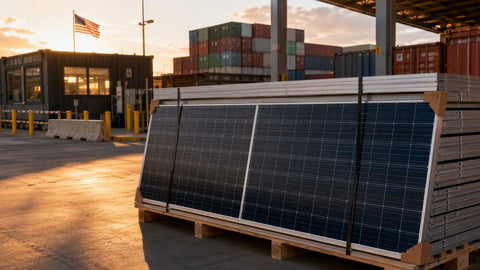
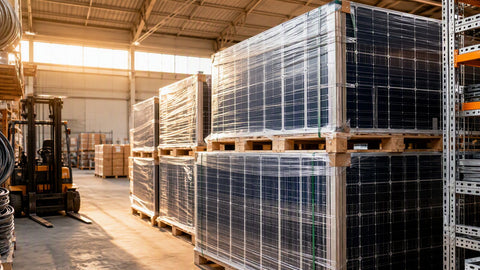
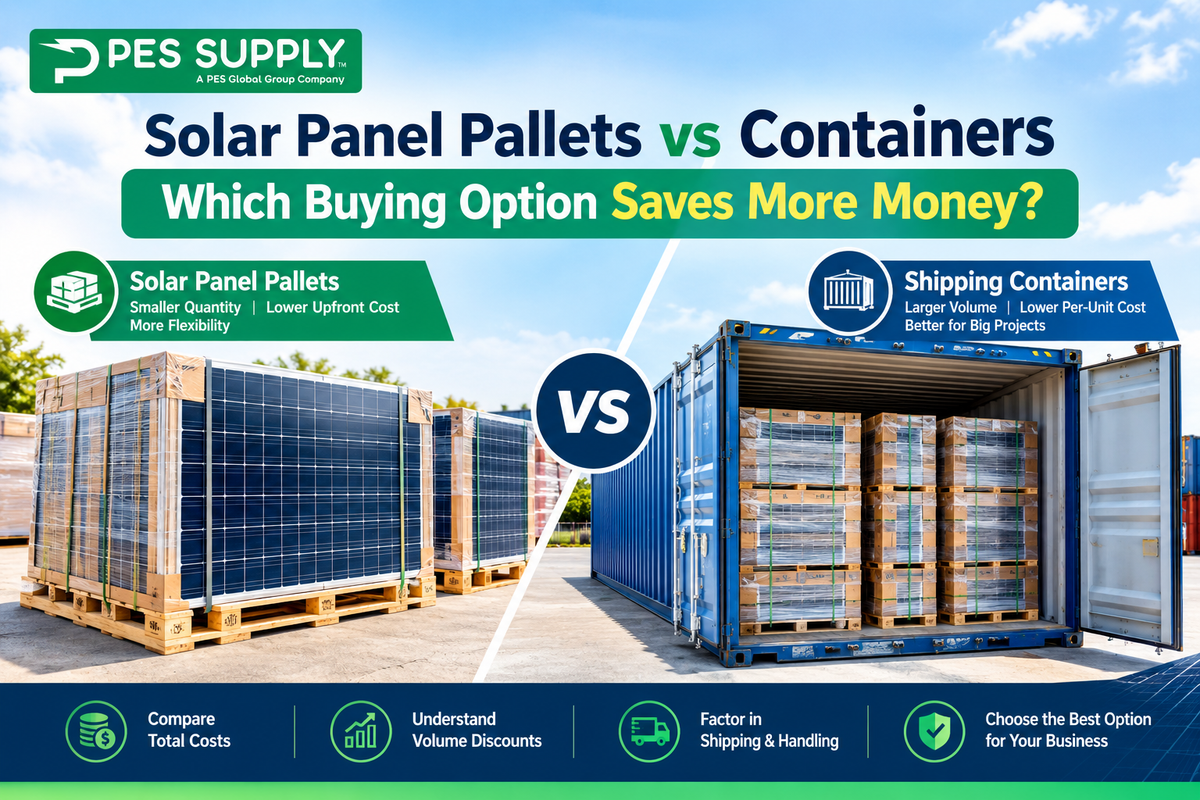
A pallet of solar panels — typically 30–36 modules depending on the model — is the standard unit of purchase from a domestic distributor's existing warehouse stock. It ships via standard freight, usually arrives within days, and can be ordered in quantities matched to a specific job or a modest inventory buffer.
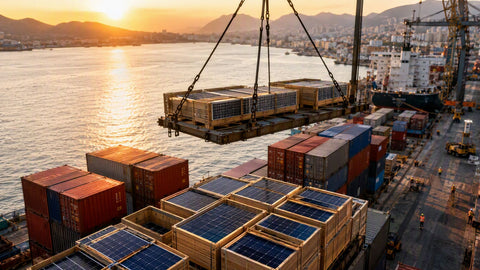
A container — typically holding the equivalent of roughly 20-26 pallets in a standard 40-foot high-cube container — is a direct order placed with (or through a broker to) an overseas manufacturer, shipped by ocean freight, cleared through U.S. customs, and delivered to the buyer's own warehouse or a bonded facility. It represents a fundamentally different purchasing relationship: you're buying from the manufacturer's production queue rather than from existing domestic inventory.
Side-by-Side Comparison
| Factor | Pallet (Domestic Distributor) | Container (Direct Import) |
|---|---|---|
| Headline Per-Watt Price | Higher | Lower |
| Lead Time | Days from order to delivery | 6–12+ weeks including production, ocean freight, and customs clearance |
| Minimum Order | Single pallet or less | Full or near-full container, often a full production run minimum |
| Capital Commitment | Matched to immediate job need | Full container value paid upfront or on strict terms, often before goods arrive |
| Storage Requirement | Minimal — order close to install date | Warehouse space for the full container until deployed across jobs |
| Customs and Compliance Risk | None — distributor handled this upstream | Buyer's responsibility — tariff classification, AD/CVD exposure, documentation |
| Damage/Claims Process | Fast — local distributor swap or credit | Slow — international claims process, often unresolved for damaged units |
| Warranty Support | Distributor provides local RMA support | Buyer often becomes first line of support for their own customers |
| Flexibility to Mix Models/Brands | High — order exactly what each job needs | Low — locked into one model/spec for the full container |
The Real Savings Math
Take a container holding roughly 700 panels at 440W each — about 308 kW total. A headline price gap of $0.05/W between pallet and container pricing looks like a $15,400 savings on paper. Once real costs are added back in, the picture changes:
| Cost Factor | Typical Impact on a ~308 kW Container |
|---|---|
| Headline Savings vs. Pallet Pricing | +$15,400 (at $0.05/W gap) |
| Ocean Freight + Drayage | −$4,000 to $10,000 |
| Customs Brokerage + Duties/Tariffs | Highly variable — $1,000 to $20,000+ depending on classification |
| Storage (3–6 months average hold time) | −$1,500 to $4,000 |
| Capital Cost (opportunity cost of tied-up cash) | −$2,000 to $6,000 (varies with financing cost and hold time) |
| Realistic Net Advantage | Often near breakeven to modestly positive, before accounting for damage/claims risk and lead-time cost |
Figures are illustrative ranges for a mid-size container order and vary significantly by tariff classification, freight market conditions, and financing terms. Run the specific numbers for your situation before deciding.
Hidden Costs of Container Buying
Beyond the line items in the table above, several less obvious costs and risks tend to surprise first-time container buyers:
- Tariff and AD/CVD reclassification risk: a container's duty rate depends on precise country-of-origin and manufacturing-location documentation; disputes or reclassification after the fact can significantly change the landed cost after the purchase decision is already made.
- Deployment mismatch: a full container locks in one model and spec, but real job requirements vary — wattage, dimensions, or aesthetic needs that don't match the container's contents mean either compromising the job spec or buying supplemental panels anyway.
- Slower cash conversion: capital spent on a container sits as inventory until deployed across enough jobs to fully utilize it, which can take months longer than anticipated if sales pipeline slows.
- Quality control distance: resolving a batch quality issue with an overseas manufacturer is a fundamentally slower and more difficult process than working with a domestic distributor who has local accountability.
What Pallet Buying Gets You That Isn't on the Price Sheet
💡 Speed Is a Competitive Advantage, Not Just a Convenience
An installer who can turn a signed contract into a scheduled install date within days — because panels ship from domestic stock rather than a 10-week container lead time — closes more jobs and keeps crews utilized more consistently than one waiting on an overseas shipment. That scheduling reliability has real revenue value that rarely makes it into a per-watt price comparison.
Pallet buying from an established domestic distributor also means the panel spec can be matched exactly to each job — mixing brands and wattages across a month's worth of installs without being locked into a single container's contents — and that warranty claims, damaged-unit swaps, and technical support all run through a local point of contact rather than an international process measured in weeks.
Where the Break-Even Actually Sits
Container buying starts to make clearer sense once an installer has: (1) consistent, predictable annual volume — typically in the hundreds of kW to low megawatt range — that will reliably absorb a full container within a reasonable timeframe; (2) available capital that isn't better deployed elsewhere in the business; (3) warehouse space and logistics capability to receive, store, and manage a container-scale delivery; and (4) internal capacity to handle customs documentation and, if needed, warranty administration for customers.
Below that threshold, the theoretical per-watt savings of container buying is consistently outweighed by the flexibility, speed, and reduced risk of pallet-level purchasing from a domestic distributor — which is why most installers under a few hundred kW of annual volume don't pursue direct import even when the headline pricing looks attractive.
Choose Pallets If / Choose a Container If
Choose Pallet Purchasing If:
- Your monthly volume varies job-to-job and doesn't reliably absorb container quantities
- Fast turnaround from signed contract to install date matters to your sales process
- You need flexibility to match panel model and spec to each individual job
- You don't have in-house customs and logistics capability
- Warranty and RMA support responsiveness matters more than the last few cents per watt
Choose Container Buying If:
- You run consistent, predictable annual volume in the hundreds of kW or more
- You have available capital that isn't better deployed elsewhere in the business
- You have warehouse space and logistics capacity to manage a bulk delivery
- You're comfortable managing customs documentation and tariff classification risk directly
- Your pipeline is stable enough that a single-model, single-spec container won't create deployment mismatches
The Middle Ground: Truckload and Standing Account Pricing
Most installers don't actually need to choose between "single pallet" and "full container" — the more common answer is a full truckload order (roughly 26 pallets) from a domestic distributor, or a standing account with volume-based pricing tiers built on a documented purchasing history. Both capture a meaningful share of the per-watt savings container buying offers, without the lead time, capital lockup, customs risk, or logistics burden. For most residential and mid-size commercial installers, this middle ground — not a container — is where the real optimization opportunity sits.
Not sure which tier fits your volume? Get a wholesale quote from PES Supply comparing pallet, truckload, and standing-account pricing side by side for your actual job pipeline.
Frequently Asked Questions
How many panels are in a container?
A standard 40-foot high-cube container typically holds the equivalent of roughly 20–26 pallets, or somewhere in the range of 600–900+ panels depending on the specific model and packaging configuration.
Is buying a container of solar panels actually cheaper than buying pallets?
The headline per-watt price is usually lower, but once freight, customs brokerage, duties, storage, and the cost of capital tied up in inventory are included, the real savings gap narrows significantly and can disappear entirely for installers below a meaningful volume threshold.
What volume do I need before container buying makes sense?
There's no single universal number, but container buying generally starts to clearly pencil out for installers with consistent annual volume in the hundreds of kW to low megawatt range, combined with available capital, warehouse space, and in-house logistics and customs capability.
How long does a container order take compared to a pallet order?
A pallet order from domestic distributor stock typically ships within days. A container order — including manufacturing lead time, ocean freight, and customs clearance — commonly takes 6 to 12 weeks or longer from order placement to warehouse-ready inventory.
What happens if panels are damaged in a container shipment?
Resolving damage claims on an international container shipment is typically a slower, more document-intensive process than a domestic distributor swap or credit, and depending on the terms of sale, the buyer may bear more of the resolution burden than they would with a domestic pallet purchase.
Compare Pallet vs. Truckload Pricing on Your Next Order
PES Supply offers pallet, multi-pallet, and full truckload pricing tiers on Tier 1 panels from domestic stock — with days-not-months delivery, local warranty support, and contractor payment terms. Get a side-by-side quote before committing to a container.
Request a Wholesale Quote Set Up a Pro AccountRelated Guides
- Solar Panel Wholesale Pricing: What Installers Should Know in 2026
- Best Solar Panels 2026 — Buyer's Guide
- Pro Account — Wholesale Pricing
- PowerLink Network — Contractor Program
- Solar Panels
- Request a Quote - Pallet, truckload, and standing-account pricing
About PES Supply
PES Supply is a nationwide distributor of Tier 1 solar panels, commercial inverters, battery storage systems, EV charging hardware, racking, switchgear, circuit breakers, generators, and complete electrical project kits. With 12+ distribution hubs, thousands of in-stock SKUs from 229+ authorized brands, NABCEP-certified design support, and a network of 8,500+ solution providers, PES Supply serves contractors, EPCs, developers, and businesses with fast delivery, wholesale pricing, and expert procurement guidance.
Location: 1507 Portland Ave, Louisville, KY, United States | Phone: 1 888-876-0007 | Website: www.portlandiaelectric.supply
Article: Solar Panel Pallets vs Containers: Which Buying Option Saves More Money?
Category: Procurement | Contractor Resources | Solar Panels
Last Updated: August 2026
Disclaimer: Cost figures and lead-time estimates in this guide are illustrative ranges based on general market conditions as of August 2026 and vary significantly by supplier, tariff classification, and freight market conditions. Always request itemized landed-cost quotes and run the specific numbers for your business before deciding between purchasing options.