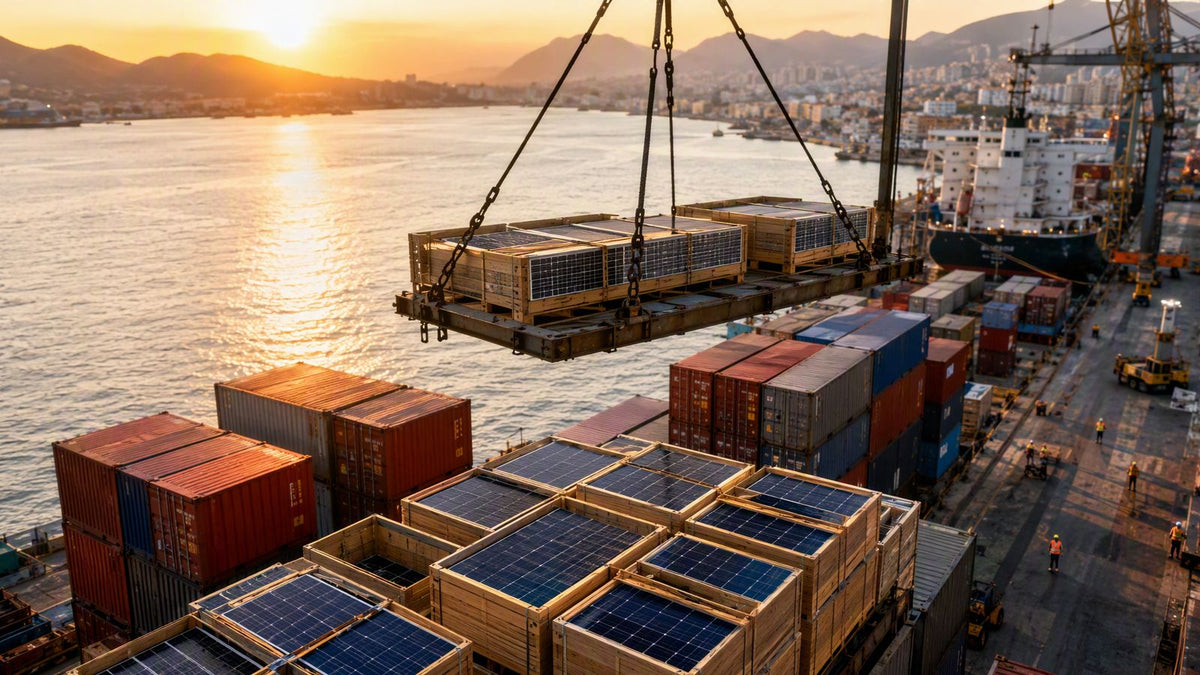
Every solar procurement decision in 2026 runs through the same three questions: where was the module made, what tariff stack applies to it, and does the domestic content math justify paying the premium. We answer these questions across the counter every day, and the honest answer keeps changing — the trade map has been redrawn three times in four years. This is the sourcing playbook as it actually stands in August 2026: real regional costs, the tariff arithmetic step by step, and the point where domestic content pays for itself.
Where Modules Are Actually Made in 2026
China: Still the Cost Floor
China produces roughly 80% of the world's solar modules and effectively all of the cheapest ones. TOPCon modules FOB China trade around $0.12/W — a number that bears no resemblance to what a U.S. buyer pays, but anchors every other region's pricing. Chinese manufacturing costs keep falling on scale and vertical integration; what keeps Chinese modules out of the U.S. market is not cost but the wall of duties described below.
Southeast Asia: The Former Backdoor
Cambodia, Malaysia, Thailand, and Vietnam spent years as the tariff workaround — Chinese-owned cell and module plants finishing product outside China's customs territory. The 2025 AD/CVD determinations closed much of that door, with rates ranging from 14.64% to over 3,500% on the worst offenders. Some Malaysian capacity with genuinely local supply chains survives at tolerable duty rates; the rest is effectively priced out of the U.S. market.
India and Indonesia: The New Targets
As Southeast Asia closed, India and Indonesia absorbed the diverted volume — and promptly attracted their own AD/CVD cases. Rates of 25% to 100%+ now apply depending on the producer, and the window for "tariff-free Indian modules" has largely closed. India's domestic content requirements for its own market further complicate export availability.
U.S. Domestic: Higher Cost, Higher Certainty
U.S. module assembly capacity has grown several-fold since the IRA's manufacturing credits took effect — the Section 45X factory boom is real. But "assembled in USA" is not "made in USA": most domestic plants still import cells, which is why domestic content percentages vary so widely between nominally American products. The cost gap by production step remains substantial:
| Step | U.S. Cost | Global Lowest (China) | U.S. Gap |
|---|---|---|---|
| Polysilicon | $12–15/kg | $6–8/kg | 2× |
| Ingot/wafer | Not commercially produced | $0.03–0.04/W | N/A |
| Cell | $0.18–0.25/W (pilot only) | $0.08–0.10/W | 2–2.5× |
| Module assembly | $0.08–0.12/W | $0.03–0.05/W | 2× |
| Glass/frame/encap | $0.03–0.05/W | $0.02–0.03/W | 1.5× |
The wafer row is the structural story: the U.S. has essentially no commercial ingot/wafer capacity, so even the most domestic module available in 2026 starts life as an imported wafer. Every domestic content calculation flows from that constraint.
Mexico: The Nearshoring Wildcard
Mexican module assembly under USMCA rules offers genuine tariff advantages and short logistics — a real option for Southwest utility projects. Capacity remains limited and the rules-of-origin math requires actual North American value-add, not re-labeling. Watch this space; it's the one sourcing lane with room to grow.
Europe: Premium, Not Volume
European modules exist, perform beautifully, and cost what they cost. At €0.13+/Wp for standard product, they're a specialty choice for projects with European sourcing mandates, not a volume answer for U.S. buyers.
Tariff Stacking: How $0.20 Becomes $0.45
The single most misunderstood mechanic in module procurement is how duties compound. Tariffs don't average — they stack multiplicatively on declared value, and each layer applies to what's left. The current stack:
| Tariff | Rate | Applies To | Estimated Impact ($/W) |
|---|---|---|---|
| Section 201 (safeguard) | 14% (bifacial excluded) | All imported crystalline modules | $0.02–0.03 |
| AD/CVD (CMTV) | 14.64%–3,500% | Cambodia, Malaysia, Thailand, Vietnam | $0.08–0.20 |
| AD/CVD (India/Indonesia/Laos) | 25%–100%+ | India, Indonesia, Laos | $0.06–0.15 |
| Section 232 (polysilicon) | TBD (August 2026) | Imported polysilicon and derivatives | $0.02–0.05* |
| Reciprocal tariffs | 10%–49% | Country-specific (China 49%, SE Asia 24–48%) | $0.03–0.10 |
Worked example: a module with $0.20/W declared customs value from a mid-rate Southeast Asian producer. Section 201 adds $0.028. AD/CVD at, say, 50% adds $0.10. Reciprocal tariffs at 24% add another ~$0.05 on the elevated value. Landed cost: roughly $0.38/W before freight, warehousing, and distributor margin — which is how a $0.20 factory price becomes a $0.45 quote. The bifacial exclusion from Section 201 is why bifacial modules often price surprisingly well for commercial and ground-mount work. The history of each layer is in our coverage of Section 201, Section 301, and Section 232 minimum import prices.
Regional Landed Cost Comparison
Pulling it together, here's what a standard TOPCon module actually costs a U.S. buyer by origin, landed at a distributor warehouse in mid-2026:
| Origin | Factory Price ($/W) | Est. Tariff Stack | Landed Cost ($/W) | Domestic Content Eligible? |
|---|---|---|---|---|
| China | $0.12 | ~100%+ combined | $0.28–0.34 (rarely imported) | No |
| Malaysia (compliant producer) | $0.16 | ~15–30% | $0.24–0.28 | No |
| India (post-AD/CVD) | $0.15 | ~25–60% | $0.24–0.30 | No |
| Mexico (USMCA) | $0.19 | Minimal | $0.24–0.28 | Partial (rules of origin) |
| U.S.-assembled, imported cells | $0.28 | None on assembly | $0.30–0.36 | Partial (assembly + some components) |
| U.S.-assembled, U.S. cells (rare) | $0.34 | None | $0.36–0.42 | Yes, highest percentage |
Note the compression: the cheapest compliant import and the cheapest domestic option now land within about six cents of each other. That gap used to be fifteen cents. The entire domestic content decision lives inside those six cents.
Scale Economics: Residential vs. Commercial vs. Utility
Residential (5–15 kW)
At 10 kW, the module bill is roughly $3,000–$3,600 of a $30,000+ system. A 15% module premium for domestic content costs the homeowner perhaps $500 — noise against total system price, and easily recovered if the ITC adder applies. Residential buyers should basically always take domestic-content-eligible modules when available. Qcells and Mission Solar are the names that come up most in this lane.
Commercial (100 kW–5 MW)
At 500 kW, a $0.03/W module premium is $15,000 against a 10% ITC adder worth ~$25,000 on a typical project — still a win, but freight, availability, and financing start to matter. This is the segment where sourcing strategy earns or loses real money.
Utility-Scale (50 MW+)
At 100 MW, three cents a watt is $3 million. Utility buyers run the math both ways on every procurement, hedge across suppliers, and increasingly structure supply agreements years ahead with tariff pass-through clauses. If you're in this segment, you already have a trade lawyer.
When Does Domestic Content Pay for Itself?
The 10% domestic content ITC adder (stacking to 40% total credit) changes the answer by project size:
| Project size | Total cost | 30% ITC | 10% adder | Module premium | Payback? |
|---|---|---|---|---|---|
| 10 kW residential | $35,000 | $10,500 | $1,050 | $500–1,000 | Yes |
| 500 kW commercial | $835,000 | $250,500 | $25,050 | $15,000–25,000 | Yes |
| 100 MW utility | $120M | $36M | $3.6M | $5–10M | Maybe (depends on module premium) |
The adder is calculated on total project cost while the premium applies only to the modules — that asymmetry is the whole trick. On the commercial example: $25,050 of extra credit against at most $25,000 of extra module cost. Residential is an easy yes; utility-scale is a coin flip that swings on the premium per watt and whether the project also claims energy community or low-income adders. One caution: Treasury's final safe harbor tables (due end of 2026) may shift the qualifying percentages, so contracts signed now should include repricing language if the rules move.
What We're Seeing at the Counter
Three patterns from actual orders this year. First, buyers are splitting BOMs: domestic-content modules on projects claiming the adder, best-value imports on projects that can't. We quote both on the same ticket routinely. Second, lead time honesty beats price: the domestic lines run 8–16 weeks out, and contractors who plan win against contractors who chase spot deals. Third, FEOC compliance questions now arrive on half our commercial quotes — buyers who never asked about provenance in 2024 now need documentation packets. If you haven't updated your sourcing for the current stack, our procurement strategy guide and the B2B wholesale buying guide walk the process, and the H2 2026 market outlook covers where prices head next.
Logistics: The Landed Cost Line Items Buyers Forget
Tariffs get the attention, but the gap between factory price and job-site price includes quieter line items that have all moved in 2026. Ocean freight normalized from its crisis peaks but still swings with Red Sea disruptions; a container of modules crossing the Pacific runs $2,500–$4,500 depending on lane and timing — roughly $0.005–0.01/W, meaningful on thin-margin utility buys. Domestic trucking from port or plant to warehouse adds more, and residential-quantity LTL freight adds most of all per watt. Warehousing and carrying costs matter when you buy ahead of safe-harbor deadlines: inventory sitting 90 days at current capital costs eats 1–2% of value. And damage: budget 0.5–1% of modules for transit breakage claims, and inspect pallets at delivery, because freight claims filed a week later rarely succeed.
Supplier Due Diligence: The Six-Question Checklist
Before committing a project to any module source, we run — and recommend buyers run — six checks. One: country of origin declaration for cells and assembly, in writing. Two: the specific AD/CVD case rates for that producer, not the country average. Three: domestic content certification against the current safe harbor tables if you're claiming the adder. Four: FEOC attestation, increasingly required by financiers. Five: financial health of the manufacturer — a 25-year warranty from a company that won't see 2030 is a marketing document. Six: actual availability and lead time against your construction schedule, confirmed within the quote validity window. A supplier who balks at any of these is telling you something. For the broader sourcing process, our wholesale panel buying guide covers the mechanics.
Looking Toward 2027
Three things will reshape this playbook again within eighteen months: Treasury's final domestic content tables (due end of 2026), which will move the adder math for every pending project; the FEOC threshold increase in January 2027, which retires some currently compliant supply chains; and whatever the Section 232 polysilicon action finally lands on. The contractors who thrive through it will be the ones treating sourcing as an ongoing discipline rather than a per-project scramble — the same lesson the 2025 consolidation wave taught the installer side.
Tariff Scenario Modeling: Budgeting With Uncertainty
Since nobody knows where the pending determinations land, smart buyers budget with scenarios instead of point estimates. Here's the framework we use when customers ask us to hold pricing:
| Scenario | Assumption | Est. Effect on Landed Module Cost | Buying Response |
|---|---|---|---|
| Status quo | Current stack holds through 2027 | Flat, ±$0.01/W drift | Buy on project schedule; no urgency premium |
| 232 lands hard | Section 232 polysilicon duties at high end | +$0.02–0.05/W on import-cell modules | Prefer U.S.-poly supply chains; lock quotes early |
| New AD/CVD round | Cases extend to Mexico or new origins | +$0.06–0.15/W on affected lanes | Diversified sourcing list is the hedge; review quarterly |
| De-escalation | Reciprocal tariffs reduced in trade deals | −$0.03–0.08/W on imports | Short quote validity protects you — reprice before each purchase |
The scenario table explains our standard advice on quote validity: never treat a 30-day-old quote as current. In a stacked-tariff environment, pricing is a snapshot, not a promise.
Working With a Distributor: What Good Looks Like
The distributor relationship is the quiet lever in module sourcing. A good wholesale partner quotes tariff-inclusive landed pricing with origin documentation attached, tells you the real lead time instead of the optimistic one, holds inventory deep enough that your project isn't a container gamble, and flags compliance exposure before your financier does. Ask three questions before opening an account: What documentation do you provide per lot? What happens to my pricing if a determination lands between quote and delivery? And what did your fill rate actually run last quarter? I've been on both sides of this counter for years, and the suppliers who answer those three questions without flinching are the ones whose projects finish on schedule. The procurement strategy guide has the full playbook.
Incoterms, Title, and Who Owns the Risk
Tariff conversations overshadow a more basic procurement question: where does risk transfer? Modules bought FOB origin port are your problem the moment they load — freight damage, delays, and duty changes in transit all land on you. DDP (delivered duty paid) pricing pushes all of that to the supplier, at a premium that's often worth paying for smaller buyers without customs brokers. Most distributor sales sit between: landed at the distributor's warehouse, title transferring at delivery. Know which you're signing, because "my modules are stuck in customs" is a very different phone call depending on the Incoterm. For anything container-quantity or larger, get the title-transfer point and the duty-change clause in writing — in a year when determinations land quarterly, the contract decides who absorbs the surprise.
A Five-Line RFQ That Gets Real Answers
Whether you're buying ten pallets or ten megawatts, a tight RFQ gets comparable quotes. Specify: exact module model or minimum specs (wattage, cell type, bifaciality, dimensions); quantity with delivery schedule; required origin and content certifications; Incoterm and delivery point; and quote validity window with escalation terms. The responses will immediately separate suppliers who control their supply chain from resellers who don't — the former answer all five lines precisely, the latter answer two and call you about the rest. We've been the first kind of supplier long enough to recognize the difference instantly.
The Bottom Line
Module sourcing in 2026 rewards discipline over heroics. The cheapest factory price is a mirage behind the tariff stack; the domestic premium is smaller than it's ever been and often pays for itself through the adder; and the scarce commodities are certainty and documentation, not watts. Buy from suppliers who show their paperwork, budget with scenarios instead of wishes, and match the sourcing lane to the project's actual incentive structure. That's the whole game.
Documentation Packets: What to Demand With Every Lot
Compliance paperwork is now part of the product. For every module lot on a project claiming incentives, collect: the bill of materials certification showing component origins; the manufacturer's domestic content percentage statement against the applicable safe harbor table; the country of origin declaration for cells and assembly; the applicable AD/CVD case number and producer-specific rate; and the FEOC attestation. File them with the project records — tax credit audits arrive years later, and the supplier who provided documents cheerfully at purchase may not exist when the audit does. This takes an extra hour per lot at procurement and can save the entire adder at audit. We've watched both outcomes.
For Residential Buyers: What the Trade War Means for Your Quote
If you're a homeowner rather than a contractor, the tariff stack shows up in one place: the equipment line of your quote. Two moves protect you. First, ask which module model is specified and where it's made — a quote naming a specific domestic or tariff-clean import module is a quote from an installer who controls their supply chain. Second, don't fixate on the panel line: modules are roughly a quarter of system cost, so even a large module-price swing moves your total by a few hundred dollars. The installer's labor, overhead, and financing terms matter far more to your wallet than which factory stamped the glass. Buy the project, not the panel.
The Unpriced Risk: Manufacturer Survival
One sourcing risk doesn't appear on any tariff table: whether the module maker will exist to honor its warranty. The industry's consolidation — covered in our 2025 consolidation analysis — thinned the manufacturer ranks alongside the installer ranks, and warranty reserves die in bankruptcy courts with everything else. The defense is boring and effective: buy from manufacturers with balance sheets you'd lend to, Tier 1 bankability that financiers have already vetted, and insurance-backed warranty programs where available. A two-cent-per-watt saving from a distressed manufacturer is the most expensive discount in solar.
One Last Check: The Total-Landed-Cost Habit
Every sourcing mistake we've watched traces to comparing factory prices instead of landed costs. Build the habit of quoting every option the same way: factory price, plus tariff stack, plus freight and insurance, plus warehousing and carrying, plus compliance documentation value, minus incentive adders it qualifies for. Only that final number is comparable across origins. The module that looks expensive at the factory gate routinely wins on the only line that matters — total cost per warranted, credit-eligible watt delivered to your job site.
The through-line across every section above: 2026 rewards buyers who treat sourcing as risk management with a purchasing department attached, not the other way around.
Frequently Asked Questions
What is the cheapest way to source solar modules in 2026?
For projects without domestic content requirements, compliant Malaysian or Mexican-origin modules landing around $0.24–0.28/W offer the best value. Direct-from-China pricing is irrelevant to U.S. buyers because the tariff stack erases the advantage.
How much does the domestic content adder actually save?
The 10% ITC adder applies to total installed project cost, not just modules — about $1,050 on a 10 kW home system and $25,000+ on a 500 kW commercial project. Against module premiums of $500–25,000 respectively, it usually pencils for residential and commercial, and is case-by-case at utility scale.
Are bifacial modules exempt from tariffs?
Bifacial modules are excluded from the Section 201 safeguard tariff (14%), but AD/CVD and reciprocal tariffs still apply by country of origin. The exemption makes bifacial the value pick for ground-mount and commercial flat-roof work — see the bifacial selection.
Will module prices fall in late 2026?
Global oversupply says yes; U.S. trade policy says no. Domestic landed prices are more likely to hold flat or drift up on compliance scarcity than to follow Chinese factory prices down. Plan budgets at current quotes plus a small contingency.
What's the difference between "assembled in USA" and domestic content qualified?
Assembly location and content percentage are different tests. A module assembled domestically from imported cells counts partially toward domestic content; the exact percentage depends on component sourcing and the applicable safe harbor tables. Always get the manufacturer's current domestic content certification in writing.
How do I verify a module's tariff status before buying?
Ask the supplier for the country of origin declaration and the applicable AD/CVD case numbers for the specific producer — rates vary by manufacturer within the same country. Reputable wholesale suppliers quote tariff-inclusive landed pricing with documentation; our quote desk does exactly that.