Amps to Watts Calculator: 120V, 240V, 12V Conversions and Circuit Capacity
Reading time: ~8 min read
📋 Key Takeaways
- Watts = amps × volts. One amp at 120V is 120 watts; one amp at 240V is 240 watts; one amp at 12V is only 12 watts. There is no single "watts per amp" number until you name the voltage.
- AC motor and ballast loads need power factor. Real watts = volts × amps × PF. At 0.8 PF, 10A at 120V delivers 960W of real work even though the circuit carries 1,200 VA.
- Three-phase adds the √3 multiplier: watts = volts × amps × 1.732 × PF, using line-to-line voltage. A 20A three-phase 480V circuit carries 16.6 kVA.
- The 80% rule caps continuous loads. A 20A/120V circuit is rated 2,400W but only 1,920W continuous; a 20A/240V circuit carries 3,840W continuous.
- Converting watts back to amps is step one of every wire and breaker sizing job — amps are what heat conductors, not watts.
"How many watts is one amp?" is the right question with a missing ingredient: volts. Amps measure current flow; watts measure power — and power is current multiplied by the pressure pushing it. That's why the same 15-amp circuit feeds 1,800 watts at 120V but 3,600 watts at 240V, and why a 12V battery cable carrying 100 amps is only moving 1,200 watts through wire the size of your thumb. The calculator below converts in both directions — amps to watts and watts to amps — across the voltages installers actually work with: 12V, 24V, and 48V DC battery systems, 120V and 240V single-phase, and 208V/480V three-phase with power factor.
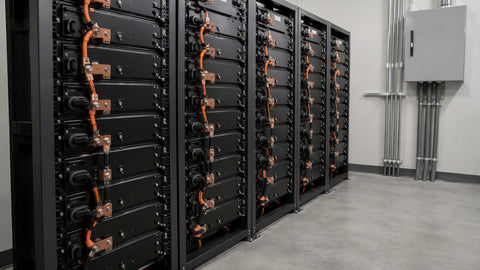
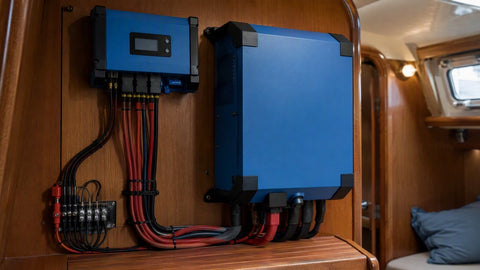
Need the hardware these numbers feed? Browse our electrical supplies, inverters, and batteries and storage. Once you have amps, the next steps are the wire size by amps chart and the breaker size calculator.
Amps ↔ Watts Calculator
Pick the direction of the conversion.
Amps (mode 1) or watts (mode 2).
Line-to-line for three-phase systems.
Three-phase applies the √3 multiplier.
Resistive loads 1.0; motors 0.8–0.9.
Result: —
Relationship: —
Formulas: DC/single-phase resistive W = V × A; single-phase AC W = V × A × PF; three-phase W = V × A × √3 × PF (√3 ≈ 1.732). Reverse: A = W ÷ V (÷ PF, ÷ √3 as applicable). Informational — nameplates and the AHJ govern.
Watts per Amp at Common Voltages
The same amp buys very different power depending on system voltage. This is the chart worth memorizing — it explains why EV chargers and ranges run at 240V and why off-grid systems moved from 12V to 48V:
| Current | 12 V DC | 24 V DC | 48 V DC | 120 V AC | 240 V AC |
|---|---|---|---|---|---|
| 1 A | 12 W | 24 W | 48 W | 120 W | 240 W |
| 5 A | 60 W | 120 W | 240 W | 600 W | 1,200 W |
| 10 A | 120 W | 240 W | 480 W | 1,200 W | 2,400 W |
| 15 A | 180 W | 360 W | 720 W | 1,800 W | 3,600 W |
| 20 A | 240 W | 480 W | 960 W | 2,400 W | 4,800 W |
| 30 A | 360 W | 720 W | 1,440 W | 3,600 W | 7,200 W |
| 50 A | 600 W | 1,200 W | 2,400 W | 6,000 W | 12,000 W |
| 100 A | 1,200 W | 2,400 W | 4,800 W | 12,000 W | 24,000 W |
Worked example: a 1,500W space heater on a 120V receptacle pulls 1,500 ÷ 120 = 12.5A — fine on a 15A circuit alone, but add a vacuum and you trip it. The same heater on 240V (a common configuration in workshops and baseboard heat) draws only 6.25A, leaving headroom on the smallest 240V circuits. Voltage is leverage: doubling voltage halves the amps for the same work, which quarters the voltage drop and the wire-heating losses.
Circuit Capacity: Rating vs the 80% Continuous Rule
Breakers are thermal devices rated for their full number — but NEC 210.20 requires loads that run three hours or more to be sized at 125% of continuous draw, which is the same as saying a circuit carries only 80% of its rating continuously. What that means in watts:
| Circuit | Rated capacity | Continuous max (80%) | Typical use |
|---|---|---|---|
| 15 A / 120 V | 1,800 W | 1,440 W | General receptacles, lighting |
| 20 A / 120 V | 2,400 W | 1,920 W | Kitchen, bath, garage circuits |
| 30 A / 240 V | 7,200 W | 5,760 W | Dryer, small water heater |
| 40 A / 240 V | 9,600 W | 7,680 W | Range, 32A EV charger |
| 50 A / 240 V | 12,000 W | 9,600 W | Range, 40A EV charger, welder |
| 60 A / 240 V | 14,400 W | 11,520 W | Subpanel feed, 48A EV charger |
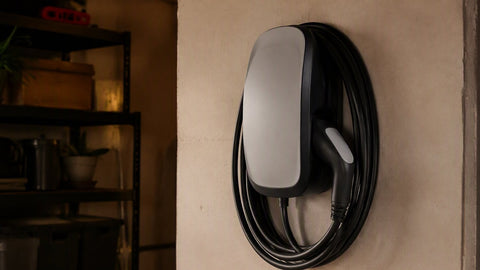
The EV row trips people up constantly: a "50-amp charger" does not exist as a continuous appliance — the charger nameplated 40A goes on the 50A breaker because 40 × 1.25 = 50. Same math protects a 1,440W continuous heater load on a 15A circuit. For the complete EV circuit workflow, see EV charger circuit sizing per NEC 625.
Where Power Factor Enters
Everything above assumes power factor 1.0 — true for resistance heat, incandescent light, and DC systems. Motors, compressors, fluorescent and older LED drivers, and welders draw current out of phase with voltage, so the circuit carries more amperage than the wattage alone predicts. A 1 HP motor doing 746W of shaft work at 120V and 0.85 PF actually pulls about 10.3A (746 ÷ 120 ÷ 0.85), not the 6.2A a resistive 746W load would draw. That gap is exactly why NEC 430 sizes motor circuits from full-load amp tables instead of nameplate watts — see the motor FLA chart for those values. Three-phase systems add one more wrinkle: the √3 (1.732) multiplier, because the three legs share the load. Watts = volts × amps × 1.732 × PF, with volts measured line-to-line.
Amps Drawn by Common Appliances (120V)
| Appliance | Watts | Amps @ 120 V |
|---|---|---|
| LED bulb | 10 W | 0.08 A |
| Laptop charger | 65 W | 0.54 A |
| Refrigerator (running) | 150 W | 1.3 A |
| Microwave | 1,000 W | 8.3 A |
| Coffee maker | 1,200 W | 10 A |
| Space heater | 1,500 W | 12.5 A |
| Window AC (10k BTU) | 1,200 W | 11.8 A @ 0.85 PF |
| Hair dryer | 1,875 W | 15.6 A |
Frequently Asked Questions
How many watts is 1 amp?
It depends on voltage: watts = amps × volts. One amp is 120 watts at 120V, 240 watts at 240V, 48 watts at 48V DC, 24 watts at 24V, and just 12 watts at 12V. There is no universal watts-per-amp number — you always have to name the system voltage first. For AC motor loads, multiply by power factor too: 1A at 120V and 0.8 PF delivers 96 real watts.
How many watts can a 20-amp circuit handle?
A 20A/120V circuit is rated 2,400 watts but limited to 1,920 watts for loads running three hours or more (the NEC 80% continuous rule). A 20A/240V circuit doubles both numbers: 4,800W rated, 3,840W continuous. Short-duration loads like a microwave can use the full rating; continuous loads like heaters and EV chargers must stay under the 80% line.
How do I convert watts to amps?
Divide watts by volts: amps = watts ÷ volts. A 1,500W heater at 120V draws 12.5A; the same heater at 240V draws 6.25A. For three-phase AC, divide by volts × 1.732 × power factor. For single-phase motor loads, divide by volts × power factor. The result is the current your wire, breaker, and terminations must carry.
Why do 240V circuits matter if watts are the same?
Because doubling the voltage halves the amps for the same wattage — and amps, not watts, determine wire size, breaker size, voltage drop, and heat in the conductors. A 9,600W load needs 80A at 120V (heavy 4 AWG copper) but only 40A at 240V (8 AWG). That is why dryers, ranges, water heaters, EV chargers, and large workshop equipment all run at 240V.
Does the amps-to-watts formula change for three-phase power?
Yes. Three-phase watts = line-to-line volts × amps × 1.732 (√3) × power factor. A 20A three-phase circuit at 480V carries 480 × 20 × 1.732 = 16.6 kVA, or about 13.3 kW at 0.8 PF. The 1.732 factor accounts for the three phase legs delivering power 120° apart — forget it and you under-size by 42%.
Turning Watts into a Circuit?
PES Supply stocks the wire, breakers, panels, and disconnects that carry the amps you just calculated — 169 authorized brands at contractor pricing. Send the load list and we'll quote the full circuit package.
Shop Electrical Supplies Contact Us for Bulk PricingRelated Resources
- Wire size by amps: ampacity chart and breaker matching
- Breaker size calculator: the NEC 125% rule
- Voltage drop calculator: the NEC 3% rule
- kVA to kW calculator: power factor converter
- Wire, breakers, and electrical supplies