Lug Torque Chart: NEC 110.14 Terminal Tightness by Size & Brand
Reading time: ~8 min read
📋 Key Takeaways
- NEC 110.14(D) makes torquing to the manufacturer's value a code requirement, not a best practice — "tight enough by feel" is a violation, and inspectors increasingly ask for the torque wrench.
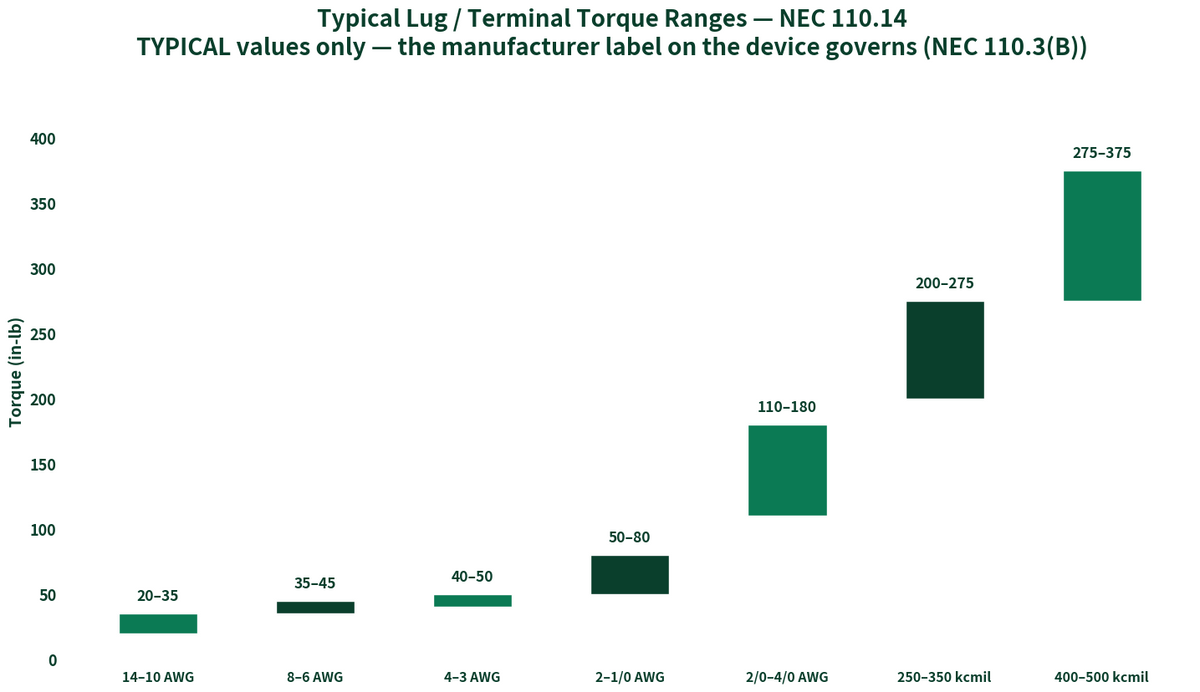
- Typical residential breaker/lug values run 20–50 lb-in for 14–1/0 AWG; large main lugs and 250 kcmil+ terminations run 250–375 lb-in (20–31 lb-ft). The table below is a planning reference — the label on the device is the only authoritative number.
- Under-torque causes resistive hot spots and is the leading root cause in termination-failure studies; over-torque strips set screws and cracks molded cases — both end in arc flash risk.
- Aluminum conductors creep under pressure: torque to spec with antioxidant compound, and re-torque only per manufacturer instructions (many prohibit re-torquing).
- A calibrated torque screwdriver (~9–60 lb-in) covers branch breakers; a lb-ft torque wrench covers mains and large lugs. Mark torqued lugs with a paint pen for the inspector.
Every termination in a panel carries a torque value, and since NEC 2017 section 110.14(D) elevated manufacturer torque instructions to an enforceable requirement, "snug plus a quarter turn" is officially a code violation. The catch for working electricians: nobody memorizes torque values across three brands and fifteen lug sizes, and the label is often under a dead front by the time anyone thinks to check. This chart collects the typical published ranges for the big three residential/commercial brands — Square D, Eaton, and Siemens — as a planning and training reference. It does not replace the device label; it tells you roughly what the label will say before you open the box.
Stocking the truck? Our electrical supplies collection carries panels, breakers, lugs, and torque tools from 169 authorized brands.
Lug Torque Lookup
Typical torque: —
Typical published ranges for common residential/light-commercial mechanical lugs — for planning and training only. NEC 110.14(D) requires torque per the manufacturer's instructions: the label on the specific device, breaker, or lug kit is the authoritative value. Values vary within product lines and change between generations.
Lug Torque Reference Chart (lb-in)
Typical published torque values for mechanical set-screw lugs across the three biggest panel brands. Ranges reflect variation within product lines — always torque to the value printed on the device label, breaker, or lug kit:
| Conductor size | Square D | Eaton | Siemens | Typical device |
|---|---|---|---|---|
| 14–10 AWG | 20–25 | 20–25 | 20–30 | Branch breakers 15–40A, neutral/ground bars |
| 8 AWG | 25 | 25–35 | 25–35 | 40–50A breakers |
| 6–4 AWG | 45 | 45 | 45–50 | 50–70A breakers, small sub-feed lugs |
| 3–1 AWG | 45–50 | 50 | 50 | 80–100A breakers, 100A mains |
| 1/0–2/0 AWG | 50–120 | 50–120 | 50–120 | 100–150A mains, sub-feed blocks |
| 3/0–4/0 AWG | 120–250 | 110–250 | 120–250 | 150–200A main lugs, meter sockets |
| 250–350 kcmil | 250–275 | 250–375 | 250–275 | 200–400A mains, CT cabinets, gutter taps |
Converting for your wrench: 250 lb-in ≈ 21 lb-ft, 375 lb-in ≈ 31 lb-ft. Compression (crimp) lugs follow the die and tool manufacturer's spec instead — the torque column only applies to mechanical set-screw and bolted connections. Neutral and ground bars cluster at the top rows even on big panels; the little set screw on a ground bar still carries a 20–25 lb-in spec.
Why Torque Matters: Hot Spots, Arc Flash, and NEC 110.14
A set-screw lug makes contact through a handful of pressure points. Under-torqued, those points have higher resistance, and resistance under load is heat: the lug warms, the conductor anneals, the connection loosens further, and the cycle runs until a thermal scan finds a 140°F breaker or the lug fails arcing. Termination failure studies consistently rank loose connections as the top root cause of electrical distribution fires — ahead of insulation failure and overload. Over-torque is the quieter killer: a stripped set screw or a hairline crack in a molded case looks fine at energization and fails months later under thermal cycling. This is why NEC 110.14(D) requires an approved means (calibrated tool) to achieve the specified torque, and why NFPA 70B maintenance programs call for torque verification on critical gear.
Aluminum adds a wrinkle: AA-8000 conductors creep — the metal slowly flows away from pressure points, relaxing the connection. The correct procedure is wire-brush to bright metal, apply manufacturer-approved antioxidant compound, torque to spec once with a calibrated tool, and follow the manufacturer's guidance on re-torquing (several major lug makers now prohibit re-torque because re-tightening a crept connection over-compresses the joint). The two-sizes-larger aluminum penalty in the ampacity tables exists partly because of this termination physics.
Field Practice: Tools, Technique, and the Paper Trail
Two tools cover a residential/commercial truck: a calibrated torque screwdriver spanning roughly 9–60 lb-in for branch breakers and neutral bars, and a click-type lb-ft torque wrench for mains, sub-feed lugs, and meter sockets. Practical technique that survives inspections:
- Read the label first. Torque values print on the breaker side label, inside the dead front, or on the lug kit bag. Photograph it for the job file before it disappears behind drywall.
- Torque, then mark. A paint-pen witness mark across the screw head and lug body tells the inspector (and the next electrician) the connection was torqued, not guessed.
- Strip length matters. Too little conductor in the barrel and the set screw lands partly on insulation; the strip gauge on the device is part of the listing.
- Log critical gear. On commercial work, NFPA 70B-aligned customers want a torque record per termination — a two-column sheet (lug ID, value applied, tool serial) takes five minutes and wins maintenance contracts.
- Recalibrate. A torque screwdriver dropped off a ladder is a random-number generator. Annual calibration (or per manufacturer interval) is what makes 110.14(D)'s "approved means" defensible.
Service equipment deserves its own discipline. Meter sockets, CT cabinets, and 200–400A main breakers carry the highest currents on the property and the largest conductors — the exact combination where a half-turn short of spec becomes a smoldering lug six months after energization. Utility-side lugs in meter bases often carry torque specs in the 250–375 lb-in range that exceed the electrician's everyday screwdriver entirely, and some utilities require their own crews to land the service conductors for precisely this reason. On solar and battery interconnections, the same rule applies at the inverter and disconnect terminals: read each device's label, torque each one, mark each one. Fifteen extra minutes per panel is the cheapest liability insurance in the trade.
Frequently Asked Questions
What torque should breaker terminals be tightened to?
Typical residential branch breaker terminals run 20–25 lb-in for 14–10 AWG wire, 25–35 lb-in for 8 AWG, and about 45 lb-in for 6–4 AWG across Square D, Eaton, and Siemens — but NEC 110.14(D) requires the value on the specific device label, which is the only authoritative number. Product lines vary, so read the label on the breaker before torquing.
Does the NEC actually require a torque wrench?
Effectively yes. NEC 110.14(D) requires that terminal torque values be achieved using an approved means — torque tools, or other methods the manufacturer specifies. Tightening by feel does not satisfy the section, and inspectors increasingly ask to see the calibrated tool or torque marks. Manufacturer instructions included with the listing are enforceable per 110.3(B).
What happens if a lug is under-torqued or over-torqued?
Under-torque leaves high-resistance pressure points that heat under load — the connection anneals, loosens further, and can fail in an arcing fault; loose terminations are the leading root cause in distribution fire studies. Over-torque strips set screws and cracks molded breaker cases, creating failures that appear months later under thermal cycling. Both are why calibrated tools are required practice.
Do aluminum conductors need special torque treatment?
Yes. Aluminum (AA-8000) creeps under sustained pressure, relaxing the connection over time. Standard practice: wire-brush to bright metal, apply manufacturer-approved antioxidant compound, and torque once to the labeled value with a calibrated tool. Follow the manufacturer on re-torquing — several lug makers now prohibit it because re-tightening a crept joint over-compresses the conductor. Verify the lug carries an AL or AL/CU marking.
How do I convert lb-in to lb-ft for large lugs?
Divide by twelve: 250 lb-in is about 21 lb-ft, and 375 lb-in is about 31 lb-ft. Small terminals (14–4 AWG, roughly 20–50 lb-in) belong on a torque screwdriver — a lb-ft wrench lacks resolution down there. Large mains and 250 kcmil+ lugs (250–375 lb-in) belong on a lb-ft click wrench. Using the right-range tool is part of achieving the labeled value accurately.
Stocking Panels, Breakers, or Torque Tools?
PES Supply carries panels, breakers, lugs, and calibrated torque tools from 169 authorized brands. Send the BOM — we'll quote at contractor pricing.
Shop Electrical Supplies Contact Us for Bulk PricingRelated Resources
- Panels, breakers, lugs, and torque tools
- Generators and transfer equipment
- Solar panels and interconnection hardware
- Battery storage and hybrid systems