AIKO Solar Panels: Price, Specs & ABC Technology
Reading time: ~7 min read
📋 Key Takeaways
- ABC stands for All Back Contact: every electrical contact moves to the rear of the cell, eliminating the front busbars that typically shadow 2–5% of cell area on conventional TOPCon and PERC panels. More active area, more watts per square foot.
- The Neostar 2P54 series (AIKO-A-MAH54Mw, 450–485W) reaches up to 24.3% module efficiency at the series maximum, with a −0.26%/°C power temperature coefficient and ≤1% first-year / ≤0.35% per-year degradation — top-tier numbers for a residential-format panel.
- Real store pricing runs $0.20–0.29 per watt: the A455-MAH54Mw at $129.99 works out to $0.286/W, while larger commercial-format bins like the A620-MAH72Dw at $124 land near $0.20/W.
- AIKO is BloombergNEF Tier 1 and a PVEL 2026 Top Performer, backs the Neostar with a 15-year product warranty (extendable to 25) plus a 30-year performance warranty, and lets you verify module authenticity by barcode at verify.aikosolar.com.
- Best fit: space-constrained residential rooftops (MAH54 series) where efficiency per square foot decides system size, and commercial arrays (MAH72/MAE72/G-MCH72 dual-glass series) where heat tolerance and low degradation compound over 30 years.
Ask a room of installers which panel technology leads on efficiency right now and the answer increasingly comes back ABC — All Back Contact. AIKO did not invent back-contact cells, but it has pushed them further into mass production than anyone else, and the result is a module family that tops the efficiency charts while looking like no other panel on the roof: a uniform, busbar-free black face. Here is what the technology actually does, what the panels cost in real dollars per watt, and how to pick between the series we stock.
What ABC (All Back Contact) actually changes
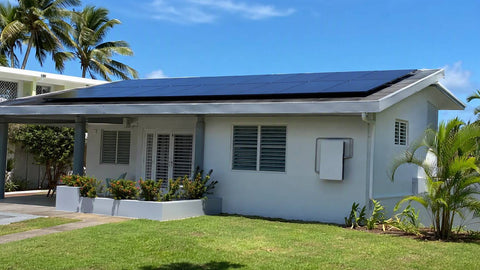
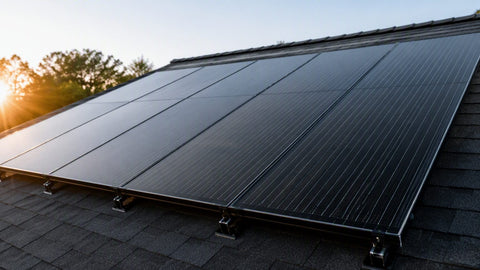
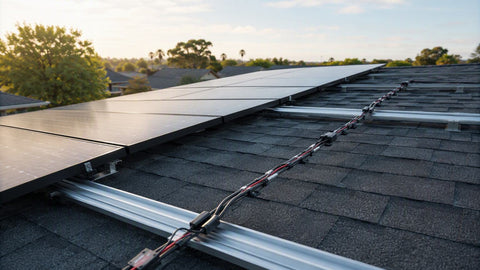
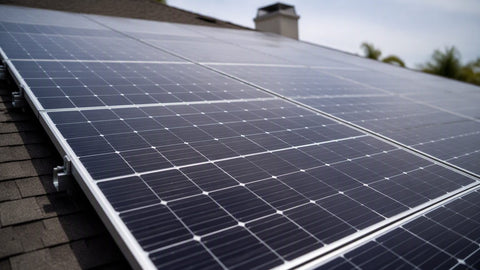
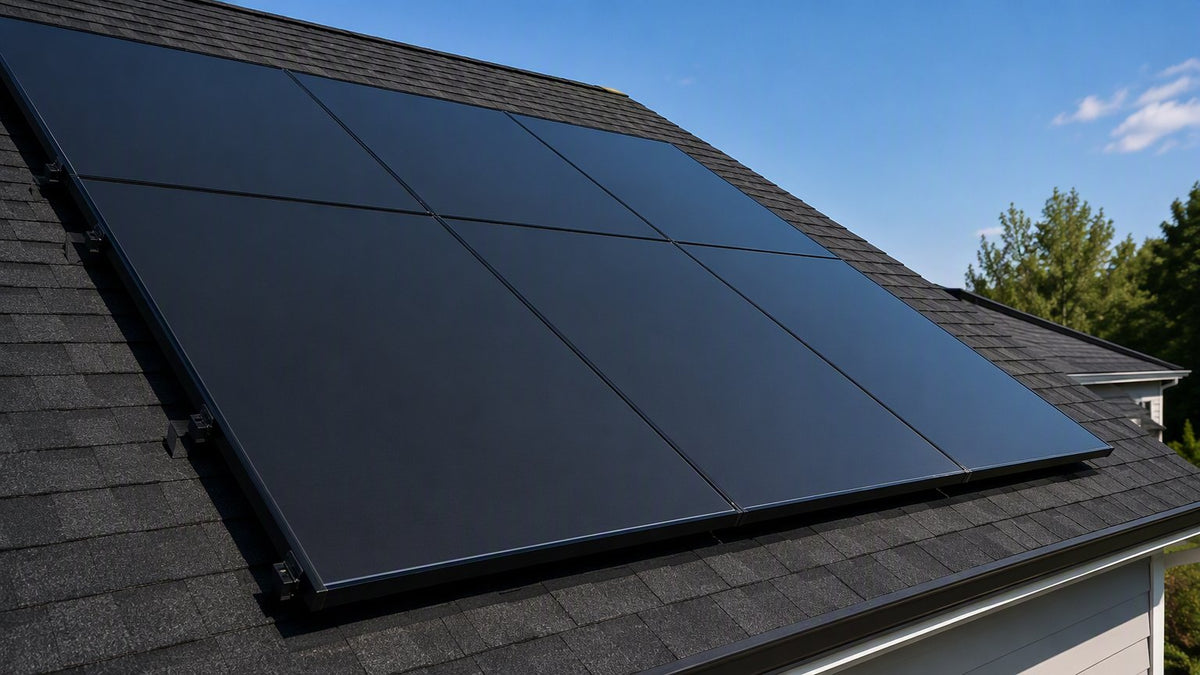
On a conventional crystalline panel — PERC or TOPCon — thin metal busbars run across the front of every cell to collect current. Those busbars and their solder pads are dead space: they typically shade 2–5% of the cell's active area, and they are the silvery grid you see on a standard module face. ABC architecture moves every electrical contact to the rear of the N-type cell. The front surface becomes 100% light-gathering area, which is where the efficiency lead comes from, and the visible payoff is a clean, uniform full-black face with no grid lines.
Moving the junction to the rear brings secondary engineering benefits AIKO designs around: partial-shading optimization (cell-level current paths behave more gracefully when part of the module is shaded), improved micro-crack resistance because there is no front-surface metallization to fracture, and a high-temperature restriction design that limits hotspot stress. None of these is magic — they are the natural consequences of the rear-contact layout, executed well.
The Neostar 2P54 series: specs that anchor the story
The reference residential series is the Neostar 2P54 Mono-Glass, model family AIKO-A-MAH54Mw, in 450–485W bins. These are the numbers that matter:
| Specification | Neostar 2P54 (AIKO-A-MAH54Mw) |
|---|---|
| Cell technology | N-type ABC (All Back Contact) |
| Power bins | 450W – 485W |
| Module efficiency | Up to 24.3% (series max; ~22.6–23.1% at 450W) |
| Degradation | ≤1% first year, ≤0.35%/yr thereafter |
| Temp coefficient | −0.26%/°C (Pmax), −0.22%/°C (Voc) |
| Dimensions / weight | 1757 × 1134 × 30 mm / 21.5 kg |
| Mechanical loads | 5400Pa snow (front) / 2400Pa wind (rear) |
| Warranty | 15-yr product (extendable to 25) + 30-yr performance |
| Credentials | BloombergNEF Tier 1; Intersolar Award 2023; PVEL 2026 Top Performer |
Two of those lines deserve translation. The −0.26%/°C power coefficient means that on a 95°F rooftop where cell temperature runs 25°C above rating conditions, an AIKO panel gives up roughly 6.5% of nameplate power, versus 7.5–8.75% for a typical −0.30 to −0.35%/°C PERC module — a real edge in hot climates, every summer afternoon, for 30 years. And the degradation schedule (≤1% year one, ≤0.35%/year after) implies at least 88.85% of original output at year 30, which is why the 30-year performance warranty is credible.
ABC vs TOPCon: the honest comparison
TOPCon is the incumbent champion of the last three years, and panels like the Canadian Solar TOPHiKu6 remain excellent value. The fair comparison: TOPCon modules typically top out around 22.5–23% efficiency; the Neostar series reaches up to 24.3%. On a 20-panel roof that is roughly the difference between an 8.9kW and a 9.7kW array on the same footprint. TOPCon's counterpunch is price per watt on mainstream bins and bifacial options at residential sizes. If your roof area is not the constraint, a quality TOPCon panel at a lower $/W can be the smarter buy; if every square foot counts — small roofs, setbacks, shade-cut usable area — ABC's density earns its premium. Our panel wattage chart helps frame what those wattage classes mean for array size.
The family we stock, with real pricing
Beyond the flagship Neostar, the store carries the wider AIKO range across residential and commercial formats:
| Series | Format / Power | Store price |
|---|---|---|
| MAH54Mw (Neostar 2P54) | 54-cell residential, 450–485W | $129.99–$140.99 |
| MAH54Mb | 54-cell full-black, 430–470W | $86–$94 |
| MCE54Mw | 54-cell, 470–495W | $94–$99 |
| MAH72Dw | 72-cell dual-glass, 610–630W | $122–$126 |
| MAE72Dw | 72-cell dual-glass, 620–645W | $124–$129 |
| G-MCH72Mw | 72-cell, 645–670W | $129–$134 |
Do the division and the story is striking: the residential A455-MAH54Mw at $129.99 is $0.286/W — premium territory, as a 23%+ efficiency panel should be. But the full-black A450-MAH54Mb at $90 is $0.20/W, and the commercial-format A620-MAH72Dw at $124 is also $0.20/W. In other words, ABC technology is available at commodity per-watt pricing in the value bins; you pay the premium only for the highest-density residential glass. Additional bins like the A460 and A475-MAH54Mw let you fine-tune array voltage and wattage to your inverter window.
Which series for which job
Residential rooftops, space-constrained: MAH54Mw (Neostar 2P54). Maximum watts per square foot, best heat behavior, full-black aesthetics that satisfy HOAs and design-conscious owners. Budget residential with the same look: MAH54Mb full-black at $0.20/W. Commercial flat roofs and ground-mounts: the 72-cell dual-glass MAH72Dw / MAE72Dw / G-MCH72Mw series — dual glass for fire rating and moisture resistance, 610W+ bins to minimize racking and labor per watt, and pricing near $0.20/W that pencils on large arrays. Size the system first with our sizing calculator, check string voltage with the string sizing guide, then model payback with the ROI calculator.
Frequently Asked Questions
What is ABC (All Back Contact) technology?
ABC is a cell architecture where every electrical contact is moved to the rear of the N-type cell, leaving the front surface completely free of busbars and solder pads. On conventional PERC and TOPCon panels those front busbars typically shade 2–5% of the cell area; eliminating them converts that dead space into active generation area, which is how the Neostar 2P54 series reaches up to 24.3% module efficiency. The visible result is a uniform full-black panel face with no grid lines, and the rear-contact layout also supports better partial-shade behavior and micro-crack resistance.
How do AIKO panels compare to TOPCon panels?
On efficiency, AIKO's ABC modules lead: up to 24.3% in the Neostar 2P54 series versus roughly 22.5–23% for typical TOPCon panels, with a better power temperature coefficient (−0.26%/°C vs −0.29 to −0.35%/°C class) and lower annual degradation. On a space-constrained roof that efficiency lead means a meaningfully larger array on the same footprint. TOPCon's advantage is price per watt on mainstream bins and wider bifacial selection at residential sizes. If roof space is not your constraint, quality TOPCon at a lower $/W is a rational choice; if it is, ABC earns its premium.
Which AIKO series should I choose for residential vs commercial?
For residential rooftops, choose the 54-cell MAH54 series: the MAH54Mw (Neostar 2P54, 450–485W) for maximum efficiency per square foot, or the MAH54Mb full-black (430–470W) when budget leads — both are compact, 21.5 kg panels sized for roof work. For commercial flat roofs and ground-mounts, choose the 72-cell dual-glass series: MAH72Dw (610–630W), MAE72Dw (620–645W) or G-MCH72Mw (645–670W). Dual glass adds fire and moisture resistance, and the 600W+ bins minimize racking and labor cost per installed watt.
What do the AIKO model numbers and letters mean?
The pattern is consistent across the range: the letter after "AIKO-A" indicates the wattage class (A450 is 450W, A620 is 620W), and the suffix identifies the series platform — for example MAH54Mw is the 54-cell Neostar mono-glass residential series, MAH54Mb its full-black variant, and the 72-series codes (MAH72Dw, MAE72Dw, MCH72Mw) denote the larger commercial formats, with "Dw" marking dual-glass construction. You do not need to memorize the codebook: match the wattage to your design, then pick the series by format — 54-cell for roofs, 72-cell dual-glass for commercial.
How much do AIKO solar panels cost?
In our catalog, current AIKO pricing spans $86 to about $141 per panel depending on series and wattage bin. In dollars per watt: the residential A455-MAH54Mw at $129.99 works out to $0.286/W; the full-black A450-MAH54Mb at $90 is $0.20/W; the commercial A620-MAH72Dw at $124 is also $0.20/W; and the 645–670W G-MCH72Mw bins run $129–$134, roughly $0.20/W. The pattern: commodity per-watt pricing in the value and commercial bins, with a premium only on the highest-efficiency residential glass.
Ready to Spec ABC Efficiency?
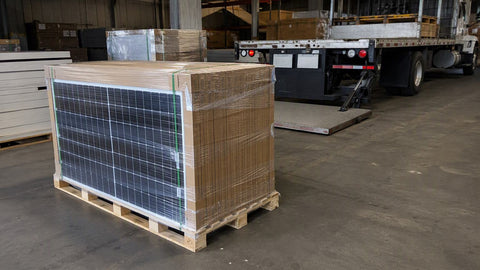
PES Supply stocks the AIKO range from 430W full-black residential to 670W commercial dual-glass — 169 authorized brands at contractor pricing, by the panel or by the pallet. Tell us the array size and we will quote the BOM.
Shop Solar Panels Contact Us for Bulk PricingRelated Resources
- Solar panel wattage chart: 400W vs 450W vs 500W
- Canadian Solar 445W vs 435W: TOPHiKu6 model guide
- Solar system sizing calculator
- Solar string sizing: max panels in series
- Solar ROI calculator: payback, ITC and 25-year savings
- Solar panels, residential to commercial