Solar 120% Rule Calculator: NEC 705.12 Maximum PV Breaker by Panel Bus
Reading time: ~8 min read
📋 Key Takeaways
- The rule in one line: main breaker + 125% of inverter output current ≤ 120% of the panel's busbar rating. That's NEC 705.12's load-side interconnection limit.
- The classic example: a 200A bus with a 200A main allows 40A of PV breaker (240 − 200 = 40) — that's a 7.7 kW inverter at 240V. The most common residential answer in the country.
- Downsizing the main breaker buys headroom. Dropping a 200A main to 175A frees a 60A PV breaker (11.5 kW) if the load calculation supports it.
- The PV breaker must sit at the opposite end of the bus from the main, and the backfed breaker needs no additional fastener exception — it must be secured per 705.12's requirements.
- Out of busbar room? A supply-side (line-side) tap connects ahead of the main and bypasses the 120% limit entirely, limited instead by service conductor and equipment ratings.
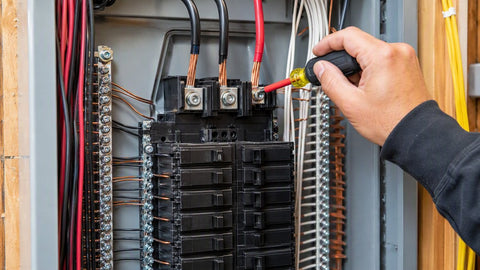
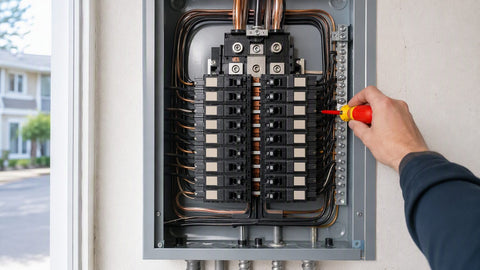
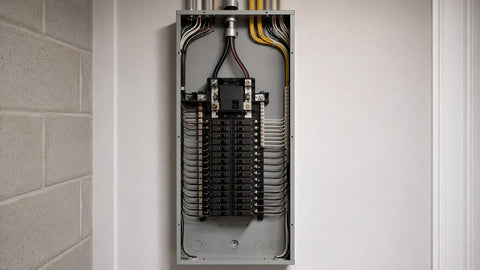
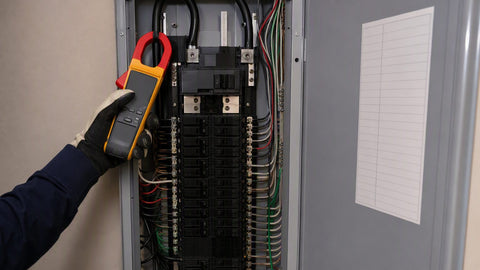
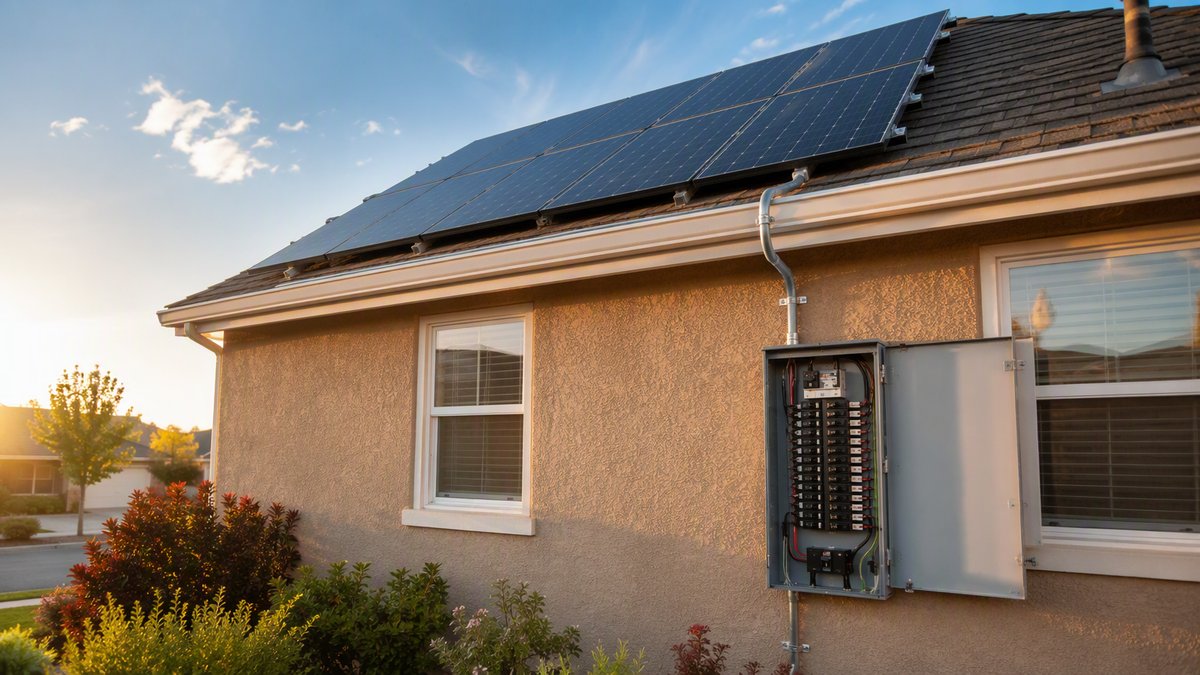
"How much solar can my panel take?" is the first real question of every residential interconnection, and NEC 705.12 answers it with arithmetic. A panel's busbar is a copper highway with a fixed ampacity; the utility feeds current in from the main breaker at one end, and your inverter pushes current in from a backfed breaker at the other. Where those two currents could add up in the middle of the bus, the code caps their combined potential at 120% of the busbar rating. The calculator below takes your busbar rating and main breaker size and returns the maximum PV breaker, the largest continuous inverter output that breaker allows, and the practical kW ceiling at 240V — plus what to do when the answer is "not enough."
Building the system once the panel math works? Our solar panels, inverters, and electrical supplies collections cover the full BOM. To size the array itself from your kWh usage, start with the solar system sizing calculator.
Solar 120% Rule Calculator
On the panel label — not the main breaker number.
Some panels run a smaller main than the bus — that helps here.
Continuous AC output current. 7.7 kW at 240V = 32A. Set 0 to skip the check.
120% of busbar: —
Maximum PV backfeed breaker: —
Max continuous inverter output: —
≈ Max inverter size at 240V: —
Your planned inverter: —
Sizing logic: NEC 705.12(B) load-side interconnection — sum of 125% of inverter output current plus the main breaker rating may not exceed 120% of the busbar rating. PV breaker is the next standard NEC 240.6 size at or below the available margin; inverter continuous current is limited to 80% of that breaker (its own 125% rule). Breaker placement and labeling per 705.12(B)(2). Informational — the AHJ and utility interconnection agreement govern.
The 120% Rule at Common Panel Sizes
The table every estimator keeps in their head — maximum PV breaker and inverter size by busbar and main combination, at 240V single-phase:
| Busbar | Main breaker | 120% cap | Max PV breaker | Max inverter (A) | ≈ Max inverter (kW) |
|---|---|---|---|---|---|
| 100 A | 100 A | 120 A | 20 A | 16 A | 3.8 kW |
| 125 A | 100 A | 150 A | 50 A | 40 A | 9.6 kW |
| 125 A | 125 A | 150 A | 25 A | 20 A | 4.8 kW |
| 150 A | 150 A | 180 A | 30 A | 24 A | 5.8 kW |
| 200 A | 200 A | 240 A | 40 A | 32 A | 7.7 kW |
| 200 A | 175 A | 240 A | 65 → 60 A | 48 A | 11.5 kW |
| 200 A | 150 A | 240 A | 90 A | 72 A | 17.3 kW |
| 225 A | 200 A | 270 A | 70 A | 56 A | 13.4 kW |
| 400 A | 400 A | 480 A | 80 A | 64 A | 15.4 kW |
Two patterns worth memorizing. First, the 200A-bus/200A-main combination that covers half of American housing tops out at a 40A PV breaker — exactly one 7.7 kW string inverter, and not a watt more. Second, every 25A you can legitimately remove from the main breaker buys 25A of PV breaker, which is why load calculations have become a revenue line in residential solar: proving the dwelling only needs 150A of service capacity per NEC 220 turns a 7.7 kW ceiling into 17.3 kW on the same panel.
Why 120%, and Why the Breaker Placement Matters
The 120% figure comes from a thermal reality: the busbar is only in danger where currents from both sources could add together. Feed the utility in at one end and the solar in at the other, and the middle of the bus carries the difference of the two currents, not the sum — the loads along the way are consuming from both directions. The 20% allowance is the code's credit for that physics, but it only holds if the PV breaker lands at the end of the bus opposite the main feed. Put the PV breaker adjacent to the main and the sum flows through the shared section, the 120% logic collapses, and the installation fails inspection. NEC 705.12(B) spells out the placement, the securing requirement for backfed breakers, and the warning labels that mark the panel as dual-fed.
When the Panel Says No: Three Ways Forward
Derate the main. A fresh NEC 220 load calculation often shows a 200A service is carrying 100–140A of real demand; swapping the 200A main for a 175A or 150A unit (with the AHJ's blessing) opens the bus dramatically. Supply-side tap. NEC 705.12(A) allows connecting the PV ahead of the main breaker, into the service conductors themselves. The 120% rule doesn't apply — instead the tap conductors and PV OCPD must be sized for the full available fault duty and the sum of all sources against the service rating. It's the standard route for big residential systems and most commercial ones. Upgrade the panel. A 225A busbar with a 200A main is the classic solar-ready panel: 70A of PV breaker room with no compromises. If you're also adding storage, our battery runtime calculator helps size the bank for the loads the system will actually carry.
Frequently Asked Questions
What is the NEC 120% rule for solar?
NEC 705.12 limits load-side solar interconnections: the main breaker rating plus 125% of the inverter's continuous output current may not exceed 120% of the panel's busbar rating. On a 200A bus with a 200A main, that leaves 40A for a PV breaker — a 7.7 kW inverter at 240V. The rule exists to keep the busbar from being thermally overloaded by utility and solar current feeding simultaneously.
How much solar can I put on a 200-amp panel?
With a 200A main breaker on a 200A busbar: a 40A PV breaker, which allows 32A of continuous inverter output — about 7.7 kW AC at 240V. If a load calculation supports downsizing the main to 175A, the allowance rises to a 60A breaker (48A, ~11.5 kW). A 225A busbar panel with a 200A main allows a 70A breaker (56A, ~13.4 kW). Bigger systems use a supply-side tap instead.
What is a supply-side (line-side) tap for solar?
A connection of the PV system to the service conductors ahead of the main breaker, permitted by NEC 705.12(A). Because the inverter no longer feeds through the panel's busbar, the 120% rule doesn't apply — the limiting factors become the service conductor ampacity and equipment ratings. It's the standard method for systems too large for the load-side limit, but it requires service-rated tap equipment and utility approval.
Where does the solar breaker go in the panel?
At the opposite end of the busbar from the main breaker feed. The 120% allowance depends on the two sources feeding from opposite ends so their currents subtract rather than add along the bus. NEC 705.12(B) also requires the backfed breaker to be secured against removal (plug-on breakers need an additional fastener or listed retainer) and the panel to carry labels identifying the dual power sources.
Does the 125% multiplier apply to my inverter size or the breaker?
Both, in opposite directions. The inverter's continuous output current gets multiplied by 125% to find the breaker and busbar margin it consumes — a 32A inverter needs a 40A breaker and 40A of bus allowance. Equivalently, a 40A PV breaker limits you to 32A of continuous inverter output. Use the inverter nameplate's maximum continuous AC output current, not a DC-STC-derived estimate, for this math.
Interconnecting a New Array?
PES Supply stocks string and hybrid inverters, PV breakers, solar-ready panels, and disconnects from 169 authorized brands. Send the panel label photo and inverter spec — we'll quote the interconnection package at contractor pricing.
Shop Solar Panels Contact Us for Bulk PricingRelated Resources
- Solar system sizing calculator: from kWh to array size
- Solar string sizing: max panels in series
- Solar charge controller sizing calculator
- Solar battery backup runtime calculator
- Solar panels, inverters, and interconnection hardware