EV Charger Circuit Sizing: NEC 625 Breaker, Wire & Load Calc Guide
Reading time: ~10 min read
📋 Key Takeaways
- EV charging is a continuous load: the circuit must be sized at 125% of the charger's rated current (NEC 625.41/625.42). A 40A charger needs a 50A circuit; a 48A charger needs a 60A circuit.
- Each EV charger outlet requires its own dedicated branch circuit (NEC 625.40) — no sharing with garage receptacles.
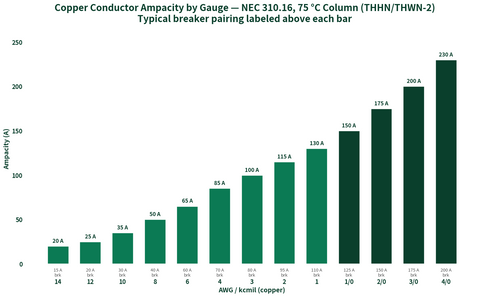
- Wire by the termination rating: 75°C THHN in conduit gives you more headroom than 60°C NM-B — 48A on 60A breaker is 6 AWG THHN but 4 AWG NM-B.
- NEC 625.42 lets an energy management system (EMS) cap the effective load — often the difference between keeping a 100A service and paying for a 200A upgrade.
- The breaker must be rated for continuous operation at 100% — most modern EVSE-rated breakers are; verify the listing.
The most common EV install mistake is pairing a 40A charger with a 40A breaker. It works for an hour, then nuisance trips — because EV charging is a continuous load and the NEC requires the circuit to carry 125% of it. The calculator below does the full chain: pick the charger's nameplate amps and it returns the minimum circuit rating, the breaker size, and the copper wire gauge at both 75°C (THHN in conduit) and 60°C (NM-B/Romex). Add your service size and existing demand, and it runs a quick capacity check so you know whether the panel can absorb the charger or whether you're quoting a service upgrade or a load-management device.
Need EVSE, breakers, or wire for the install? Browse our EV chargers collection and electrical supplies — trade pricing, 169 authorized brands.
EV Charger Circuit Calculator
From a load calc or utility peak data, not breaker-sum.
Min circuit rating (125%): — · Breaker: —
Wire (THHN Cu, 75°C): — · Wire (NM-B Cu, 60°C): —
Service capacity check: —
Circuit sizing per NEC 625.41/625.42 (125% of EVSE nameplate). Wire ampacities from NEC 310.16 copper at the termination-temperature column. The capacity check is a screening estimate only — a full NEC 220.83 optional-method load calculation (or 220.87 metered data) governs for permits. NEC 625.42 EMS settings must be secured per the listing.
The 125% Continuous Rule, Applied
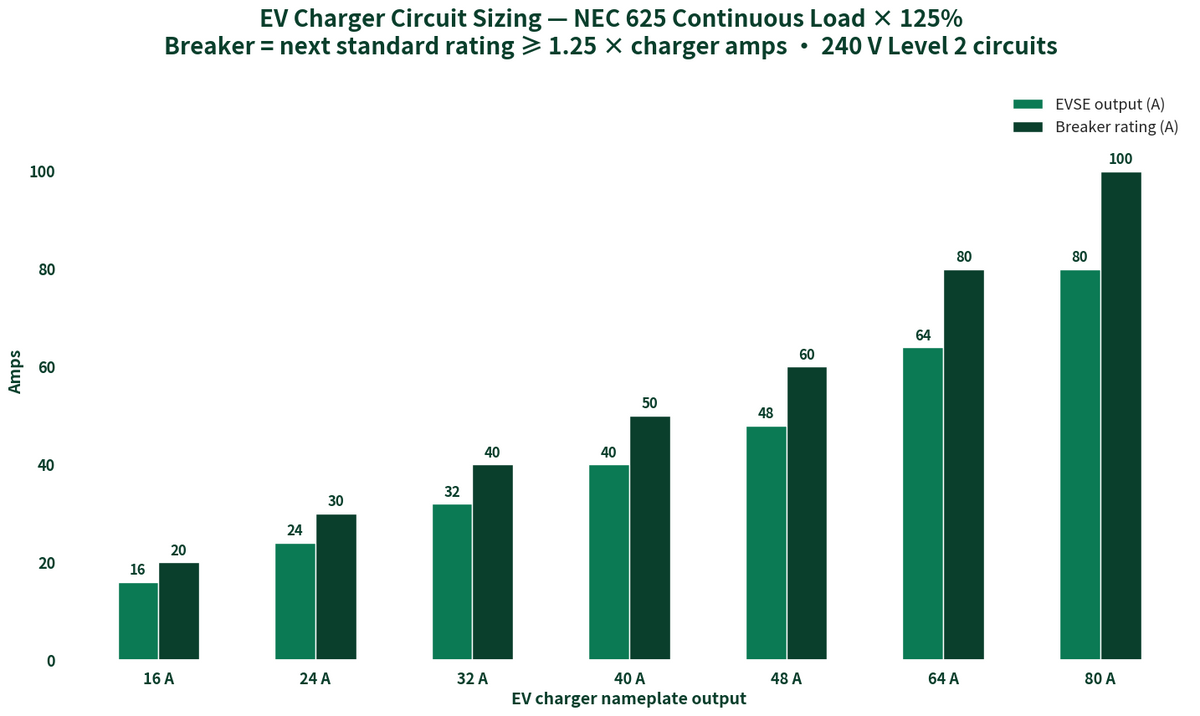
EV charging runs at full current for hours — the definition of a continuous load under NEC Article 100. NEC 625.41 requires overcurrent protection sized for continuous duty, and 625.42 requires the EVSE load to be considered continuous for branch-circuit sizing. The result is the master table every estimator should memorize:
| Charger output | Min circuit (×1.25) | Breaker | THHN Cu (75°C) | NM-B Cu (60°C) |
|---|---|---|---|---|
| 16 A (3.8 kW) | 20 A | 20 A | 12 AWG | 12 AWG |
| 24 A (5.8 kW) | 30 A | 30 A | 10 AWG | 10 AWG |
| 32 A (7.7 kW) | 40 A | 40 A | 8 AWG | 8 AWG |
| 40 A (9.6 kW) | 50 A | 50 A | 8 AWG | 6 AWG |
| 48 A (11.5 kW) | 60 A | 60 A | 6 AWG | 4 AWG |
| 64 A (15.4 kW) | 80 A | 80 A | 4 AWG | 3 AWG |
| 80 A (19.2 kW) | 100 A | 100 A | 3 AWG | 1 AWG |
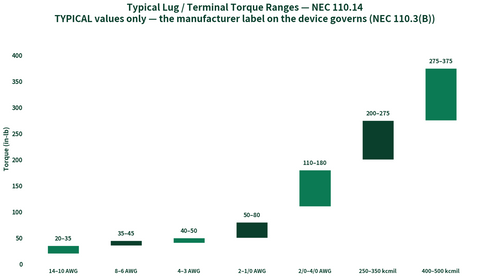
Two details separate clean installs from callbacks. First, the termination temperature: conductors are sized at the temperature rating of the weakest termination (NEC 110.14(C)). Breakers and panels at these sizes are 75°C rated, so THHN/XHHW in conduit uses the 75°C column; NM-B is limited to the 60°C column regardless of its 90°C insulation — which is why the NM-B column jumps a full size at 40A and 48A. Second, the breaker listing: continuous loads want a breaker rated for 100% continuous operation, or sized so the continuous load is ≤80% of rating — the 125% sizing above already bakes that in.
The 40A-on-50A Classic (and Why 40A-on-40A Fails)
The single most installed residential configuration is a 40A charger on a 50A circuit with 6 AWG NM-B or 8 AWG THHN. It exists because 40A × 1.25 = 50A lands exactly on a standard breaker size with real wire. The failure mode is the shortcut version — a 40A EVSE plugged or hardwired to a 40A breaker with 8 AWG NM-B. The load equals the breaker rating, the conductor's 60°C ampacity (40A) equals the continuous load with zero margin, and thermal nuisance tripping shows up in the first summer. Inspectors catch the breaker mismatch; the wire margin problem they sometimes miss. Don't give them either opportunity.
Also note NEC 625.40: each outlet installed for EV charging must be supplied by an individual branch circuit. The NEMA 14-50 trick of sharing with a range or dryer circuit is flatly non-compliant for EVSE use, and 210.23's load rules would kill it anyway.
Service Capacity: Will the Panel Take It?
The charger circuit is only half the question. A 48A charger adds a 60A continuous circuit to a service that may already be spoken for. The screening math is simple — service rating minus existing demand leaves spare capacity, and the EV circuit needs to fit with margin. The code-recognized ways to establish existing demand:
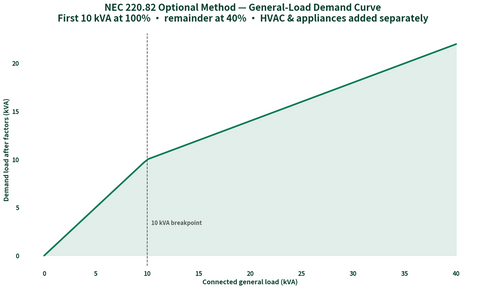
- NEC 220.83 (optional method, dwelling units): the worksheet approach — general load at 100% of the first 10 kVA and 40% of the remainder, plus HVAC and major appliances. Most residential EV permits run on this.
- NEC 220.87 (metered data): 12 months of utility peak demand data × 1.25. For service upgrades and commercial work, this often proves far more headroom than a worksheet suggests.
- NEC 220.83's 40% rule frequently surprises: a 200A service with a finished house, AC, and electric range often has 60–80A of computed spare capacity even with an EV circuit added.
When the calc fails, the cheapest compliant fix is usually NEC 625.42 load management: a listed energy management system (or an EVSE with integral load management) that monitors service current and throttles charging when the house approaches capacity. Because the EV load is then controlled, the branch circuit can be sized to the controlled rating rather than the EVSE maximum — a 48A charger effectively becomes a 20A or 30A load on the service calc. The setting must be secured per the listing so the homeowner can't dial it back up.
Hardwired vs. Plug-In, GFCI, and Disconnects
A few more NEC 625 items that shape the install:
- 625.44 connection: plug-in EVSE uses a receptacle matched to the circuit (14-50 for 40A-class, 6-50 for some 32A units); hardwired is cleaner, avoids GFCI-receptacle cost, and is required above certain ratings.
- GFCI: 625.54 requires GFCI protection for personnel on EV charging receptacles — a GFCI breaker on a 50A/60A 2-pole circuit is a real line item. Hardwired EVSE with integral CCID20 protection typically satisfies this without the GFCI breaker.
- 625.43 disconnect: required for EVSE rated more than 60A or 150V-to-ground — the 64A and 80A chargers need a lockable disconnect in sight.
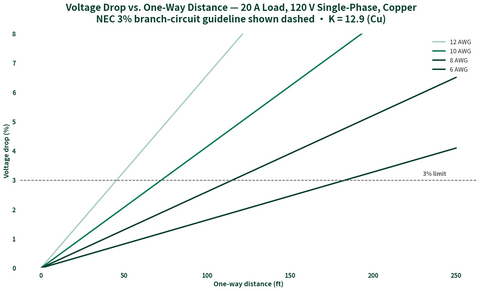
- Voltage drop: garage subpanels and long driveway runs deserve the same 3% discipline as feeders — a 60A circuit over 150 ft wants a size bump to 4 AWG THHN even though 6 AWG passes ampacity.
Build the full BOM in one place: EVSE from our EV chargers collection, breakers and load-management gear from electrical supplies, and if the project adds backup power, our generators and batteries & storage collections cover that conversation too.
Frequently Asked Questions
What size breaker do I need for a 48-amp EV charger?
A 48A EV charger is a continuous load, so NEC 625 requires the circuit to be sized at 125%: 48 A × 1.25 = 60 A, which means a 60A 2-pole breaker. Wire it with 6 AWG copper THHN in conduit (75°C column) or 4 AWG copper NM-B (60°C column). The EVSE itself must be hardwired or connected through a receptacle and circuit rated for the load — most 48A units are hardwire-only.
Can I put a 40-amp EV charger on a 40-amp breaker?
No. EV charging is a continuous load, and NEC 625.41/625.42 require the circuit and overcurrent device to be rated at 125% of the charger's current. A 40A charger therefore requires a 50A circuit: a 50A breaker with 6 AWG NM-B or 8 AWG THHN copper. A 40A breaker under a 40A continuous load will nuisance-trip and runs the conductors at zero margin.
Does an EV charger need its own circuit?
Yes. NEC 625.40 requires each outlet installed for the purpose of charging electric vehicles to be supplied by an individual branch circuit with no other outlets. Sharing a circuit with garage receptacles, a dryer, or a range is not compliant, and the continuous nature of EV load would violate general branch-circuit loading rules regardless.
Can a 100-amp panel support an EV charger?
Often yes, but it must be proven by calculation, not assumed. Run the NEC 220.83 optional-method load calculation (or use 220.87 metered peak data). If the calc comes up short, a NEC 625.42 load-management device that throttles the EVSE when household demand peaks usually brings the service into compliance without an upgrade — typically far cheaper than a 200A service change.
What wire size do I need for a 60-amp EV circuit?
For a 60A EV circuit (48A charger): 6 AWG copper THHN/XHHW in conduit sized at the 75°C column (65A ampacity), or 4 AWG copper NM-B/Romex at the 60°C column (70A ampacity; 6 AWG NM at 55A is too small for the 60A continuous design load). Long runs over ~150 ft should also be checked for voltage drop, which may bump the size regardless of wiring method.
Need EVSE, Breakers, or Load-Management Gear?
PES Supply stocks Level 2 chargers, breakers, and panel gear from 169 authorized brands. Send us the charger spec and service size — we'll quote the complete circuit package.
Shop EV Chargers Contact Us for Bulk PricingRelated Resources
- EV chargers and charging accessories
- Electrical supplies: breakers, panels, and wire
- Generators and backup power
- Batteries and energy storage