Solar Garage Heater Sizing Calculator: BTU to Panels
Reading time: ~9 min read
📋 Key Takeaways
- Heat loss runs 5–15 BTU/h per square foot depending on insulation and design temperature — a 2-car garage (440 sq ft) in a cold climate needs a 5,000W (17,000 BTU/h) heater; the same garage insulated and sealed needs 2,000–3,000W.
- Watts = BTU/h ÷ 3.412. Every 1,000W of electric heat is 3,412 BTU/h, and every hour it runs is a kWh the solar system must replace.
- The solar math is honest but unforgiving: a 5kW heater running 6 winter hours burns 30 kWh/day — a 10kW+ array in winter sun. Insulation is always the cheapest "panel" you can buy.
- Rule of thumb: 1kW of heater per 100–150 sq ft for a reasonably insulated garage at a 40°F design temperature difference.
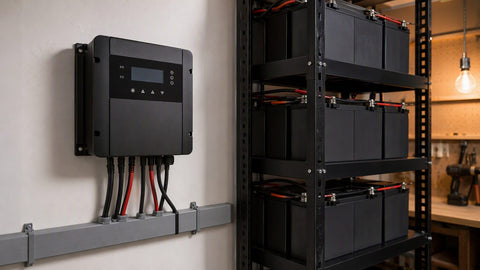
- Storage decides comfort: resistance heat at night means battery kWh roughly equal to the heater's nightly kWh, at 48V for sane currents.
"Can solar heat my garage?" has a real answer, but it is two calculations chained together, not one. First the building question: how many BTU per hour does the garage lose at your coldest design temperature — a function of square footage, insulation, and air sealing. Then the energy question: how many watts of panels and how much battery does it take to feed an electric heater through a winter day when solar production is at its worst. The calculator below runs both halves and shows you the trade in real numbers: every dollar of insulation you skip shows up again as panels and batteries. Run it once un-insulated and once insulated — the difference pays for the insulation by itself.
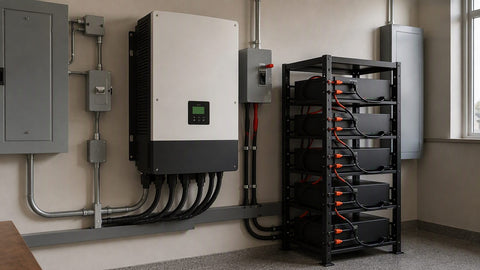
System components live here: solar panels, batteries and storage, and inverters. The companion reads are the solar system sizing calculator (daily kWh → array size) and the power consumption calculator (heater watts → kWh → cost).
Solar Garage Heater Calculator
1-car ≈ 240; 2-car ≈ 440; 3-car ≈ 660.
Per sq ft at a 40°F design difference.
Indoor target minus coldest outdoor design temp.
Duty-cycle hours, not thermostat-on time.
Northern winter 2–3; Southwest 4–5.
Heat loss / heater size: —
Daily energy: —
Solar array needed: —
Battery for overnight heat: —
Formulas: heat loss = sq ft × BTU/h·sqft × (ΔT ÷ 40). Heater watts = BTU/h ÷ 3.412. Daily kWh = heater kW × run hours. Array watts = daily kWh ÷ winter sun-hours ÷ 0.75 system derate. Battery kWh assumes two-thirds of run hours fall outside daylight, at 90% usable DoD. Informational — a Manual J calc governs permitted work.
Heater Size by Garage: The Quick Chart
At a 40°F design temperature difference (say 60°F inside, 20°F outside), the building's heat loss — and therefore the electric heater that matches it — falls out of square footage and insulation alone:
| Garage | Uninsulated (15 BTU/h·sqft) | Some insulation (10) | Well insulated (5) |
|---|---|---|---|
| 1-car, 240 sq ft | 3,600 BTU/h → 1.1 kW | 2,400 BTU/h → 0.7 kW | 1,200 BTU/h → 0.4 kW |
| 2-car, 440 sq ft | 6,600 BTU/h → 2.0 kW | 4,400 BTU/h → 1.3 kW | 2,200 BTU/h → 0.7 kW |
| 3-car, 660 sq ft | 9,900 BTU/h → 2.9 kW | 6,600 BTU/h → 2.0 kW | 3,300 BTU/h → 1.0 kW |
| Shop, 1,000 sq ft | 15,000 BTU/h → 4.4 kW | 10,000 BTU/h → 3.0 kW | 5,000 BTU/h → 1.5 kW |
Add roughly 25% to the heater column for every 10°F beyond the 40°F design difference — a Minnesota 60°F delta pushes the insulated 2-car row from 0.7kW to 1.1kW of heat loss, and most installers step up to a 3–5kW unit for recovery speed. The classic 5,000W / 240V garage heater exists precisely because it covers the worst-insulated common case with margin.
The Solar Side: Why Winter Is the Design Constraint
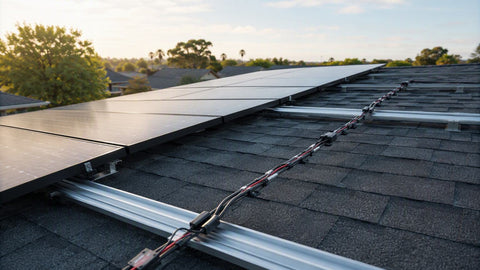
Sizing solar for heat is different from sizing it for annual bill offset. Heating demand peaks exactly when production craters — short days, low sun angle, snow cover. A system that looks generous in July runs a deficit in January, so the honest approach sizes the array to winter peak sun-hours and accepts summer surplus. The conversion chain: heater kW × daily run hours = daily kWh; daily kWh ÷ winter sun-hours ÷ 0.75 system derate = array kW. A 3kW heater running 6 hours in 3-sun-hour winter country asks for 8kW of panels — twenty 400W modules — plus roughly 13kWh of battery to carry the evening hours. That is not an argument against solar heat; it is an argument for insulating first, choosing the smallest heater that holds temperature, and letting the thermostat, not the occupant, manage the duty cycle. The solar system sizing calculator turns those daily kWh into a full array design, and the battery runtime calculator checks how many hours a given bank carries the heater.
Circuit and Safety Notes for the Heater Itself
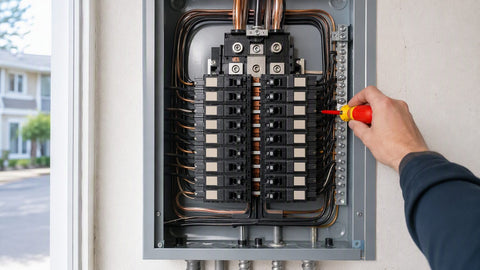
A 5,000W garage heater at 240V pulls 20.8A — a continuous load under the NEC, so the circuit sizes at 125%: 26A, which means a 30A double-pole breaker and 10 AWG copper. A 3,000W unit at 12.5A still lands on a 20A circuit by the same rule; never hang a garage heater on a shared 15A receptacle circuit, no matter what the packaging implies. Verify your exact pairing with the breaker size calculator and the 240V wire size calculator. If the heater runs off an inverter instead of the grid, the inverter must carry the full resistive load continuously — size it with the off-grid inverter sizing guide, and count its idle draw in the daily kWh budget.
Frequently Asked Questions
How many watts of heat do I need for a 2-car garage?
At a 40°F design temperature difference: about 2,000W uninsulated, 1,300W with some insulation, and under 1,000W if well insulated and sealed — figure 5–15 BTU/h per square foot and divide by 3.412 to get watts. Most installers step up to a 3,000–5,000W unit for faster recovery after the door opens, especially in climates colder than a 40°F delta.
How many BTU per square foot does a garage need?
Plan 5 BTU/h per square foot for a well-insulated, sealed garage, 7–10 for average insulation, and up to 15 for uninsulated walls with a drafty overhead door — all at a 40°F design temperature difference. Scale linearly with your real delta: a 60°F difference multiplies those figures by 1.5.
Can solar panels really run a garage heater?
Yes, but winter production sets the budget. A 3kW heater running 6 hours uses 18 kWh/day; at 3 winter peak sun-hours and a 0.75 system derate that needs an 8kW array — about twenty 400W panels — plus roughly 13kWh of battery for the evening hours. Insulating first typically cuts the required array by a third to a half, which is why sealing the garage beats buying panels.
What size breaker does a 5,000W garage heater need?
A 5,000W heater at 240V draws 20.8A. Because heat is a continuous load, the NEC 125% rule sizes the circuit at 26A — so a 30A double-pole breaker with 10 AWG copper wire. A 3,000W heater (12.5A) fits a 20A circuit with 12 AWG by the same math. Never run a garage heater on a shared 15A receptacle circuit.
Is it cheaper to insulate the garage or add more solar?
Insulate, almost every time. Dropping from uninsulated (15 BTU/h·sqft) to insulated (5) on a 440 sq ft garage cuts heat loss by 4,400 BTU/h — about 1.3kW of heater and 7.8 kWh/day at 6 run-hours, which is roughly 3.5kW of panels and 5kWh of battery you no longer need. Weatherstripping and batts cost a small fraction of that equipment and work around the clock.
Ready to Power the Workshop?
PES Supply stocks the panels, batteries, inverters, wire, and breakers for an off-grid or solar-assisted garage — 169 authorized brands at contractor pricing. Send your garage dimensions and climate and we will quote the full system.
Shop Solar Panels Contact Us for Bulk PricingRelated Resources
- Solar system sizing calculator: kWh usage to array size
- Power consumption calculator: kWh and cost
- Solar battery backup runtime calculator
- Breaker size calculator: the NEC 125% rule
- Off-grid inverter sizing: continuous and surge
- Inverters for off-grid and backup