Battery Cable Size Chart: 12V/24V/48V Inverter & Bank Cabling
Reading time: ~10 min read
📋 Key Takeaways
- DC current is what sizes battery cable: a 2,000W inverter pulls ~196A at 12V but only ~49A at 48V — same watts, quarter the current, a quarter of the voltage-drop pain.
- Size cable for both ampacity AND voltage drop; on 12V systems longer than ~5 feet, voltage drop governs and the cable gets big fast.
- Target ≤2% drop battery-to-inverter; every volt lost at the battery terminals is inverter capacity you paid for and can't use.
- Fuse the cable at the battery end at ≥125% of continuous DC current, with a fuse type (Class T, ANL, MEGA) matched to available fault current.
- Fine-strand 105°C battery/welding cable is the right product for battery banks; THHN belongs in conduit, not on battery lugs in a vibrating, high-flex environment.
Nothing in low-voltage power work humbles a spreadsheet faster than battery cable. At 12 volts, even modest inverter loads demand currents that turn undersized cable into a space heater and sag the bank voltage until the inverter low-voltage cutout trips under load — while the batteries are still half full. The calculator below handles the whole chain: enter inverter watts, system voltage, efficiency, and one-way cable length; it computes DC current, checks cable ampacity (105°C fine-strand battery cable), checks round-trip voltage drop, and returns the recommended cable size plus a fuse rating at 125%. Below it: the 12V vs. 24V vs. 48V drop table that shows why higher-voltage banks win, welding cable vs. THHN, and fuse-selection rules.
Need batteries, inverters, or cable by the foot? Browse batteries & storage, inverters, and electrical supplies — trade pricing on 169 authorized brands.
Battery Cable Size Calculator
DC current at full load: — · Design current (×1.25): —
Min cable by ampacity: — · Min cable by voltage drop: —
Recommended cable: — · Fuse at battery: —
Ampacities for single fine-strand 105°C copper battery/welding cable in free air (ABYC-style values). Voltage drop uses copper K = 12.9 Ω·cmil/ft, round trip. Fuse sizes are standard ANL/Mega/Class T ratings — verify interrupt rating against your battery bank's available fault current (LiFePO4 banks can exceed ANL ratings; use Class T).
Why 48V Wins: The Same Load at Three Voltages
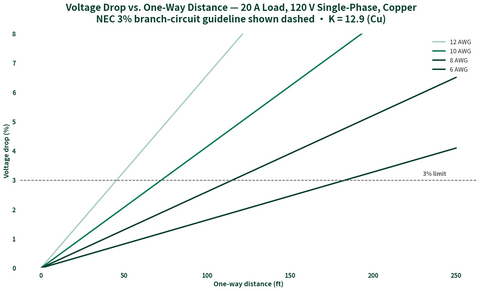
Watts are watts, but current is what heats cable and drops voltage. Watch what happens to a 2,000W inverter load (at 90% efficiency) on a 10 ft one-way run with 2/0 copper:
| System voltage | DC current | Design current (×1.25) | Drop over 10 ft (2/0) | Drop % | Verdict |
|---|---|---|---|---|---|
| 12 V | 185 A | 231 A | 0.36 V | 3.0% | Marginal — at the 3% ceiling with the largest common cable |
| 24 V | 93 A | 116 A | 0.18 V | 0.75% | Comfortable — could drop to 2 AWG and stay under 2% |
| 48 V | 46 A | 58 A | 0.09 V | 0.19% | Trivial — 6 AWG passes both checks with margin |
The same inverter on 48V needs roughly one-eighth the copper of the 12V build for the same performance. That is why every serious off-grid and RV platform above ~2,000W continuous has migrated to 24V or 48V banks, and why 12V is reserved for small loads: charging, lighting, and inverters under ~1,500W with very short runs. If your calculator result above came back "redesign needed" at 12V, the table is telling you the redesign is the voltage, not the cable.
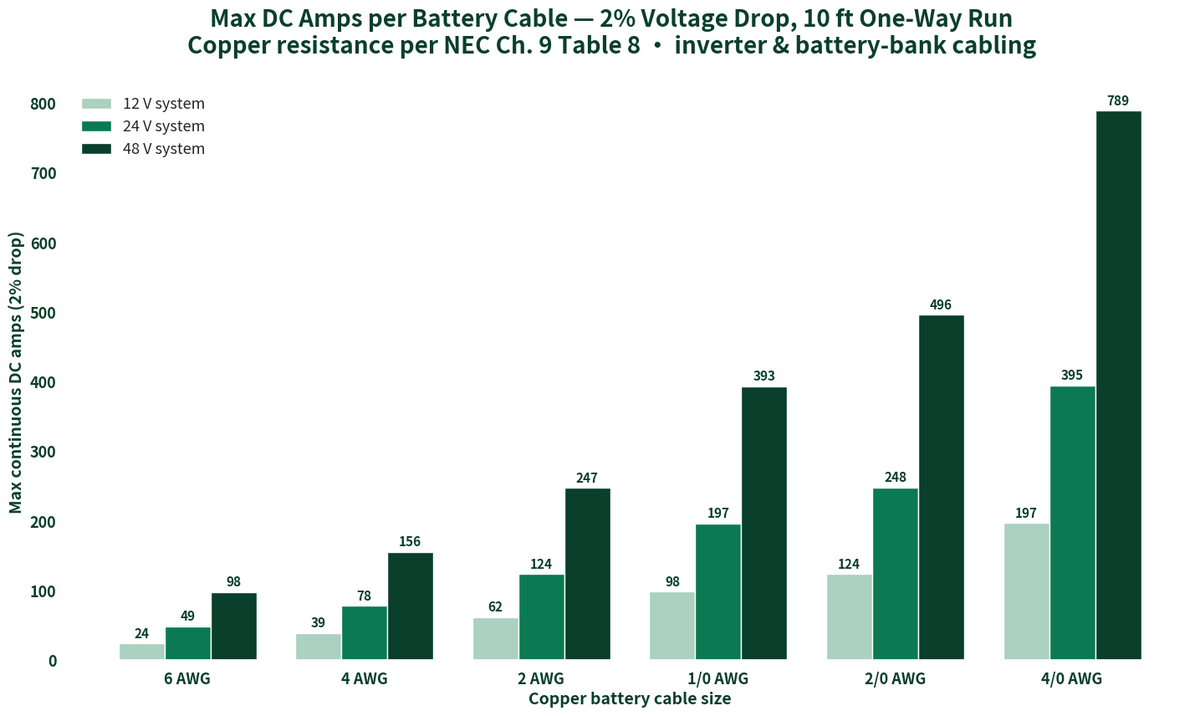
The Chart: Battery Cable Ampacity and Drop at a Glance
Quick-reference for 105°C fine-strand copper battery cable, 2% drop budget, round trip. "Max amps @ length" is the largest continuous DC load that keeps a 12V system under 2% drop at that one-way length (double the amps for 24V, quadruple for 48V):
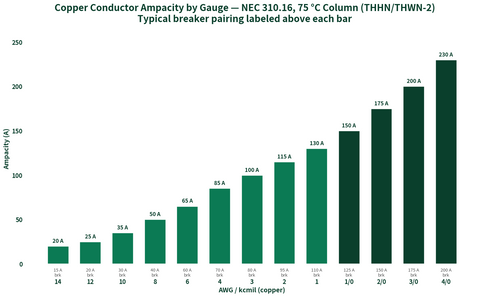
| Cable | Ampacity (105°C) | Max A @ 3 ft (12V, 2%) | Max A @ 5 ft | Max A @ 10 ft | Max A @ 15 ft |
|---|---|---|---|---|---|
| 6 AWG | 120 A | 62 A | 37 A | 19 A | 12 A |
| 4 AWG | 160 A | 98 A | 59 A | 29 A | 20 A |
| 2 AWG | 210 A | 156 A | 93 A | 47 A | 31 A |
| 1/0 AWG | 285 A | 248 A | 149 A | 74 A | 50 A |
| 2/0 AWG | 330 A | 312 A | 187 A | 94 A | 62 A |
| 4/0 AWG | 445 A | 496 A | 298 A | 149 A | 99 A |
Read it this way: a 3,000W 12V inverter (~278A continuous) needs 4/0 even on a 3 ft run, and nothing on this chart carries it 10 ft within 2%. That's the math pushing you to 48V.
Fuse Sizing at the Battery: 125% and Interrupt Ratings
The fuse protects the cable, not the inverter — the inverter has its own protection. The rules that matter:
- Rating: fuse ≥ 125% of maximum continuous DC current, and ≤ cable ampacity. A 46A design current (2,000W at 48V) lands on a 60A fuse protecting 6 AWG or larger.
- Location: within 7 inches of the battery positive terminal (ABYC E-11 practice, adopted across RV and off-grid). An unfused battery cable that shorts downstream is a fire with a battery behind it.
- Interrupt rating (AIC) is the sleeper spec. Flooded lead-acid banks of any size and nearly all LiFePO4 banks can deliver fault currents beyond the ~2,000–6,000A interrupt rating of ANL and Mega fuses. Class T fuses (20,000A AIC) are the correct choice for lithium banks and large lead banks; ANL is acceptable only on small flooded banks. This is the single most-missed detail in DIY builds.
- Both legs in mobile work: ABYC also expects overcurrent protection thinking on ungrounded conductors; in RV/marine practice the negative is typically the grounded return, so the positive fuse at the source does the work.
Welding Cable vs. THHN vs. "Battery Cable"
All three appear on battery banks; they are not equal:
- Fine-strand battery cable (105°C, SGT/SGX or marine UL 1426): the correct product. Hundreds of fine strands tolerate vibration and tight bends, insulation is rated for the environment, and tinned copper marine versions resist the corrosion that battery off-gassing guarantees. This is what the calculator's ampacities assume.
- Welding cable (e.g., 600V, 90°C or 105°C): electrically fine and wonderfully flexible — but it is not sunlight/oil/flame rated to the same standards in all jackets, and it carries no marine listing. Acceptable in protected compartments in RV/off-grid work; not the right call for engine spaces or marine banks where ABYC applies. Check the jacket print.
- THHN/THWN: stiff 19-strand building wire for conduit. It works electrically on a stationary bank inside conduit, but the coarse strands fatigue under vibration, the insulation is the wrong jacket for battery compartments, and landing it on lugs is miserable above 2 AWG. Keep THHN on the AC side of the inverter where it belongs.
Termination discipline matters as much as the cable: tinned copper lugs sized to both the cable and the stud, hex-die crimps (not hammer crimps) on anything above 4 AWG, adhesive-lined heat shrink over every barrel, and a torque wrench on the battery studs. A 2/0 connection at 0.001 Ω of extra contact resistance dissipates 34W at 185A — enough to melt the lug and start the fire you fused the cable to prevent.
Build the bank right the first time: batteries and BMS gear from batteries & storage, inverter-chargers from inverters, cable, lugs, and Class T fuses from electrical supplies.
Frequently Asked Questions
What size battery cable do I need for a 2000-watt inverter?
It depends on system voltage and run length. At 48V (≈46A continuous), 6 AWG 105°C battery cable covers runs up to about 5 ft within a 2% drop. At 24V (≈93A), use 2 AWG for short runs and 1/0 for 10 ft. At 12V (≈185A), you need 4/0 even at 3 ft, and a 10 ft run cannot hold 2% drop with any single standard cable — that load belongs on a higher-voltage bank.
Why does 48V need smaller cable than 12V for the same inverter?
Current scales inversely with voltage at constant power: 2,000W at 12V is ~185A but only ~46A at 48V. Cable ampacity and voltage drop both scale with current, so the 48V system carries a quarter of the current and needs roughly one-eighth the copper for equivalent drop performance. Above about 2,000W continuous, 24V or 48V banks are the professional standard for exactly this reason.
How do I size the fuse for a battery cable?
Size the fuse at or above 125% of the maximum continuous DC current and at or below the cable's ampacity — the fuse protects the cable. Install it within 7 inches of the battery positive terminal. Match the fuse type to available fault current: Class T (20,000A interrupt rating) for lithium (LiFePO4) and large lead-acid banks; ANL or Mega fuses are acceptable only on small flooded banks whose fault current stays within their interrupt rating.
Can I use welding cable for battery banks?
Welding cable is electrically suitable — fine-strand copper with a 90°C or 105°C jacket — and it is common in RV and off-grid builds because it is flexible and affordable. Its limits: not all jackets are sunlight-, oil-, or flame-rated, and it carries no marine (UL 1426) listing, so it is not ABYC-appropriate for boat or engine-space use. For stationary or vehicle builds in protected compartments it works well; for marine banks, use tinned marine battery cable.
What voltage drop is acceptable between a battery and inverter?
Target 2% or less on the battery-to-inverter run at full continuous load, with 1% for short critical runs and 3% as the hard ceiling. Low-voltage DC is unforgiving: at 12V, a 2% budget is just 0.24V round trip, which is why battery cables are short and fat. Excessive drop causes inverter low-voltage cutouts under load even when the batteries still hold plenty of charge.
Need Battery Cable, Lugs, or Class T Fuses?
PES Supply stocks 105°C battery cable by the foot, tinned lugs, Class T and ANL fuses, and the banks and inverters they connect. Send your load list and we'll quote the complete DC package.
Shop Batteries & Storage Contact Us for Bulk PricingRelated Resources
- Batteries and energy storage
- Inverters and inverter-chargers
- Solar panels and charge controllers
- Electrical supplies: cable, lugs, and fuses