Breaker Size Calculator: The NEC 125% Rule and Breaker-to-Wire Chart
Reading time: ~8 min read
📋 Key Takeaways
- Continuous loads get a 125% multiplier. NEC 210.19(A)(1) and 210.20(A) require conductors and overcurrent devices serving a continuous load (3+ hours — water heaters, EV chargers, lighting runs) to be rated at no less than 125% of that load. A 32A EV charger designs at 40A, not 32A.
- Round the breaker up, never the load down. NEC 240.6(A) lists the standard ratings; NEC 240.4(B) lets you round up to the next standard size when the conductor ampacity falls between ratings and the load doesn't exceed the ampacity.
- Small conductors have hard caps: 14 AWG copper is limited to 15A, 12 AWG to 20A, and 10 AWG to 30A by NEC 240.4(D), regardless of what the 75°C ampacity table says.
- The wire protects the breaker decision. A breaker that trips is information — replacing it with a bigger one without checking conductor size is a fire hazard, not a fix.
- Size the equipment grounding conductor off the breaker rating per NEC Table 250.122 — our calculator returns it alongside the breaker and wire.
"What size breaker do I need?" is really three questions: what does the load actually draw, does it run long enough to count as continuous, and which standard rating lands next? Get the multiplier wrong in either direction and you either nuisance-trip a legitimate load or leave a conductor protected above its ampacity. The calculator below takes the load current and the continuous/non-continuous call, applies the NEC 125% rule where it belongs, and returns the design current, the next standard breaker per NEC 240.6, the minimum conductor at 75°C, and the equipment grounding conductor per NEC 250.122.
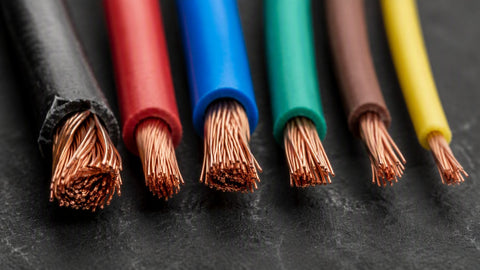
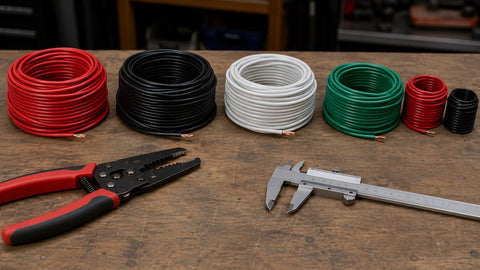
Stocking up for the panel work? Our electrical supplies collection covers breakers, THHN-2/XHHW-2, panels, and lugs from 169 authorized brands. If you're not sure which breaker family your panel accepts, check the breaker compatibility chart before you order.
Breaker Size Calculator
Amps = watts ÷ volts. A 7,680W EV charger at 240V draws 32A.
Continuous loads size at 125% per NEC 210.20(A).
Ampacities from NEC 310.16 at the 75°C column (termination-limited).
Load / design current: —
Breaker (next standard size): —
Minimum conductor (75°C): —
Equipment grounding conductor (Cu, NEC 250.122): —
Sizing logic: continuous loads at 125% per NEC 210.19(A)(1)/210.20(A); breaker rounded to the next standard rating per NEC 240.6(A) as allowed by 240.4(B); conductor selected from NEC 310.16 (75°C) with the NEC 240.4(D) small-conductor caps enforced (14 AWG → 15A, 12 AWG → 20A, 10 AWG → 30A copper); EGC per NEC Table 250.122. Motor and air-conditioning circuits follow NEC 430/440 instead — different rules apply there. Informational — the AHJ and equipment instructions govern.
Common Loads, Design Amps, and Breaker Sizes
Applying the 125% continuous rule where the load warrants it, and NEC 310.16 75°C copper ampacities:
| Load | Nameplate amps | Continuous? | Design amps | Breaker | Min. copper (75°C) |
|---|---|---|---|---|---|
| Microwave / kitchen SABC, 1,500W @ 120V | 12.5 A | Yes (as wired) | 15.6 A | 20 A | 12 AWG |
| Electric water heater, 4,500W @ 240V | 18.8 A | Yes | 23.4 A | 25 A (30 A common) | 10 AWG |
| Electric dryer, 5,600W @ 240V | 23.3 A | Yes | 29.2 A | 30 A | 10 AWG |
| Electric range, 8,000W @ 240V | 33.3 A | No (NEC 220.55) | 33.3 A | 40 A | 8 AWG |
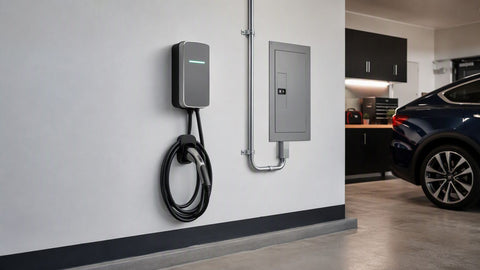
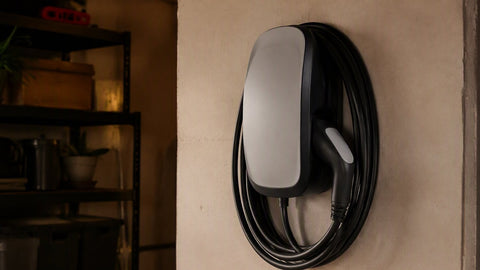
| Level 2 EV charger, 7,680W @ 240V | 32 A | Yes (NEC 625.41) | 40 A | 40 A | 8 AWG |
| Level 2 EV charger, 9,600W @ 240V | 40 A | Yes (NEC 625.41) | 50 A | 50 A | 8 AWG |
| Subpanel feeder, 60A calculated load | 60 A | Per load calc | 60 A | 60 A | 6 AWG |
| Shop welder receptacle, 36A input | 36 A | No | 36 A | 40 A | 8 AWG |
Two notes on that table. First, EV circuits have their own article: NEC 625.41 treats EV charging as continuous by definition, and the EVSE nameplate already assumes the 125% — our EV charger circuit sizing guide walks the full calculation including load management. Second, ranges and dryers follow the NEC 220.55/220.54 demand rules for the load-calculation side, but the branch circuit itself still sizes to the appliance nameplate.
How the 125% Continuous Rule Actually Works
NEC 100 defines a continuous load as one where maximum current is expected to continue for three hours or more. Two code sections then team up: 210.19(A)(1) requires the conductor to carry 125% of the continuous portion, and 210.20(A) requires the overcurrent device to be rated at 125% of the continuous portion. The reason is thermal: breakers are tested to carry 80% of their rating indefinitely, so a 40A breaker holds 32A forever without cooking its trip element.
The practical test is honest time analysis. Water heaters, EV chargers, lighting, pool pumps, and anything thermostatically controlled that can flat-out run for three hours count as continuous. A shop saw that runs in 90-second bursts does not. When in doubt, treat it as continuous — the cost delta between 10 and 8 AWG is trivial next to a failed inspection or a hot breaker.
Matching the Breaker to the Wire: NEC 240.4(B) and 240.4(D)
The breaker's job is to protect the conductor, so the default rule is breaker ≤ conductor ampacity. NEC 240.4(B) relaxes that when the ampacity falls between standard ratings: you may round up to the next standard breaker as long as the load doesn't exceed the conductor ampacity and the circuit isn't a multi-outlet receptacle branch circuit serving cord-and-plug loads above the lower rating. That's how a 23.4A design current on 10 AWG copper (35A ampacity) lands legally on a 30A breaker.
NEC 240.4(D) then carves out the small conductors with absolute caps, because #14, #12, and #10 get misused more than any other sizes:
| Conductor | 75°C ampacity (310.16) | Max breaker (240.4(D)) |
|---|---|---|
| 14 AWG copper | 20 A | 15 A |
| 12 AWG copper | 25 A | 20 A |
| 10 AWG copper | 35 A | 30 A |
| 12 AWG aluminum | 20 A | 15 A |
| 10 AWG aluminum | 30 A | 25 A |
Motor circuits (NEC 430) and hermetic air-conditioning circuits (NEC 440) are the big exceptions — 240.4(G) routes them to their own articles, where a breaker legitimately larger than the conductor ampacity provides short-circuit protection only while the overload device handles running current. Don't generalize that exception to ordinary branch circuits.
Grounding: The Fourth Number on Every Circuit
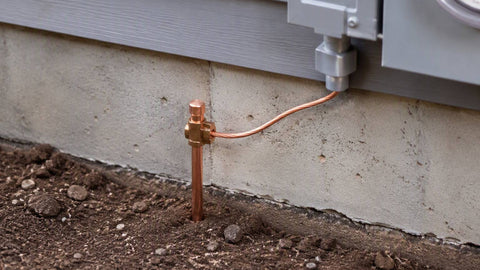
Every branch circuit answer ends with an equipment grounding conductor sized from the breaker rating per NEC Table 250.122 — 15A circuits take 14 AWG, 20A takes 12 AWG, 30–60A takes 10 AWG, 70–100A takes 8 AWG, and 110–200A takes 6 AWG copper. Where you upsize the current-carrying conductors for voltage drop, NEC 250.122(B) requires the EGC to grow proportionally. Our ground wire size chart covers the full table including the aluminum columns.
Frequently Asked Questions
What size breaker do I need for a 4,500-watt water heater?
A 25A breaker at minimum (30A is the common install) with 10 AWG copper. A 4,500W element at 240V draws 18.75A; water heaters are continuous loads, so NEC 210.20(A) requires 125% — 23.4A design current. The next standard size per NEC 240.6 is 25A, and NEC 240.4(B) permits a 30A breaker on 10 AWG copper (35A ampacity) since the load doesn't exceed the ampacity. NEC 240.4(D) caps 10 AWG at 30A, so don't go bigger.
What is the NEC 125% continuous load rule?
A continuous load is one expected to run at maximum current for three hours or more (NEC 100). NEC 210.19(A)(1) and 210.20(A) require the conductor and the overcurrent device to be rated at no less than 125% of the continuous load plus 100% of any non-continuous load. The practical effect: a 32A EV charger needs a 40A circuit, a 40A charger needs a 50A circuit, and a 16A continuous lighting load needs a 20A circuit.
Can I put a 30-amp breaker on 12-gauge wire?
No. NEC 240.4(D) caps 12 AWG copper at 20A overcurrent protection even though its 75°C ampacity is 25A, and 12 AWG aluminum at 15A. The only common exceptions are motor circuits (NEC 430) and air-conditioning circuits (NEC 440), which are routed to their own sizing rules by NEC 240.4(G). For a general branch circuit, 30A requires 10 AWG copper.
My breaker keeps tripping — can I just install a bigger one?
Not without checking the conductor first. The breaker protects the wire: upsizing the breaker beyond the conductor's protection limit turns the cable in your walls into the fuse. Diagnose the trip instead — a breaker tripping after minutes of load points to overload (shed load or add a circuit), tripping instantly points to a short or ground fault (find the fault), and tripping only with motor starts may call for a different trip curve, not a bigger rating.
What are the standard breaker sizes?
NEC 240.6(A) lists standard ratings: 15, 20, 25, 30, 35, 40, 45, 50, 60, 70, 80, 90, 100, 110, 125, 150, 175, 200, 225, 250, 300, 350, 400A and above. When your design current falls between two ratings, NEC 240.4(B) generally allows rounding up to the next standard size provided the conductor ampacity isn't exceeded by the load and the 240.4(D) small-conductor caps don't apply.
Roughing In a New Circuit?
PES Supply stocks breakers, panels, THHN-2, XHHW-2, and listed lugs from 169 authorized brands. Send the load list or panel schedule — we'll quote the complete circuit package at contractor pricing.
Shop Electrical Supplies Contact Us for Bulk PricingRelated Resources
- Breaker compatibility chart: QO vs BR vs QP panels
- EV charger circuit sizing: breaker, wire, and load calc
- Ground wire size chart: NEC 250.122 EGC sizing
- Subpanel sizing guide: feeder, spaces, and load calc
- Breakers, wire, panels, and lugs