Wire Duct & Cable Tray Sizing Guide: Wireway Fill, Types & NEC Rules (2026)
Reading time: ~11 min read
📋 Key Takeaways
- Wire duct, wireway, cable tray, and raceway are four different products with four different rules — picking the wrong one is a design error, not a preference.
- For control-panel wiring duct, size to 40–50% practical fill: enough room for adds and troubleshooting without wasted backpanel space.
- NEC Article 376/378 wireways are capped at 20% fill and 30 current-carrying conductors before derating — panel duct rules are completely different and come from UL 508A practice, not the NEC.
- Cable tray fill is governed by NEC 392.22 with different tables for multiconductor cable, single-conductor cable, and tray width.
- Panduit, Legrand (Cablofil/Wiremold), and HellermannTyton dominate the duct and tray landscape — standard sizes make sizing arithmetic portable across brands.
"Wire duct" gets used as a catch-all on job sites, but a panel shop ordering Panduit-style slotted duct, an electrician pulling feeders through a lay-in wireway, and an industrial crew running basket tray across a ceiling are working with three different products governed by three different rule sets. This guide separates them, gives you the sizing math for each, and includes an interactive duct-size picker: enter your conductor count by AWG and it returns the smallest standard duct width × height at a practical fill percentage. Below the tool you'll find the decision table, the NEC article map, the DIN-rail panel duct sizing rules of thumb, and the brand landscape.
Need duct, tray, wireway, or the THHN to fill it? Browse our electrical supplies collection — 50,000+ SKUs with trade pricing.
Wire Duct Size Picker
Total wire area: — · Required duct area: —
Suggested duct: — · Fill at that size: —
Wire areas include insulation (NEC Chapter 9 Table 5 values; 18/16 AWG use typical MTW/TEW outside dimensions). Standard sizes follow the common Panduit/Legrand/HellermannTyton width × height matrix. This tool sizes panel wiring duct by practical fill — NEC wireway (20% fill) and cable tray (Article 392) sizing use different rules covered below.
Wire Duct vs. Cable Tray vs. Wireway vs. Raceway: The Decision Table
These four products solve four different problems. Confusing them wastes money or fails inspection:
| Product | Where it lives | What it holds | Governing rules | Typical sizes |
|---|---|---|---|---|
| Wiring duct (panel duct) | Inside control panels, on DIN-rail backpanels | Control and power wiring between components and terminal blocks | UL 508A / panel-shop practice; no NEC fill cap, 40–50% practical fill | 1"×1" up to 6"×4", slotted or solid wall |
| Wireway (lay-in) | Industrial walls/ceilings, between panels and equipment | Feeders and branch circuits, hinged or screw-cover trough | NEC 376 (metal) / 378 (nonmetallic): 20% max fill, 30 CCCs before derating | 2.5"×2.5" up to 12"×12" |
| Cable tray | Overhead industrial/commercial spans, long cable routes | Tray-rated multiconductor cable and large single conductors | NEC Article 392; fill by 392.22 tables, tray cable required | 6"–36" wide, ladder/ventilated/solid bottom |
| Raceway (conduit, EMT, PVC) | Everywhere — walls, underground, exposed | Individual insulated conductors | NEC Chapter 9 fill tables (53/31/40%), Article 300+ | 1/2"–6" trade sizes |
The practical dividing lines: if the wires never leave the cabinet, it's wiring duct. If insulated conductors need a covered metal trough between equipment, it's wireway. If factory-jacketed tray cable runs long distances overhead, it's cable tray. If you're pulling individual conductors through a fully enclosed tube, it's conduit. When in doubt, check the listing — using panel duct outside an enclosure, or non-tray-rated cable in tray, are the two most common listing violations inspectors cite.
Panel Wire Duct Sizing: The 40–50% Fill Practice
Wiring duct inside a control panel is not governed by NEC fill limits — the duct is part of the equipment, and UL 508A (the industrial control panel standard) leaves duct sizing to good engineering practice. The industry-accepted practice is straightforward:
Duct area (in²) = Σ wire areas ÷ target fill (0.40–0.50)
- 40% fill for panels that will be modified, commissioned in stages, or serviced by others — the extra room pays for itself the first time someone adds a wire with the cover snapping shut cleanly.
- 50% fill is the accepted ceiling for stable designs. Beyond 50%, covers bow, wires pinch at fingers, and tracing a single conductor becomes a teardown.
- Wiring density rule of thumb: count your terminal block points. A panel section feeding 40 terminal points typically lands in a 2"×2" or 2"×3" duct at 40% fill with 14–18 AWG control wire; dense PLC I/O sections with 60+ points want 3"×3" or two levels.
- Separate power and control. Run motor leads and 480V power in one duct, 24VDC and signal in another. Cross at 90° where they must intersect. Many shops spec slotted duct for general wiring and solid-wall duct for shielded-sensitive runs.
A worked example: a starter section with 24 × 14 AWG (0.0097 in² each), 12 × 18 AWG (0.0072 in² each), and 3 × 8 AWG motor leads (0.0366 in² each). Total area = 0.233 + 0.086 + 0.110 = 0.429 in². At 40% fill you need 1.07 in² — a 1.5"×1.5" duct (2.25 in²) is the comfortable pick, leaving you at 19% actual fill with room to spare. Run the same bundle at 50% and a 1"×1.5" duct barely passes — but you'll regret it at the first field change.
The NEC Article Map: 362 / 368 / 376 / 378 / 392
Wire-management articles in the NEC are frequently confused, partly because the numbering changed. Here is the map as it stands in current editions:
| Article | Product | Key sizing rule |
|---|---|---|
| 362 | Electrical Nonmetallic Tubing (ENT) — "smurf tube." Historical note: before the 2002 NEC, Article 362 covered wireways; the wireway rules moved to 376/378 in 2002. | Chapter 9 fill tables (53/31/40%) |
| 366 | Auxiliary gutters — sheet-metal troughs at switchboards and meter centers | 20% fill; no derating for ≤30 CCCs |
| 368 | Busways — factory-assembled busbar runs, plug-in and feeder style | Ampacity by listing; 368.17 overcurrent protection |
| 376 | Metal wireways (lay-in trough) | 376.22: max 20% fill; adjustment factors apply beyond 30 current-carrying conductors |
| 378 | Nonmetallic wireways | 378.22: same 20% fill / 30-CCC framework as 376 |
| 392 | Cable tray systems | 392.22: fill by cable type and tray width; single-conductor 4/0 and larger in ladder tray by diameter sum; multiconductor by cross-section tables |
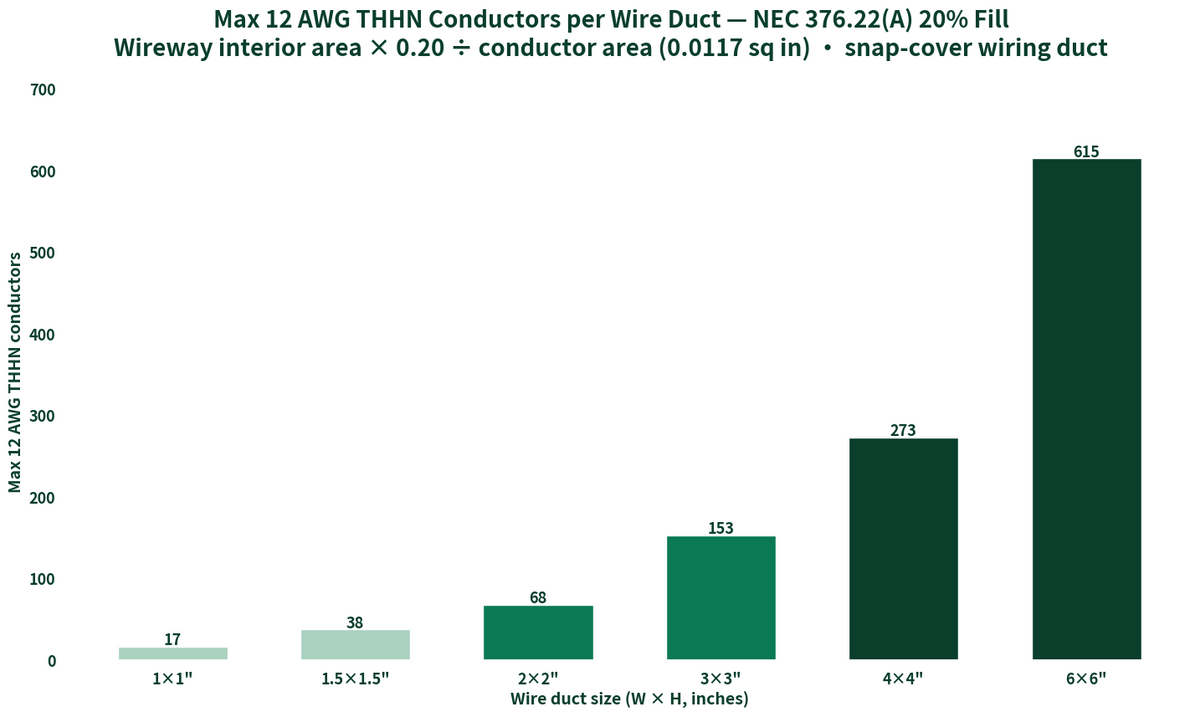
The 20% wireway fill limit shocks people coming from panel duct work. Wireways exist to route many conductors accessibly, and the NEC deliberately keeps them loosely packed for heat dissipation. Note the 30-conductor threshold in 376.22(B) and 378.22: exceed 30 current-carrying conductors — even under 20% fill — and NEC 310.15(C)(1) adjustment factors start cutting ampacity. Signal and control circuits per 376.22(A) don't count against the 30.
Cable Tray Fill: The 392.22 Framework
Cable tray sizing depends on what's in the tray. The three cases that cover most industrial work:
- Multiconductor cables (TC tray cable, MC): sum the cable cross-sectional areas and compare against the 392.22(A) table column for your tray width. For a ventilated trough with only multiconductor cables 4/0 and larger, usable depth fill is capped at 40% of the tray's inside depth area.
- Single conductors 1/0 through 4/0: permitted in ventilated channel tray or with spacing per 392.22(B); sum of diameters may not exceed the tray width for ladder trays in a single layer.
- Single conductors 250 kcmil and larger: ladder or ventilated trough only, single layer, sum of diameters ≤ tray width (392.22(B)(1)).
Field rule of thumb that holds up: for a single-layer power tray of large single conductors, you need roughly one inch of tray width per large conductor diameter plus margin — a 12" tray realistically carries eight to ten 1-inch-OD cables once you respect spacing for ampacity. And remember 392.18/392.20: tray must be supported and bonded as an equipment grounding path only when listed and installed for it — many specs still call for a separate EGC in the tray.
The Brand Landscape: Panduit, Legrand, HellermannTyton, ABB
Panel duct is a commodity with real differences in finger design, cover retention, and material:
- Panduit — the reference standard. Type F narrow-finger and Type G wide-finger slotted duct define the WxH matrix (1×1 through 6×4) that everyone else's sizes map to. Type NNC halogen-free and Type FD flexible duct cover specialty panels.
- HellermannTyton — strong in slotted duct and wiring accessories; their sizes cross-reference Panduit's matrix closely, and their T1/T1E series is a panel-shop staple.
- Legrand — owns Cablofil (wire mesh basket tray, the dominant open-tray brand) and Wiremold (surface raceway and wire management). If the spec says basket tray, it's usually Cablofil by another name.
- ABB / Thomas & Betts — Ty-Duct panel duct plus the legacy T&B tray and wireway lines; Iboco duct is the other common cross-reference in OEM panels.
Because the WxH matrix is effectively standardized, the sizing math in the picker above is portable: a 2"×3" is a 2"×3" whether the label says Panduit G2X3, HellermannTyton, or a value brand. Where brands differ is cover grip, finger brittleness after repeated removals, and adhesive/screw mounting options — the things your panel techs will actually complain about.
Stocking a panel build or an industrial tray run? Get duct, wireway, tray, and the wire to fill them from our electrical supplies collection — and check our generators and solar panels collections if the project includes standby or PV power.
Frequently Asked Questions
What is the difference between wire duct and wireway?
Wiring duct is the slotted or solid-wall plastic channel mounted inside control panels to route wire between components — sized by practical 40–50% fill under panel-shop practice. Wireway is a metal or nonmetallic lay-in trough installed as part of the premises wiring between equipment, governed by NEC Articles 376/378 with a hard 20% fill limit and a 30-conductor threshold before ampacity derating applies.
What fill percentage should I use for control panel wire duct?
Forty percent for panels that will see future adds or staged commissioning; fifty percent as the working ceiling for stable designs. These are UL 508A-era shop practices, not NEC numbers — the NEC does not regulate duct inside an enclosure. Above 50%, covers bow, conductors pinch at the fingers, and troubleshooting time balloons.
What is the NEC fill limit for wireways?
NEC 376.22 (metal) and 378.22 (nonmetallic) limit wireway fill to 20% of the interior cross-sectional area. Additionally, when a wireway contains more than 30 current-carrying conductors, NEC 310.15(C)(1) adjustment factors apply even below the 20% fill cap. Control and signal conductors under 376.22(A) are exempt from the 30-conductor count.
How is cable tray fill calculated?
Per NEC 392.22, by cable type. Multiconductor tray cables fill by summed cross-sectional area against the Table 392.22(A) columns for the tray's width (40% of depth area for 4/0-and-larger multiconductor-only trays). Single conductors 250 kcmil and larger must run in a single layer in ladder or ventilated trough tray, with the sum of cable diameters not exceeding the tray width.
Which wire duct brand is best: Panduit, HellermannTyton, or Legrand?
All three use the same standard width × height matrix, so duct sizes cross-reference directly. Panduit Type F/G is the de facto spec reference with the broadest specialty line; HellermannTyton competes hard on value with equivalent sizes; Legrand's strength is basket tray (Cablofil) and surface raceway (Wiremold). For pure panel duct, choose on cover retention and finger durability after repeated service — both are things your technicians notice long before your customers do.
Need Wire Duct, Tray, or Wireway Quoted?
PES Supply stocks panel duct, cable tray, wireway, and THHN from 169 authorized brands. Send us your panel layout or tray schedule and we'll quote the full bill of material.
Shop Electrical Supplies Contact Us for Bulk PricingRelated Resources
- Electrical supplies: duct, tray, wireway, and wire
- Solar panels and array equipment
- Generators and transfer equipment