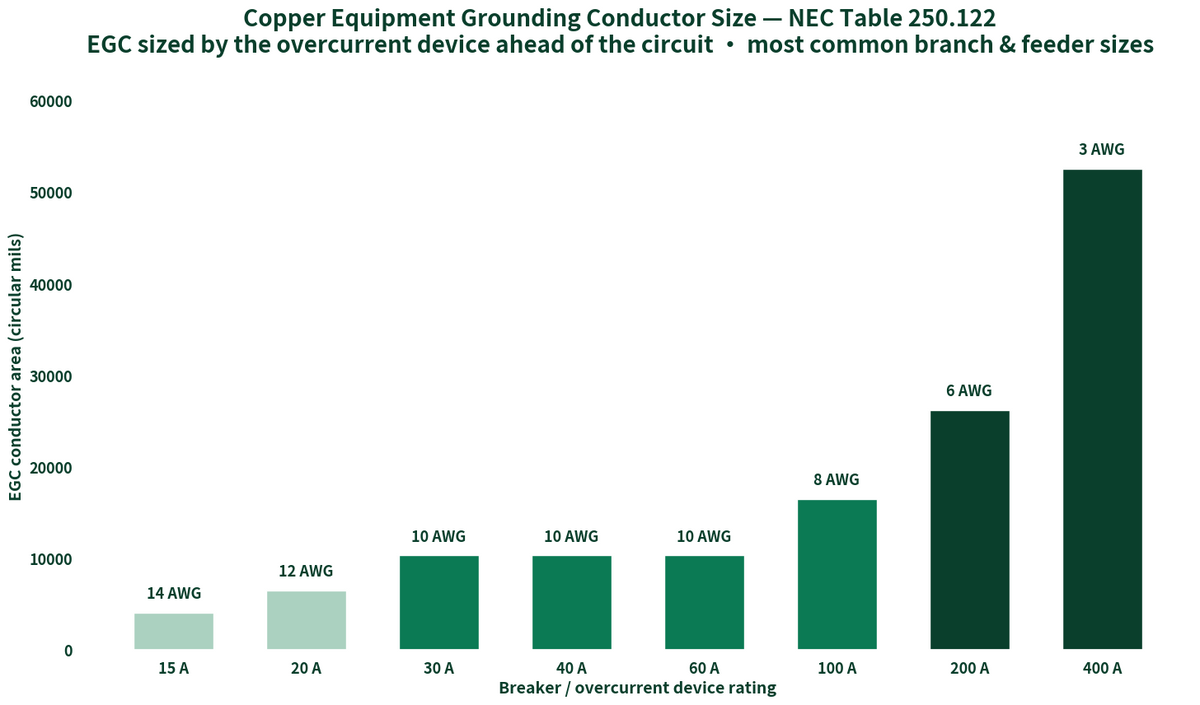
Ground Wire Size Chart: NEC 250.122 EGC Sizing by Breaker Size
Reading time: ~10 min read
📋 Key Takeaways
- The equipment grounding conductor (EGC) is sized from the overcurrent device rating ahead of the circuit, not the load and not the wire size — NEC Table 250.122 is the only table you need.
- Common residential answers: 20A breaker → 12 AWG Cu, 60A → 10 AWG Cu, 100A → 8 AWG Cu, 200A → 6 AWG Cu. Aluminum runs roughly two sizes larger.
- When you upsize the ungrounded conductors (voltage drop, derating), NEC 250.122(B) requires the EGC to be upsized proportionally by circular-mil area — the calculator below applies this automatically.
- EGC ≠ GEC. The grounding electrode conductor that ties the service to ground rods and water pipe is sized from Table 250.66 off the service conductor size — a completely different table.
- The EGC never needs to be larger than the circuit conductors (250.122(A)), and bare copper, green, or green-with-yellow-stripe insulation are all acceptable per 250.118/250.119.
Ground wire sizing questions come in two flavors, and mixing them up is the most common mistake we see on plan reviews: the equipment grounding conductor (EGC) that runs with every branch circuit and feeder, and the grounding electrode conductor (GEC) that bonds the service to earth. They use different NEC tables (250.122 vs 250.66) and answer different questions. This page is the EGC chart — the wire that trips the breaker when a hot conductor faults to a cabinet. The calculator below takes the breaker size, returns the copper and aluminum EGC from Table 250.122, and applies the 250.122(B) proportional upsizing rule when you've bumped the circuit conductors for voltage drop or derating.
Stocking a rough-in? Our electrical supplies collection carries THHN, bare copper, grounding bushings, and bonding hardware from 169 authorized brands at trade pricing.
Ground Wire Size Calculator (NEC Table 250.122)
Triggers NEC 250.122(B) proportional EGC increase.
Copper EGC: — · Aluminum EGC: —
Table row used: —
Sizes from NEC Table 250.122 (2023), using the next-higher table row when the OCPD rating falls between rows. Proportional upsizing per 250.122(B) uses circular-mil area ratios; the EGC is never required to exceed the circuit conductor size (250.122(A)). Flexible cord and fixture-wire EGCs follow 400.23/Table 400.5 instead.
Full NEC Table 250.122 Reference Chart
Print this for the trailer. The left column is the rating of the overcurrent device ahead of the circuit — the breaker or fuse protecting the conductors, not the load on them:
| OCPD rating (not exceeding) | Copper EGC | Aluminum / copper-clad Al EGC |
|---|---|---|
| 15 A | 14 AWG | 12 AWG |
| 20 A | 12 AWG | 10 AWG |
| 60 A | 10 AWG | 8 AWG |
| 100 A | 8 AWG | 6 AWG |
| 200 A | 6 AWG | 4 AWG |
| 300 A | 4 AWG | 2 AWG |
| 400 A | 3 AWG | 1 AWG |
| 500 A | 2 AWG | 1/0 AWG |
| 600 A | 1 AWG | 2/0 AWG |
| 800 A | 1/0 AWG | 3/0 AWG |
| 1000 A | 2/0 AWG | 4/0 AWG |
| 1200 A | 3/0 AWG | 250 kcmil |
| 1600 A | 4/0 AWG | 350 kcmil |
| 2000 A | 250 kcmil | 400 kcmil |
Note the table's "not exceeding" structure: a 30A, 40A, 50A, or 60A breaker all land on the 60A row (10 AWG Cu). A 90A breaker lands on the 100A row (8 AWG Cu). There is no interpolation — you always round up to the next row, which is exactly what the calculator does.
EGC vs. GEC: The Two "Ground Wires" That Aren't the Same
Half the "what size ground wire" questions we get are actually GEC questions wearing an EGC hat. Keep them straight:
- EGC (equipment grounding conductor): runs with the circuit conductors from panel to load. Its job is fault clearing — provide a low-impedance path back to the source so the breaker trips fast on a ground fault. Sized from Table 250.122 by the OCPD rating. That's this page.
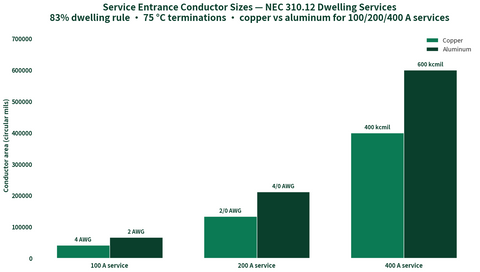
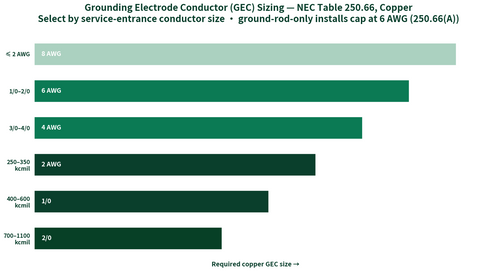
- GEC (grounding electrode conductor): connects the service (or separately derived system) to the grounding electrodes — ground rods, Ufer, water pipe, building steel. Its job is lightning/surge reference, not fault clearing. Sized from Table 250.66 by the service conductor size. A 200A service with 2/0 Cu service conductors takes a 4 AWG Cu GEC (6 AWG if rod-only per 250.66(A) exceptions).
- Bonding jumpers around water meters, gas piping, and metal piping systems follow 250.104 — sized from 250.122 or 250.66 depending on whether it's bonding on the load side or supply side of the service.
The practical tell: if the wire lands on a ground rod or a water pipe at the service, it's 250.66 territory. If it terminates on a green screw, grounding bar, or device ground terminal downstream, it's 250.122 territory.
The 250.122(B) Upsizing Rule — Where Most EGC Errors Live
Here's the rule that fails inspections: when ungrounded conductors are upsized for any reason — voltage drop on a long run, adjustment factors for bundled conductors, ambient temperature — the EGC must be increased proportionally, using the ratio of circular-mil areas. The classic case is a 200A feeder to a detached shop 250 feet away: ampacity says 2/0 Cu, but voltage drop pushes you to 4/0. Circular-mil ratio is 211,600/133,100 = 1.59, so the base 6 AWG EGC (26,240 cmil) must grow to at least 41,700 cmil — a 4 AWG EGC. Install the 6 AWG straight from the table and you've got a violation.
Two carve-outs keep this sane. First, 250.122(A): the EGC never needs to exceed the size of the circuit conductors themselves — a proportional calc that overshoots the ungrounded conductors just caps there. Second, the rule applies to wire-type EGCs; a properly listed and installed metal raceway (EMT, rigid) can serve as the EGC under 250.118 and doesn't scale with conductor upsizing at all — one reason long commercial feeders stay in conduit.
Solar and Bonding Notes
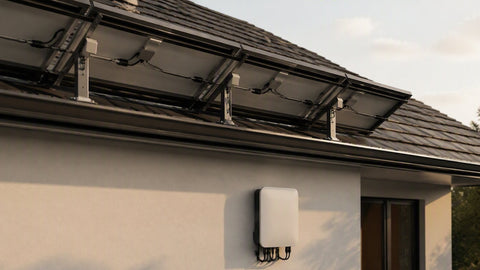
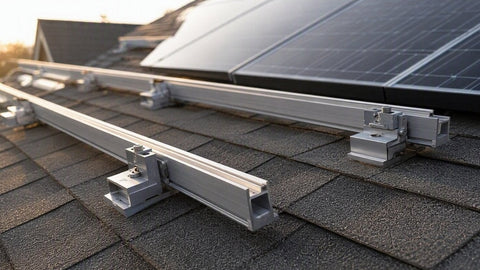
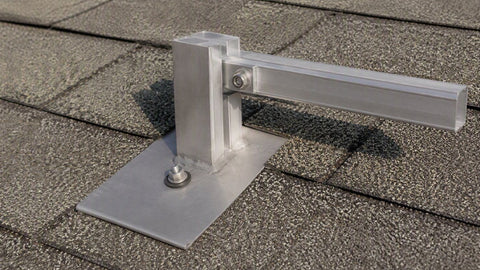
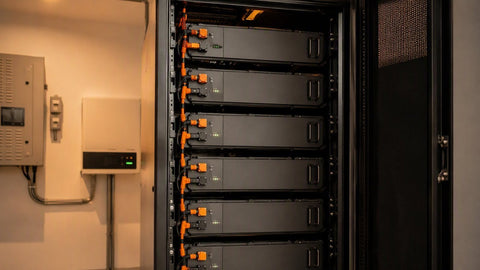
PV work adds a couple of EGC wrinkles worth flagging because they come up on every solar rough-in. The PV array's equipment grounding conductors are sized per 250.122 based on the OCPD protecting that circuit — for many residential string-inverter circuits with no OCPD between modules and inverter, 690.45 sends you back to 250.122 using the inverter output circuit breaker. Module frames bond through listed rail/WEEB hardware, and that continuous bare copper you see across the array is the EGC — typically 6 AWG bare per manufacturer listings. If your project combines PV with battery storage, each separately derived source gets its own grounding analysis. We stock array grounding hardware alongside the panels in our solar panels collection and batteries & storage.
Frequently Asked Questions
What size ground wire do I need for a 200-amp service or panel?
Per NEC Table 250.122, a 200A overcurrent device requires a 6 AWG copper or 4 AWG aluminum equipment grounding conductor (EGC). Don't confuse this with the grounding electrode conductor (GEC) to the ground rods, which is sized from Table 250.66 by service conductor size — typically 4 AWG copper for a 200A service with 2/0 Cu conductors, or 6 AWG if it runs only to ground rods.
What is the difference between an EGC and a GEC?
The equipment grounding conductor (EGC) runs with every circuit from panel to load and clears ground faults by giving fault current a path back to trip the breaker — sized by Table 250.122 from the breaker rating. The grounding electrode conductor (GEC) connects the service neutral to grounding electrodes (rods, Ufer, water pipe) for lightning and surge reference — sized by Table 250.66 from the service conductor size. Same color, different jobs, different tables.
Do I have to upsize the ground wire if I upsize the circuit conductors?
Yes. NEC 250.122(B) requires the EGC to be increased proportionally to the circular-mil area increase of the ungrounded conductors whenever they're upsized (voltage drop, derating, bundling). Example: a feeder needing 2/0 installed as 4/0 is a 1.59× area increase, so a base 6 AWG EGC must grow to 4 AWG. The EGC never has to exceed the circuit conductor size itself.
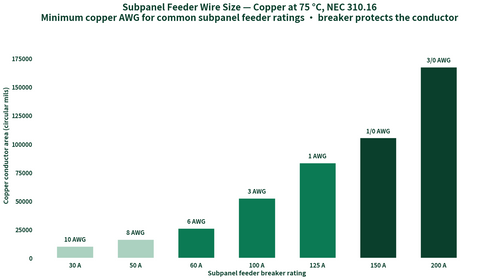
What size ground wire for a 100-amp subpanel?
For a subpanel fed by a 100A breaker, Table 250.122 calls for an 8 AWG copper or 6 AWG aluminum EGC. If you upsized the feeder conductors (common on long detached-building runs for voltage drop), 250.122(B) requires the EGC to grow proportionally — a 1/0 feeder where 3 AWG was required, for example, pushes the EGC up a size or two.
Can the ground wire be bare copper?
Yes. NEC 250.118 and 250.119 permit the EGC to be bare, covered, or insulated; if insulated it must be green or green with yellow stripe. Bare copper is standard in NM cable and common for bonding jumpers. Listed metal raceways such as EMT and rigid conduit can also serve as the EGC per 250.118, though many contractors still pull a wire-type EGC for reliability on long runs.
Need Grounding Hardware, Wire, or Bonding Gear?
PES Supply stocks bare copper, THHN, grounding bushings, and bonding hardware from 169 authorized brands. Send the panel schedule — we'll quote the complete grounding package.
Shop Electrical Supplies Contact Us for Bulk PricingRelated Resources
- Electrical supplies: wire, conduit, and grounding hardware
- Solar panels and array grounding hardware
- Generators and transfer equipment
- Batteries and energy storage