Updated September 2026 — refreshed against the live PES catalog; product pricing verified 2026-09-26.
Wire Size by Amps: Ampacity Chart & Breaker Matching Guide (NEC 310.16)
Reading time: ~10 min read
📋 Key Takeaways
- Match the breaker to the wire, never the other way around: 15 A → 14 AWG, 20 A → 12 AWG, 30 A → 10 AWG, per NEC 240.4(D).
- Most residential and commercial terminations are rated 75 °C, so the 75 °C column of NEC Table 310.16 governs even when you pull 90 °C THHN.
- Continuous loads (3 hours or more) must be sized at 125% of the load current per NEC 210.20(A) — that rule alone forces one size up on many circuits.
- The 90 °C column is only usable for derating calculations (ambient temperature and conduit fill), not for final ampacity on 75 °C-rated equipment.
- Ampacity is only half the check — verify voltage drop on any run longer than about 100 feet.
Every wire in a building answers to two numbers: the load it carries and the breaker that protects it. Get the pairing wrong in one direction and the insulation cooks before the breaker trips; get it wrong in the other and you're paying for copper you didn't need. This guide gives you the NEC Table 310.16 ampacity values you'll actually use — copper THHN at 75 °C and 90 °C, plus aluminum — a breaker-to-wire matching table, the 125% continuous-load rule, and a quick lookup tool. Pull the wire and breakers from our electrical supplies collection when you're ready to order.
Breaker-to-Wire Quick Lookup
Breaker already sized for a continuous load? NEC 210.20(A) requires the breaker at 125% of the load, so a 20 A breaker carries at most 16 A continuous.
Minimum wire size: —
Based on the NEC Table 310.16 75 °C column, the NEC 240.4(D) small-conductor limits, and the 240.4(B) round-up rule. Ambient-temperature and conduit-fill derating may force a larger size — see below.
NEC Table 310.16 Ampacity Chart (14 AWG – 4/0)
Table 310.16 lists allowable ampacities for insulated conductors rated up to 2,000 V, at 30 °C ambient, with no more than three current-carrying conductors in a raceway. These are the values for the sizes you'll pull every day:
| Wire Size | Copper 75 °C (THHN/THWN) | Copper 90 °C (THHN-2) | Aluminum 75 °C | Aluminum 90 °C |
|---|---|---|---|---|
| 14 AWG | 20 A | 25 A | — | — |
| 12 AWG | 25 A | 30 A | 20 A | 25 A |
| 10 AWG | 35 A | 40 A | 30 A | 35 A |
| 8 AWG | 50 A | 55 A | 40 A | 45 A |
| 6 AWG | 65 A | 75 A | 50 A | 55 A |
| 4 AWG | 85 A | 95 A | 65 A | 75 A |
| 3 AWG | 100 A | 115 A | 75 A | 85 A |
| 2 AWG | 115 A | 130 A | 90 A | 100 A |
| 1 AWG | 130 A | 145 A | 100 A | 115 A |
| 1/0 AWG | 150 A | 170 A | 120 A | 135 A |
| 2/0 AWG | 175 A | 195 A | 135 A | 150 A |
| 3/0 AWG | 200 A | 225 A | 155 A | 175 A |
| 4/0 AWG | 230 A | 260 A | 180 A | 205 A |
Values from NEC Table 310.16. Assumes 30 °C (86 °F) ambient and three or fewer current-carrying conductors per raceway.
Why the 75 °C Column Usually Wins
THHN wire is 90 °C-rated, so it's tempting to size from the 90 °C column. Don't. NEC 110.14(C) requires you to use the ampacity column that matches the weakest termination in the circuit, and nearly every breaker, panel, and disconnect rated 100 A or less is listed for 75 °C (or 60 °C on older gear). The 90 °C column still earns its keep in one place: as the starting point for derating. If you're correcting for a hot attic (Table 310.15(B)(1)) or a conduit packed with current-carrying conductors (Table 310.15(C)(1)), you may start the math from the conductor's actual 90 °C rating — but the final derated number still can't exceed the 75 °C column value at the terminations.
Breaker-to-Wire Matching Table
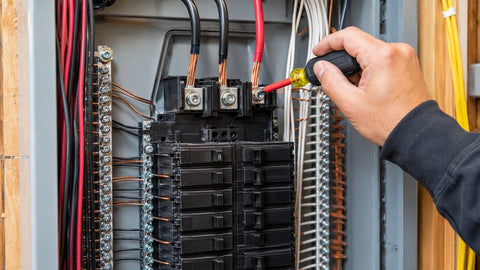
The breaker protects the wire, so the wire's ampacity must be at least the breaker's rating — with the NEC 240.4(D) small-conductor caps applied to 14, 12, and 10 AWG, and the 240.4(B) round-up rule allowing the next standard breaker size above ampacity for larger conductors:
| Breaker | Min. Copper (75 °C) | Min. Aluminum (75 °C) | Typical Use |
|---|---|---|---|
| 15 A | 14 AWG | — | Lighting, general receptacles |
| 20 A | 12 AWG | — | Kitchen/bath receptacles, small appliances |
| 30 A | 10 AWG | 8 AWG* | Dryers, small AC units, water heaters |
| 40 A | 8 AWG | 6 AWG | Ranges, EV chargers (40 A) |
| 50 A | 8 AWG | 6 AWG | Ranges, welders, hot tubs |
| 60 A | 6 AWG | 4 AWG | Subpanels, large AC condensers |
| 70 A | 4 AWG | 3 AWG | Subpanels (round-up from 65 A ampacity) |
| 80 A | 4 AWG | 2 AWG | Subpanels, EV chargers (80 A circuit) |
| 100 A | 3 AWG | 1 AWG | Small services, large subpanels |
| 125 A | 1/0 AWG | 2/0 AWG | Services and main-lug panels |
| 150 A | 2/0 AWG | 4/0 AWG | Residential services |
| 200 A | 3/0 AWG | 250 kcmil | Standard residential service |
*Aluminum is uncommon below 8 AWG in modern work; 240.4(D) caps 12 AWG aluminum at 15 A and 10 AWG aluminum at 25 A on branch circuits. For 100 A+ feeders, also check the dwelling-unit service sizing allowance in NEC 310.12, which permits smaller conductors for residential services.
The 125% Continuous Load Rule (NEC 210.20)
A continuous load — anything expected to run at maximum current for three hours or more — gets special treatment. NEC 210.20(A) requires the overcurrent device to be rated at least 125% of the continuous load, and 210.19(A)(1) applies the same multiplier to the conductor:
Breaker & wire ampacity ≥ 1.25 × continuous load + 100% of non-continuous load
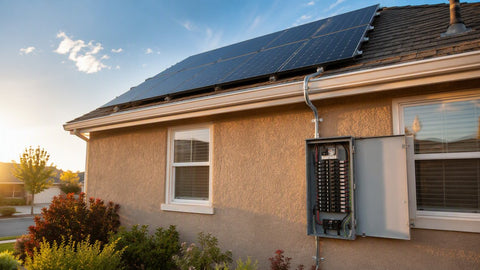
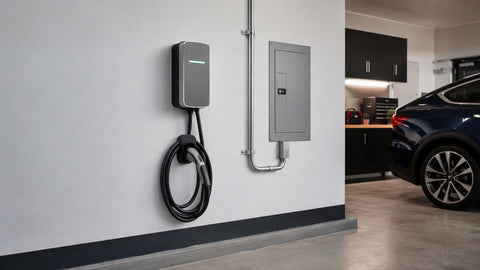
What counts as continuous in the real world: EV chargers, commercial lighting, water heaters, heat pumps, server rooms, and any load an occupancy sensor keeps on all day. A 40 A EV charger is the classic case: 40 A × 1.25 = 50 A, so you need a 50 A breaker and 8 AWG copper minimum — not the 40 A breaker and 8 AWG you'd grab off the nameplate alone. Solar inverter output circuits get the same treatment (NEC 690.8/690.9 apply their own 125% factors), which is why a 7.7 kW inverter at 32 A lands on a 40 A breaker with 8 AWG, not 10 AWG.
Exception worth knowing: if both the breaker and its enclosure are listed for 100% continuous operation, you can skip the 125% multiplier. That's common on large frame breakers, rare on residential load centers.
When You Must Upsize Beyond the Chart
- Continuous loads: the 125% rule above — the single most common reason a "code-minimum" install fails inspection.
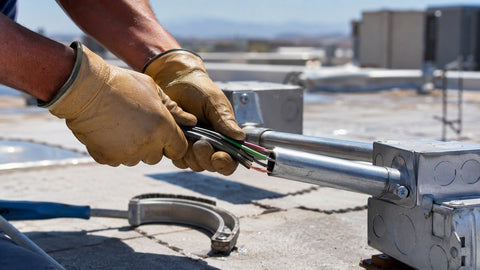
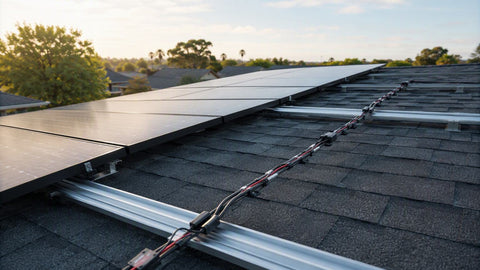
- Ambient temperature: ampacities assume 30 °C. Attics, rooftops, and boiler rooms run hotter; apply the Table 310.15(B)(1) correction factors. Rooftop solar conduit can add another 20–30 °C of effective ambient.
- Conduit fill: more than three current-carrying conductors in one raceway triggers the Table 310.15(C)(1) adjustment — 80% for 4–6 conductors, 70% for 7–9, 50% for 10–20.
- Voltage drop: ampacity keeps the wire from overheating; it says nothing about delivered voltage. On runs past ~100 ft, verify drop against the NEC 3% recommendation and upsize as needed.
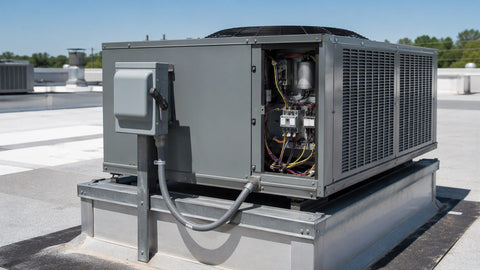
- Motor and HVAC circuits: NEC 240.4(G) routes these to Article 430/440 rules, where the breaker can be sized well above conductor ampacity to survive inrush — a deliberate, code-sanctioned exception to the matching table above.
Common Mistakes That Get Installers Red-Tagged
- Sizing from the 90 °C column because the spool says THHN — the terminations say 75 °C, and 110.14(C) sides with the terminations.
- Ignoring 240.4(D): 12 AWG copper carries 25 A at 75 °C, but you may not protect it with a 25 A breaker — the cap is 20 A.
- Forgetting the neutral counts as current-carrying on nonlinear loads (offices full of LED drivers and switch-mode supplies), which changes your conduit-fill derating math.
- Pairing aluminum wire with CU-only lugs: aluminum conductors need AL-rated terminations and anti-oxidant compound per 110.14.
- Upsizing the breaker to stop nuisance trips instead of fixing the load or the wiring. The breaker is the safety valve for the wire; bigger is not safer.
Frequently Asked Questions
What size wire do I need for a 20 amp circuit?
12 AWG copper minimum, per NEC 240.4(D). Although 12 AWG THHN is rated 25 A at 75 °C, the small-conductor rule caps its overcurrent protection at 20 A. For a continuous 20 A load, apply the 125% rule: you need a 25 A-rated conductor path, so size the wire for 25 A and use a 25 A or 20 A breaker as the load allows — most installers simply step to 10 AWG on long or hot runs.
Can I use the 90 °C column of Table 310.16?
Only as a starting point for temperature and conduit-fill derating. NEC 110.14(C) limits the final ampacity to the column matching your termination rating — 75 °C for virtually all equipment rated 100 A or less and most larger modern gear. The final, derated number may never exceed the termination column value.
What wire size is required for a 100 amp service?
From the 75 °C column: 3 AWG copper or 1 AWG aluminum. However, NEC 310.12 allows smaller conductors for dwelling-unit services — 4 AWG copper or 2 AWG aluminum for a 100 A residential service — because diversified residential loads rarely approach the service rating. Check your local amendments; some jurisdictions don't adopt 310.12.
Does aluminum wire need to be bigger than copper?
Yes — aluminum has about 61% of copper's conductivity, so you typically go up two sizes: a run needing 6 AWG copper takes 4 AWG aluminum. Aluminum is standard practice for service entrance and large feeders because the installed cost is far lower, but it requires AL-rated lugs, anti-oxidant compound, and correct torque.
What happens if the wire is bigger than the breaker requires?
Nothing bad — oversizing wire is always electrically safe (the breaker still protects it). You trade money for lower voltage drop, less heat, and headroom for future load growth. The only hard limits are physical: the conductor must fit the terminal, or you splice down to a listed pigtail size.
Wire, Breakers, and Panels — One PO
PES Supply stocks THHN, feeders, breakers, and load centers from 169 authorized brands. Send your panel schedule and we'll quote the whole bill of material with trade pricing.
Shop Electrical Supplies Contact Us for a QuoteRelated Resources
- Electrical supplies: wire, breakers, panels, and lugs
- Solar panels and inverter equipment
- Batteries and energy storage
Need pricing or availability on anything in this guide?
Portlandia Electric Supply dropships direct from the manufacturer — most items Ship Direct with lead times stated up front, no surprises.
Get a quote from PESBulk, pallet and contractor pricing available.