Updated September 2026 — refreshed against the live PES catalog; product pricing verified 2026-09-26.
Off-Grid Inverter Sizing: Continuous, Surge & Battery Bank Pairing
Reading time: ~9 min read
📋 Key Takeaways
- Size continuous watts to your simultaneous load, plus 25% headroom. Add up everything that can run at once — not everything you own — and multiply by 1.25. A cabin pulling 2,400W simultaneous wants a 3,000W inverter, not a 2,500W unit running flat-out.
- Surge rating is decided by your biggest motor. Well pumps, compressors, and refrigerators pull 3–7× running watts at start. The inverter's surge rating must cover (other running loads + the motor's starting surge), held for the seconds the motor needs to spin up.
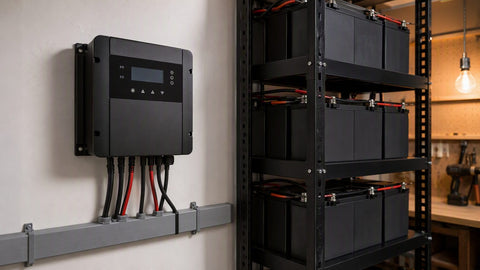
- Battery bank voltage is an amperage decision. 3,000W at 12V is ~280A of DC current — welding-cable territory. Rule of thumb: 12V up to ~1,200W, 24V to ~3,500W, 48V beyond that. Higher voltage halves cable cost and voltage-drop pain.
- The inverter is only as good as the bank behind it. Surge current comes from the batteries, not the inverter's capacitors — an undersized bank sags and trips the inverter on low-voltage cutout exactly when the pump starts.
- Low-frequency (transformer-based) inverters surge harder and run motors cleaner; high-frequency units are lighter and cheaper but surge marginally. Match the topology to the load list.
Off-grid inverter sizing fails in two directions: undersized inverters that fault every time the well pump kicks, and oversized units that waste battery on idle draw and never see their rated load. The right answer comes from an honest load worksheet — what actually runs simultaneously — plus the one surge event the system must survive, and a battery bank voltage that keeps DC currents sane. The worksheet calculator below does all three: enter your simultaneous continuous load, your largest motor's surge, and your planned bank voltage, and it returns the inverter continuous and surge ratings, the DC current the bank must deliver, and whether your voltage class matches the job.
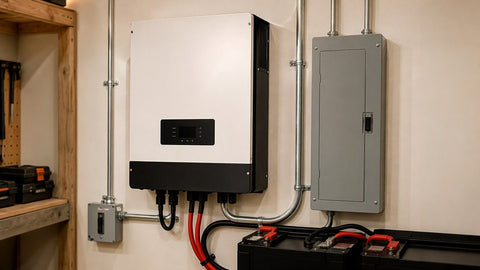
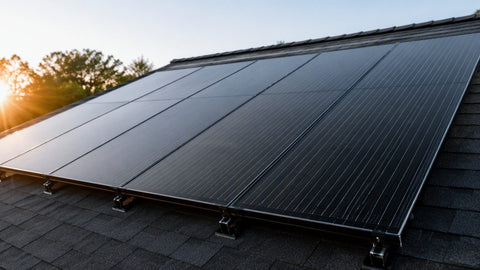
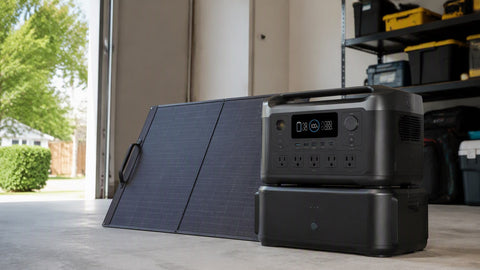
Building the system? Our inverters collection covers off-grid and hybrid units, batteries and storage covers the bank, and solar panels keep it charged. For the heavy-gauge DC side, use our battery cable size chart once you have your DC current number.
Off-Grid Inverter Sizing Worksheet
Sum of running watts for everything on at once — use the worksheet table below.
Starting watts of the biggest motor: well pump, AC compressor, fridge. Typically 3–7× running.
Surge replaces running watts for that motor during startup — we subtract it to avoid double-counting.
Minimum continuous inverter rating: —
Required surge rating: —
DC current at full continuous load: —
Battery voltage fit: —
Sizing logic: continuous rating = simultaneous load × 1.25 headroom, rounded to standard inverter sizes; surge requirement = (simultaneous load − motor running watts) + motor surge; DC current = watts ÷ bank voltage ÷ 0.90 inverter efficiency. Voltage-class guidance: 12V to ~1,200W, 24V to ~3,500W, 48V above. Informational — follow the inverter and battery manufacturer instructions (NEC 110.3(B)) and NEC Article 710 for stand-alone systems.
The Load Worksheet: Getting Honest Numbers
The single biggest sizing error is adding up every nameplate in the building. What matters is what runs at the same time. Typical running and starting watts:
| Load | Running watts | Starting surge | Notes |
|---|---|---|---|
| Refrigerator (modern, 18–22 cu ft) | 120–200 W | 600–1,200 W | Surge lasts ~1 sec; cycles 30–40% duty |
| Chest freezer | 100–150 W | 500–900 W | Often paired with fridge — both can start together |
| Well pump, 1/2 HP 240V | 900–1,100 W | 2,500–4,000 W | The classic off-grid killer; surge held 2–3 sec |
| Window AC, 8,000 BTU | 700–900 W | 2,000–3,000 W | Inverter-drive mini-splits surge far less (~1.3×) |
| Microwave, 1,000W output | 1,400–1,600 W | ≈ running | Resistive/magnetron — no meaningful surge |
| LED lighting, whole cabin | 60–200 W | — | Count what's actually on at peak evening |
| Starlink / router / laptops | 50–150 W | — | Continuous background load |
| Coffee maker / toaster | 900–1,500 W | — | Behavioral load — schedule it, don't size for it with the pump |
| Washing machine | 400–800 W | 1,200–2,300 W | Motor surge on agitate cycle |
Build the worksheet by time of day: the evening peak (lights + fridge + electronics + pump events) usually sets the continuous rating, while the worst single event (pump starting while the microwave runs) sets the surge requirement. An inverter that carries the evening peak at 60–70% of rating runs cooler, lasts longer, and keeps headroom for the load you forgot.
Battery Bank Voltage: 12V vs 24V vs 48V
Bank voltage is really a current-management decision. Power is watts either way; what changes is the amperage the batteries, cables, and overcurrent devices must carry:
| Bank voltage | Sweet spot (inverter size) | DC amps at 1,000W load | DC amps at 3,000W load | Typical platform |
|---|---|---|---|---|
| 12 V | ≤ 1,200 W | ~93 A | ~278 A — avoid | RVs, vans, small cabins, portable power |
| 24 V | 1,200–3,500 W | ~46 A | ~139 A | Cabins, boats, mid-size off-grid |
| 48 V | 3,500 W+ | ~23 A | ~69 A | Whole-home off-grid, hybrid systems, 3kW+ inverters |
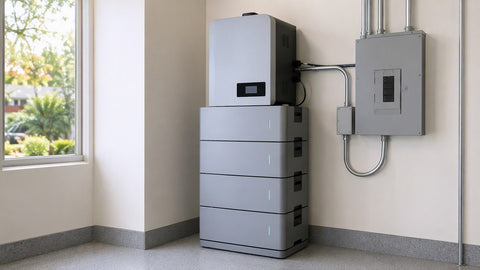
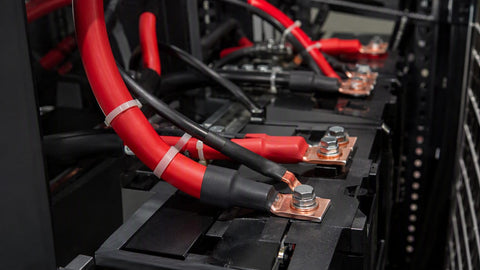
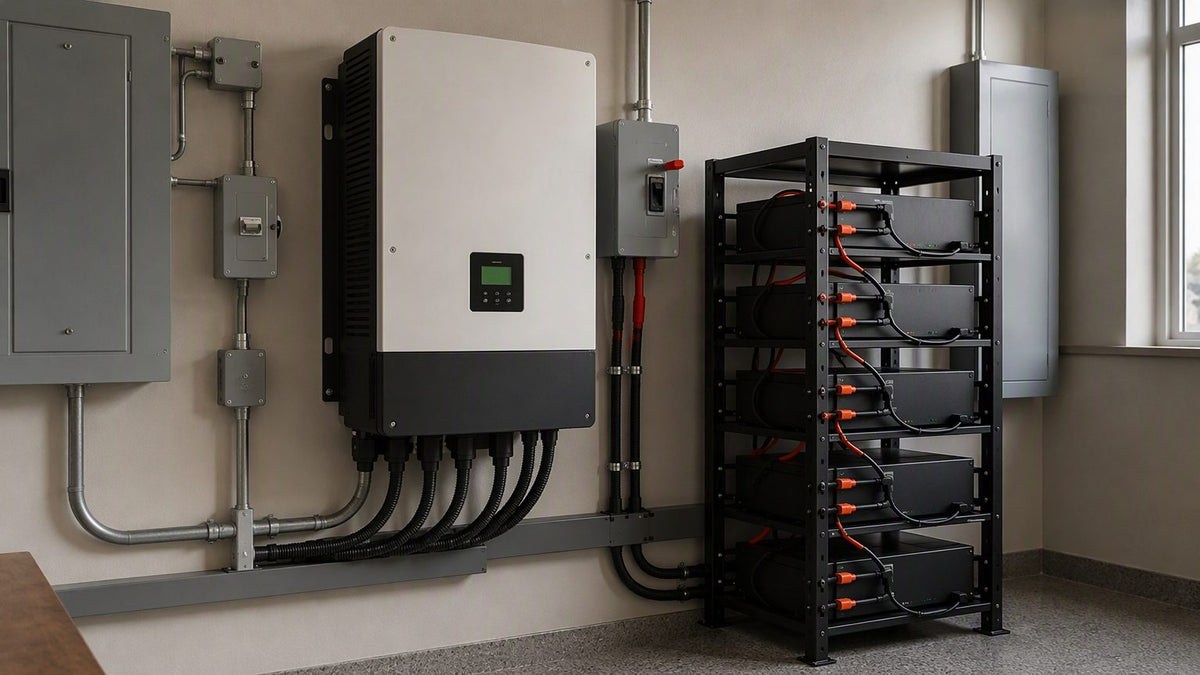
The cable math makes the decision concrete: 3,000W on a 12V bank means ~278A continuous — 4/0 copper, enormous lugs, and a 300A+ DC breaker. The same load on 48V draws ~69A and runs comfortably on 2 AWG with a 100A breaker. Above 4–5kW, 12V isn't just inefficient, it's effectively unavailable — major inverter manufacturers simply don't build big 12V units. Lithium batteries at 48V (16-cell LiFePO4, or rackmount 51.2V modules) are the current default for whole-home off-grid for exactly this reason.
Surge Ratings, Topology, and the NEC Side
Spec sheets quote surge two ways: high-frequency (HF) inverters typically surge to 2× continuous for under a second — fine for electronics and resistive loads, marginal for motors. Low-frequency (LF, transformer-based) inverters surge 2.5–3× for several seconds, which is what a well pump or compressor actually needs. If the worksheet shows a serious motor load, LF topology or an inverter with a documented 5-second surge rating is the answer, not a bigger HF unit. On the compliance side, stand-alone systems fall under NEC Article 710; inverters should be listed to UL 1741 (or UL 1741 SB for interactive functions), installed per NEC 110.3(B), and the battery bank overcurrent protection and disconnects follow NEC 706 for energy storage systems. For runtime math — how long the bank carries the load — pair this sizing with our battery backup runtime calculator.
Frequently Asked Questions
What size inverter do I need for an off-grid cabin?
Add up the running watts of everything that operates simultaneously — for a typical cabin (fridge, lights, electronics, occasional microwave or pump) that's usually 1,500–3,000W — then multiply by 1.25. Most cabins land on a 2,000–4,000W inverter at 24V or 48V, with a surge rating of at least 2.5× continuous if a well pump or compressor is on the load list. The worksheet above gives the exact number from your loads.
What's the difference between continuous and surge wattage?
Continuous (rated) watts is what the inverter delivers indefinitely; surge is the short burst — 2× for high-frequency units, up to 3× for low-frequency transformer-based models — available for a few seconds to start motors. Motors like pumps and compressors draw 3–7× their running watts at startup, so the inverter's surge rating must exceed (other running loads + motor surge) or the unit faults every time the motor kicks.
Should I use a 12V, 24V, or 48V battery bank?
Match voltage to inverter size: 12V below ~1,200W (RVs, small cabins), 24V to ~3,500W (cabins and mid-size systems), 48V above that (whole-home off-grid). The driver is DC current — 3,000W is ~278A at 12V but only ~69A at 48V — which dictates cable size, breaker ratings, and connection quality. Higher voltage also halves resistive losses for the same wiring.
Can an off-grid inverter run a well pump?
Yes, if two conditions are met: the inverter's surge rating covers the pump's starting watts (a 1/2 HP 240V pump surges 2,500–4,000W for 2–3 seconds), and the battery bank can deliver the surge current without voltage sag tripping the inverter. In practice that means a low-frequency inverter of 4,000W+ on a 48V bank, or a dedicated soft-start on the pump. High-frequency inverters with 1-second surge specs typically fail this load.
How many batteries do I need for a 3,000W inverter?
Voltage first: a 3,000W inverter belongs on 24V minimum, preferably 48V. Capacity depends on runtime, not inverter size — at 48V and ~70A full-load draw, a 200Ah bank (≈10kWh) runs full load for roughly 2.5 hours, or a realistic 1,000W evening load for 8+ hours. For lithium, also confirm the bank's BMS continuous and pulse current ratings exceed the inverter's DC draw (70A continuous / 140A+ surge here).
Building an Off-Grid System?
PES Supply stocks low-frequency and hybrid inverters, LiFePO4 battery banks, and the DC-rated breakers and cable to wire them — from 169 authorized brands. Send the load worksheet — we'll spec the inverter and bank at contractor pricing.
Shop Inverters Contact Us for Bulk PricingRelated Resources
- Battery cable size chart: 12V/24V/48V inverter cabling
- Battery backup runtime calculator: hours by load and bank size
- Off-grid and hybrid inverters
- LiFePO4 batteries and storage systems
- Solar panels to charge the bank
Need pricing or availability on anything in this guide?
Portlandia Electric Supply dropships direct from the manufacturer — most items Ship Direct with lead times stated up front, no surprises.
Get a quote from PESBulk, pallet and contractor pricing available.