240V Wire Size Calculator: Breaker, Gauge, and Voltage Drop by Circuit Amps
Reading time: ~8 min read
📋 Key Takeaways
- The classic 240V pairings: 20A → 12 AWG, 30A → 10 AWG, 40A → 8 AWG, 50A → 8 AWG (6 AWG for long runs), 60A → 6 AWG, all copper at the 75°C column of NEC 310.16.
- Continuous loads change the math. EV chargers, water heaters, and anything running 3+ hours size at 125% of nameplate per NEC 210.19(A)(1)/210.20(A) — a 32A EVSE lands on a 40A breaker with 8 AWG copper.
- Distance can beat ampacity. Past roughly 100–150 feet at 240V, voltage drop (NEC 210.19(A)(1) informational 3% branch-circuit guidance) forces a larger conductor than the ampacity table demands — our calculator checks both and returns the bigger wire.
- Aluminum is legal and common for feeders and large 240V circuits — expect to go up about two AWG sizes versus copper and use listed AL-rated lugs with antioxidant.
- The breaker protects the wire, not the appliance: never upsize a breaker to stop nuisance trips without rechecking conductor ampacity first.
Every 240V circuit question — "what wire for a 30-amp dryer," "can I run 10/2 to a 50A range," "what gauge for a welder outlet 80 feet from the panel" — is really the same three-step problem: size the breaker to the load (with the 125% continuous multiplier where it applies), pick the smallest conductor whose 75°C ampacity covers the design current, then check that the run length doesn't push voltage drop past 3%. The calculator below runs all three steps and returns the breaker, the ampacity-minimum conductor, the voltage-drop-adjusted conductor, and the NEMA receptacle family that matches.
Roughing in the circuit? Our electrical supplies collection has the breakers, THHN-2, NM-B, and receptacles to build it. If the load is an EV charger specifically, the EV charger circuit sizing guide covers the NEC 625 rules that stack on top of this math.
240V Wire Size Calculator
Amps = watts ÷ 240. A 7,680W EVSE draws 32A.
Continuous loads design at 125% per NEC 210.20(A).
Panel to receptacle, one way. Voltage drop checked at 3% (7.2V).
Ampacities from NEC 310.16 at the 75°C column.
Load / design current: —
Breaker (next standard size): —
Minimum conductor by ampacity (75°C): —
Conductor after voltage-drop check: —
Estimated voltage drop at full load: —
Typical receptacle: —
Sizing logic: continuous loads at 125% per NEC 210.19(A)(1)/210.20(A); breaker from the NEC 240.6(A) standard ratings; conductor from NEC 310.16 (75°C) with 240.4(D) small-conductor caps; voltage drop per the single-phase CM formula (CM = 2 × K × I × L ÷ VD, K = 12.9 Cu / 21.2 Al) against the NEC 210.19(A)(1) informational 3% branch-circuit guidance. Informational — the AHJ and equipment instructions govern.
The Classic 240V Circuit Pairings (Copper, 75°C)
For runs under 100 feet, ampacity — not distance — sets the wire size. These pairings cover nearly every residential 240V circuit:
| Breaker | Min. copper wire | Typical 240V loads | Receptacle |
|---|---|---|---|
| 15 A | 14 AWG | Small window AC, water pump | 6-15R |
| 20 A | 12 AWG | Window AC, small air compressor | 6-20R |
| 30 A | 10 AWG | Electric dryer, tankless point-of-use heater | 14-30R / 6-30R |
| 40 A | 8 AWG | Electric range, 7.7kW EVSE (32A continuous) | 14-50R |
| 50 A | 8 AWG | Range, 9.6kW EVSE (40A continuous), RV pedestal | 14-50R / 6-50R |
| 60 A | 6 AWG | Large tankless heater, subpanel feed, welder | Hardwired |
| 80 A | 4 AWG | 19.2kW EVSE (64A continuous), large shop loads | Hardwired |
| 100 A | 3 AWG | Subpanel feeder, whole-shop feed | Hardwired |
Water heaters and EVSE are the two loads people most often mis-size, because both are continuous. A 4,500W water heater draws 18.8A but designs at 23.4A — 25A breaker minimum, 30A common, 10 AWG copper either way (the NEC 240.4(D) cap stops you at 30A). A 48A EVSE designs at 60A and wants 6 AWG copper on a 60A breaker.
When Distance Takes Over: Voltage Drop
NEC 210.19(A)(1) carries an informational note recommending no more than 3% voltage drop on a branch circuit and 5% total for feeder plus branch. At 240V, 3% is 7.2 volts. Ampacity tables assume the wire can dissipate heat; voltage drop cares about resistance over distance — so a 150-foot run to a barn or detached garage can require a size or two up even when the load is modest. The single-phase formula is CM = 2 × K × I × L ÷ VD, where K is 12.9 for copper and 21.2 for aluminum, I is the design current, and L is the one-way length. Our calculator runs it against every candidate conductor and reports the first size that satisfies both ampacity and drop. For a deeper treatment including three-phase runs and aluminum trade-offs, see the voltage drop calculator.
Copper vs Aluminum at 240V
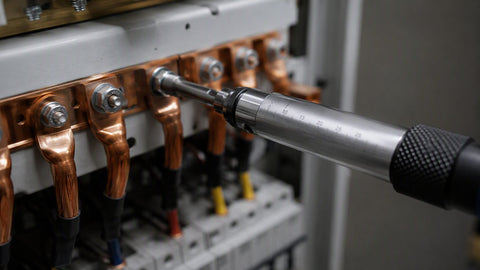
Aluminum is the norm for feeders and increasingly common for big branch circuits: roughly two sizes up from copper (a 60A circuit on 6 AWG copper lands on 4 AWG aluminum) at 30–50% of the copper cost. The rules that matter: use AA-8000 series alloy, lugs marked AL or AL/CU, torque to the marked value with a calibrated tool, and apply antioxidant compound. Small aluminum branch circuits below 8 AWG are effectively obsolete for 240V appliance circuits — stick to copper there. Ampacities above come straight from the 75°C column; if the conduit run is hot or crowded, run those conditions through the ampacity chart before committing.
Frequently Asked Questions
What size wire do I need for a 30-amp 240V circuit?
10 AWG copper (10/2 NM-B for a dryer) or 8 AWG aluminum. NEC 310.16 rates 10 AWG copper at 35A in the 75°C column, and NEC 240.4(D) caps it at 30A of overcurrent protection. For runs past about 120 feet at a full 30A load, step up to 8 AWG copper to hold voltage drop near the 3% guidance.
What size wire for a 50-amp 240V circuit?
8 AWG copper or 6 AWG aluminum for runs under 100 feet. A 50A circuit feeding a continuous load (like a 40A EVSE) designs at 50A exactly, and 8 AWG copper's 50A ampacity at 75°C covers it with no margin — long runs or hot conduits push you to 6 AWG copper. Use a 14-50R receptacle when a neutral is present, 6-50R for straight 240V loads like welders.
Can I use 12-gauge wire on a 240V circuit?
Yes — on a 20A breaker. Voltage has nothing to do with wire size; current does. 12 AWG copper on 240V is exactly the same 20A-max conductor it is on 120V, per NEC 240.4(D). You need a double-pole 20A breaker and typically a 6-20R receptacle. The mistake to avoid is assuming 240V loads need bigger wire automatically: a 3,000W 240V heater draws only 12.5A and runs fine on 12 AWG.
How far can I run 10-gauge wire at 240V before voltage drop matters?
About 130 feet at a full 30A load before drop exceeds 3% (7.2V). At 20A on the same 10 AWG copper you get roughly 195 feet; at 24A continuous (design 30A) about 130 feet. The rule of thumb: every doubling of distance doubles the drop, and dropping the load current proportionally extends the acceptable distance. Longer runs to outbuildings usually land on 8 or 6 AWG.
Do 240V circuits need a neutral wire?
Only if the appliance uses 120V internally. Straight 240V loads — baseboard heaters, water heaters, welders, most EVSE — need two hots plus ground only. Appliances with timers, lights, or 120V control boards (dryers, ranges) need the neutral, which is why they use 14-30R and 14-50R receptacles with four conductors. Since NEC 250.140, new dryer and range circuits must be four-wire; the old three-wire exception applies to existing installations only.
Building a 240V Circuit?
PES Supply stocks double-pole breakers, NM-B and THHN-2 by the foot, NEMA receptacles, and disconnects from 169 authorized brands. Send the load list — we'll quote the complete circuit at contractor pricing.
Shop Electrical Supplies Contact Us for Bulk PricingRelated Resources
- Voltage drop calculator: the NEC 3% rule
- Breaker size calculator: the NEC 125% rule
- EV charger circuit sizing: breaker, wire, and load calc
- Wire size by amps: ampacity chart and breaker matching
- Breakers, wire, receptacles, and disconnects