Generator Sizing Calculator: Running Watts, Starting Watts & Whole-Home Guide
Reading time: ~12 min read
📋 Key Takeaways
- Generator capacity must cover total running watts plus the surge from the largest motor load that can start while everything else runs.
- Motor loads — well pumps, AC compressors, furnace blowers — draw 2–3× their running watts for a few seconds at startup.
- Add 20–25% headroom to your calculated surge total before choosing a generator size.
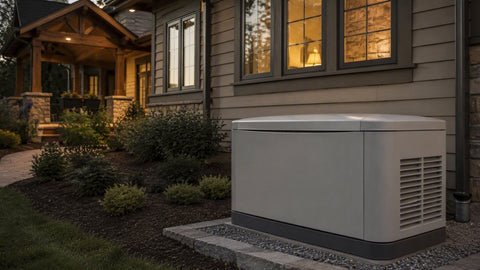
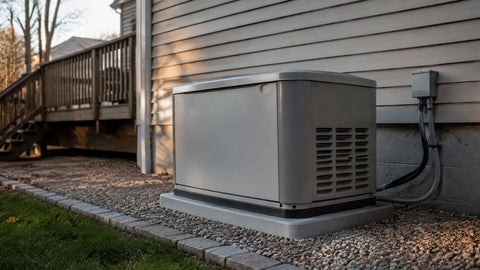
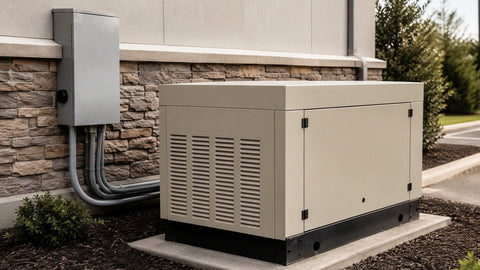
- Portable units top out around 12 kW; whole-home standby units start near 10 kW and run to 60+ kW.
- Any generator tied into a home's wiring needs a properly sized transfer switch or interlock — no exceptions.
Undersizing a generator is the most common buying mistake we see, and it always shows up the same way: the AC compressor kicks on, the generator bogs, and the customer's freezer starts thawing. Sizing correctly takes ten minutes of arithmetic — list the loads, separate running watts from starting watts, add headroom. This guide gives you the load checklist, an interactive calculator, and the portable-vs-standby and fuel decisions that follow. When you have a number, our generator collection has portable, standby, and commercial units to match it.
Running Watts vs. Starting Watts
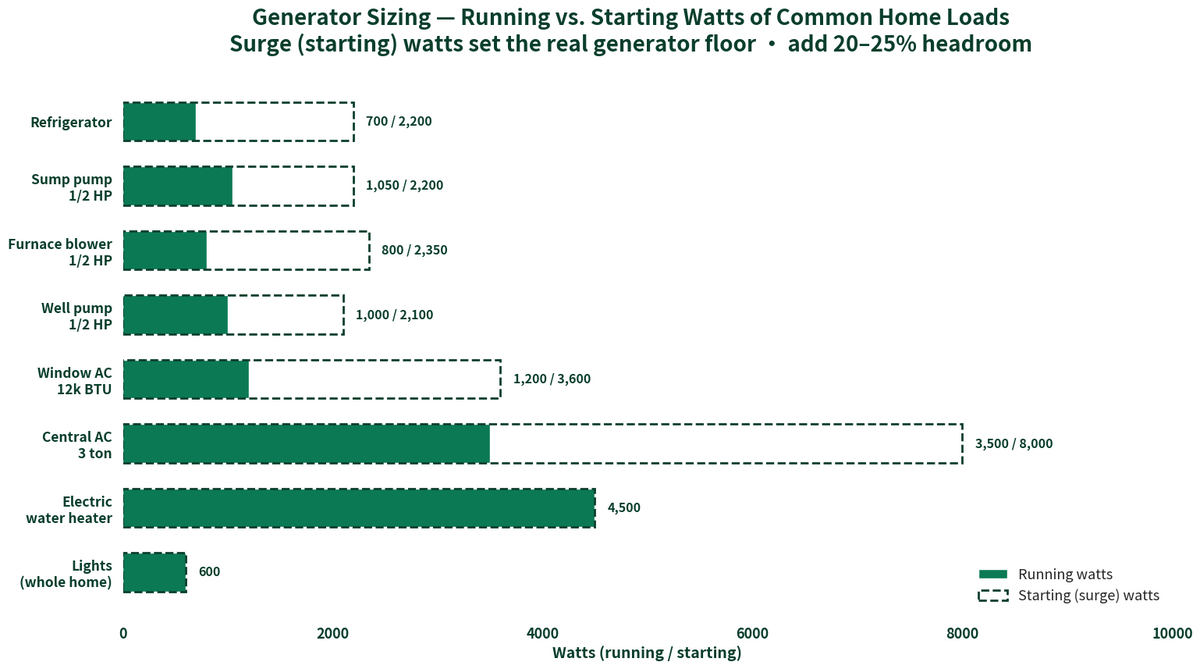
Every load on your list has two numbers. Running watts are what the device draws continuously. Starting watts (surge watts) are the extra draw for the first 2–10 seconds while a motor spins up. Resistive loads — lights, heaters, toasters — have no meaningful surge: starting equals running. Motor loads are the problem children:
- Refrigerator compressor: ~3× running watts at start
- Well pump: ~2–3×
- Central AC compressor: ~2–3× (a soft-start kit can cut this dramatically)
- Furnace blower: ~2–3×
The sizing rule that works in the field: generator surge capacity ≥ (total running watts of everything on simultaneously) + (largest single starting-watt load in that group). You don't add every surge together because motors rarely start at the same instant — but you plan for the worst one starting while the rest are already running. Then add 20–25% headroom so the generator isn't living at 100% output, which shortens engine life and leaves nothing for the load you forgot.
Interactive Generator Sizing Calculator
Check the loads you expect to run during an outage (typical wattages are pre-filled — adjust them to match actual nameplates), add custom rows for anything missing, and the calculator returns total running load, worst-case surge, and a recommended generator size with 20% headroom.
| Load | Running W | Starting W | |
|---|---|---|---|
| Refrigerator | |||
| Chest freezer | |||
| Sump pump (⅓ HP) | |||
| Well pump (½ HP) | |||
| Furnace blower (½ HP) | |||
| Central AC (3 ton) | |||
| Window AC (10,000 BTU) | |||
| Electric water heater | |||
| Electric range (one burner) | |||
| Microwave | |||
| Lighting circuit (LED) | |||
| TV + internet/router | |||
| Garage door opener | |||
Worked Example: Essential-Circuits Home
A homeowner wants to back up the essentials: refrigerator (700/2,200 W), sump pump (800/1,300 W), furnace blower (800/2,350 W), lighting (200 W), and the microwave (1,000 W).
| Step | Math | Result |
|---|---|---|
| Total running | 700 + 800 + 800 + 200 + 1,000 | 3,500 W |
| Largest surge extra | Furnace blower: 2,350 − 800 | +1,550 W |
| Worst-case surge | 3,500 + 1,550 | 5,050 W |
| With 20% headroom | 5,050 × 1.20 | 6,060 W |
| Recommended size | Round up to standard class | 7.5 kW portable / 8–10 kW standby |
Add a 3-ton central AC to that list and the answer jumps to roughly 13–14 kW — squarely in whole-home standby territory. That single checkbox is the dividing line between a $1,500 portable and a $5,000+ installed standby system, which is why we always ask about air conditioning first.
Portable vs. Standby: Decision Table
| Factor | Portable Generator | Standby Generator |
|---|---|---|
| Typical capacity | 2–12 kW | 10–60+ kW |
| Startup | Manual (recoil or electric start) | Automatic, ~10 seconds after outage |
| Fuel | Gasoline, some dual-fuel propane | Natural gas or propane (diesel for commercial) |
| Connection | Extension cords or manual transfer switch/inlet box | Automatic transfer switch, hardwired |
| Runtime | 8–14 hrs per tank; refueling during outages | Indefinite on NG; limited by propane tank size |
| Installed cost | $500–$3,000 (unit + inlet + cord) | $5,000–$15,000+ installed |
| Best for | Occasional short outages, job sites, budget backup | Frequent/long outages, medical loads, unattended homes, whole-home coverage |
The rule of thumb: if the home has medical equipment, a sump pump in a flood zone, or occupants who travel, standby is the right answer regardless of price. If outages are rare and short, a portable unit with a proper inlet box covers the essentials for a fraction of the cost.
Transfer Switch: The Non-Negotiable
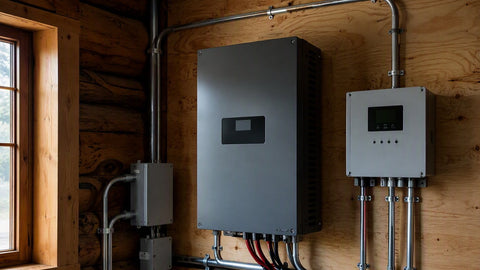
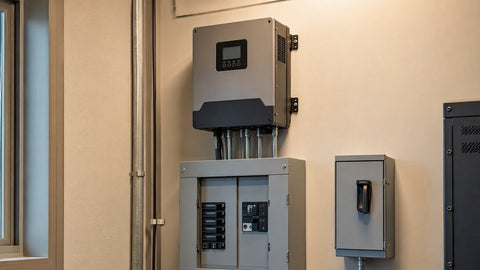
Never backfeed a home through a dryer outlet. It can kill a line worker, it violates code everywhere, and it voids insurance. A transfer switch — manual or automatic — isolates the house from the grid before generator power touches the panel. Size the switch to the generator's output breaker, not the other way around: a 50A inlet/transfer switch pairs with portables up to ~12 kW; standby units ship with matched automatic transfer switches rated for the unit. Our generator collection includes transfer-switch-ready standby packages, and our team can match a manual transfer switch to any portable unit.
Fuel Comparison: Natural Gas vs. Propane vs. Diesel
| Factor | Natural Gas | Propane (LP) | Diesel |
|---|---|---|---|
| Availability in outage | Continuous via utility line (rarely interrupted) | Limited by on-site tank (250–1,000 gal typical) | Limited by on-site tank; delivery needed for long runs |
| Power density | ~10% derate vs. LP on most units | Full rated output on most standby units | Highest output per gallon; best for large kW |
| Storage life | N/A — piped | Indefinite in tank | 12–24 months untreated; needs stabilizer and polishing |
| Cold-weather behavior | Unaffected | Vaporization drops below ~0°F on small tanks | Gels without winter additive |
| Typical use | Residential standby with gas service | Rural standby without gas service | Commercial, industrial, and prime power |
| Installed cost impact | Lowest (plumb to existing meter) | Moderate (tank + regulator) | Highest (tank, containment, fuel maintenance) |
For homes with existing natural gas service, NG is almost always the right call — unlimited runtime and no fuel management. No gas service means propane, sized so the tank carries at least 5–7 days of runtime. Diesel enters the picture above ~50 kW and for commercial duty cycles, where its efficiency and engine longevity pay back the maintenance overhead.
Sizing Mistakes We See in the Field
Adding every surge wattage together. This is the error that sells 26 kW units to homes that need 14. Motors almost never start simultaneously, and standby units with load management can sequence starts automatically. Size to the largest single start, not the sum of all of them.
Trusting the marketing number instead of the spec sheet. Portable generators are often sold on surge watts — a "9,500-watt" unit may run 7,500 continuous. Size against the running (rated) watts for continuous coverage and the surge rating for motor starts, and keep both above your calculated numbers.
Forgetting altitude and temperature derates. Naturally aspirated engines lose roughly 3–4% of output per 1,000 ft of elevation, and more in extreme heat. A 10 kW unit at 7,000 ft in Colorado is effectively a 7.5 kW unit. Derate first, then compare against your load.
Sizing the transfer switch to the panel instead of the generator. A 200A panel doesn't need a 200A transfer switch unless the generator can feed it. Match the switch to the generator's output breaker — oversizing the switch adds cost without adding capability.
Frequently Asked Questions
What size generator do I need to run a whole house?
Most 2,000–3,000 sq ft homes with central AC need 18–26 kW for true whole-home coverage. Homes with gas heat and no electric water heater can get by on 12–14 kW. Run the calculator above with your actual loads — square footage is only a rough proxy.
What's the difference between running watts and starting watts?
Running watts are the continuous draw of a device. Starting (surge) watts are the brief 2–3× spike motors draw while spinning up. Generators carry both ratings; the surge rating must cover your running total plus the largest motor start in the group.
Will a 7,500-watt generator run a house?
It will run the essentials — refrigerator, furnace blower, sump pump, lights, microwave, and electronics — with care about what runs simultaneously. It will not comfortably start and run a central AC of 3 tons or larger. For AC, plan on 12 kW or more.
How much headroom should I leave when sizing a generator?
20–25% above your calculated worst-case surge. Running a generator at or near 100% continuously shortens engine life, increases fuel consumption, and leaves no margin for the loads you forgot to list.
Do I really need a transfer switch?
Yes. Backfeeding through an outlet is illegal under the NEC, lethal to utility line workers, and grounds for insurance denial. A manual transfer switch or interlock kit for a portable unit is a few hundred dollars; standby units include an automatic transfer switch in the package.
Is natural gas or propane better for a standby generator?
If the home has natural gas service, NG wins on runtime and convenience — the fuel never runs out. Propane is the answer for homes without gas service and stores indefinitely, but runtime is capped by tank size. Most standby units are field-convertible between the two.
Ready to spec a unit? PES Supply stocks portable and standby generators from leading manufacturers, plus transfer switches, inlet boxes, and installation accessories. Send us your load list from the calculator above and our sales team will quote the right unit with contractor and bulk pricing — including freight to your site.