Conduit Fill Calculator: NEC Chapter 9 Tables for EMT, PVC & RMC (2026)
Reading time: ~10 min read
📋 Key Takeaways
- NEC Chapter 9 Table 1 caps conduit fill at 53% for one conductor, 31% for two conductors, and 40% for three or more conductors.
- Conductor cross-sectional areas come from NEC Chapter 9 Table 5 (THHN/THWN, XHHW); conduit internal areas come from Table 4 for EMT, PVC, and RMC.
- Two-conductor runs have the tightest limit (31%) because of jamming — check the jam ratio when the conduit ID is between 2.8 and 3.2 times the conductor OD.
- Equipment grounding conductors count toward fill. Every conductor in the raceway uses up area, whether it carries current or not.
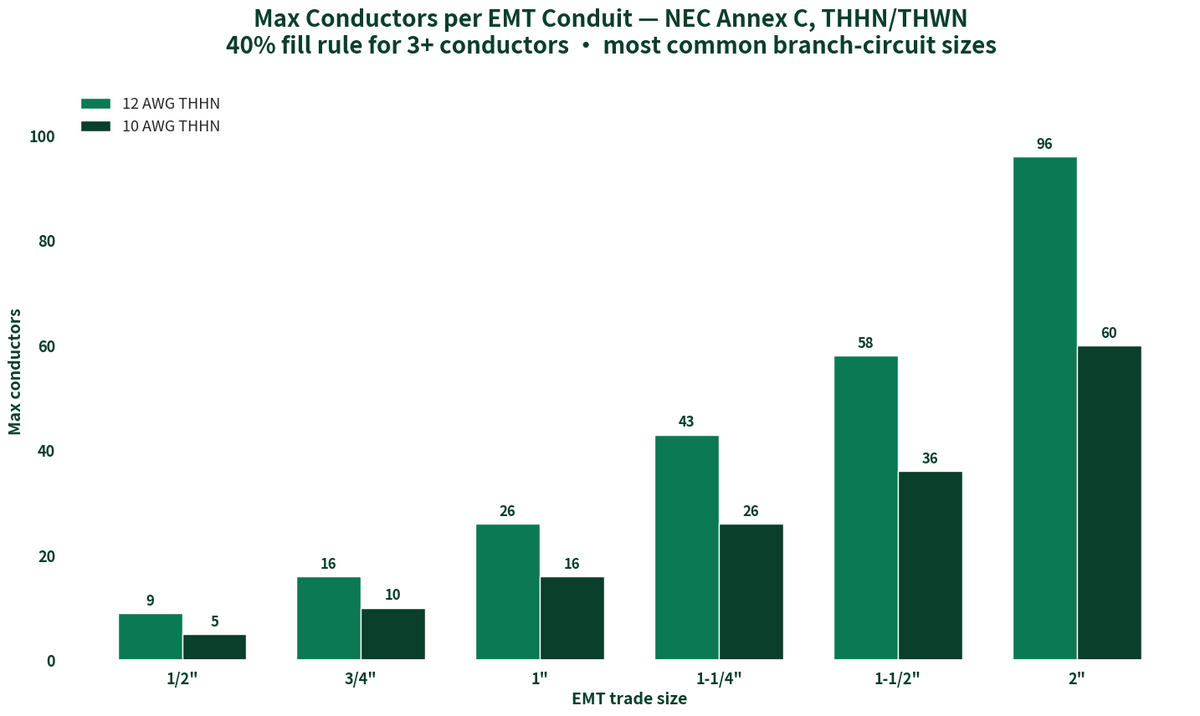
- A 1/2" EMT holds nine 12 AWG THHN conductors at 40% fill; a 3/4" EMT holds sixteen.
Every failed conduit fill inspection traces back to the same mistake: someone eyeballed the pull instead of doing the math. Overfilled conduit means conductors that won't pull, insulation damaged on the way in, heat that can't dissipate, and a red tag from the inspector. The calculator below does the NEC Chapter 9 arithmetic for you — pick the conduit type and trade size, add your conductors by type and AWG, and it returns the total fill percentage and a pass/fail against the correct Table 1 limit. Below the calculator you'll find the fill rules explained, the jam-ratio warning for two-conductor pulls, and a quick-reference chart of common combinations.
Need conduit, fittings, or THHN by the spool? Browse our electrical supplies collection — 50,000+ SKUs with trade pricing.
Conduit Fill Calculator
Total conductor area: — · Conduit internal area: —
Fill: — · NEC limit: — · Result: —
Areas use NEC Chapter 9 Table 4 (conduit) and Table 5 (conductors). Limits per Chapter 9 Table 1: 53% one conductor, 31% two conductors, 40% three or more. Verify against the current NEC and local amendments for design-critical work.
The NEC Conduit Fill Rules, in Plain Terms
NEC Chapter 9 Table 1 sets the maximum percentage of a raceway's internal cross-section that conductors may occupy:
| Number of conductors | Maximum fill | Why |
|---|---|---|
| 1 | 53% | A single conductor can shift aside while pulling, so more fill is tolerable. |
| 2 | 31% | Two conductors can jam side-by-side across the conduit — the strictest limit. |
| 3 or more | 40% | Three or more conductors nest into a stable triangular bundle. |
The 31% two-conductor limit surprises people. Intuition says more conductors should mean tighter limits, but two same-size conductors in a snug conduit can wedge against each other at a bend — that's the jamming problem the table guards against. Three conductors self-align into a bundle and actually pull better at 40% than two do at 31%.
The math itself is simple division:
Fill % = (Σ conductor areas ÷ conduit internal area) × 100
Conductor areas come from NEC Chapter 9 Table 5 — note the areas include the insulation, which is why THHN's thin nylon jacket lets you fit more wires than XHHW in the same conduit. Conduit internal areas come from Table 4, which lists every raceway type and trade size. Equipment grounding conductors count at their full insulated area; bare grounding conductors use the bare-wire dimensions from Table 8.
The Jam Ratio: Why Two-Conductor Pulls Deserve a Second Look
Chapter 9 Table 1's informational note warns about jamming when the ratio of conduit inside diameter to conductor outside diameter falls between 2.8 and 3.2. In that band, two conductors can line up across the diameter and lock against each other at a bend. The calculator above computes this ratio automatically on two-conductor pulls and flags it. If you see the warning, the fix is one trade size up, or swapping one conductor for a different size so they can't align.
Jamming matters most on pulls with two or more 90° bends. On a straight, short run you might get away with a borderline ratio — but the inspector won't care about your pull experience, and NEC 300.18 requires raceways to be complete before conductors are installed anyway, so every pull has the bends baked in.
Common Combinations: THHN/THWN in EMT (40% Fill)
Maximum conductor counts at 40% fill in EMT, the bread-and-butter of commercial branch wiring:
| THHN/THWN Size | 1/2" EMT | 3/4" EMT | 1" EMT | 1-1/4" EMT | 1-1/2" EMT | 2" EMT |
|---|---|---|---|---|---|---|
| 14 AWG | 12 | 22 | 35 | 61 | 84 | 138 |
| 12 AWG | 9 | 16 | 26 | 45 | 61 | 101 |
| 10 AWG | 5 | 10 | 16 | 28 | 38 | 63 |
| 8 AWG | 3 | 5 | 9 | 16 | 22 | 36 |
| 6 AWG | 2 | 4 | 6 | 11 | 16 | 26 |
| 4 AWG | 1 | 2 | 4 | 7 | 9 | 16 |
| 2 AWG | 1 | 1 | 2 | 5 | 7 | 11 |
| 1/0 AWG | 0 | 1 | 1 | 3 | 4 | 7 |
| 2/0 AWG | 0 | 1 | 1 | 2 | 3 | 6 |
| 3/0 AWG | 0 | 0 | 1 | 2 | 3 | 5 |
| 4/0 AWG | 0 | 0 | 1 | 1 | 2 | 4 |
| 250 kcmil | 0 | 0 | 0 | 1 | 2 | 3 |
Counts rounded down to whole conductors at exactly 40%. A "0" means even one conductor of that size exceeds the single-conductor 53% limit in that trade size — or simply doesn't fit. Always verify against Chapter 9 Tables 4 and 5 for your specific conductor type.
Worked example: three 12 AWG THHN conductors (hot, neutral, ground) for a 20 A circuit in 1/2" EMT. Three times 0.0133 in² = 0.0399 in², divided by 0.304 in² = 13.1% fill — far under the 40% limit. You could run four full 20 A circuits (twelve conductors) in that same 1/2" EMT before fill becomes the constraint. But watch NEC 310.15(C)(1) adjustment factors: more than three current-carrying conductors in one raceway triggers ampacity derating, which often becomes the binding constraint long before fill does.
EMT vs. PVC vs. RMC: Same Trade Size, Different Space
Trade size is the nominal inside diameter class, not the actual inside diameter — and actual ID varies by raceway type. RMC has the thickest wall and thread allowance of the metal raceways yet a slightly larger listed area than PVC Schedule 80; PVC Schedule 80's extra wall thickness makes it the tightest of all. Compare 1" trade size: EMT gives you 0.864 in², PVC Schedule 40 gives 0.832 in², RMC gives 0.887 in², and PVC Schedule 80 only 0.688 in². A pull that passes at 38% in RMC can fail at 47% in Schedule 80 PVC. Always compute against the raceway you're actually installing, especially underground where Schedule 80 is required at physical-damage locations per NEC 300.5 and 352.10.
- EMT: lightest, cheapest, indoor/dry locations or with listed fittings in wet locations. The default for commercial branch work.
- PVC Schedule 40/80: direct burial, concrete encasement, corrosive soils. Schedule 80 where subject to physical damage.
- RMC: physical protection, service masts, threaded hubs. Heaviest and priciest, but the most rugged.
Whatever the raceway, pull planning is where labor is won or lost. Stock up on conduit, bodies, and pulling gear from our electrical supplies collection, and pair the raceway with THHN and XHHW by the spool from the same aisle.
Frequently Asked Questions
What is the maximum conduit fill allowed by the NEC?
NEC Chapter 9 Table 1 allows 53% fill for one conductor, 31% for two conductors, and 40% for three or more conductors. These percentages apply to the raceway's internal cross-sectional area as listed in Chapter 9 Table 4, using conductor areas (including insulation) from Table 5.
Do ground wires count toward conduit fill?
Yes. Equipment grounding conductors occupy space in the raceway and count at their full insulated area per Chapter 9 Table 5. Bare (uninsulated) grounding conductors use the bare conductor dimensions from Chapter 9 Table 8, which take up less room — one reason bare grounds are common in feeder conduit.
How many 12 AWG THHN wires fit in 1/2 inch EMT?
Nine 12 AWG THHN/THWN conductors fit in 1/2" EMT at the 40% fill limit for three or more conductors (9 × 0.0133 in² = 0.1197 in² versus 0.1216 in² usable). In 3/4" EMT you can fit sixteen, and in 1" EMT, twenty-six.
What is the jam ratio in conduit pulling?
The jam ratio is the conduit inside diameter divided by the conductor outside diameter. When two conductors are pulled and this ratio falls between 2.8 and 3.2, the conductors can wedge side-by-side at bends and jam mid-pull. The fix is going up one trade size or mixing conductor sizes so they cannot align across the diameter.
Is THHN or XHHW better for tight conduit fills?
THHN/THWN-2 has a thinner insulation system (PVC with a nylon jacket), so each size occupies less area than XHHW — for example, 12 AWG THHN is 0.0133 in² versus 0.0181 in² for XHHW. In tight pulls, THHN buys you real capacity. XHHW's thicker XLPE insulation earns its keep in wet, underground, and higher-temperature applications.
Need Conduit, Fittings, or Wire by the Spool?
PES Supply stocks EMT, PVC, rigid conduit, and THHN from 169 authorized brands. Send us your conduit schedule and we'll quote the full bill of material.
Shop Electrical Supplies Contact Us for Bulk PricingRelated Resources
- Electrical supplies: conduit, fittings, boxes, and lugs
- Generators and transfer equipment
- Solar panels and array equipment