EG4 built its reputation on 48V server-rack batteries, but the 24V lineup is the quiet workhorse for RVs, boats, small off-grid cabins, and legacy 24V inverter systems that deserve better than lead. Two families carry the flag: the EG4 LifePower4 24V 200Ah and the EG4-LL (V2) 24V 200Ah, both 5.12kWh LiFePO4 server-rack units with 200A internal BMS, and both in stock in our EG4 battery catalog. This guide sorts the differences, gives the verified specs, and walks the bank-sizing math we run at the counter.

Why 24V still earns its place
The industry drifted to 48V for good reasons — halved current, smaller wire, cheaper charge controllers per watt. But 24V refuses to die because an enormous installed base runs on it: Class A and Class C RVs with 24V house systems, sailboats, telecom shelters, and legacy inverter-chargers that cost real money to replace. If your inverter is 24V, your battery bank is 24V — full stop. The question is never "should I convert to 48V" until the inverter dies; the question is which 24V lithium belongs in the rack.
Halving the voltage versus 48V doubles current for the same power, so conductor sizing gets real at 24V. A 3,000W inverter pulls roughly 125–130A continuous at 24V — that is 2/0 copper territory on the battery run with proper Class-T fusing, sized from the ampacity tables in our NEC wire sizing guide.
The lineup: verified specifications
| Specification | EG4 LifePower4 24V 200Ah (V2) | EG4-LL V2 24V 200Ah |
|---|---|---|
| Nominal voltage | 25.6V (24V class) | 25.6V (24V class) |
| Capacity / energy | 200Ah / 5.12kWh | 200Ah / 5.12kWh |
| Cell architecture | 16 UL-recognized 3.2V prismatic cells (8S2P) | Tier-one A+ LiFePO4 cells |
| Internal BMS | 200A — 5,120W continuous, 7,680W surge (5s) | 200A |
| Cycle life | 6,000+ cycles @ 80% DoD | 7,000 cycles @ 80% DoD |
| Design life | 15+ years at 80% DoD daily | 15+ years (designed up to 20) |
| Round-trip efficiency | 99% | 99% |
| Max parallel | 64 units (327.7kWh closed-loop) | 16 units (81.9kWh) |
| Communications | RS485 / CAN closed-loop (Victron, Schneider, Sol-Ark, Growatt, EG4) | RS485 / CAN closed-loop (same protocol list) |
| Safety hardware | Dual on-board fire arrestors; BMS on/off switch (dead-front service) | Dual fire arrestors; on-board LCD |
| Certifications | UL 1973 / UL 9540A | UL 1973 |
| Dimensions | ≈ 6.1 × 17.4 × 18.5 in | ≈ 6.1 × 19.3 × 17.7 in |
| Weight | ≈ 100 lb | ≈ 99 lb |
| Warranty | 10-year limited | 10-year limited |
Choosing between them: the LifePower4 V2 is the pick for big parallel ambitions (64-unit closed-loop ceiling) and for the dead-front BMS switch, which lets you kill terminal voltage for safe service — a feature I wish every rack battery had. The LL V2 counters with the longer published cycle rating and an on-board LCD that techs love during commissioning. For banks of four or fewer batteries, either serves; pick on price and stock the week you order.
Charge parameters: program these before first current
| Parameter | Setpoint | Note |
|---|---|---|
| Bulk / absorption | 28.1V (±0.2V) | Per EG4 24V documentation |
| Float | 27.0V (±0.2V) | Lower is fine for standby; lithium does not need float |
| Max constant charge | 100A (30–50A recommended) | Gentler charge = longer life |
| Max constant discharge | 100A | BMS-enforced |
| Low DC cutoff | 23.5–22V depending on load | Start high, lower only if nuisance trips under surge |
| Charging temperature window | 32–113 °F (0–45 °C) | No charge below freezing — BMS protects, but design for it |
| Discharge temperature window | −4 to 122 °F (−20 to 50 °C) | Discharge works cold; charging does not |
| Equalization | Disabled, always | Equalize voltages will trip the BMS |
Closed-loop communication is the free upgrade most installers skip. With the RS485/CAN cable to a supported inverter — Victron, Sol-Ark, Schneider, Growatt, or EG4 — the BMS dictates charge current dynamically, and the system displays true state of charge instead of a voltage guess. Ten minutes of cabling, years of better battery life. Our charge controller selection guide covers the solar-side settings.
Sizing a 24V bank: the math with real numbers
Formula: bank kWh = daily load kWh × days of autonomy ÷ usable DoD ÷ 0.99 efficiency. Worked example — a 24V off-grid cabin, 5kWh/day, one day of autonomy, 80% DoD:
| Step | Math | Result |
|---|---|---|
| Daily load | Given | 5.0 kWh |
| Account for efficiency | 5.0 ÷ 0.99 | 5.05 kWh |
| At 80% DoD | 5.05 ÷ 0.80 | 6.31 kWh nameplate minimum |
| Batteries required | 6.31 ÷ 5.12 → round up | 2 × 24V 200Ah (10.24kWh) |
| Max continuous load check | 2 × 5,120W BMS | 10,240W — covers a 3kW inverter with huge margin |
The second row of that table is where 24V banks quietly fail: not capacity, but current. A single battery's 100A discharge ceiling caps a 24V system at about 2.4kW continuous regardless of how many kWh sit in the rack. Running a 3,000W inverter? You need two batteries minimum just for the BMS current headroom — the capacity comes along for free. We see under-paralleled 24V banks trip BMS protection every time the microwave and the water pump overlap.
Field note: I've commissioned a dozen of these racks, and my rule is one battery per 2.5kW of inverter at 24V, round up. Nobody has ever called me back to complain about too much BMS headroom. Plenty have called about a bank that browns out when the well pump starts while dinner cooks.
24V vs 48V: when to hold, when to fold
| Factor | Stay 24V | Move to 48V |
|---|---|---|
| Existing inverter | 24V inverter in good health — keep the system | Inverter due for replacement anyway |
| System power | ≤ 3–4kW continuous | Above 4kW — current at 24V gets expensive |
| Mobility | RV/marine where 24V chassis systems exist | Fixed residential with 48V-native hybrid inverters |
| Expansion | Bank additions match existing rack | New builds — 48V halves conductor and fusing cost |
If the math says move, the full EG4 catalog carries the 48V rack families, and our EG4 vs Tesla Powerwall comparison frames the residential-scale decision. For whole-system storage design, the home battery bank sizing guide scales the same worksheet to house loads.
Installation notes from the rack
- Rack and clearance. Standard 19-inch rack format; leave a couple of inches above each unit for heat and cable bend radius. IP20 — indoor, conditioned space.
- Parallel cabling. Use the included parallel cables, diagonal takeoff for the main run, identical cable lengths per position. Closed-loop banks over 6 units need the RS485 USB comm cable for monitoring.
- Fusing. Class-T within inches of the bank positive; at 100A+ continuous per battery, a dead short is a plasma event, not a spark.
- Commissioning. Charge each battery to full before paralleling, verify firmware on the master, confirm closed-loop communication before declaring done. Log the serial numbers for the 10-year warranty.
- Cold sites. Below 0 °C the BMS refuses charge — put the rack in conditioned space or add insulation and a thermostatic heater. Our battery life and maintenance guide covers seasonal care.
Where to buy
Both 24V families ship from our EG4 battery catalog with the cables in the box, and we kit them with inverters, charge controllers, racking, and fusing so the BOM arrives complete. Contractors: a Pro Account gets wholesale pricing on the rack and everything around it, with LTL freight coordinated to the site.
The 24V use cases in detail

RV house banks
This is the home market for 24V EG4 gear. Class A coaches with 24V chassis systems and serious solar roofs are dropping AGM strings for two or four of these rack units in a ventilated bay. The numbers explain the migration: two batteries deliver 10.24kWh — about 8.2kWh usable — at 200 lb total, replacing an AGM bank of similar usable energy at well over 500 lb. Payload is gold in a coach, and the 99% round-trip efficiency means the roof array actually fills the bank by early afternoon instead of fighting lead-acid charge acceptance all day.
Marine house systems
Sailboats with 24V house buses get the same weight story plus one bonus that matters at sea: LiFePO4 voltage holds flat under load, so autopilots, radar, and refrigeration stop dimming the cabin lights every time a compressor starts. Mount upright in a dry locker, fuse each battery, and confirm your alternator charging path is lithium-appropriate — a dumb alternator feeding lithium directly is a cooked alternator waiting to happen. A DC-DC charger between engine and bank is the correct architecture.
Telecom and remote monitoring shelters
Unattended 24V DC plants are where the 15-year design life earns its keep. The sites we supply run these batteries in parallel pairs behind rectifier/charger systems, with the BMS handling protection and the RS485 data feeding remote monitoring. The previous AGM banks wanted replacement every three to five years plus a service call every winter; the lithium math ended both line items.
Monitoring and the BMS tools
Both 24V families expose their data two ways. The on-battery LCD (LL V2) gives you voltage, current, and SOC at a glance during commissioning and troubleshooting. For the full picture — per-cell voltages, temperatures, cycle counts, firmware — EG4's BMS monitoring software connects via the RS485 USB cable, one per six batteries. In closed-loop systems the inverter's display or app shows bank SOC directly, which is what most owners end up watching daily. Whichever path you run, log the baseline at commissioning: a screenshot of healthy cell voltages is priceless diagnostic evidence three years later.
Warranty, support, and buying smart
Both families carry a 10-year limited warranty, and EG4's US-based support has a genuinely good reputation in the installer community — lifetime technical support comes with the product. Warranty claims live and die on documentation: register the batteries, keep the serials, save commissioning screenshots, and buy from an authorized distributor so the claim path is clean. We are an authorized channel — the EG4 catalog on our site is factory-backed stock, and the contractor program extends wholesale terms across batteries, inverters, and racking on one purchase order.
One practical note on mixing: do not blend V1 and V2 units in new banks, and if you must expand an existing V1 bank, EG4's documentation supports using a V2 as the master to bring expanded communication to the older units. Call our tech line before you mix vintages — five minutes now beats a parallel-balance headache later.
Pairing with a generator: the 24V off-grid winter plan
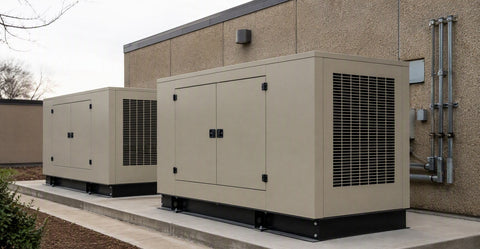
A 24V lithium bank plus solar covers spring through fall for most cabins; winter is where the generator earns its keep. The clean architecture at 24V mirrors the 48V pattern: a generator feeds a properly sized battery charger (or the inverter-charger's gen input if the power qualifies), the charger refills the bank at a controlled current, and the inverter carries the loads from the battery. Two batteries at 100A each accept up to 200A combined — a 4–5kW generator becomes a 90-minute refill rather than an all-night drone. Keep charge current in the recommended 30–50A per battery band for daily cycling and the bank will outlast the cabin's roof. Our generator buyer's guide sizes the generator side of that pairing.
What the efficiency number is really worth
The published 99% round-trip efficiency looks like a spec-sheet detail until you price it. A comparable AGM bank returns about 80–85% of what you put in; on a 5kWh daily cycle, the AGM throws away roughly 0.75–1.0kWh of array production every single day — energy you paid for in panels. Over a year that is 275–365kWh of solar you either harvest or you do not, which on a small cabin array is the difference between running the generator weekly and running it rarely. Lithium's sticker premium is partly a purchase of your own solar production back from the laws of lead chemistry.
Reading the market: why 24V EG4 pricing moves
Cell prices drive rack-battery pricing, and they have fallen steeply for three years — which is why the 24V 200Ah class costs today what a 100Ah class cost not long ago. The practical guidance: do not wait for the bottom, because the bottom keeps moving, and the bank you install this season starts returning value this season. Buy from a distributor with real stock velocity — fresh manufacturing dates, full warranty clocks, and firmware current out of the box. Our battery storage catalog turns over fast enough that shelf age is measured in weeks, and every unit ships with its documentation trail intact.
The commissioning checklist we hand installers
Print this for the job folder. One: verify every battery's firmware is current before paralleling. Two: charge each unit to full individually, then parallel. Three: torque all terminal hardware to spec and paint-mark each lug. Four: land the RS485/CAN comms and confirm the inverter sees the bank — a battery with no comms is a battery guessing. Five: program charge parameters (28.1V absorb, 27.0V float, equalize off) even with closed-loop active, as the fallback values. Six: load-test at the inverter's rating and watch the BMS current split across units — within 10–15% is healthy. Seven: photograph the serial labels and the LCD screens at rest and under load. That photo set has settled more warranty questions than any other document.
When to choose 24V EG4 over a DIY 24V build
Assembling 3.2V cells into a 24V pack saves money on paper and costs it in the field — a quality external BMS, compression fixturing, busbars, and the labor to commission it erase most of the gap, and the result carries no UL listing, which matters increasingly to inspectors and insurers. The EG4 rack units arrive as listed, tested, warrantied appliances. For a tinkerer's shed project, DIY is a fine hobby; for anything a customer, a tenant, or an insurance company touches, buy the listed box.
Frequently asked questions
What 24V batteries does EG4 make?
Two main server-rack families: the LifePower4 24V 200Ah (V2) with 6,000+ cycle rating and 64-unit parallel ceiling, and the EG4-LL V2 24V 200Ah rated at 7,000 cycles with a 16-unit parallel limit. Both are 25.6V nominal, 5.12kWh, with 200A internal BMS and 10-year warranties.
How many EG4 24V batteries do I need for a 3,000W inverter?
Two minimum. Each battery's BMS caps continuous discharge at 100A (about 2.4–2.5kW at 24V), so a single unit cannot carry a 3kW inverter at full tilt. Two batteries deliver 10.24kWh of storage and roughly 5kW of BMS headroom.
What are the correct charge settings for EG4 24V lithium?
Bulk/absorption 28.1V, float 27.0V, equalization disabled, charge current 30–50A recommended (100A max), and no charging below 32 °F. With a supported inverter, use the RS485/CAN closed-loop cable and let the BMS drive charging dynamically.
Can EG4 24V batteries be wired in series for 48V?
No — EG4's 24V rack batteries are parallel-only designs. For 48V systems, use EG4's 48V-native families; the BMS coordination and warranty both depend on it.
How long will an EG4 24V battery last?
The published ratings are 6,000–7,000 cycles at 80% depth of discharge depending on family, translating to a 15+ year design life at daily cycling — with a 10-year limited warranty backing it. Real lifespan tracks temperature discipline and charge current more than anything else.
EG4 24V lithium vs AGM for an RV — which wins?
Lithium on every metric that matters in a moving vehicle: half the weight per kWh, double the usable depth of discharge, 99% efficiency versus ~85%, and 6–10× the cycle life. AGM only wins on upfront price and on unheated installations that must charge below freezing.