Updated September 2026 — content reviewed and refreshed by the PES team. For current pricing and availability, see the linked product pages or request a quote.
A 100 kW inverter sits at an awkward and profitable junction in the solar business: too big for residential muscle memory, too small for the utility playbook. It powers school rooftops, agricultural packing sheds, municipal water plants, mid-size warehouses, and the bigger end of the C&I retrofit market. We've spec'd, sold, and helped commission dozens of systems in this class at Portlandia Electric Supply, and the buying mistakes are remarkably consistent — wrong voltage class, ignored AC derating, undersized conductors, and monitoring that nobody configured. This guide walks the selection process the way we walk it with contractors: specs first, then interconnection, cooling, lifecycle costs, and a procurement checklist you can actually use. Browse current inventory in our 100 kW inverter collection while you read.

What "100 kW Inverter" Actually Means
Start with the rating itself, because manufacturers name products loosely. A "100 kW" inverter may be rated 100 kVA apparent power, 100 kW real power at unity power factor, or 100 kWac output at a specific ambient temperature with derating above it. At 0.9 power factor, a 100 kVA unit delivers 90 kW real. That 10 kW gap has killed more than one production guarantee. Read the datasheet's continuous output power at 40–50°C ambient, not the marketing nameplate, and check whether the published efficiency is CEC-weighted (the number AHJs and incentive programs want) or peak European efficiency (the number brochures want).
Voltage class is the second fork. In North America, 100 kW-class inverters come in 208V, 480V, and increasingly 600V three-phase variants. Match the service voltage at the point of interconnection — a 480V inverter on a 208V service means a step-up transformer, and that transformer costs money, space, and about 1–2% of your energy harvest to losses. DC side, most modern 100 kW string inverters accept 1000V or 1500V strings; 1500V architecture reduces string count and BOS cost on larger arrays but demands 1500V-rated modules, fuses, and switchgear throughout.
Key Specifications to Evaluate
| Specification | What to Look For | Why It Matters in the Field |
|---|---|---|
| Continuous AC output | kW and kVA at 40°C / 50°C ambient | Nameplate at 25°C is a lab number; your roof is not a lab |
| AC voltage / phases | 208V, 480V, or 600V 3-phase, match to service | Wrong voltage class = transformer cost + 1–2% harvest loss |
| Max DC input voltage | 1000V or 1500V string capability | 1500V cuts string count ~33% on big arrays |
| MPPT count & input current | ≥6 MPPTs, ≥26–32A per input for modern high-current modules | 210mm-format modules exceed the input current of older MPPTs |
| CEC weighted efficiency | ≥97.5% for current-generation string inverters | Each 0.5% is real money over 25 years on 100 kW |
| DC/AC ratio tolerance | 1.2–1.5 supported without voiding warranty | Overbuilding DC harvests more morning/evening energy |
| Integrated features | DC/AC disconnects, arc-fault (AFCI), rapid-shutdown transmitter, SPD Type II | Each missing integrated feature is a box you buy and mount separately |
| Certifications | UL 1741 SB (IEEE 1547-2018), UL 1741 SA, CSA C22.2, FCC Part 15 | Rule 21 / IEEE 1547-2018 compliance is mandatory in most US interconnection queues now |
On MPPT count: a 100 kW inverter with 6 MPPTs and 12 string inputs gives you the layout flexibility C&I roofs demand — parapet shading, HVAC shadows, and split roof planes are the rule, not the exception. Two-MPPT designs belong on clean ground mounts.
Products We Actually Sell in This Class
To make this concrete, here are representative 100 kW-class units from our catalog. Specs are from manufacturer datasheets; confirm the current revision before design.
| Model | AC Output | AC Voltage | DC Architecture | Best Fit |
|---|---|---|---|---|
| Solis S5-GC100K-US | 100 kW | 480V 3-phase | String, multi-MPPT, 1500V class | Cost-driven C&I rooftops |
| SolarEdge SE100K-US | 100 kW | 480V 3-phase (277/480V WYE) | DC-optimized architecture with module-level power optimizers | Complex roofs needing module-level monitoring and shutdown |
| Atess HPS100-US-480 | 100 kW hybrid | 480V 3-phase, transformer included | Hybrid (PV + battery), bidirectional | Solar-plus-storage and backup-critical C&I |
| Atess HPS100-US-220Y | 100 kW hybrid | 220V WYE, transformer included | Hybrid, bidirectional | Lower-voltage services and retrofit microgrids |
| Sungrow SG350HX-US | 352 kVA (multi-unit scale-up reference) | 800V | 1500V string, 12–16 MPPT | When the project grows past 100 kW into multi-MW blocks |
The string-versus-optimized decision deserves a sentence. SolarEdge's SE100K moves the MPPT to the module level with power optimizers — you pay more per watt and in return get module-level monitoring, NEC 690.12 rapid shutdown without extra transmitters, and shade tolerance that string designs can't match. On a flat warehouse roof with zero shading, that's money spent for nothing. On a school with HVAC units and a parapet, we've seen optimizer architectures claw back 4–8% annual production versus a naive string layout. Match the architecture to the roof, not to the brand loyalty.
Sizing the System Around the Inverter
DC/AC ratio is the first sizing decision. Modern practice runs 1.2–1.4:1 on C&I — so 120–140 kWdc of modules behind a 100 kWac inverter. Clipping losses at that ratio typically run 1–3% annually while morning, evening, and winter harvest gains more than pay it back. Going past 1.5:1 on a single-MPPT string design invites chronic midday clipping; past the manufacturer's stated max ratio invites warranty arguments. Use the inverter sizing calculator and system size calculator to model it for your site.
Then the AC side electrical math, which is where we see the most plan-check corrections:
| Calculation | NEC Reference | Formula | Worked Example (100 kW @ 480V 3-ph) |
|---|---|---|---|
| Inverter output current | 690.8(A) | P / (√3 × V) | 100,000 / (1.732 × 480) = 120.3 A |
| Continuous-duty conductor ampacity | 690.8(B), 210.19 | I × 1.25 | 120.3 × 1.25 = 150.4 A → 1/0 AWG Cu (150A @ 75°C) minimum; step to 2/0 for margin |
| OCPD | 240.6, 705 | ≥ 150.4 A, next standard size | 175 A breaker |
| Load-side interconnection limit | 705.12(B) 120% rule | Busbar × 1.2 − main breaker | 600A bus / 600A main → 120A max backfeed: FAILS → need supply-side tap or main derate |
| Grounding electrode conductor / EGC | 250.66 / 250.122 | Per conductor size tables | Size EGC per 250.122 off the 175A OCPD |
That 120% rule row is the one that bites. A 100 kW inverter at 480V wants to backfeed ~125–150A continuous. On a 600A service with a 600A main, the 120% rule allows only 120A of PV backfeed — you're over before you start. The fixes, in order of cost: derate the main breaker to 500A (if the load calc allows), tap the supply side of the main per 705.12(A), or step the inverter down to 80 kW. We've done all three; the supply-side tap is usually cheapest on paper and the most painful with the utility. Start that conversation with the AHJ and utility in week one, not after the gear is ordered.
Wire and conduit details: our NEC ampacity guide, wire ampacity chart, and conduit fill chart cover the tables. For disconnects and rapid shutdown hardware see the NEC 690 disconnect and OCPD guide.
Grid Interconnection, Standards, and Safety
Any 100 kW system in the US now interconnects under IEEE 1547-2018 with UL 1741 SB certification — the smart-inverter functions (volt-var, frequency-watt ride-through) are mandatory in California Rule 21, Hawaii, and an expanding list of ISO territories. Confirm the inverter's exact model number appears on the California Energy Commission's approved equipment list and your utility's approved inverter list before purchase; "it's UL 1741 listed" is necessary but not sufficient. Screens and studies at this size class typically take 3–9 months in active queues — we've seen rural co-ops approve in six weeks and big IOUs take a year. Budget the schedule, not just the hardware.
Surge protection and grounding close out the safety stack: Type II SPDs on both DC and AC sides, grounding per NEC 250 and 690.43 — details in our grounding and bonding guide and SPD sizing guide.
Cooling, Placement, and Installation
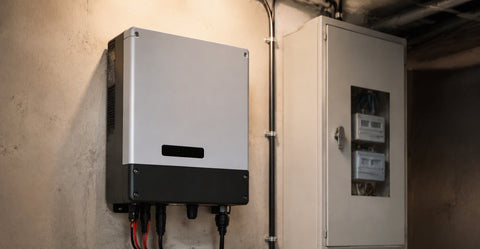
A 100 kW string inverter rejects 2–4 kW of heat at full power. Wall-mount in direct western sun and it will derate every afternoon of every summer — we've logged units pulling back 10–15% at 45°C+ ambient with sun on the heatsink. Mount north-facing or shaded, keep the manufacturer clearances (typically 24–36 in. sides, more above), and never box the unit into an unventilated electrical room. Noise is modest (fan-cooled units run 60–70 dBA at a meter), but don't hang one on the office wall behind the conference room.
Commissioning checklist we hand to installers:
| Step | Action | Pass Criteria |
|---|---|---|
| 1 | Torque all DC/AC terminations to spec, document with calibrated wrench | Torque marks visible, values logged |
| 2 | Measure string Voc and polarity before landing strings | Within design window, polarity correct, Voc ≤ inverter max at coldest design temp |
| 3 | Insulation resistance test on DC runs (megger per manufacturer procedure) | Per manufacturer threshold, typically ≥1 MΩ |
| 4 | Verify grid profile / Rule 21 / IEEE 1547 settings match the interconnect agreement | Screenshot of configured grid code saved to project file |
| 5 | Confirm rapid shutdown initiates and meets 690.12 boundaries | Controlled conductors ≤30V within 30 s, per AHJ test |
| 6 | Register monitoring, set alert recipients, verify revenue-grade meter if SRECs/incentives apply | Data flowing, alerts tested |
Step 4 is the one that gets skipped. An inverter left on the default grid profile will trip offline during the first grid disturbance, and the customer will call you, not the manufacturer.
Energy Storage Integration
Hybrid 100 kW units like the Atess HPS100 family fold the battery PCS into the inverter — PV, battery, grid, and backup loads through one box. The design questions that follow: battery capacity sized to the critical load (not the whole facility), transfer time for backup loads, and whether you need islanding capability or just peak-shaving. For storage sizing math, use the battery sizing calculator, and for AC-coupled alternatives, our hybrid inverter overview compares architectures. Browse 100–200 kWh C&I batteries for the storage side of a 100 kW pairing.
Reliability, Monitoring, and Lifecycle Cost

String inverters at this class are consumable assets — fan and capacitor service around year 8–12, expected service life 12–20 years with maintenance. Standard warranties run 5–10 years with extensions to 20–25 available; on a financed project, buy the extension — one out-of-warranty replacement erases the savings. Monitoring is non-negotiable at 100 kW: a failed string discovered at the annual true-up instead of by an alert email costs thousands in lost production. Set string-level current alerts, configure the datalogger before you leave site, and put the monitoring login in the O&M binder. For upkeep planning, the solar maintenance guide lays out the schedule we recommend to commercial owners.
Procurement Checklist
| # | Checklist Item | Common Failure It Prevents |
|---|---|---|
| 1 | Confirm service voltage and phase at the interconnect point | Buying a 480V unit for a 208V service |
| 2 | Verify model on CEC and utility approved lists | Interconnection rejection after purchase |
| 3 | Run the 705.12 interconnection math before ordering switchgear | Failed plan check, switchgear reorder |
| 4 | Match MPPT input current to module Isc (incl. bifacial gain) | Chronic MPPT clipping on 210mm-format modules |
| 5 | Confirm derating curve vs site design temperature | Afternoon output collapse in hot climates |
| 6 | Price the warranty extension into the proposal | Year-11 replacement eating the maintenance reserve |
| 7 | Order mounting, disconnects, SPDs, and datalogger as one BOM | Three-week delay over a $90 conduit box |
ROI and Production Math for a 100 kW Block
Run the base economics once so the hardware choices have context. A 100 kWac inverter behind 125 kWdc of modules in a 5.0 peak-sun-hour market produces roughly 125 × 5.0 × 365 × 0.80 (system losses) ≈ 182,500 kWh/year. At $0.12/kWh blended commercial value, that's about $21,900/year of offset energy. Now the equipment decisions show up in dollars: a half-point of CEC efficiency (97.5% vs 97.0%) is worth roughly $900/year — $18,000+ over 20 years, more than the price difference between value and premium hardware. A 4% shade-recovery advantage on a complex roof is ~$3,600/year. And a single undetected failed string (about 5% of array output) discovered at annual true-up instead of by alert email burns ~$1,100 per occurrence. This is why we push monitoring configuration as a commissioning step, not an afterthought — the ROI of the whole project flows through whether anyone is watching the data.
The Pitfalls We See Repeatedly
Four mistakes account for most of the pain in this size class. First, buying on nameplate watts without reading the derating curve — a unit that holds 100 kW to 40°C and one that starts sliding at 35°C are different machines in Fresno. Second, ignoring MPPT input current: modern 210mm-format modules run Isc to 14–18A, and paralleling two strings on one input can exceed what the MPPT will harvest — the inverter won't break, it will just silently clip. Third, treating the interconnection study as paperwork instead of the critical path — at 100 kW, the utility timeline is usually longer than the construction timeline. Fourth, value-engineering away the disconnects and SPDs to save a few hundred dollars, then paying an electrician triple to retrofit them when the inspector red-tags the job. Every one of these is cheaper at design time than at commissioning time.
The Voltage-Class Decision: 208V vs 480V vs Stepping Up
This fork deserves its own section because it's where the most expensive ordering mistake in the class lives. Rule one: design to the service you have. A 480V inverter on a 480V service is clean. A 208V service with a 100 kW PV design forces a choice — a native 208V inverter (fewer model choices, slightly higher current, larger conductors) or a 480V inverter behind a step-up transformer. The transformer route adds $8,000–$20,000 installed, a point or two of conversion loss, and one more component in the maintenance plan. We generally quote native 208V unless the project also contemplates future expansion past 250 kW, where the 480V backbone starts paying for itself. And note the hybrid exception: units like the Atess HPS100 family ship with integrated transformers precisely to serve 208/220V services without external magnetics — one reason hybrids have taken share in the retrofit market.
Spares, Service, and the Questions to Ask Before You Sign
Five procurement questions that separate vendors who support commercial equipment from vendors who ship boxes. One: where is the nearest stocked spare-parts depot, and what's the committed replacement-unit turnaround? Two: who performs warranty labor — a national service network, or your installer billing against an RMA? Three: is commissioning support included or billed? Four: what's the fan/capacitor service kit part number and price — if they can't answer, they haven't thought about year nine. Five: what's the end-of-life path — does the manufacturer run a refurbishment or trade-in program? A 100 kW inverter is a 15–20-year asset; buy it from someone organized for that timeline. This is also where buying through a distributor who stocks the product — rather than a broker who dropships it — pays for itself the first time you need a replacement fan board on a Friday.
A Note on DC/AC Ratio and Climate
The 1.2–1.4 ratio guidance isn't universal — it shifts with climate and tariff. High-irradiance desert sites clip more at the same ratio, so they justify 1.15–1.25; cloudy northern sites can run 1.4–1.5 and rarely see the ceiling. Demand-charge tariffs favor flatter midday output (higher ratio), while time-of-use export markets sometimes favor inverter headroom. Model it with real weather data before locking the BOM — the solar ROI calculator is built for exactly this iteration.
Lead Times, Logistics, and Receiving
Logistics at this size deserve planning. A 100 kW string inverter ships as a 200–300 lb crate or pallet that needs a forklift or liftgate on the receiving end — confirm before the freight call, because residential-style delivery assumptions don't apply. Lead times in 2026 run from in-stock to 8–12 weeks depending on model and grid-code variant; order the exact utility-approved configuration, because a firmware variant difference can mean a different SKU with a different lead time. On receipt, inspect the crate before signing the freight bill, photograph any damage, and store the unit dry and indoors until the install — condensation inside an unpowered inverter is a real failure mode on units stored in damp warehouses.
One last field note: the best 100 kW project we've commissioned was boring by design — right voltage class, conservative DC/AC ratio, monitoring configured, spare fan kit on the shelf. Boring is what twenty years of reliable production looks like from the inside.
Frequently Asked Questions
How many solar panels do I need for a 100 kW inverter?
At a typical 1.25 DC/AC ratio you want about 125 kWdc of modules — roughly 280 panels at 450W each, or 210 panels at 600W. Roof area, shading, and budget push the ratio between 1.1 and 1.4.
What size wire do I need for a 100 kW inverter at 480V?
Output current is about 120A; at 125% continuous sizing that's ~150A minimum conductor ampacity — 1/0 AWG copper at 75°C per NEC 310.16, with a 175A breaker per NEC 240.6. Long runs and conduit derating can push you to 2/0.
Can a 100 kW inverter run on a 208V service?
Only if the inverter is rated for 208V, or you add a step-up transformer. A 480V-only inverter on a 208V service is a common and expensive ordering mistake.
String inverter or SolarEdge-style optimized system for 100 kW?
Clean, unshaded commercial roofs: string inverters win on cost. Complex roofs with shading or module-level monitoring requirements: optimizer architectures can recover 4–8% annual production and simplify rapid-shutdown compliance.
How long does a 100 kW commercial inverter last?
Expect 12–20 years with fan and capacitor service around years 8–12. Standard warranties run 5–10 years; extensions to 20–25 are available and worth it on financed projects.
What certifications does a 100 kW inverter need in the US?
UL 1741 SB (IEEE 1547-2018) is the current baseline, plus listing on the CEC and your utility's approved equipment lists. Hybrid units also need UL 9540-system consideration when paired with batteries.
Related: solar inverter basics · top solar inverter picks · solar inverter buyer's guide · NEC code compliance guide · all solar inverters · string inverters · 150 kW inverters · 350 kW–1 MW utility inverters