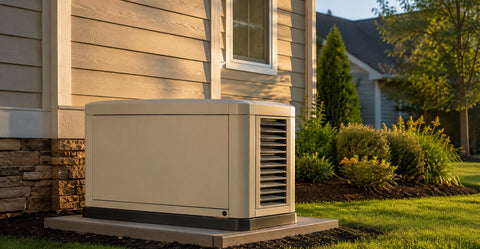
Search BAT512110710 and half the results are marketplaces calling it three different things. Here is the ground truth: BAT512110710 is the Victron Energy Lithium SuperPack 12,8V/100Ah (M8) — High Current, a self-contained LiFePO4 battery with an integrated BMS and internal safety switch, no external battery management hardware required. It stores 1,280 Wh in a Group 31-sized case that weighs about 14 kg, and it is the battery we reach for when a customer wants lithium reliability in a 12V build without designing a full BMS ecosystem.

This guide decodes the part number, lays out the verified specifications, explains where the SuperPack shines and where its hard limits will bite you, and walks through the wiring and verification steps we run on every install.
Decoding BAT512110710
Victron battery part numbers carry structure. The BAT prefix is the battery catalog family; the 512 series is Victron's lithium lineup; the digits that follow encode the 12.8V nominal class and the 100Ah capacity tier; the trailing characters pin the High Current M8 variant. What matters practically: this exact string maps to exactly one product, and any listing that will not show you the full part number on the case label is not a listing to buy from.
| Attribute | Specification | Why it matters on the job |
|---|---|---|
| Manufacturer / part number | Victron Energy / BAT512110710 | Match label, datasheet, and invoice exactly |
| Product line | Lithium SuperPack 12,8V/100Ah (M8), High Current | Self-contained battery — BMS and safety switch built in |
| Chemistry | LiFePO4 (lithium iron phosphate) | Thermally stable, long cycle life, no cobalt |
| Nominal voltage | 12.8 V | Drop-in class for 12V lead-acid replacement |
| Nominal capacity | 100 Ah @ 25 °C (≈ 80 Ah @ 0 °C) | Plan winter capacity honestly on cold-climate builds |
| Stored energy | 1,280 Wh | ≈ 1.02 kWh usable at 80% DoD |
| Cycle life | ≈ 2,500 cycles @ 80% DoD, 25 °C | 6× the throughput of comparable AGM |
| Terminals | M8 threaded inserts | Torque to datasheet spec; 8mm hardware |
| Dimensions (L × W × H) | 330 × 220 × 172 mm (≈ 13.0 × 8.7 × 6.8 in) | Group 31-class footprint |
| Weight | ≈ 14 kg (30.9 lb) | One person, one hand, up a ladder — try that with a 66Ah AGM |
| Series / parallel | Parallel allowed; series NOT allowed | This is a hard limit, not a suggestion — details below |
| Orientation | Upright only | Internal switch geometry requires upright mounting |
| Warranty | 3 years (Victron lithium policy) | Claims route through the selling dealer |
What "SuperPack" means in practice
The SuperPack line exists to remove the two scariest parts of a lithium conversion: the external BMS and the wiring complexity. The battery protects itself. An internal switch disconnects the pack on over-discharge, over-charge, or high temperature, and it reconnects when conditions clear. There is no shunt to configure, no external relay to wire, no VE.Bus network to set up. You bolt on cables with M8 lugs and the battery does the rest.
That simplicity is why we put SuperPacks in work trucks, small RVs, trolling-motor conversions, and portable power carts. I've retrofitted a dozen service-van inverter setups with these where the alternative — a Smart Lithium bank plus a Lynx BMS — would have doubled the parts list and the labor. The SuperPack gets the van running the same afternoon.
Field note: The self-protection switch is also the most common support call. A customer runs the pack flat, the internal switch opens, and the battery "reads dead" on a voltmeter at the terminals. It is not dead — it is asleep. Put a charger on it and the pack wakes up and reconnects. Save yourself the panic and the return shipping.
High Current vs standard: why the suffix matters
The BAT512110710 is the High Current SuperPack, built on the same 100Ah cells but rated for heavier discharge duty than the standard SuperPack variant. If your load list includes an inverter over about 1,000W, a thruster, or a winch, the High Current version is the one to quote. For light loads — LED lighting, a fridge, electronics — either works, but the price delta is small enough that we default to High Current so the customer never outgrows the pack.
| Decision point | SuperPack High Current (BAT512110710) | Victron Smart Lithium + external BMS |
|---|---|---|
| System voltage | 12V only (no series) | 12/24V via series configurations |
| BMS hardware | Integrated, zero extra parts | External BMS (e.g., Lynx Smart BMS) required |
| Monitoring | Basic — no per-cell Bluetooth telemetry | Full cell-level data via VictronConnect |
| Install labor | Minutes | Hours, plus config |
| Expansion | Parallel strings for more Ah | Series and parallel, larger banks |
| Best fit | 12V mobile and portable builds | Fixed off-grid and marine house systems at 24V+ |
The two hard limits you must design around
1. Series connection is not allowed — ever
Victron's documentation is unambiguous: SuperPack batteries may be paralleled but must never be wired in series. The internal protection of one pack cannot coordinate with another, and a series pair can drive one pack into damage the instant one switch opens. If the design calls for 24V or 48V, stop and respec — either step up to Smart Lithium with an external BMS, use a 24V-native product, or keep the bus at 12V and size conductors accordingly. We have torn out exactly one series-wired SuperPack pair in a customer's DIY RV; one pack was fine, one was a paperweight.
2. Charging below freezing is restricted
Like all LiFePO4, the SuperPack must not accept charge current below 0 °C — lithium plating permanently damages the cells. In heated vans and RVs this never comes up. In an unheated cargo trailer at a Montana jobsite, it is the whole design conversation. Options: relocate the battery inside the thermal envelope, add a small heater pad on a thermostat, or accept AGM for that application. Our solar battery buyer's guide covers the cold-weather decision in more depth.
Sizing math: how far does 1,280 Wh actually go?
Contractors think in load hours, so here is the runtime arithmetic with honest derating — 80% DoD for cycle life, 90% inverter efficiency:
| Load | DC watts | Runtime on 1 pack (1.02 kWh usable) | Runtime on 2 packs parallel (2.05 kWh usable) |
|---|---|---|---|
| 12V fridge (avg duty) | 60 W | ≈ 15.3 h | ≈ 30.7 h |
| LED lighting + laptops + router | 120 W | ≈ 7.7 h | ≈ 15.3 h |
| 1,000W inverter load | 1,000 W (≈ 1,111 W DC after losses) | ≈ 0.9 h | ≈ 1.8 h |
| 2,000W inverter load | 2,000 W (≈ 2,222 W DC) | Not recommended — check discharge rating | ≈ 0.8 h |
The formula for your own load list: runtime (h) = usable Wh ÷ (AC watts ÷ 0.90). For a structured approach to whole-system storage sizing, our home battery bank sizing guide and the battery backup runtime calculator walk the same math at house scale.
Charging parameters
The SuperPack wants standard LiFePO4 charge values, and every Victron charger and MPPT carries a lithium preset that lands correctly. Verify at the terminals on commissioning:
| Parameter | Setpoint | Note |
|---|---|---|
| Absorption voltage | 14.2 V (do not exceed 14.4 V) | Victron LiFePO4 preset default |
| Float voltage | 13.5–13.8 V | Lithium does not need float; keep it low for standby |
| Equalization | Disabled — always | Equalize voltages will trip the protection switch |
| Absorption time | Short (≈ 30 min) or per preset | Lithium saturates fast; long absorption adds nothing |
| Temperature | No charge below 0 °C | Use a charger with low-temp cutoff where relevant |
Lead-acid profiles on old chargers are the number-one mistake on retrofits. A charger stuck on a flooded profile at 14.8V will bounce the SuperPack's internal protection on and off all afternoon. Reprogram the charger to LiFePO4 before the battery ever sees current — our charge controller catalog and the MPPT vs PWM selection guide cover the solar side.
Parallel wiring done right

- Identical units only. Same model, same age, commissioned at the same state of charge. Top-balance the packs with a full charge before paralleling them permanently.
- Diagonal takeoff. Main positive from one end of the bank, main negative from the other, so each pack sees equal cable resistance and shares current evenly.
- Fuse each pack. Lithium fault current is brutal — a Class-T fuse or equivalent within inches of each positive terminal. NEC Article 480 logic applies to stationary installs; ABYC E-11 on boats.
- Check sharing under load. With a clamp meter on each pack's cable at a known load, parallel packs should split current within roughly 10–15%. A pack loafing at half the current of its neighbor has a connection problem.
For conductor sizing on the battery and inverter runs, the NEC wire sizing and ampacity guide has the 310.16 tables and derating rules you will be working from.
Verifying a genuine pack before money moves
Cloned lithium is more dangerous than cloned lead — a counterfeit BMS is a fire risk, not just a warranty problem. Our verification routine:
- Full part number BAT512110710 on the case label and the invoice — no partial matches.
- Buy through an authorized Victron channel so the 3-year lithium warranty is real. Our Victron Energy catalog is authorized stock.
- Weight check: ≈ 14 kg. Counterfeits with undersized cells come in light.
- Case and label print quality; M8 inserts clean and correctly threaded.
- First charge behavior: a genuine pack absorbs smoothly to 14.2V and rests around 13.3–13.4V. Wild terminal voltage on a new pack means walk away.
Where it fits in our catalog
The SuperPack High Current sits in a crowded middle of our battery wall: cheaper per kWh than modular server-rack lithium, far longer-lived than AGM deep-cycle, and simpler than anything else we sell. Contractors building service vehicles and portable power carts can bundle it with inverters, DC-DC chargers, and fusing through a Pro Account quote — one PO, one freight drop, everything matched.
How it stacks against the 12V lithium competition
The 12V 100Ah lithium shelf is the most crowded aisle in the battery business, and the honest differences come down to BMS quality, low-temperature protection, and warranty support. Battle Born and SOK sell excellent packs with Bluetooth telemetry the SuperPack lacks; budget brands undercut everyone on price with BMS boards we would not trust in a boat bilge. The SuperPack's pitch is different: nothing to configure, nothing to network, nothing to fail between the cells and the terminals, backed by Victron's dealer channel. On service vans and rental-fleet equipment where the installer is not the operator, that simplicity is worth more than telemetry.
Where the SuperPack concedes ground: no per-cell monitoring, no Bluetooth state-of-charge display on your phone, no series capability, and a 3-year warranty where some rivals offer longer. If you want a dashboard, buy the Smart Lithium line and the external BMS. If you want the battery to disappear into the build and simply work for a decade, this is the one.
Storage and seasonal care
Store the pack at roughly half charge in a cool, dry place and it will sit happily for a year — LiFePO4 self-discharge is a few percent per month at worst, and the internal switch draws next to nothing when open. Before returning a stored pack to service, put a full charge on it and confirm it absorbs cleanly to 14.2V. The one storage sin is leaving it fully discharged: the pack will protect itself by opening the switch, but cells left at the bottom for months can drift into unrecoverable territory, and no warranty on earth covers neglect.
Charging time from solar
A single 100Ah SuperPack refills from empty in about five peak sun hours behind a 400W array through an MPPT controller — our walkthrough of how long a 200W panel takes to charge a 12V 100Ah battery runs the arithmetic panel-by-panel, and doubling the array halves the time. For RV roofs with two 220W panels, figure on a day and a half of good sun from empty; in practice, daily cycling rarely takes the pack below 40%, and the array catches up by early afternoon.
Real installs, real numbers
Three configurations we have supplied repeatedly, all still in service: a pair in parallel (2.56kWh) running a 2,000W inverter, fridge, and diesel heater in a Sprinter conversion; a single pack on a fishing boat running a 55-lb-thrust trolling motor for a full tide cycle; and a four-pack bank (5.12kWh) in a telecom shelter with a 400W solar array where the AGM bank it replaced died every third winter. The shelter math alone sold the customer: four SuperPacks weigh 56 kg total against roughly 130 kg for the AGM string at half the cycle life. Freight, install labor, and replacement interval all moved the right direction at once. Browse the full Victron deep catalog for the chargers, monitors, and DC distribution that complete these builds.
Frequently asked questions
What product is part number BAT512110710?
It is the Victron Energy Lithium SuperPack 12,8V/100Ah (M8) High Current — a self-contained LiFePO4 battery with integrated BMS and safety switch, 1,280 Wh of storage, roughly 14 kg, in a Group 31-class case.
Can I wire two BAT512110710 batteries in series for 24V?
No. Victron prohibits series connection of SuperPack batteries — the internal protection switches cannot coordinate, and series wiring can destroy a pack. Parallel for more capacity at 12V is fine; for 24V or 48V, choose a different product family.
How many cycles does the SuperPack 100Ah deliver?
Victron rates approximately 2,500 cycles at 80% depth of discharge at 25 °C — roughly six times the cycle throughput of a comparable AGM battery, which is the entire economic case for the upgrade.
Can the SuperPack charge in freezing weather?
No — like all LiFePO4 it must not be charged below 0 °C. In cold unheated installs, bring the battery inside the thermal envelope, add a thermostatically controlled heater, or spec AGM instead.
What charger settings does it need?
Standard LiFePO4 values: about 14.2V absorption, 13.5–13.8V float, equalization disabled, and low-temperature charge cutoff where relevant. Any Victron charger's lithium preset works; legacy lead-acid chargers on flooded profiles must be reprogrammed first.