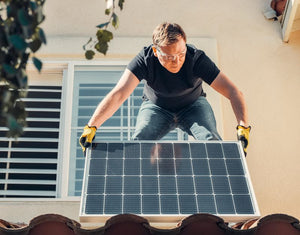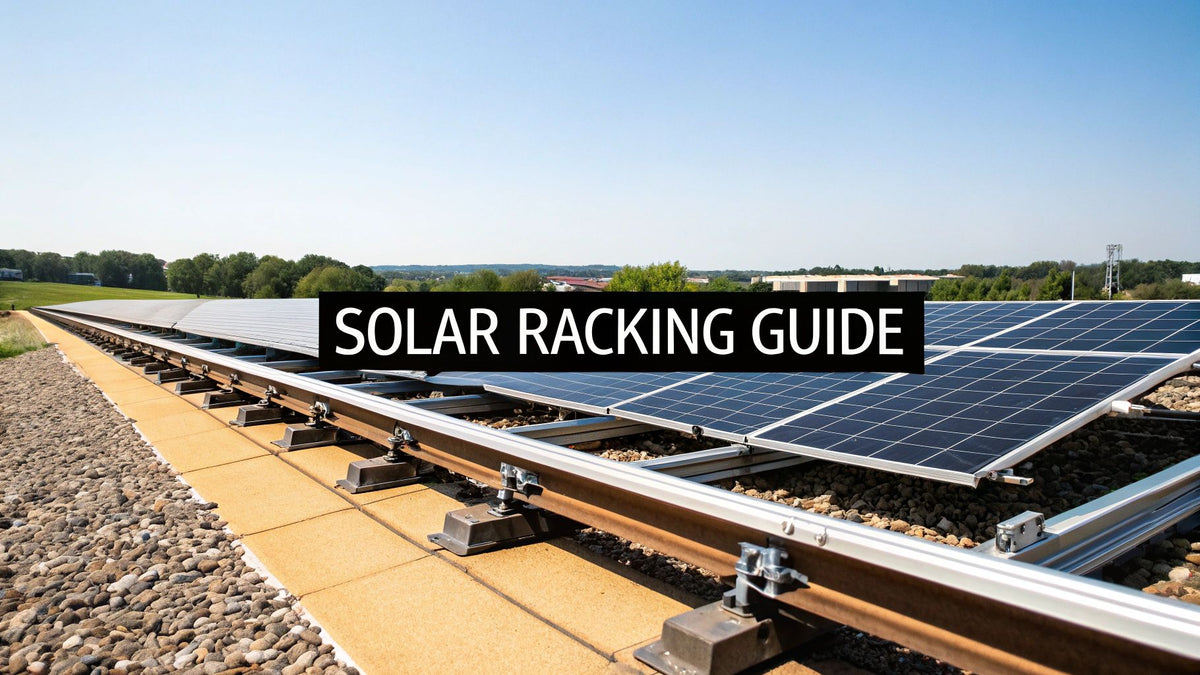
For solar installers, EPCs, and developers, choosing the right racking system for solar panels is the first critical decision that dictates project profitability, safety, and long-term performance. Get it wrong, and you're facing inflated labor hours, structural failures, and compliance nightmares that kill margins. This guide provides a real-world decision-making framework to help you select, procure, and install the correct racking for any project, ensuring your builds are on time, on budget, and up to code.
Foundation First: Choosing the Right Racking System
The first fork in the road is always the same: roof-mount or ground-mount? This single choice ripples through the entire project, dictating engineering specs, the Bill of Materials (BOM), and site labor. Nailing this decision early is key to an accurate bid, smooth procurement, and avoiding costly change orders.
- Installation Speed: A rail-less system on a simple composition shingle roof or a pile-driven ground mount can shave significant hours—and labor costs—off an install compared to more complex setups.
- Material & Freight Costs: Ground-mounted systems are steel- and concrete-heavy. That means bigger material costs and higher freight bills, a critical factor for procurement managers balancing budgets.
- Code Compliance & Permitting: Every jurisdiction has its own rules for structural loads (per ASCE 7), setbacks, and environmental impact. Each racking type comes with its own set of NEC and local code compliance hoops to jump through.
This decision tree shows how the site itself makes the first call for you.
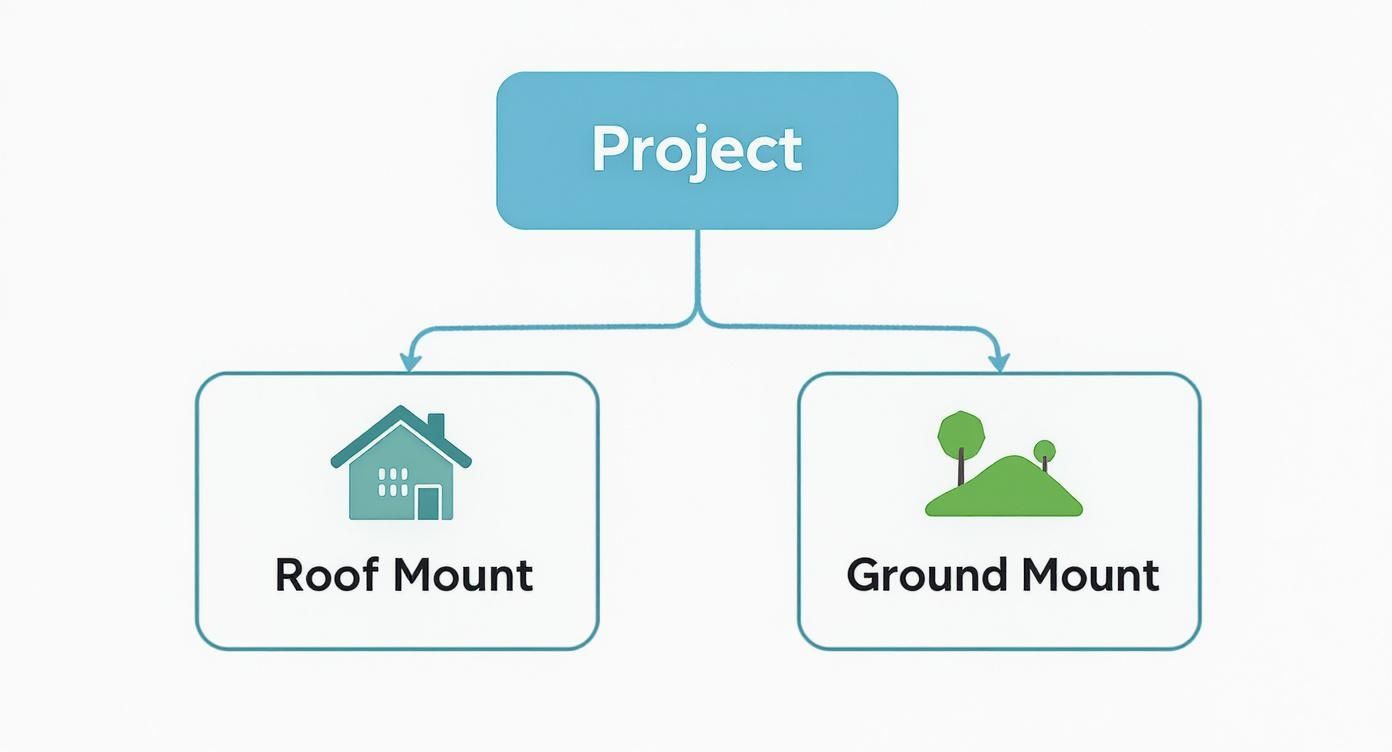
As you can see, the site’s available space and structural capacity immediately point you toward either a roof or ground solution.
Market Growth and Procurement Strategy
The stakes for getting this right are only getting higher. The photovoltaic (PV) mounting system market is projected to jump from USD 33.9 million in 2025 to a whopping USD 166.6 million by 2035, a compound annual growth rate of 17.46%. This isn't just hype; it reflects real demand driven by new racking tech that's making installs faster and more efficient. You can dig into more of these photovoltaic mounting system market trends on futuremarketinsights.com.
For Procurement & Project Managers: This growth is a flashing sign: lock in your supply partnerships. Having a supplier like PES Supply with deep inventory, freight optimization, and real design support for both roof and ground systems isn't a luxury—it's how you de-risk your project pipeline and prevent delays before the first truck even rolls.
Racking System At-a-Glance Decision Matrix
To simplify the initial planning phase, this table offers a quick reference for matching project needs to the most suitable racking system. It's a high-level guide to point your design process in the right direction from the get-go.
| Project Factor | Best Fit Roof Mount | Best Fit Ground Mount | Key Consideration |
|---|---|---|---|
| Budget-Sensitive | Railed Flush-Mount | Fixed-Tilt (Pile/Post) | Standardized components lower costs. |
| Fast Installation | Rail-Less System | Pile-Driven System | Fewer components mean less time on site. |
| High Wind/Snow Load | Tilted Flush-Mount | Fixed-Tilt (Ballasted) | Engineered for extreme weather resilience. |
| Complex Roof (Dormers, Vents) | Rail-Less or Micro-Rail | N/A | Offers greater layout flexibility around obstacles. |
| Poor Soil Conditions | N/A | Ballasted System | Avoids deep excavation/piles. |
| Maximizing Energy Output | Tilted Flush-Mount (for optimal angle) | Single-Axis Tracker | Tracks the sun for up to 25% more production. |
| Limited Roof Space | N/A | Fixed-Tilt or Tracker | Can be sized precisely for energy needs. |
| Aesthetics are a Priority | Rail-Less Flush-Mount | N/A | Sleek, low-profile look. |
This matrix isn't a substitute for a stamped engineering review, but it's an invaluable tool for early-stage client conversations and for honing in on the right equipment for your BOM.
A Roofer's Guide to Solar Racking Systems
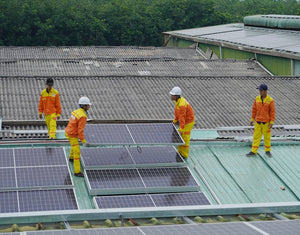
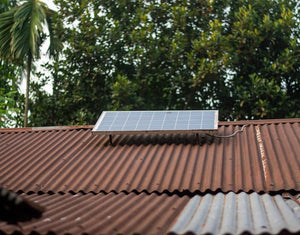
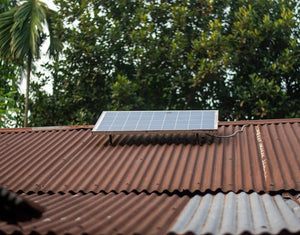
For most residential jobs and a good chunk of commercial projects, the roof is where the action is. When you're picking a roof-mounted racking system, you're making a call that ripples through the whole job—from labor hours and aesthetics to the long-term structural health of the building.
This isn't just about bolting panels down. It’s about specifying a UL 2703 certified system that makes the install smoother and guarantees solid performance for the next 25 years.
The two main camps are rail-based and rail-less. Understanding the operational difference is the first step to quoting jobs accurately and planning your work efficiently.
Rail-Based Racking: The Industry Workhorse
Think of traditional rail-based racking as the classic ladder frame on a pickup truck. It's tough, proven, and built to handle imperfect conditions. These systems use long aluminum rails attached to the roof, creating a perfectly straight and adjustable platform to clamp modules onto.
The real value of rails is handling imperfect roofs. A wavy roof deck or minor structural inconsistencies are easily spanned, ensuring a flat, professional-looking array. This flexibility is why they've been the go-to standard for so long.
Rail-Less Racking: Built for Speed and Simplicity
If railed systems are the classic truck frame, rail-less systems are the modern unibody chassis. Instead of long rails, you're working with smaller, individual mounting blocks attached directly to the roof rafters. The solar panels themselves lock into these mounts, creating the structural grid.
The big win here is speed. With fewer parts to haul up a ladder and no long rails to manage, crews can often fly through an installation, directly lowering labor costs. Plus, the final product sits lower to the roof, giving it a sleek, low-profile look that homeowners love.
Pro Tip for Installers
The roof itself should make the decision. On a brand-new, straight roof, a rail-less system can save significant time. But for an older house with a saggy roofline, the adjustability of a classic railed system is your best friend for getting a secure, professional finish without shims and headaches.
Flush-Mount vs. Tilted Systems
Once you've settled the rail debate, you need to decide on panel orientation. The overwhelming majority of residential installs use a flush-mount setup, meaning the racking follows the natural slope of the roof. It's the cleanest looking, most straightforward, and usually the most budget-friendly option.
But what if the roof pitch is wrong for optimal solar production? A tilted system is the only way to go. On flat commercial roofs or low-slope residential ones, tilted racks angle the panels toward the sun to maximize energy harvest. It adds cost and complexity, but the jump in kWh production almost always delivers a solid ROI.
Attachment and Waterproofing: Where Pros Shine
You can talk about racking all day, but none of it matters if you don't nail the roof connection. Proper attachments and bulletproof waterproofing are what separate a 25-year asset from a costly leak repair and a damaged reputation. Every penetration must be perfectly sealed. Period.
- For Asphalt Shingle Roofs: Forget sealant alone. Use a proper metal flashing designed for solar. This plate slides under the row of shingles above your lag bolt, creating a layered, water-shedding barrier that will last as long as the roof itself.
- For Standing Seam Metal Roofs: This is the easiest application. Use non-penetrating clamps from a trusted brand like S-5!. These clamps bite down directly onto the standing seams, so you don't drill a single hole, preserving the roof's warranty and eliminating any chance of a leak.
For a deeper look at the nuts and bolts of roofing work, our guide on how to install solar panels on a rooftop walks through the critical steps. The roof's integrity is every bit as important as the array's performance.
Analyzing Ground-Mounted Racking Options
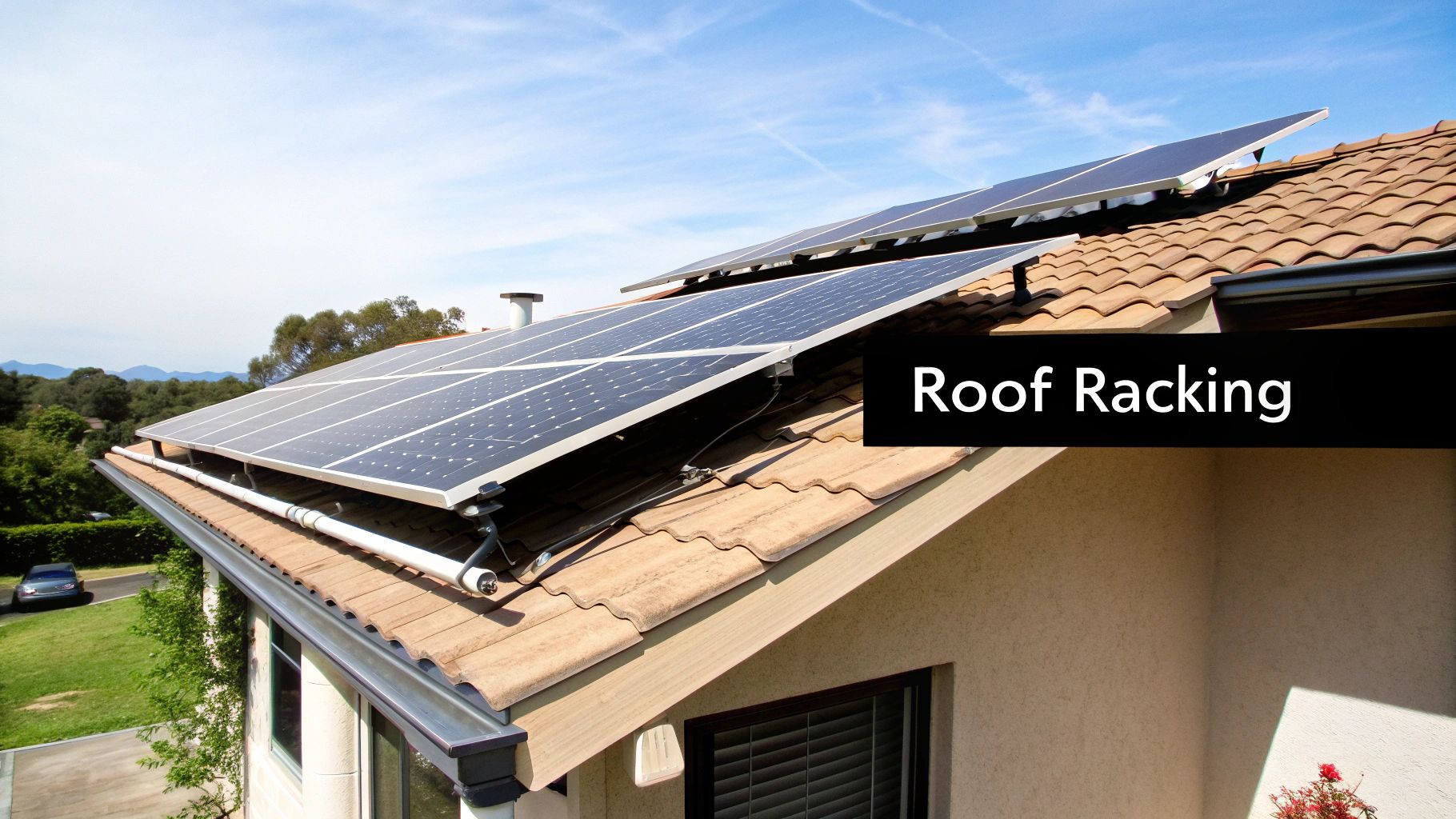
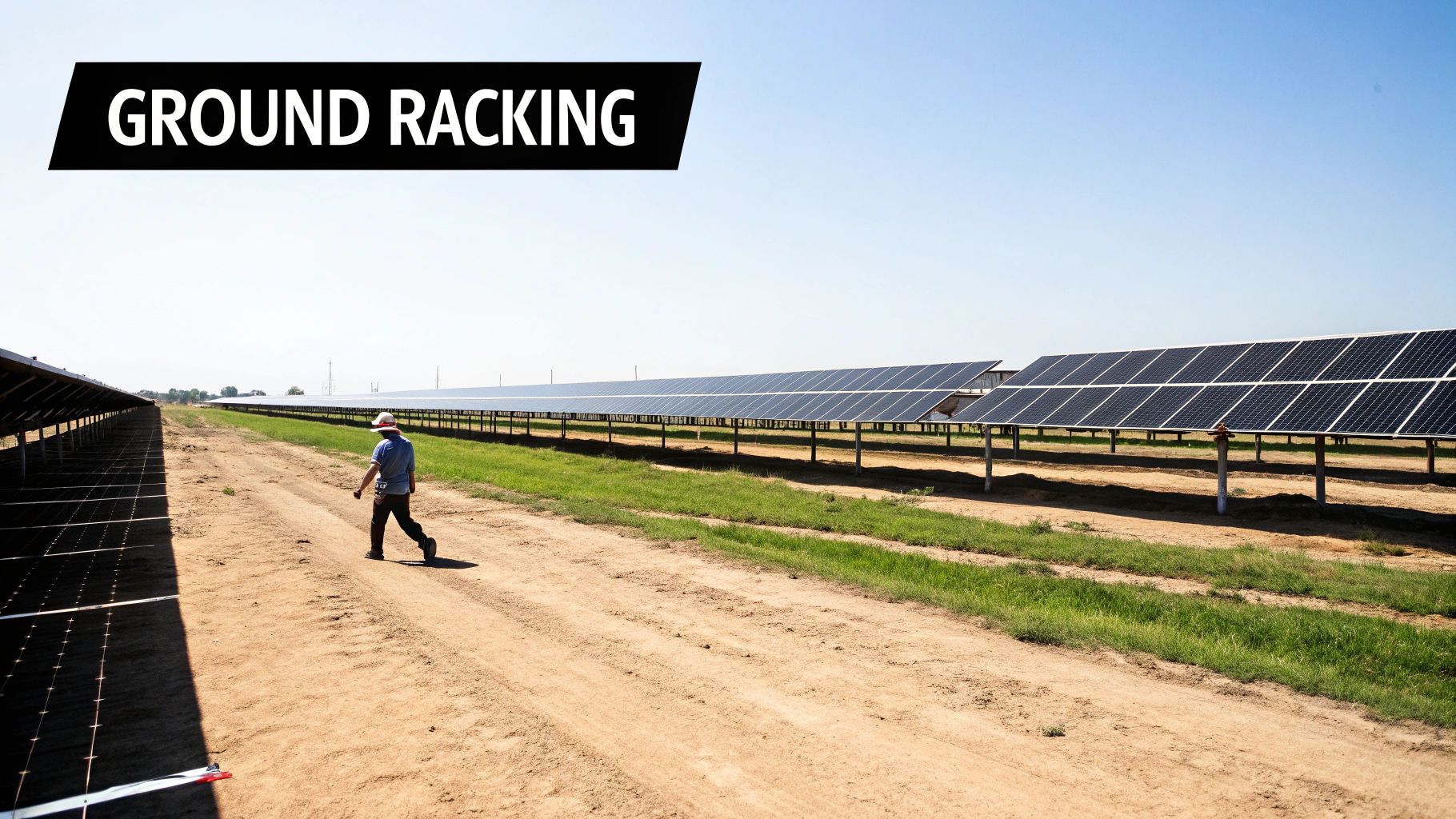
When you have the available land, ground-mounted racking systems open up a world of possibilities for solar design and scale. These are the workhorses of commercial, industrial, and utility-scale solar, turning open fields into power-generating assets.
Of course, moving an array off the roof brings new engineering challenges. Now, we’re focused on foundations, soil conditions, and squeezing every last watt out of the system. The global market for solar installation is booming and expected to hit $1.07 billion by 2025, with ground-mounts being a huge piece of that pie.
Fixed-Tilt Systems: The Cost-Effective Default
Your standard fixed-tilt racking is the go-to for a reason—it’s the most common and cost-effective ground-mount. The panels are locked at a fixed angle, optimized for the site’s latitude to maximize annual energy production.
They’re simple, tough, and have minimal moving parts, which translates to lower O&M costs over the system's life. This no-fuss design makes them perfect for projects where budget and long-term reliability are the primary drivers.
For other configurations, check out our post on the practicalities of installing solar panels on poles.
Solar Trackers: Maximizing Energy Harvest
If maximizing energy harvest is the number one goal, solar trackers are the undisputed champs. These advanced systems use motors and sensors to physically follow the sun, providing a significant boost in production.
- Single-Axis Trackers: These systems track the sun from east to west, cranking up energy yield by 15-25% compared to a fixed-tilt array. It’s why they’re the standard for large commercial and utility projects where that extra output directly impacts the ROI.
- Dual-Axis Trackers: These are the ultimate trackers, following the sun east-to-west and tracking seasonal north-to-south changes. While they deliver the biggest energy gain, their complexity and cost mean they’re usually reserved for very specific, high-value applications.
The choice between fixed-tilt and trackers comes down to a financial question: does the long-term revenue from the extra energy justify the higher upfront CapEx of the tracker?
Foundation Options: Dictated by the Ground Itself
The success of any ground-mount project starts underground. The foundation must be engineered to handle decades of wind, snow, and soil movement. The site's soil conditions will determine the foundation type.
Before a single post goes in the ground, proper site work is mandatory. This includes clearing, grading, and prepping the land, as covered in this expert guide to site preparation excavation.
Once the site is ready, you’re looking at these key foundation options:
- Driven Piles: Steel beams (I-beams or C-channels) hammered directly into the earth. They're fast, efficient, and cost-effective, making them the default choice on sites with suitable soil.
- Helical Piles: Essentially giant corkscrews, these are screwed into the ground and are a fantastic solution for softer or less stable soils where a driven pile lacks sufficient grip.
- Ballasted Systems: When you can't excavate due to rocky terrain, landfill caps, or contaminated soil, ballasted systems are the answer. They use heavy concrete blocks to anchor the array without penetrating the surface.
Compliance Watchout: Geotechnical Surveys Are Non-Negotiable
Do not skip the geotechnical survey. For any serious ground-mount project, a "geotech" report is the single most critical piece of due diligence. This report provides the hard data on soil composition, bearing capacity, and frost heave potential that informs the entire foundation design. It's required by nearly every local permitting authority (AHJ). Trying to cut this corner is a surefire way to invite project failure, massive delays, or even a catastrophic structural collapse.
Mastering Structural Engineering and Code Compliance
A solar array is only as strong as its foundation. When it comes to racking systems for solar panels, this isn't just a saying—it's the law. Getting the engineering and code compliance right is non-negotiable. This is where you move from picking parts to building an engineered system designed to handle decades of wind, snow, and seismic activity. Mess this up, and you’re looking at a serious liability.
Every installation adds new structural loads. For rooftops, you have the constant weight of the panels and racking (the dead load) plus dynamic forces from wind uplift and snow (the live loads). For ground-mounts, the focus shifts to the soil's ability to keep the foundation from pulling up, sliding, or sinking.
This is why a professional engineering (PE) review is critical. An engineer's stamp isn't just paper to satisfy the permit office; it's your professional guarantee that the system is structurally sound.
Calculating Environmental Forces
Engineers calculate environmental loads based on strict standards, primarily the ASCE 7 (Minimum Design Loads for Buildings and Other Structures). It provides the maps and formulas to determine site-specific wind speeds and ground snow loads.
On top of ASCE 7, local building codes add their own requirements, like exposure categories or frost depth minimums. Correctly interpreting these codes is key to designing a racking system that will pass inspection and perform safely for its entire lifespan.
Our NABCEP-certified design support acts as an insurance policy for your project. We ensure every structural calculation and component choice is double-checked against all relevant codes before you order materials. This heads off expensive redesigns and frustrating on-site delays.
Guidance for Installers
For boots on the ground, compliance boils down to one thing: mastering the manufacturer's specs. Every racking system comes with a certified engineering letter and detailed installation manual. These documents aren't suggestions; they're your rulebook.
- Attachment Specs are Mandatory: The manual dictates the exact fastener type, size, embedment depth, and spacing for different wind/snow conditions. Deviating from these instructions voids the warranty and UL listing.
- Waterproofing is Paramount: A rock-solid attachment is worthless if it lets water in. Be meticulous with flashing and sealing at every roof penetration. Your reputation depends on it.
- Point Loads and Rafters: You must confirm that roof rafters can handle the concentrated point loads from racking stanchions. This often requires a structural assessment, especially on older homes.
Guidance for Developers
For developers and EPCs, the engineering and permitting phase is its own project. The goal is to de-risk the investment and clear the path to construction.
- Engineering Sign-Offs: The golden ticket is a stamped structural package, including all load calculations, foundation designs, and attachment plans.
- Permitting Pathways: Getting through the Authority Having Jurisdiction (AHJ) requires a bulletproof plan set demonstrating full compliance with local building, electrical, and zoning codes.
- Geotechnical Reports: For any ground-mount, a geotech report is non-negotiable. It gives the structural engineer the crucial soil data needed to design a stable and cost-effective foundation.
Code Compliance and Load Checklist
Before breaking ground, run through this checklist to ensure all structural and code requirements are buttoned up from design through final inspection.
| Compliance Check | Requirement | Verification Method | PES Support |
|---|---|---|---|
| Wind Load Calculation | Determined by ASCE 7 and local codes. | Use local wind speed maps; confirm exposure category. | NABCEP design review can validate calculations. |
| Snow Load Calculation | Based on ground snow load maps and roof pitch. | Consult local code and ASCE 7; account for drift. | We provide spec sheets confirming load ratings. |
| Structural PE Stamp | Required by most AHJs for permit approval. | Engage a licensed structural engineer for review. | We can connect you with engineering partners. |
| Attachment Compliance | Follow racking manufacturer's certified manual. | On-site verification of fastener type, spacing, and torque. | Full access to manufacturer installation manuals. |
| Geotechnical Survey | Mandatory for ground-mount foundation design. | Commission a report from a local geotechnical firm. | Guidance on integrating report data into design. |
Using this framework helps guarantee that your project is built to last, fully compliant, and ready to withstand the elements for the next 25+ years.
Getting Racking Where It Needs to Go: Procurement and Logistics
Perfectly engineered plans are just paper if the right hardware doesn't land on the job site on time. Sourcing racking systems for solar panels is all about operational precision—a single missing part can bring an entire crew to a halt, burning daylight and money.
Nailing procurement transforms logistical nightmares into a smooth, predictable process. It’s how you protect margins and keep client promises.
It all starts with a meticulously accurate Bill of Materials (BOM). This isn't just a shopping list; it's the project's DNA, detailing every last rail, clamp, bolt, and flashing required for a code-compliant job. A precise BOM guarantees that racking, modules, and balance-of-system components will integrate seamlessly, preventing surprises on install day.
Building a Bulletproof Bill of Materials
A solid BOM leaves zero room for guesswork. It must be built directly from the final, stamped design, specifying not just quantities but exact manufacturer part numbers. A vague BOM—"100 mid-clamps"—is a recipe for disaster, leading to wrong parts, costly delays, and unhappy customers.
The trick is to think granularly. Forgetting a single box of module clamps is just as crippling as ordering rails that are five feet too short.
Navigating the Real World of Supply Chains and Freight
Once your BOM is locked in, real-world logistics begin. Lead times for racking components can vary wildly with the manufacturer, seasonal demand, and market volatility. And freight costs for bulky items like long rails or heavy ballast blocks can blow a hole in your budget if not planned for.
The market pressure is intense. The global market for solar mounting systems hit around USD 44.5 billion in 2024 and is growing. Manufacturers are constantly innovating with materials like aluminum and galvanized steel to speed up installs and increase durability. You can see how these market trends affect product availability over at gminsights.com.
For international sourcing, understanding shipping terms is critical to manage costs. This guide on Understanding Incoterms 2025 is a great resource.
Critical Mistake: The Small Parts That Halt Big Projects
Never underestimate the power of a tiny component to derail an installation. We’ve seen projects sit idle for days over a simple part shortage.
- Mid-Clamps and End-Clamps: These are specific to the module frame thickness. The wrong size can damage a panel or fail to secure it, voiding warranties and creating a serious safety risk.
- Flashing and Sealants: Using the right flashing for the roof type is non-negotiable. Running out halfway through the job is a critical failure.
- Bonding Hardware: Many UL 2703 systems have integrated bonding, but if your setup needs separate grounding lugs or jumpers, forgetting them means you can't safely commission the system.
A strategic supply partner like PES Supply eliminates this risk. We verify your BOM against the design, ensuring every piece is accounted for and kitted for delivery. This proactive planning is essential, as detailed in our guide on effective supply chain disruption management. A partner who gets logistics is as critical as one who gets engineering.
Your Guide to Solar Racking Questions
No matter how well you plan, questions always pop up. This section gives straight answers to common queries from solar pros speccing and installing racking systems for solar panels.
What Are the Most Common Mistakes When Selecting Solar Racking?
The biggest blunders happen before anyone climbs a ladder. Common costly mistakes include skipping a proper structural engineering review of the roof, specifying the wrong attachments for a specific roofing material, or underestimating local wind and snow loads per ASCE 7.
The single most frequent cause of on-site delays is an incomplete Bill of Materials (BOM). It only takes one missing box of clamps to bring the entire installation to a halt.
How Does Racking Choice Impact Project ROI?
Racking directly impacts a project's Return on Investment (ROI) through three areas: initial material cost, labor hours for installation, and the system's long-term energy production.
- Upfront Cost vs. Long-Term Value: A cheaper, non-certified system might look good on the initial quote but often costs more in maintenance or fails prematurely.
- Performance Gains: Advanced setups like single-axis trackers can boost energy production by 25% or more. For commercial projects, that extra output can dramatically accelerate ROI, justifying the higher upfront cost.
The smart choice balances initial investment with installation speed, durability, and any gains in energy harvest.
Can I Mix Racking Components From Different Brands?
This is a hard no. It's a critical safety and compliance point. Racking systems are engineered, tested, and certified to work as a complete, integrated unit.
The moment you mix components—rails from one brand and clamps from another—you void the manufacturer's warranty and the system’s UL listing. Worse, you create an untested assembly that could lead to catastrophic failure. Always stick to the components specified in the installation manual.
A UL 2703 certification is the gold standard for the entire mounting and racking assembly. It guarantees every part works together for structural integrity and proper electrical bonding. Never compromise this certification by mixing and matching parts.
What Is the Difference Between UL 2703 and UL 1703 Certification?
Knowing the difference between these UL standards is fundamental for any solar professional.
- UL 1703: This standard covers the solar panels (PV modules) themselves—their safety and performance.
- UL 2703: This is the standard for the entire mounting system. A UL 2703 certification means the whole assembly has been tested for structural integrity, module bonding, and grounding as a single unit.
Using a fully UL 2703-certified system is a huge time-saver. It often eliminates the need for separate grounding hardware for every module, cutting down on time, labor, and material costs.
At PES Supply, we provide the expert design review, freight optimization, and complete, verified BOMs you need to eliminate costly errors and keep your projects moving.
Request a Quote Today to Streamline Your Next Solar Installation
Related Resources:
- Best Solar Panels 2026 — Buyer's Guide
- EG4 vs Tesla Powerwall
- Qcells vs Trina vs JA
- Solar Inverter Buyer's Guide
- Solar Battery Buyer's Guide
- 5kW Solar Kit
- 10kW Solar + Battery Kit
- Off-Grid Cabin Kit
- EG4 Batteries
- Qcells Solar Panels
- Trina Solar
- JA Solar
- REC Solar
- Mission Solar
- Sol-Ark Inverters
- SolarEdge Inverters
- Generac PWRcell
Calculate how much storage you need with our battery sizing calculator.
Check solar incentives available in your state.
Use our free solar system calculator to size your array.
Check out our Solar Panel Comparison Tool. Check out our Inverter Sizing Calculator.
Calculate your solar payback and 25-year savings with our Solar ROI Calculator. Follow our complete DIY solar installation guide for step-by-step instructions. Keep your system running at peak performance with our Solar Maintenance Guide.
Related Resources
- Solar System Calculator
- Battery Sizing Calculator
- Solar Panel Comparison Tool
- Inverter Sizing Calculator
- Solar ROI Calculator
- Solar Installation Guide
- Solar Maintenance Guide
- Solar Permitting Guide
- Battery Installation Guide
- NEC Code Compliance Guide
- Solar Panel Mounting Guide
- Grounding & Bonding Guide
- Solar Incentives by State
- Pro Account — Wholesale Pricing
- PowerLink Network — Contractor Program