Updated September 2026 — refreshed against the live PES catalog; product pricing verified 2026-09-26.
2026 product line update
| Product | Class | Price |
|---|---|---|
| Canadian Solar 710W TOPCon Bifacial Solar Panel | 710W | $340.80 |
| Hyundai 640W 156-Cell TOPCon Bifacial Solar Panel | 640W | $220.78 |
| Thornova Solar TS-BGT72(600) 600W Bifacial Solar Panel | 600W | $165.76 |
| Thornova Solar 595W Solar Panel 144 Cell Bifacial TS-BGT72(595) Wholesale 31 panels per pallet | 595W | $164.64 |
| ZNShine Solar 585W 144-Cell Bifacial Solar Panel | 585W | $246.99 |
| Hyundai HiS-S585OJ 585W Clear on Transparent156 Half-Cell Bifacial Solar Panel | 585W | $195.86 |
Live prices verified 2026-09-26. The current pallet line tops out at 550–640W, plus the Canadian Solar 710W TOPCon flagship panel.
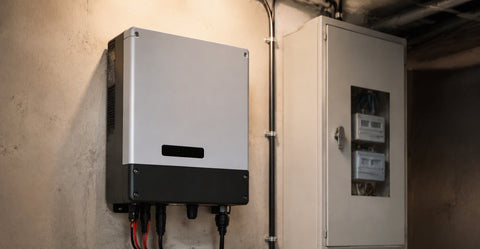
A hybrid solar inverter is the piece of hardware that turned "solar plus batteries" from a two-box science project into a single wall-mounted appliance. It converts DC from your panels to AC for your house, charges and discharges a battery bank, talks to the utility grid, and — the part that matters during an outage — forms its own grid when the utility goes dark. I've commissioned hybrids in everything from off-grid hunting cabins to grid-tied homes with 40 kWh of storage, and the buying mistakes are remarkably consistent: wrong topology, undersized surge, incompatible battery. This guide walks through how hybrids work, how to size one, and how to choose between the real options on the market — including the hybrid inverter lineup we stock and support.

Introduction to Hybrid Solar Inverters
What is a hybrid solar inverter?
A hybrid inverter (also called a battery-based or multi-mode inverter) combines three devices in one chassis: a grid-tie solar inverter, a battery charger, and a battery inverter. A conventional string inverter only converts panel DC to grid AC and shuts down the instant the grid fails — anti-islanding rules require it. A hybrid keeps running, isolates your home from the dead grid through an internal or external transfer mechanism, and powers your loads from panels and batteries.
How it merges solar charging, storage, and grid interaction in one unit
Inside the box, a bidirectional power stage handles both directions of energy flow. When the sun is out and the house is full, surplus power charges the battery. When the battery is full, surplus exports to the grid (if your utility agreement allows it). After sunset, the battery discharges through the same power stage to run the house. One unit, one efficiency budget, one monitoring app — instead of a string inverter, a separate battery inverter, and a rats' nest of AC coupling wiring.
Common use cases
- Self-consumption: store midday solar, burn it in the evening peak instead of exporting at wholesale rates.
- Backup power: keep critical loads alive through outages with sub-second transfer.
- Time-of-use arbitrage: charge from the grid at 11 p.m. rates, discharge during the 5–9 p.m. peak.
- Off-grid: run a property with no utility connection at all, with a generator as the fallback source. Our off-grid cabin kits are built around exactly this topology.
- Grid services: some utilities now pay for demand-response dispatch from customer batteries.
How Hybrid Solar Inverters Work
AC-coupled vs DC-coupled configurations
This is the first fork in every design conversation. In a DC-coupled system, panels feed the hybrid's MPPT inputs directly, and the battery hangs on the same DC bus. Solar energy charges the battery with one conversion (DC→DC), then inverts once more to AC for the house. In an AC-coupled system, panels keep their own grid-tie inverter, and the hybrid (functioning as a battery inverter) absorbs or supplies AC power on the home's bus. AC coupling shines when retrofitting batteries to an existing solar array; DC coupling wins on new builds for efficiency and cost.
| Attribute | DC-Coupled Hybrid | AC-Coupled Retrofit |
|---|---|---|
| Solar → battery round-trip efficiency | ≈ 94–97% (one DC-DC conversion) | ≈ 88–92% (DC→AC→DC→AC) |
| Best application | New installations, off-grid | Adding storage to existing grid-tie solar |
| PV inverter required? | No — MPPTs built into hybrid | Yes — existing string/micro inverters stay |
| Black-start / off-grid capability | Native | Possible with compatible PV inverter (frequency-shift control) |
| Clipping losses on oversized arrays | Can capture clipped energy into battery (DC oversizing) | Clipped energy is lost at the PV inverter |
| Typical installed cost premium | Lower (one inverter) | Higher (battery inverter added to existing inverter) |
Battery charging sources and energy flow management
A hybrid can charge its battery from solar, from the grid, or from a generator — and the energy management logic decides which source wins at any moment. Typical priority: loads first, battery second, export third. During an outage the priority flips: loads first, battery reserve protected. Generator support matters more than spec sheets admit. I've nursed plenty of off-grid systems through dark November weeks where the generator input was the only thing standing between the customer and a dead battery at 4 a.m.; a hybrid with a configurable generator start/stop relay and a charger that respects a small generator's wattage limits is worth real money in those climates.
Key internal components
- MPPT trackers: two to four independent inputs on most residential units, each optimizing a string's voltage/current operating point.
- Bidirectional inverter stage: IGBT or SiC power electronics converting DC↔AC in both directions.
- Battery interface: low-voltage (48 V nominal) on most residential hybrids, high-voltage (150–600 V) on some ecosystems.
- Transfer switch: internal relays or a contactor that islands the home, typically switching in under 20 ms on backup-rated units.
- Comms: CAN/RS485 to the battery BMS, Wi-Fi/Ethernet/Cellular for monitoring, and increasingly SunSpec Modbus for third-party integration.
Key Features to Look For in a Hybrid Inverter
Battery compatibility and chemistries supported
The battery market has consolidated around LiFePO4 for good reasons — cycle life, thermal stability, and depth of discharge — but the inverter must speak the battery's BMS protocol. Closed-loop CAN communication lets the battery dictate charge voltage, current limits, and temperature cutoffs; open-loop (voltage-based) charging works but forfeits the BMS's protection logic. Check the inverter's published compatibility list against the EG4 rack batteries or whatever bank you intend to buy, and confirm the firmware version — compatibility lists move. The EG4 vs. Powerwall comparison covers the two dominant philosophies: open DIY-friendly batteries versus closed ecosystems.
Efficiency, surge capacity, MPPT count, and thermal performance
Peak efficiency numbers (97%+ is common) matter less than the efficiency curve at 10–30% load, because that's where inverters live most of the day. Surge capacity — usually expressed as 2× rated output for 5–10 seconds — determines whether your well pump and AC compressor start without a fault. MPPT count decides how many roof planes and orientations you can use without penalty. And thermal design (heatsink vs. fan-cooled, ambient derating above 45 °C) decides whether the unit survives a garage install in August. Wall-mounting a fanless unit on a south-facing exterior wall is a mistake I've had to un-make on more than one job; check the derating curve before you pick the mounting location.
| Spec | Entry Hybrid (3–5 kW) | Mid-Range (6–8 kW) | Whole-Home (11–15 kW) |
|---|---|---|---|
| Continuous AC output | 3,000–5,000 W | 6,000–8,000 W | 11,000–15,000 W |
| Surge (5–10 sec) | ≈ 2× rating | ≈ 2× rating | ≈ 1.5–2× rating |
| MPPT inputs | 1–2 | 2–3 | 3–4 |
| Max PV input (DC) | ≈ 1.3–1.5× AC rating | ≈ 1.5× AC rating | ≈ 1.5–2× AC rating |
| Peak efficiency | ≈ 96.5–97.5% | ≈ 97.0–97.8% | ≈ 97.5–98.2% |
| Battery voltage | 48 V nominal (LV) | 48 V (LV) | 48 V or HV stack |
| Transfer time to backup | 10–20 ms | < 10–20 ms | < 10 ms (UPS-grade on some) |
| Typical role | Cabins, critical loads | Most family homes | Large homes, light commercial — e.g., Sol-Ark 15K class |
Smart features and interoperability
Look for time-of-use scheduling, grid-charging windows, generator auto-start dry contacts, and open Modbus/SunSpec support. Closed ecosystems lock you into one battery brand and one monitoring app; open protocols let a home-automation platform or a third-party aggregator dispatch the system. Also check whether the unit can AC-couple a legacy string inverter behind its backup port — a feature that rescues a lot of retrofits.
Sizing and System Design for Homes and Small Businesses
How to perform a load analysis
Start with the wattage audit: list every load the inverter must carry in backup mode, total the simultaneous running watts, and add the largest motor's starting surge. Our home wattage sizing guide has the full appliance table and NEC 220.83 math, and the inverter sizing calculator automates the arithmetic. For daily energy, pull 12 months of kWh from the utility bill and divide by 365.
Guidance on inverter rating and battery storage sizing
Inverter rating covers peak watts; battery capacity covers kWh of autonomy; PV array covers daily recharging. All three must agree. A 12 kW inverter behind a 5 kWh battery is a sports car with a lawnmower fuel tank — full power for about twenty minutes.
| Design Target | Inverter (Continuous) | Battery (Usable kWh) | PV Array (4.5 PSH, 0.80 derate) | Backup Autonomy (Essentials, 500 W avg) |
|---|---|---|---|---|
| Critical loads only (2.5 kW peak) | 3–4 kW | 5–10 kWh | 3–4 kW | 10–20 hours |
| Essentials + kitchen (5 kW peak) | 6 kW | 10–20 kWh | 5–7 kW | 20–40 hours |
| Whole home minus heavy HVAC (8 kW peak) | 8–10 kW | 20–30 kWh | 8–10 kW | 40–60 hours |
| Whole home incl. 3-ton AC (12 kW peak) | 12–15 kW | 30–45 kWh | 10–13 kW | 60–90 hours (load-managed) |
The battery-to-inverter ratio rule of thumb I use on every quote: at least 1 kWh of usable storage per 500 W of inverter output, and double that if the customer wants overnight autonomy. So a 6 kW inverter wants 12 kWh minimum, 24 kWh for comfort. Rack batteries like the EG4-LifePower4 class (5.12 kWh each) make that modular — two racks for the minimum, four for the comfortable build.
Considerations for topology, battery chemistry, and autonomy goals
Decide the topology first (DC-couple new builds, AC-couple retrofits), then chemistry (LiFePO4 unless a datasheet gives you a specific reason otherwise — see the comparison below), then autonomy (hours of backup at your essential-load average). Autonomy drives battery cost harder than any other variable, so be honest about whether you need 8 hours or 3 days.
Battery Integration and Chemistry Considerations

Overview of common battery chemistries
| Chemistry | Cycle Life (to 80% capacity) | Usable DoD | Round-Trip Efficiency | Thermal Runaway Risk | Best Fit |
|---|---|---|---|---|---|
| LiFePO4 (LFP) | 4,000–6,000+ cycles | 90–100% | 95–98% | Very low | Residential storage, daily cycling — the default choice |
| NMC (Nickel Manganese Cobalt) | 2,000–3,000 cycles | 80–90% | 94–96% | Moderate — needs strict BMS thermal control | Space-constrained installs, EV-derived packs |
| Lead-Acid (AGM/Flooded) | 500–1,200 cycles | 50% | 80–85% | None (thermal), but off-gassing requires venting | Budget builds, seasonal cabins with light use |
| Sodium-Ion (emerging) | 3,000–5,000 cycles (early data) | 90%+ | ≈ 95% | Low | Cold-climate installs; watch the market through 2026 |
The lifetime-cost math settles most arguments. A 10 kWh LFP bank at 6,000 cycles delivers ≈ 54,000 kWh of lifetime throughput (10 × 0.9 DoD × 6,000). An AGM bank at 800 cycles and 50% DoD delivers 4,000 kWh. Even at half the purchase price, lead-acid costs several times more per delivered kWh — before you count the maintenance hours. Our battery buyer's guide and sizing calculator run the numbers for your use case, and the LiFePO4 collection shows current options.
BMS integration, thermal management, and enclosure considerations
Closed-loop BMS communication is the single most reliability-relevant feature in a battery purchase. With CAN communication, the battery tells the inverter exactly how much current it will accept at its current temperature and state of charge; without it, the inverter charges blind against fixed voltage setpoints. Thermally, LFP is happy between 0 °C and 45 °C for charging — below freezing, charging must be inhibited or the cells plate lithium. Batteries with internal heaters (most quality rack units now include them) solve garage and outbuilding installs in cold climates. Indoors, follow NEC 706 and UL 9540 listings; large residential installations may trigger NFPA 855 spacing and room requirements.
Maintenance, cycle life, and warranty considerations
LFP maintenance is nearly zero: keep the firmware current, keep the enclosure dry, and check terminal torque annually (most rack batteries spec 4–5 N·m on M8 terminals — verify with your model's manual). Warranties cluster at 10 years or a throughput guarantee (e.g., 30+ MWh). Read whether the warranty is prorated and whether it's serviced by a US warehouse or a container from overseas; that answer matters at year seven.
Grid Interconnection, Standards, and Safety
Standards and codes affecting hybrids
UL 1741 (inverter safety) with the SB supplement and IEEE 1547-2018 (grid interconnection behavior) govern whether your utility will approve the unit. California Rule 21 and Hawaii Rule 14H impose additional grid-support functions. On the installation side, NEC Article 705 covers interconnected power sources, 706 covers energy storage, 690 covers PV, and 702 covers standby systems. Our NEC compliance guide maps these articles to real inspection checkpoints.
Anti-islanding, export control, and net metering coordination
Every grid-tied hybrid must cease energizing a dead grid — that's anti-islanding, and it's why line workers can trust a de-energized feeder. Export control is the configurable cousin: many utilities now approve "zero-export" systems that self-consume without selling back, which sidesteps hostile net-metering tariffs. Check your utility's interconnection queue timeline early; in some territories the approval process takes longer than the installation. State incentive and net-metering rules vary enough to change the system design.
Safety considerations and best practices
- Label every disconnect per NEC 690.13 and 705.10 — inspectors and firefighters both look for them.
- Rapid shutdown (NEC 690.12) applies to the PV array on the roof regardless of inverter type.
- Arc-fault and ground-fault protection are built into listed hybrids; don't defeat them to silence nuisance trips — find the fault.
- Battery rooms need clearances per the battery's listing, and bollards if the garage install is in bumper range.
Installation, Commissioning, and Best Practices
Commissioning is where hybrid systems succeed or fail, and it's mostly software. Set the battery charge/discharge limits to the BMS-recommended values, not the inverter's defaults. Program the grid-charge windows and reserve SOC before the first outage, not during it. Test the transfer: kill the main breaker with real loads running and confirm the transfer time doesn't reboot the customer's NAS or desktop. We log every commissioning with photos of the settings screens — a habit that has saved more warranty arguments than any other paperwork we keep.
Physical install basics: mount on a structural wall with the clearances in the manual (typically 12 in. sides, 24 in. front), keep DC battery cable runs short and equal-length on parallel strings, torque lugs to spec with a calibrated wrench, and bond the chassis ground to the system grounding electrode conductor per NEC 250. If the inverter feeds a critical-loads sub-panel, label it and move only the circuits the battery can actually support. The installation guide covers conduit, wire sizing, and racking; our solar inverter guide compares hybrids against string and micro alternatives.
Choosing Between the Leading Hybrid Options
Residential hybrids in 2026 fall into three camps. Value-oriented split-phase units (the EG4 18Kpv / 6000XP class) deliver 8–12 kW of output with open battery communication at aggressive prices. Premium grid-interactive units (Sol-Ark, SolarEdge Home Hub) add higher surge, generator smart-port features, and deeper monitoring. Closed ecosystems (Tesla Powerwall, Enphase IQ) trade flexibility for polish and a single throat to choke on warranty claims. Match the camp to the customer: a DIY-capable off-gridder and a suburban net-metering customer want different machines even at identical wattages.
The Three Sizing Mistakes We See Every Week
After a few hundred hybrid quotes, the failure modes repeat. Mistake one: sizing the inverter to the array instead of the loads. A 10 kW array behind a 6 kW hybrid is fine for grid-tie production, but if the backup panel carries a 1.5 HP well pump and a 3-ton AC, that 6 kW unit faults on the first compressor start. Size the backup output to the backed-up loads; size the PV input to the array. Mistake two: ignoring the battery discharge rate. A single 5.12 kWh rack battery typically sustains 100 A at 51.2 V — about 5 kW — so one battery behind a 12 kW inverter can only deliver a third of the inverter's nameplate. Three batteries feed it properly. Mistake three: burying the equipment a hundred feet from the service. Every extra length of feeder between inverter, sub-panel, and main panel adds voltage drop, conduit cost, and labor. A thirty-minute site walk with the electrician before quoting has saved us more money than any equipment discount we've ever negotiated.
Frequently Asked Questions
What is the difference between a hybrid inverter and a regular solar inverter?
A regular (grid-tie) inverter converts panel DC to grid AC and shuts down during outages. A hybrid adds a bidirectional battery port and an internal transfer mechanism, so it can charge and discharge storage, run your home from batteries, and keep producing power when the grid is down.
Can a hybrid inverter work without batteries?
Yes — most operate as ordinary grid-tie inverters with storage added later, which makes them a common hedge for buyers who want battery-ready solar. A few features (backup output, peak shaving) simply stay dormant until a battery is connected.
How long can a hybrid inverter power a house during an outage?
Divide usable battery kWh by your average backup load. A 10 kWh bank running a 500 W essential load lasts about 20 hours; with daytime solar recharging, a well-designed system runs indefinitely through multi-day outages.
Are hybrid inverters compatible with any solar panel brand?
Yes — panels from Qcells, REC, Trina, JA Solar, or Mission Solar all work, provided string voltage stays inside the MPPT window across your local temperature extremes. Battery compatibility is the restricted list, not panels.
Do hybrid inverters need internet to work?
No. Core functions — inverting, charging, backup transfer — run locally with no cloud dependency. Internet enables remote monitoring, firmware updates, and time-of-use schedule syncing, but an offline hybrid keeps your lights on.
Related Resources
- Solar Inverter Guide: Types, Sizing, and Performance
- How Many Watts to Power a Home
- Solar Inverter Buyer's Guide · 10 kW Solar + Battery Kit
Need pricing or availability on anything in this guide?
Portlandia Electric Supply dropships direct from the manufacturer — most items Ship Direct with lead times stated up front, no surprises.
Get a quote from PESBulk, pallet and contractor pricing available.