The most expensive mistake we see in solar system design isn't a bad panel or a cheap charge controller — it's picking the wrong inverter architecture and building an entire system around it. A customer buys an off-grid inverter for a house that's still on the utility, then discovers it can't sell power back and can't blend grid and solar in real time. Or someone grid-ties a hybrid and learns during the first outage that half its features only work when the grid is alive. Hybrid and off-grid inverters look identical on the shelf: same wall-mounted box, same battery terminals, same MPPT inputs. They are not the same machine. This guide lays out what each one actually does, the NEC and UL framework around them, sizing math that holds up in the field, and the decision criteria we run through with every customer at the design table.
Definitions First: Grid-Tied, Hybrid, and Off-Grid Are Three Different Animals
A grid-tied string inverter converts solar DC to grid-synchronized AC and that's all — no battery port, no backup, dead during outages by law (UL 1741 anti-islanding). An off-grid inverter (or inverter-charger) creates its own AC waveform from a battery bank, never syncs to the utility, and is designed to be the only source of power a building ever sees. A hybrid inverter does both: it runs grid-interactive day to day — selling excess, time-shifting energy — and islands itself into a battery-backed microgrid within milliseconds when the utility drops. The hybrid is not "an off-grid inverter with extra features." It's a grid-interactive inverter with a transfer function. That distinction drives everything below.
| Capability | Grid-tied string | Hybrid (battery-based) | Off-grid inverter-charger |
|---|---|---|---|
| Sells excess to utility | Yes | Yes (configurable) | No |
| Works during outage | No | Yes, <20 ms transfer | Yes (always islanded) |
| Battery port | No | Yes, 48V nominal typical | Yes, core of the system |
| Generator input | No | Yes (most modern units) | Yes, standard |
| UL 1741 SB / IEEE 1547 | Required | Required | Not applicable / not listed |
| Needs utility permission | Yes, interconnection agreement | Yes | No (never touches grid) |
| Typical residential sizes | 5–12 kW | 8–15 kW | 3–12 kW |
| Price class (10 kW range, 2026) | $1,800–2,800 | $3,100–8,000 | $1,500–4,500 |
How a Hybrid Inverter Actually Earns Its Price
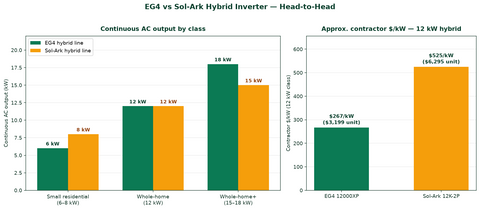
The hybrid's value is economic arbitrage plus resilience. On a time-of-use rate — California, Arizona, much of Texas and the Northeast — grid power costs 2–4× more at 6 p.m. than at noon. A hybrid charges its batteries from solar midday, then discharges through the evening peak so you never buy 40-cent electricity. Under California's NEM 3.0, where exported solar earns a fraction of retail, self-consumption through a hybrid is often the difference between an 11-year and a 6-year payback. Layer on the backup function: when the grid fails, a relay inside the unit opens, the inverter becomes the grid for your critical loads, and the transfer happens fast enough that the desktop computer doesn't reboot. Units like the Sol-Ark 15K and EG4 18KPV (compare them in detail in our Sol-Ark vs EG4 breakdown) carry 200A passthrough, so the whole house sits behind the inverter with load management deciding what runs during an outage.
The hidden cost: complexity. A hybrid is a bidirectional power plant with firmware, and it needs commissioning — grid profile selection per your utility's Rule 21 or equivalent, battery BMS handshake over CAN-bus, export limits, charge schedules. Budget real money for a competent installer or real hours for your own learning curve. A hybrid misconfigured isn't dangerous — the listings prevent that — but it underperforms silently, and we've audited systems losing $40 a month because the time-of-use schedule was programmed wrong since day one.
Where Off-Grid Inverters Are Unbeatable
Take the utility out of the picture — a cabin at the end of a five-mile power line quote, a ranch well, an RV, a boat — and the off-grid inverter-charger becomes the obvious tool. It's built to be the sole authority: it sets the 60 Hz, it absorbs the surges, it decides when the generator runs. Classic lines like Victron MultiPlus/Quattro, Schneider XW, and MidNite's Rosie are engineered around this duty, with surge ratings that crush residential hybrids (a 4 kW Victron will start motors that stall a 12 kW hybrid) and idle consumption tuned for systems where every watt-hour comes from a battery. For the charge-controller side of those builds, our MidNite vs Victron comparison covers the two brands we trust most.
Off-grid inverters also win on one thing nobody expects: honesty about capacity. A 4,000W off-grid unit means 4,000W of continuous inverter output from batteries, sustained, in a hot room. Hybrid ratings often describe blended capacity — 12 kW "output" that assumes the grid or solar is carrying part of the load. Read the datasheet line for "battery-only continuous output" before comparing numbers; it's frequently 30–40% lower than the marketing figure.
Sizing Math That Survives Contact With Your House
Size the inverter to the load, the battery to the night, and the array to the day. Three calculations, in order:
1. Inverter continuous rating — list every load that must run simultaneously during an outage, convert to watts, add motor starting surges (3–5× running for pumps and compressors, 1.2× with soft starters), and add 25% headroom. A typical essential-loads panel (fridge 250W, furnace blower 700W, lights 300W, internet/TV 300W, well pump 1,000W running with 3,000W surge) totals ~2.5 kW running, 4.5 kW with surge events — an 8 kW-class hybrid handles it without breathing hard. Add a 3.5-ton AC (4 kW running, 12 kW surge, 5 kW with soft start) and you're shopping 12–15 kW.
2. Battery bank — nightly consumption × days of autonomy ÷ usable depth of discharge. A house burning 8 kWh overnight wanting one night of autonomy on LiFePO4 at 90% usable needs ~9 kWh; round to a 10 kWh module. Two nights with a cloudy buffer: 20 kWh. Our home battery bank sizing guide and the off-grid storage calculation guide walk the full worksheet, and the backup runtime calculator sanity-checks the result.
3. Solar array — daily kWh needed ÷ peak sun hours ÷ system derate (0.75–0.82 real-world). A 30 kWh/day off-grid home in 4.5-sun country wants roughly 9 kW of array. Oversizing the array 20–30% above inverter rating is standard practice and costs nothing at the inverter; morning and evening harvest improves noticeably.
| Design target | Formula | Worked example |
|---|---|---|
| Inverter continuous | Σ(simultaneous loads) × 1.25 + largest surge | 2.5 kW loads + 3 kW surge → 8 kW class |
| Battery bank | Nightly kWh × nights ÷ usable DoD | 8 kWh × 2 ÷ 0.9 → ~18 kWh → buy 20 |
| Solar array | Daily kWh ÷ PSH ÷ 0.8 derate | 30 kWh ÷ 4.5 ÷ 0.8 → 8.3 → buy 9 kW |
| Generator (off-grid) | 1.2–1.5× max charge rate | 10 kW charge → 12–15 kW genset |
| Battery cable (48V, 250A) | NEC 310.16, 75°C column | 2/0 AWG copper minimum |
The Gray Zone: Grid-Interactive With Zero Export
Plenty of customers want hybrid behavior — batteries, backup, self-consumption — but their utility either bans export, pays nothing for it, or their interconnection queue is a year long. Modern hybrids handle this with a "zero export" mode: CT clamps on the service entrance measure grid flow 50 times a second and the inverter throttles so nothing ever backfeeds. You keep every solar watt-hour on your side of the meter without utility permission in most jurisdictions (verify locally; some AHJs still require notification). It's also the answer for oversized DIY systems where the interconnection agreement would cap the array. Just know the trade: zero-export systems waste midday surplus once batteries are full. An export-enabled hybrid under a decent net-metering tariff monetizes that surplus instead. Run your own tariff numbers; there is no universal right answer, only a right answer per utility.
Battery Chemistry and BMS Handshake: The Compatibility Minefield
Both architectures now live on 48V LiFePO4, and the communication link between inverter and battery BMS is where installs succeed or fail quietly. Closed-loop CAN-bus (EG4 with EG4 batteries, Sol-Ark with its compatibility list, Victron with managed lithium) lets the BMS dictate charge current and voltage in real time — the safest, longest-life arrangement. Open-loop (voltage-based charging with no data link) works, but you're flying on estimates: no cell-level temperature data, no dynamic current limits, and warranty claims get awkward. Match brands within a system when you can; when you can't, verify the exact battery model appears on the inverter's published compatibility list before purchase, not after. The 20–80 battery rule explains the daily depth-of-discharge habits that double lithium lifespan regardless of brand, and battery maintenance best practices covers the physical side.
Code and Listing Framework: What Inspectors Look For
Hybrids interconnecting with the utility need UL 1741 SB listing (the 2021 "Supplement B" revision with IEEE 1547-2018 grid support functions) — non-negotiable, and every AHJ plan checker will ask for the cut sheet. NEC 705 covers the interconnection side (point of connection, 120% rule for load-side taps), NEC 706 covers energy storage (disconnects, signage, and 706.15's rules for dwelling-unit battery locations), and NEC 690 folds the PV into it. Off-grid systems skip 705 entirely but still answer to 706 and 690, plus 702 if a generator enters the picture. One trap worth naming: some "off-grid only" imported inverters lack any UL listing. Fine for a hunting cabin you'll never insure or sell; a genuine problem for a permitted residence. Our NEC 690 disconnect guide covers the overcurrent and isolation hardware these systems need on the PV side.
| Scenario | Right architecture | Why |
|---|---|---|
| Suburban home, net metering available, wants backup | Hybrid | Monetizes surplus and covers outages |
| California NEM 3.0 or TOU rate territory | Hybrid | Self-consumption economics dominate |
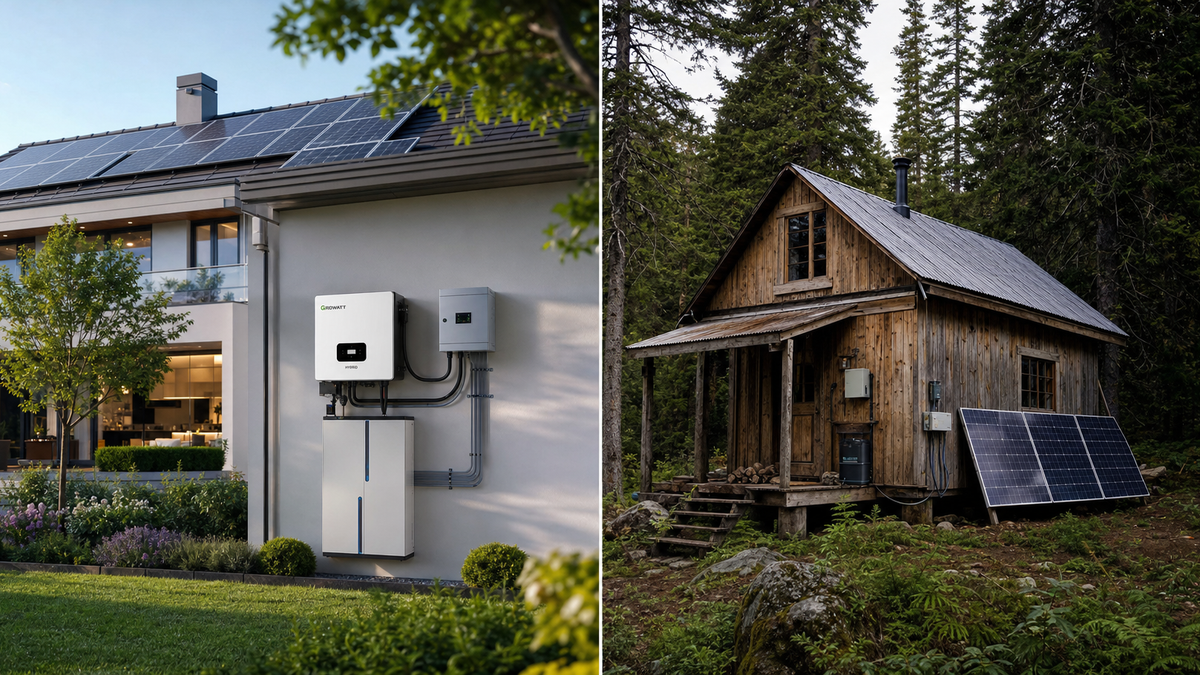
| Cabin/property beyond the power line | Off-grid inverter-charger | No grid exists to hybridize with |
| RV, boat, mobile application | Off-grid (12/24V class) | Shore power is occasional, not structural |
| Utility bans export / interconnection delayed | Hybrid in zero-export mode | Full features without utility agreement |
| Workshop with huge motor loads, grid present | Grid-tied + generator, or oversized hybrid | Surge duty favors off-grid-style units only if islanded |
The Verdict We Give at the Design Table
If a utility meter exists on your building and backup matters, buy the hybrid — the economics of self-consumption and the milliseconds transfer make it the default residential answer in 2026. If no meter exists and none is coming, buy the off-grid inverter-charger and spend the savings on a bigger battery bank and a properly sized generator; that combination is cheaper and tougher than stretching a hybrid to do a job it wasn't shaped for. And if backup doesn't matter at all, a plain grid-tied string inverter at half the price still wins on simplicity. Browse current inventory in 10–12 kW hybrids, 13–18 kW hybrids, and brand lines like Sol-Ark, EG4, and Growatt; our top inverter picks roundup ranks the broader field, and the primer on what a hybrid solar inverter is is a good share for friends just starting out.
One last field note before you commit: whichever architecture you choose, spend one evening writing down your actual outage priorities — the circuit list, the watt numbers, the must-run sequence. Every failed system design we have been called to fix started with someone buying equipment before doing that arithmetic. The hardware is the easy part; the honest load list is the engineering, and it is the one document your installer cannot produce for you.
AC-Coupled vs DC-Coupled: The Retrofit Question
One fork in the road deserves its own section because it decides retrofit costs. In a DC-coupled hybrid system, the solar array feeds the hybrid's built-in MPPT inputs and everything flows through one box — highest round-trip efficiency (94–96% battery-in-to-AC-out), cleanest wiring, the standard for new builds. In an AC-coupled system, your existing string inverter or microinverters stay put, and a battery inverter (Tesla Powerwall, Enphase IQ Battery, or an AC-coupled hybrid) bolts onto the AC side, charging from grid-frequency AC and inverting back. AC coupling costs 5–8% round-trip efficiency but saves you from rebuilding an existing array's wiring — it's the answer for "I already have solar, now I want backup." The trap we see twice a year: a customer buys a DC-coupled hybrid for a retrofit, then discovers their existing microinverter array has no DC to connect to it. Microinverter systems must AC-couple, full stop. Know what your roof already has before the inverter cart goes through checkout.
Efficiency Losses: Where the Watt-Hours Actually Go
Nobody budgets for losses, and then November arrives. Here's the honest stack for a hybrid system storing solar at noon and serving it at 7 p.m.: MPPT conversion ~97%, battery charge ~95%, storage self-discharge ~1% per month, battery discharge ~95%, inversion to AC ~96%. Multiply it out and a stored kWh returns about 0.83 kWh to your loads. An off-grid system has the same stack minus the grid dance; a straight grid-tied system skips storage losses entirely but sells surplus at whatever your utility feels like paying. This math is why we tell flat-rate-net-metering customers to think twice about batteries — if the utility credits you 1:1, the grid is a 100%-efficient "battery" and a physical battery at 83% is an expensive downgrade. Under NEM 3.0 or zero-export rules, that 83% beats a 15% export credit by a mile. Run your tariff through the stack before romanticizing storage.
| Loss stage | Typical efficiency | Cumulative |
|---|---|---|
| MPPT / charge conversion | 97% | 0.97 |
| Battery charge (LiFePO4) | 95% | 0.92 |
| Storage (30 days self-discharge) | 99% | 0.91 |
| Battery discharge | 95% | 0.87 |
| Inversion to AC | 96% | 0.83 |
Surge, Idle Draw, and the Specs That Get Buried
Three datasheet lines separate field-proven units from brochure heroes. First, surge duration: a "2× surge" that lasts 20 milliseconds won't start a table saw; you want 5–10 seconds at 150–200% for motor starting. Off-grid inverter-chargers traditionally dominate here — transformer-based low-frequency units (the heavy ones, 60+ lbs for a 4 kW) shrug off surges that fold lightweight high-frequency designs. Second, idle consumption: an off-grid unit burning 60W just being alive eats 1.4 kWh a day from your bank — that's a whole extra panel's output sacrificed to keeping the inverter awake. Search-mode sleep settings (the inverter pulses, senses a load, and wakes) cut this to single digits; configure it or pay for it forever. Third, power factor behavior: cheap inverters rate themselves in VA and hope you don't notice that a 0.8 PF load — every motor and LED driver in your house — delivers 20% fewer real watts than the nameplate promises. We size every motor-heavy system against the watt figure at 0.8 PF, not the VA headline.
And the warranty fine print matters differently per architecture. A hybrid lives grid-connected and firmware-updated; manufacturers push updates that occasionally change behavior — we've seen charge schedules reset by an update, twice. Off-grid units run static firmware for years, which is either stability or stagnation depending on your temperament. Either way, register the product, record the serial, and export the configuration file after commissioning. The day you need warranty service, that file turns a two-hour phone call into a ten-minute one.
Installed Cost, 2026: The Full System Picture
Since architecture choice locks in a decade of operating economics, price the whole system, not the inverter. These are real installed ranges we're quoting in 2026 for a typical single-family home:
| System (8–10 kW class) | Equipment | Labor + permits | Total before ITC | Backup? |
|---|---|---|---|---|
| Grid-tied string, no battery | $9,000–12,000 | $5,000–7,000 | $14,000–19,000 | No |
| Hybrid + 10 kWh battery | $13,000–17,000 | $6,000–8,500 | $19,000–25,500 | Essentials |
| Hybrid + 20 kWh battery | $16,000–21,000 | $6,500–9,000 | $22,500–30,000 | Most of home |
| Off-grid 9 kW array + 20 kWh + generator tie | $17,000–23,000 | $7,000–10,000 | $24,000–33,000 | Full autonomy |
After the 30% federal credit, the hybrid-plus-10-kWh configuration lands within $3,500–4,500 of the plain grid-tied system — and that's why hybrids have eaten the residential market. The off-grid row looks similar on paper but buys a fundamentally different thing: independence where no meter exists. Compare current equipment pricing in our 10 kW inverter and 12 kW inverter collections.
Frequently Asked Questions
Can an off-grid inverter connect to the utility grid?
No — a true off-grid inverter-charger never syncs to or feeds the grid; it can only accept grid or generator power as an AC input for charging and passthrough. If you want to sell power or blend solar with grid in real time, that's a hybrid's job.
How fast does a hybrid inverter switch to battery during an outage?
Modern hybrids transfer in under 20 milliseconds — fast enough that computers and most electronics never notice. That's dramatically faster than a generator-plus-ATS combination, which takes 20–40 seconds.
What size battery bank does a hybrid inverter need?
For evening self-consumption plus one night of essential backup, most homes land between 10 and 20 kWh of LiFePO4. Size by nightly kWh consumption divided by usable depth of discharge (~90% for lithium), then round up to the next module size.
Is a hybrid inverter worth it without time-of-use rates?
With flat-rate net metering at full retail, the economic case weakens — you're buying the backup function and future-proofing. If your utility is moving toward TOU or reduced export compensation (most are), the hybrid pays off later; if rates are locked flat, a string inverter plus generator is cheaper today.
Can I start with grid-tied and add batteries later?
Yes, via AC-coupled batteries or by replacing the string inverter with a hybrid. Retrofitting is real money though — if backup is even a "maybe" in your plans, buying the hybrid on day one is almost always cheaper than converting later.
Do off-grid systems need permits?
The PV array and battery bank still fall under NEC 690/706 and local building codes in most jurisdictions, even with no utility connection. The utility interconnection agreement is the part you skip — not the electrical permit.
Sources and Standards
UL 1741 SB; IEEE 1547-2018; NEC 2023 Articles 690, 705, 706, and 702; manufacturer datasheets for Sol-Ark, EG4, Victron, and Schneider inverter lines. Field figures reflect systems we've commissioned and audited across the Pacific Northwest and Southwest since 2019.