Solar Battery Sizing: How to Calculate Storage Needs for Off-Grid Living
Reading time: ~11 min read
📋 Key Takeaways
- Off-grid battery sizing must account for days of autonomy (typically 2-5 days without sun).
- Depth of discharge (DoD) affects usable capacity and battery lifespan.
- System voltage (12V, 24V, 48V) impacts battery bank configuration and wire sizing.
- Temperature derating is critical — battery capacity drops significantly in cold conditions.
- Load profiling (identifying essential vs. non-essential loads) optimizes battery bank size.
Off-grid solar systems live or die by the battery bank. Undersize it and your clients face frequent generator run-time, premature battery degradation from deep cycling, and dissatisfaction with system performance. Oversize it and you inflate capital costs beyond what the load profile justifies. Correct battery sizing requires a systematic approach: calculate daily energy consumption, determine autonomy requirements, apply depth-of-discharge and temperature derating factors, and add system efficiency losses. This guide walks through each step with worked examples for different home sizes.
We've sized banks for weekend cabins, full-time off-grid homesteads, and a handful of off-grid commercial sites, and the failure mode is nearly always the same: somebody sized the solar array first and treated the battery as an afterthought. The battery is the system. The array just feeds it.
PES Supply stocks the battery modules, charge controllers, and hybrid inverters needed to build properly sized off-grid systems. Browse our Battery Storage collection for LiFePO4 modules from EG4, Fortress Power, Battle Born, and Victron, or explore complete Energy Storage Systems for all-in-one hybrid inverter packages.
Step 1: Calculate Daily Energy Consumption (Load Audit)
The foundation of every battery sizing calculation is an accurate daily load audit. This means listing every electrical load the battery bank must support, its wattage, and the hours of operation per day. The product of wattage and hours gives daily watt-hours (Wh), which sum to total daily energy consumption in kilowatt-hours (kWh).
Load Audit Worksheet Template
| Load | Watts | Hours/Day | Daily Wh | AC or DC |
|---|---|---|---|---|
| Refrigerator (efficient) | 150 | 24 (compressor cycles ~8h) | 1,200 | AC |
| LED Lighting (8 fixtures) | 10 each | 5 | 400 | AC or DC |
| Well Pump (1/2 HP) | 1,000 | 1 | 1,000 | AC |
| Washing Machine | 500 | 1 | 500 | AC |
| Laptop / Router / Modem | 100 | 8 | 800 | AC |
| TV (LED, 50") | 100 | 4 | 400 | AC |
| Phone / Device Charging | 50 | 4 | 200 | AC |
| Ventilation Fans | 40 | 12 | 480 | AC |
| Total Daily Load | 4,980 Wh (~5.0 kWh) |
I carry a clamp meter and a kill-a-watt to every site audit, because nameplate wattage lies — usually in the optimistic direction. For a load audit to be accurate, use actual nameplate wattage or measured draw with a clamp meter or kill-a-watt device. Refrigerator compressors do not run 24 hours — they cycle on roughly 30-50% of the time, so multiply rated wattage by an effective duty cycle. Well pumps and motors have surge currents 3-6 times their running wattage; size the inverter for surge, but calculate battery load on running wattage.
Seasonal variation matters. Heating and cooling loads can double or triple daily consumption in peak summer or winter months. Always size for the worst-case season the system must handle without generator backup.
Step 2: Determine Days of Autonomy
Autonomy days define how long the battery bank can sustain the load without any solar recharge. This is the buffer for cloudy weather, storms, or periods of low solar production. The number of autonomy days depends on climate, the client's tolerance for generator use, and whether a backup generator is present.
Recommended Autonomy by Application
| Application Type | Autonomy Days | Rationale |
|---|---|---|
| Weekend cabin (backup generator present) | 1–2 days | Generator covers extended cloud periods |
| Full-time off-grid, mild climate | 2–3 days | Standard off-grid design with moderate solar variability |
| Full-time off-grid, harsh winters | 3–5 days | Low winter solar production requires deeper buffer |
| Critical loads (medical, communications) | 3–5+ days | Maximum reliability; redundancy is non-negotiable |
Each additional autonomy day directly increases battery bank size and cost. For systems with a reliable backup generator, 2-3 days of autonomy is typically the sweet spot — enough to ride through normal weather variability without excessive capital investment.
Step 3: Apply Depth of Discharge (DoD) Factor
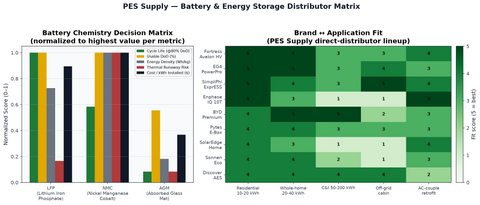
Depth of discharge is the percentage of the battery's total capacity that can be safely used before recharging. DoD varies by chemistry and directly affects how much nominal capacity you need to purchase to deliver the required usable energy.
| Battery Chemistry | Recommended DoD | Usable Capacity Multiplier |
|---|---|---|
| Lithium Iron Phosphate (LiFePO4) | 80–95% | 1.05–1.25× |
| Lead-Acid (Flooded) | 50% | 2.0× |
| Lead-Acid (AGM/Gel) | 50–60% | 1.67–2.0× |
| Saltwater / Sodium-Ion | Up to 100% | 1.0–1.1× |
The usable capacity multiplier tells you how much nominal capacity you need relative to the energy you must deliver. For example, if you need 10 kWh of usable energy with lead-acid at 50% DoD, you must purchase a 20 kWh battery bank. With LFP at 90% DoD, you need approximately 11.1 kWh of nominal capacity — nearly half the lead-acid requirement.
We stopped speccing flooded lead-acid for full-time off-grid homes years ago; the replacement-cycle math kills it every time. This is why LFP has become the dominant chemistry for off-grid installations. The lower DoD multiplier means smaller banks, fewer modules, less weight, and lower upfront cost when measured against usable energy delivered.
Step 4: Apply Temperature Derating
Battery capacity is rated at 25°C (77°F) under standard test conditions. Real-world operating temperatures deviate from this benchmark, and battery chemistry responds differently to temperature extremes.
Temperature Derating Factors
| Battery Temperature | Lead-Acid Capacity | LFP Capacity |
|---|---|---|
| -10°C (14°F) | ~65% of rated | ~75% of rated (discharge only) |
| 0°C (32°F) | ~75% of rated | ~85% of rated |
| 10°C (50°F) | ~87% of rated | ~92% of rated |
| 25°C (77°F) — Standard | 100% of rated | 100% of rated |
| 35°C (95°F) | ~102% of rated (short-term) | ~100% of rated |
| 45°C (113°F) | ~100% but accelerated aging | ~98% but accelerated aging |
One January install in northern Idaho taught us more about temperature derating than any datasheet: a bank sized perfectly on paper came up 25% short until the owner insulated the battery shed. Cold temperatures reduce usable capacity, while high temperatures accelerate calendar aging and shorten overall lifespan. For battery banks installed in unconditioned spaces in cold climates, apply a temperature derating factor of 0.75-0.85 to account for winter capacity loss. For installations in temperature-controlled environments (garages, basements, utility rooms maintained near 20-25°C), derating may be minimal (0.95-1.0).
Important caveat for LFP: while discharge is permitted down to -20°C, charging below 0°C can cause irreversible lithium plating on the anode. Systems installed in cold environments should specify LFP batteries with integrated self-heating elements or include a thermostatically controlled battery heater.
Step 5: Account for System Efficiency Losses
Energy is lost at multiple conversion stages between the solar array and the loads. The standard system derating factor of 0.8 accounts for:
- Inverter efficiency: 90-96% for pure sine wave inverters under typical loading
- Wiring and connection losses: 2-5% depending on conductor sizing and run lengths
- Charge controller efficiency: 95-99% for MPPT controllers
- Battery round-trip efficiency: 92-98% for LFP, 70-85% for lead-acid
Multiply the daily load by a system efficiency factor to account for these losses. For LFP systems with modern MPPT controllers and properly sized wiring, an overall efficiency factor of 0.85 is conservative. For lead-acid systems, use 0.75 to account for lower round-trip efficiency and Peukert losses at higher discharge rates.
The Complete Sizing Formula
Combining all factors, the battery bank sizing formula is:
Battery Bank Capacity (kWh) = (Daily Load (kWh) × Autonomy Days) / (DoD × Temperature Derating × System Efficiency)
Let's break down each variable:
- Daily Load: Total energy consumption from your load audit (Step 1)
- Autonomy Days: Required backup days without solar recharge (Step 2)
- DoD: Decimal depth of discharge (0.90 for LFP, 0.50 for lead-acid) (Step 3)
- Temperature Derating: Decimal capacity factor at operating temperature (Step 4)
- System Efficiency: Decimal overall system efficiency (Step 5)
Worked Sizing Examples
Example 1: Small Off-Grid Cabin (1-2 occupants)
Scenario: A 400 sq ft cabin used on weekends and occasionally for week-long stays. No air conditioning. Propane heating and cooking. A backup generator is present.
- Daily Load: 3.0 kWh (refrigerator, LED lights, water pump, device charging, small TV)
- Autonomy Days: 2
- Chemistry: LFP (LiFePO4)
- DoD: 0.90
- Temperature Derating: 0.90 (unconditioned shed, mild climate)
- System Efficiency: 0.85
Calculation: (3.0 × 2) / (0.90 × 0.90 × 0.85) = 6.0 / 0.6885 = 8.7 kWh nominal
Recommended System: One one EG4 14.3kWh heated wall-mount battery paired with an EG4 12000XP 48V 12kW off-grid inverter, or two EG4 LifePower4 rack batteries (5.12 kWh each, 10.24 kWh total) with an EG4 12kPV hybrid inverter. Alternatively, two Fortress Power eFlex 5.4 kWh batteries (10.8 kWh total) provide comfortable headroom.
Example 2: Average Full-Time Off-Grid Home (3-4 occupants)
Scenario: A 1,800 sq ft home occupied year-round. Wood/propane heating, efficient electric well pump, standard appliances, no central air conditioning. Located in a temperate climate with moderate winter solar resource.
- Daily Load: 8.0 kWh (refrigerator, freezer, well pump, LED lighting, washing machine, laptops, TV, ventilation fans, occasional microwave use)
- Autonomy Days: 3
- Chemistry: LFP (LiFePO4)
- DoD: 0.90
- Temperature Derating: 0.95 (conditioned garage, maintained above 10°C)
- System Efficiency: 0.85
Calculation: (8.0 × 3) / (0.90 × 0.95 × 0.85) = 24.0 / 0.7268 = 33.0 kWh nominal
Recommended System: A pair of EG4 16kWh wall-mount indoor batteries (32 kWh total), or three Fortress Power eFlex 5.4 kWh modules stacked (16.2 kWh) with room to grow. A Sol-Ark 15K or EG4 18kPV hybrid inverter pairs well with this bank size.
Example 3: Large Off-Grid Home (5+ occupants)
Scenario: A 3,500 sq ft home with a full complement of modern appliances, including an energy-efficient refrigerator and chest freezer, well pump, septic pump, electric dryer (occasional), LED lighting throughout, home office equipment, and a mini-split heat pump for supplemental heating/cooling. Located in a climate with cold winters and significant snow cover reducing winter solar production.
- Daily Load: 15.0 kWh
- Autonomy Days: 4
- Chemistry: LFP (LiFePO4)
- DoD: 0.85 (slightly conservative to extend cycle life for daily cycling)
- Temperature Derating: 0.90 (conditioned space, but winter dips below 10°C at times)
- System Efficiency: 0.85
Calculation: (15.0 × 4) / (0.85 × 0.90 × 0.85) = 60.0 / 0.6503 = 92.3 kWh nominal
Recommended System: A commercial-scale rack configuration with twelve to fourteen EG4 LL-S 48V 100Ah rack batteries (5.12 kWh each, ~61-72 kWh) on an EG4 battery rack, supplemented by additional modules, or a BYD 15.4kWh lithium battery pack scaled across a multi-stack configuration to 90+ kWh. Pair with dual Sol-Ark 15K inverters or an Outback Power Radian system for the required surge and continuous power capacity.
Example 4: Same Home with Lead-Acid (For Comparison)
Using the same large home parameters but with flooded lead-acid at 50% DoD and 0.75 system efficiency:
Calculation: (15.0 × 4) / (0.50 × 0.90 × 0.75) = 60.0 / 0.3375 = 177.8 kWh nominal
This illustrates why lead-acid is rarely specified for full-time off-grid homes: you need nearly double the nominal capacity to deliver the same usable energy, resulting in a larger footprint, heavier weight, and ultimately higher cost when replacement cycles are factored in.
Sizing Worksheet Summary
Use this worksheet for every off-grid battery sizing project:
| Parameter | Value | Notes |
|---|---|---|
| 1. Daily Load (kWh) | _______ | From load audit (Step 1) |
| 2. Autonomy Days | _______ | Based on climate and backup (Step 2) |
| 3. Energy Required (kWh) | _______ | Line 1 × Line 2 |
| 4. DoD (decimal) | _______ | 0.90 for LFP, 0.50 for lead-acid (Step 3) |
| 5. Temperature Derating | _______ | 0.75–1.0 based on operating temp (Step 4) |
| 6. System Efficiency | _______ | 0.85 for LFP, 0.75 for lead-acid (Step 5) |
| 7. Combined Derating Factor | _______ | Line 4 × Line 5 × Line 6 |
| 8. Required Battery Capacity (kWh) | _______ | Line 3 ÷ Line 7 |
| 9. Battery Voltage | _______ | 48V for most off-grid; 51.2V for LFP systems |
| 10. Required Ah at System Voltage | _______ | (Line 8 × 1000) ÷ Line 9 |
Battery Bank Voltage and Amp-Hour Math
Nominal kWh is only half the procurement conversation. Batteries are sold in amp-hours at a voltage, and the same 10 kWh bank looks very different at 12V, 24V, and 48V. The math is plain division:
Required Ah = (Nominal kWh × 1,000) ÷ Bank Voltage
| Nominal bank size | Ah @ 12V | Ah @ 24V | Ah @ 48V |
|---|---|---|---|
| 5 kWh | 417 Ah | 208 Ah | 104 Ah |
| 10 kWh | 833 Ah | 417 Ah | 208 Ah |
| 20 kWh | 1,667 Ah | 833 Ah | 417 Ah |
| 30 kWh | 2,500 Ah | 1,250 Ah | 625 Ah |
Look at the 12V column and the reason for the 48V standard announces itself: a 10 kWh bank at 12V must move 833 amps to deliver its rated energy on demand, which means 4/0 cable, enormous lugs, and real voltage drop. The same bank at 48V moves 208 amps on 2/0. Series stacking raises voltage without raising current; paralleling raises capacity (Ah) at the same voltage. Most residential LFP modules are 51.2V nominal (sixteen 3.2V cells), so a "48V" LFP bank is really 51.2V — confirm inverter compatibility, but every modern hybrid inverter in our energy storage systems collection expects exactly that.
Wire sizing follows the same logic. The battery-to-inverter run is the highest-current connection in the whole system, and undersizing it shows up as nuisance low-voltage disconnects exactly when loads peak — the inverter sees sag at the terminals and faults out even though the bank is half full. We size that run for the inverter's maximum continuous current plus surge, keep it under ten feet round trip wherever the layout allows, and torque every lug to the battery manufacturer's spec with a calibrated wrench. Loose, hot lugs on a 200-amp bank are how battery rooms earn their reputation.
Additional Sizing Considerations
Inverter Surge Capacity
Well pumps, air compressors, and power tools have surge currents 3-6 times their running wattage. Size the inverter (not the battery bank) for the largest combined surge. The battery bank must be capable of delivering this surge current without voltage sag that triggers a low-voltage disconnect. LFP batteries with integrated BMS typically handle 1C continuous and 2C peak discharge rates without issue.
Charge Controller Sizing
The solar array must be large enough to fully recharge the battery bank on a typical solar day, even during winter months with reduced sun hours. As a rule of thumb, size the array to deliver at least 1.2 times the daily load plus charging losses during the shortest solar day of the year. Use MPPT charge controllers rated for the array voltage and current, with sufficient headroom for cold-weather voltage spikes.
Future Expansion
Specify battery systems with modular expansion capability. LFP rack-mount systems (EG4 24V 200Ah server-rack batteries, Pylontech US series, BYD Battery-Box) allow adding modules as loads grow. Communicate expansion plans to clients so conduit, racking, and charge controller capacity are specified with headroom from day one.
Products and Support
PES Supply offers battery storage solutions from 169 authorized brands with over 50,000 SKUs. Our inventory includes:
- Battery Storage Collection — Stackable residential ESS, rackmount commercial units, and LiFePO4 batteries from EG4, Fortress Power, Sol-Ark, Battle Born, Victron, BYD, and more
- Energy Storage Systems Collection — All-in-one hybrid inverters with integrated charge controllers from Sol-Ark, EG4, Outback Power, Schneider Electric, and MidNite Solar
All products ship with full manufacturer warranties. Standard delivery is 7-10 business days. Our technical support team can assist with system sizing verification, component compatibility, and commissioning support for off-grid projects of any scale.
Conclusion
Proper battery sizing is the difference between an off-grid system that performs reliably for a decade and one that frustrates the client from year one. The formula is straightforward: calculate daily loads accurately, select autonomy days appropriate to the climate and backup strategy, apply chemistry-specific DoD and temperature derating factors, and add system efficiency losses. The worked examples in this guide provide a framework, but every installation is unique. When in doubt, consult the battery manufacturer's sizing guidelines and work with a qualified system designer to verify your calculations.
Frequently Asked Questions
How do I calculate battery storage needs for off-grid living?
Start by calculating your daily energy consumption in watt-hours. Multiply by the desired days of autonomy (2-5 days). Divide by the battery voltage and DoD to get the required amp-hour capacity. Add temperature derating and a safety margin to arrive at the final battery bank size.
How many days of autonomy should I plan for off-grid?
For off-grid living, plan for 2-3 days of autonomy in sunny climates and 3-5 days in cloudy or winter-dominated climates. This ensures reliable power during extended cloudy periods without requiring an excessively large (and expensive) battery bank.
What battery voltage should I choose for my off-grid system?
For systems under 1,500W, 12V is acceptable. For 1,500-5,000W systems, 24V is recommended. For systems over 5,000W, 48V is standard. Higher voltage reduces current, allowing smaller wire gauges and reducing system losses.
How does temperature affect battery capacity?
Battery capacity decreases in cold conditions. At 0C (32F), a LiFePO4 battery may deliver only 70-80% of its rated capacity. Lead-acid batteries lose 40-50% at the same temperature. Always size batteries for the worst-case operating temperature in your installation environment.
Can I add more batteries to my system later?
Yes, but with caveats. Adding batteries in parallel is possible, but all batteries in a bank should be the same age, chemistry, and capacity for optimal performance. Mixing old and new batteries can reduce overall bank performance and lifespan.
Ready to Source Your Equipment?
Browse 50,000+ SKUs from 169 authorized brands. Trade pricing with full OEM warranties.
Shop All Categories Request a QuoteShop This Article
Ready to build your system? PES Supply stocks 50,000+ SKUs from 169 authorized brands, with delivery in 7-10 business days. Here are the products mentioned in this article:
- EG4 14.3kWh Heated Lithium Battery, Wall Mount, 48V 280Ah
- EG4 16kWh WallMount Indoor Battery, 48V 314Ah
- Fortress eFlex Max - 5.4kWh 51.2V Battery
- BYD 16.0kWh LFP Home Battery
- Sonnen ECOLX20SS-15 8.0KW Energy Storage System (20.0kwh Capacity)
Browse all lithium batteries · Browse all battery storage
Related Articles
Related reading: Solar & Electrical Calculators